The Crypto Exchange Wants to Be Your Only Account
The product reveal Coinbase staged in mid-June didn't look like a crypto company shipping a feature. It looked like the grand opening of a brokerage, a bank, and a financial advisor all at once. In a single "System Update," the company rolled out US stock and ETF trading, options on both equities and crypto, pre-IPO perpetual futures, an SEC-registered AI investment advisor, one-for-one tokenized stocks, and, tellingly, the ability to transfer your existing stock portfolio in from another brokerage.
Chart 1: Crypto Exchange Super App
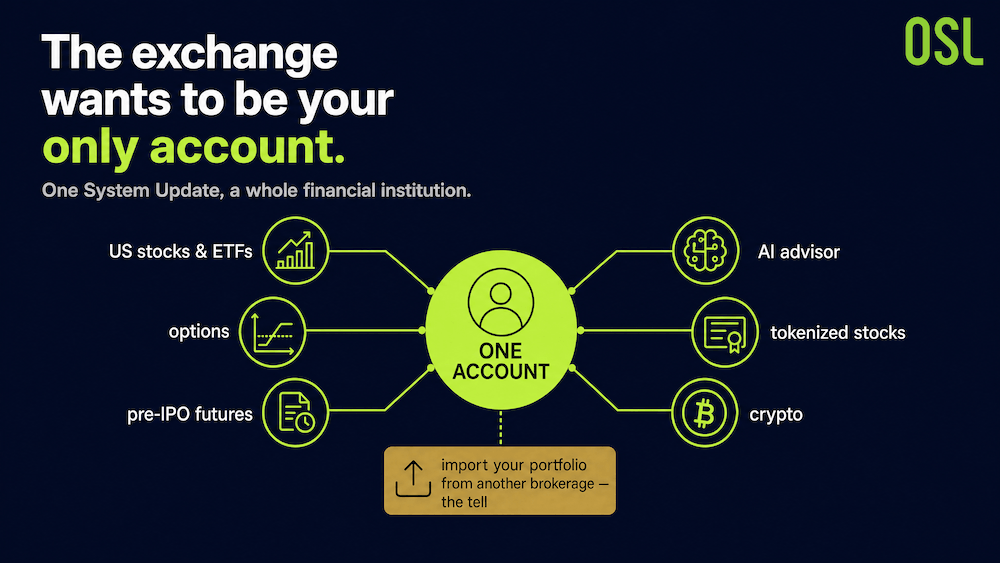
That last item is the tell. Why would a crypto exchange want to import the holdings you keep somewhere else? Because the thing it's actually competing for isn't a trade. It's the account.
The real product is the account, not the stock
A Coinbase executive said the quiet part plainly at the launch, framing the platform as a single account meant to replace a user's brokerage, advisor, and bank. Stocks, in that vision, are not the destination. They're bait. Once your equities sit in the same place as your crypto, the platform can stack everything else on top (margin, lending, options, an AI advisor, a debit card), and every added service is one more reason you never log out.
This reframes what looks like a product race as something closer to a land grab. A venue that earns only trading fees on coins is fragile and replaceable. A venue that holds your stocks, your stablecoins, your retirement-curious index funds, and your borrowing in one balance is sticky in a way that's very hard to leave. The prize isn't your next trade. It's your financial home address.
Everyone is making the same move
Coinbase is the loudest, not the only one. Binance has spent 2026 pitching itself as a financial "super app," putting more than 7,000 US stocks and ETFs into the same balance that holds a user's crypto, settled in stablecoins or its own token. The broader field is moving in lockstep: Binance, Kraken, Bybit, and Gemini are all wiring US equities into their crypto apps, making a direct play for the retail brokerage relationship that Wall Street has owned for a century.
Chart 2: Cryptocurrency Exchanges Are Collectively Entering the U.S. Stock Market
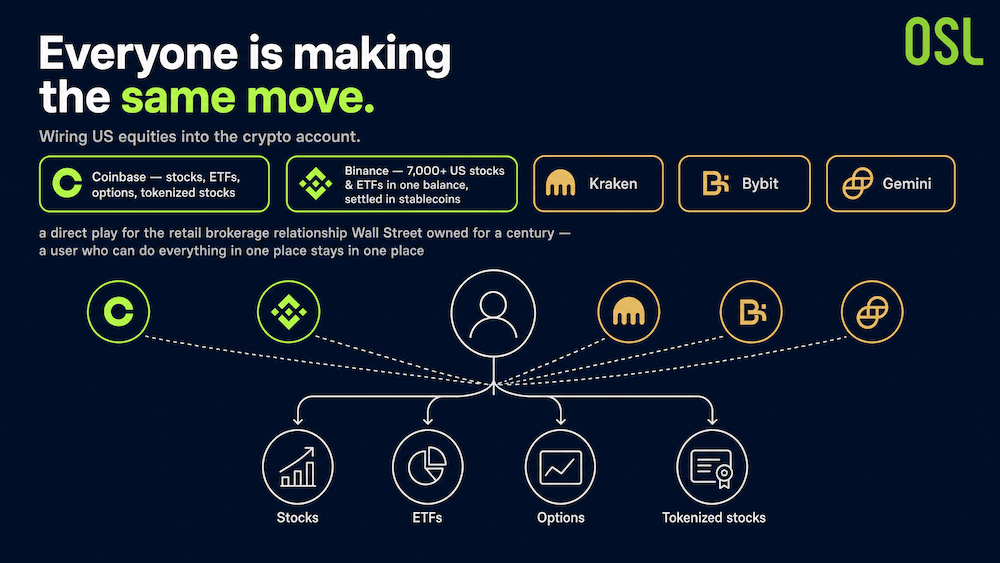
The competitive logic is almost mechanical. The moment one platform lets a user buy Apple, hold stablecoins, and trade Bitcoin without leaving the app, every rival faces the same pressure: a user who can do everything in one place stays in one place. So they all rush to make equities native to the crypto account, because the alternative is watching customers wander off to someone who already did.
They're buying their way in
This isn't just a software update; it's being financed with acquisitions. Kraken bought the futures platform NinjaTrader, roughly 1.7 million users and a CFTC-registered broker license, in a deal valued near $1.5 billion, the largest in its history. Coinbase folded in the derivatives exchange Deribit, acquired for $2.9 billion, into a unified global liquidity pool. The pattern is unmistakable: exchanges are spending real money to acquire the licenses, infrastructure, and user bases of traditional finance, because you can't become a full-service financial institution on crypto-native plumbing alone.
Chart 3: Exchanges Enter the Traditional Financial Sector Through M&A
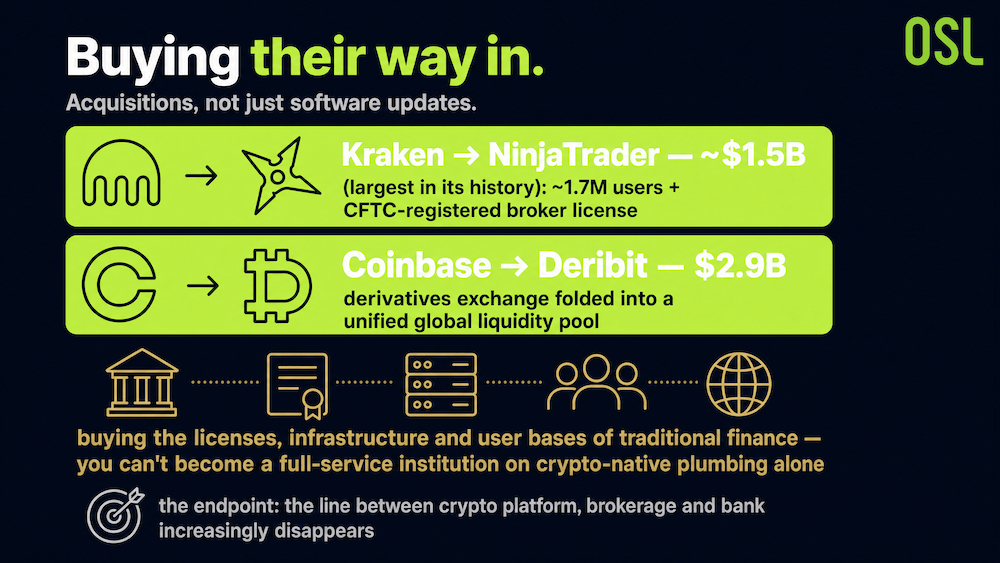
The endpoint of that spending is a category blur. As one industry analysis put it, the distinction between crypto platforms, brokerages, and banks is increasingly disappearing. An exchange that holds your equities, lends against them, advises you with an AI, and issues you credit is no longer an exchange in any meaningful sense. It's a bank that happens to have started in crypto.
The retention machinery
Watch what gets bundled in, and the strategy reads clearly. Coinbase's new AI advisor offers portfolio recommendations and automated tax-loss harvesting. Your imported shares can be lent out for yield, posted as collateral for a loan, or gifted. Each of these is dressed as a convenience, and each is also a hook: the more of your financial life that runs through one login, the higher the cost of moving any of it elsewhere. Convenience and lock-in are the same feature viewed from two angles.
There's nothing exotic about the destination, which is worth saying out loud. The "super app" is a concept borrowed straight from Asia's consumer internet, where platforms like WeChat and Alipay long ago proved that people will happily run messaging, payments, investing, and shopping through a single app. Western finance is now playing catch-up to that model, and the runway is enormous, given that in large parts of Asia fewer than one in five people hold any equities at all, a gap fractional shares and stablecoin settlement are built to close.
What it means to live inside one login
The old crypto account answered a narrow question: which coin do you want to buy? The account these companies are racing to build answers a far larger one: can your dollars, stocks, options, savings, and borrowing all live in one place, managed through one interface and one login?
Chart 4: The Concept of Single Sign-On for Consolidated Financial Data
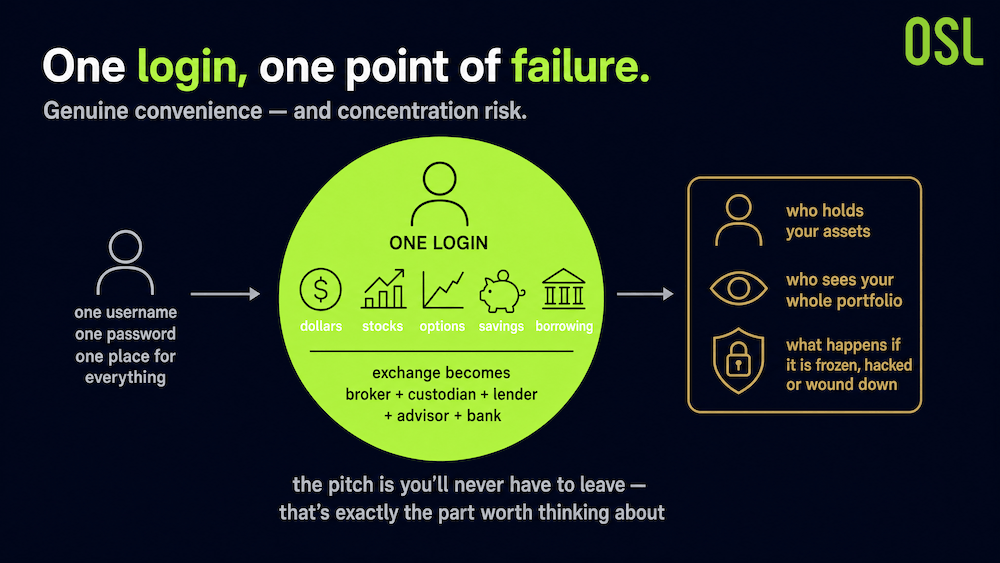
Once that question gets answered yes, the exchange stops being a venue that lists coins and starts being the hybrid of broker, custodian, lender, advisor, and bank that its acquisitions are quietly assembling. That's a genuine convenience, and it's worth using clearly. Concentrating every part of your financial life behind a single login is also concentration risk: over who holds your assets, who sees your whole portfolio, and what happens to all of it at once if that one account is frozen, hacked, or wound down. The pitch is that you'll never have to leave. That's exactly the part worth thinking about before you move in.
FAQ
Q1: What is a crypto "super app"? A: A single account that bundles trading, investing, lending, payments, and advice in one place. Exchanges like Coinbase and Binance are adding US stocks, ETFs, options, AI advisors, and credit on top of crypto so users can run their whole financial life through one login.
Q2: Why are crypto exchanges adding US stocks? A: The goal isn't the trading fee on equities; it's owning the account. Once your stocks sit alongside your crypto, the platform can layer on margin, lending, options, and advice, making the account sticky and hard to leave.
Q3: How are exchanges building this so fast? A: Through acquisitions. Kraken bought NinjaTrader (about 1.7 million users and a CFTC-registered broker license) for near $1.5 billion, and Coinbase folded in the derivatives exchange Deribit for $2.9 billion, buying the licenses, infrastructure, and users of traditional finance.
Q4: What's the risk of keeping everything in one account? A: Concentration risk. Putting your dollars, stocks, savings, and borrowing behind a single login concentrates control over who holds your assets, who sees your whole portfolio, and what happens to all of it at once if that account is frozen, hacked, or wound down.
The views and opinions expressed in this article are solely those of the author and do not constitute professional financial advice.
Sources
CoinDesk: Coinbase introduces AI adviser, stock options and pre-IPO markets in finance push (June 16, 2026)
Unchained: Coinbase Bets on Tokenized Stocks and AI to Become an 'Everything Exchange' (June 16, 2026)
Fortune: Binance adds U.S. stocks in 'super app' push (June 1, 2026)
CryptoSlate: Crypto exchanges are opening a two-front war for the stock market (June 12, 2026)
Yellow.com: Binance, Coinbase, and Kraken Are Becoming Full Banks in 2026 (June 18, 2026)
The Economic Times: One balance, many markets: Binance and the making of a finance 'super app' (June 24, 2026)
Finovate: Coinbase Wants to Become Your Primary Financial Platform (June 18, 2026)
Start your safe cryptocurrency journey now
OSL | Secure Ramps. Trusted Rails !
More topics
More topics
Latest
Why India's $620B Bond Pilot Changed Nothing Legal
SEBI and the RBI's Demat 2.0 pilot issues corporate bonds as digital tokens and settles them with the wholesale digital rupee, preserving existing legal terms while digitizing the infrastructure beneath a $620...
Why India's $620B Bond Pilot Changed Nothing Legal
Why S&P Global Leads Kaiko: Not Hype, But 24/7 Market Infrastructure
S&P Global led a $110 million extension of Kaiko's Series B to build data infrastructure for round-the-clock tokenized markets.
Why S&P Global Leads Kaiko: Not Hype, But 24/7 Market Infrastructure
When One Firm Holds 5% of Ethereum: Infrastructure Stress Test
Bitmine's accumulation of more than 5 million staked ETH raises questions about whether custody, audit, and validator infrastructure can support single-asset concentration at public-company scale.
When One Firm Holds 5% of Ethereum: Infrastructure Stress Test
Best Enterprise Stablecoin Payment Providers: A 2026 Evaluation Framework
Compare enterprise stablecoin payment providers by use case, legal entity, workflow, controls, integration, reconciliation, support, and contract terms.
Best Enterprise Stablecoin Payment Providers: A 2026 Evaluation Framework
How to Reconcile a USDGO Payment: An Illustrative Finance-Close Example
See how Finance can trace a USDGO payment from an approved obligation through payment records, recipient confirmation, reconciliation, and accounting close.
How to Reconcile a USDGO Payment: An Illustrative Finance-Close Example
A USDGO Reserve Review in Practice: Findings, Limits and Follow-up Questions
Review what the July 2026 USDGO reserve attestation establishes, what it does not prove, and which issuer, redemption, and liquidity questions remain.
A USDGO Reserve Review in Practice: Findings, Limits and Follow-up Questions
Recommended for you
More topics
More topics
