Stablecoins Aren't Instant or Free: Where the Real Costs Hide
The Pitch, and the Problem
The marketing case for stablecoins is seductive: sub-cent gas fees, settlement in seconds, 24/7 availability. All of it is true. None of it is the whole story.
Take a business-school view for a moment. The real question is not whether the blockchain is fast. It is whether the end-to-end payment, from a sender's bank account to a recipient's usable local currency, is faster and cheaper than the alternative. Once you frame it that way, the headline numbers start to look incomplete.
Chart 1: Stablecoin Payment Costs
Myth 1: "Stablecoin Payments Are Basically Free"
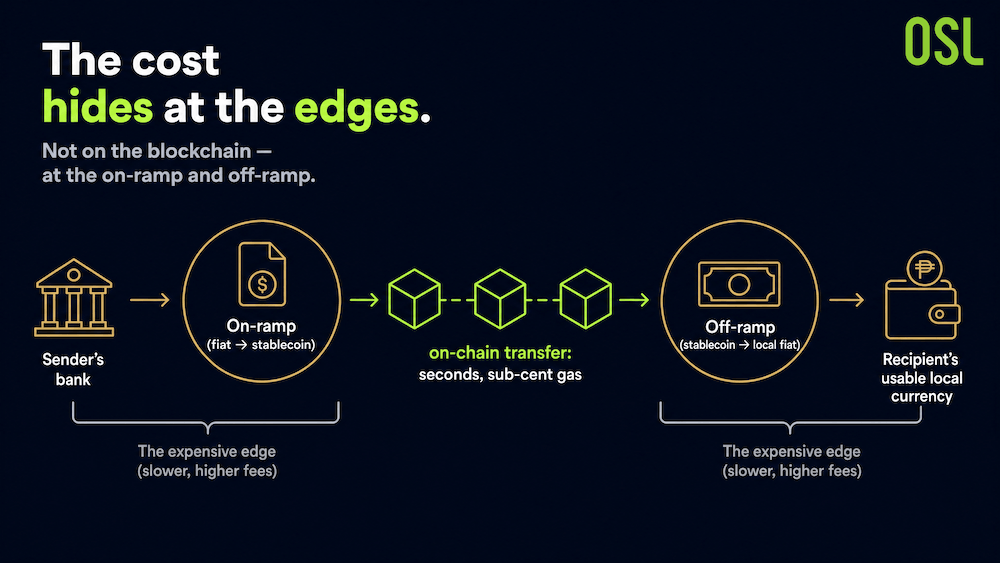
On-chain settlement costs cents. But you cannot pay a supplier in raw USDC unless they can use it. Someone has to convert fiat in, and convert stablecoin out.
According to PaymentBrief's 2026 analysis, the on-ramp and off-ramp at each end charge 0.1% to 1.0% per conversion, take one to two business days, and require KYB checks. The off-ramp cost varies by market: roughly 10–40 basis points in mature markets like the UK, EU, and Australia, and 30–80 basis points in Latin America. Their conclusion is blunt: where the ramps are cheap, stablecoin payments win; where they are not, they don't. The blockchain fee, under $0.01 per transfer on networks like Solana or an L2, is a rounding error next to the conversion economics.
Chart 2: Where the Cost Actually Sits
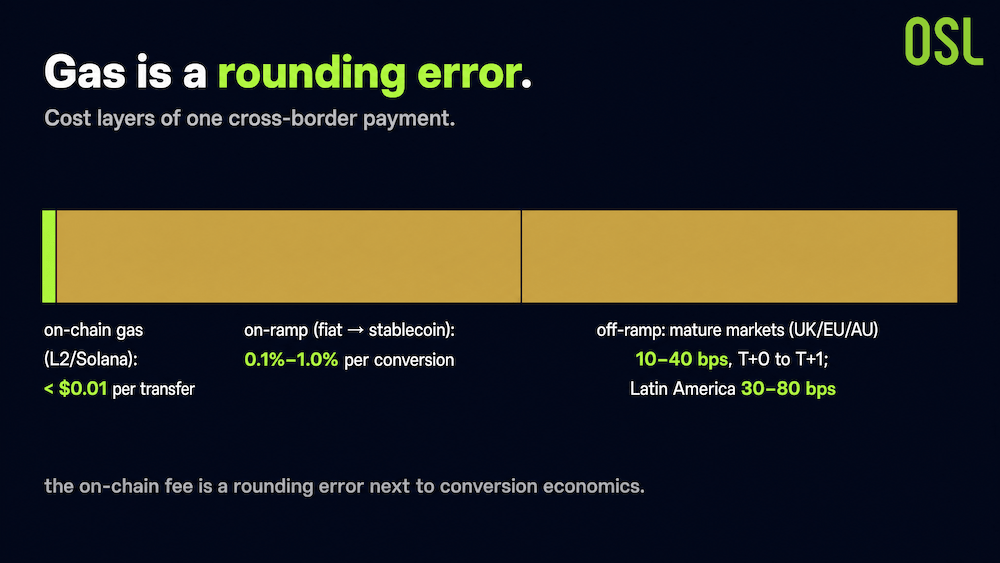
Source: PaymentBrief's 2026 analysis
Myth 2: "Stablecoin Payments Are Instant"
The on-chain transfer is. The payment often is not.
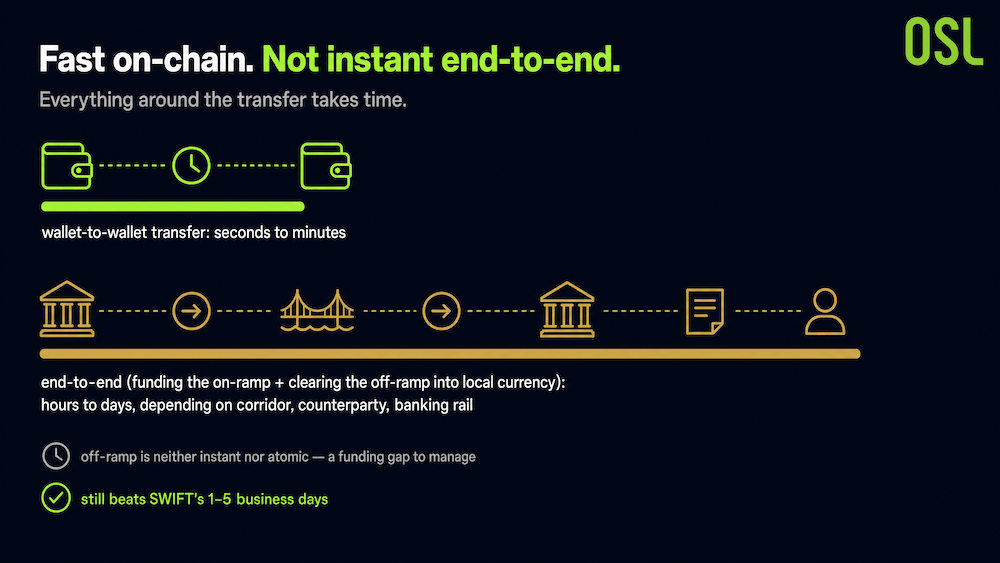
As Lisk put it in June 2026, "stablecoin settlement is fast; everything around it is not." Moving value wallet to wallet takes seconds to minutes. But the end-to-end timeline, including funding the on-ramp and clearing the off-ramp into local currency, can still run to hours or days depending on the corridor, the counterparty, and the banking rail underneath.
This is the off-ramp problem CGI flagged in June 2026: the conversion back into fiat is "neither instant nor atomic." The off-ramp often extends liquidity ahead of settlement, holding a digital asset while it has already paid out fiat, which creates a funding gap that has to be managed. That is real operational cost, hidden behind a "settles in seconds" headline.
To be clear, the comparison still favours stablecoins. A two-hour stablecoin payment beats a SWIFT transfer that takes one to five business days. The improvement is genuine. It is just not the magic-instant experience the rail speed alone implies.
Chart 3: A Comparison of Time Frames for the “Instant” Misconception Regarding Stablecoins
Source: Lisk put it in June 2026, CGI flagged in June 2026
Myth 3: "$33 Trillion Moved, So Stablecoins Are Already a Payment Giant"
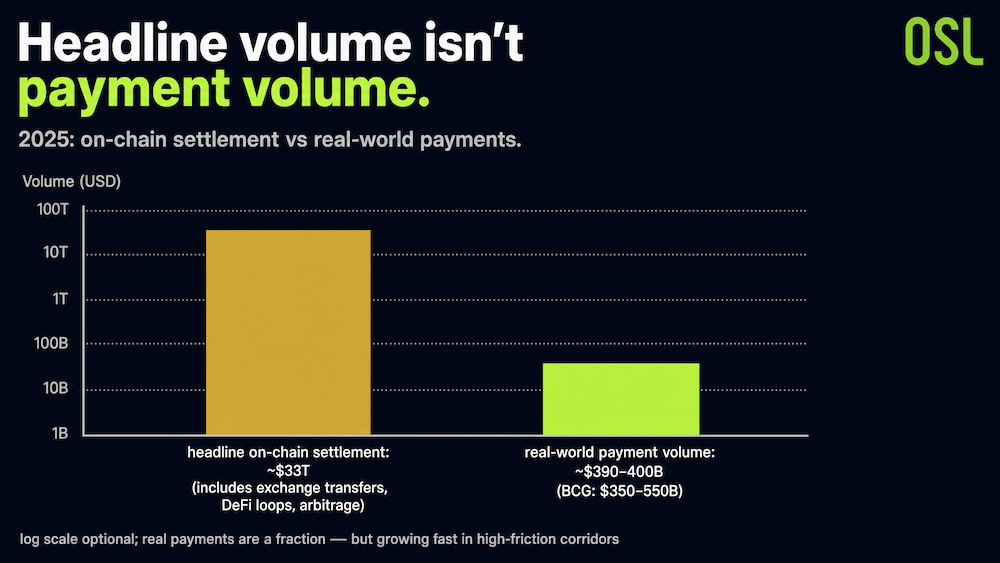
Headline on-chain volume is not the same as real commercial payment volume. The big numbers include exchange-internal transfers, DeFi loops, and arbitrage bots.
Strip those out and the picture is more modest. The report puts genuine payment usage at roughly $390–400 billion annualised in 2025, with BCG estimating $350–550 billion. That is a fraction of the headline figure. It is also, importantly, growing fast in exactly the high-friction places where the edges are worth paying for: cross-border B2B and remittances.
Chart 4: Comparison of Stablecoin Nominal Market Capitalization and Actual Transaction Volume
Source: Report: The Liquidity Hub of the Digital Economy (OSL × HKPU Faculty of Business)
So Where Do Stablecoins Actually Win?
Not everywhere, and that is the honest answer. In mature, competitive corridors, specialist digital remitters already deliver low costs, and stablecoins are not guaranteed to beat them once ramp fees are counted.
The real edge shows up where the traditional rails are broken or absent: corridors where correspondent banks have withdrawn, where local currency is volatile, where end-to-end costs run 7–8% or higher. There, stablecoins offer something the legacy system cannot, access from zero, plus transparency and programmability the old rails were never built for.
Chart 5: Comparison of Stablecoin Application Scopes
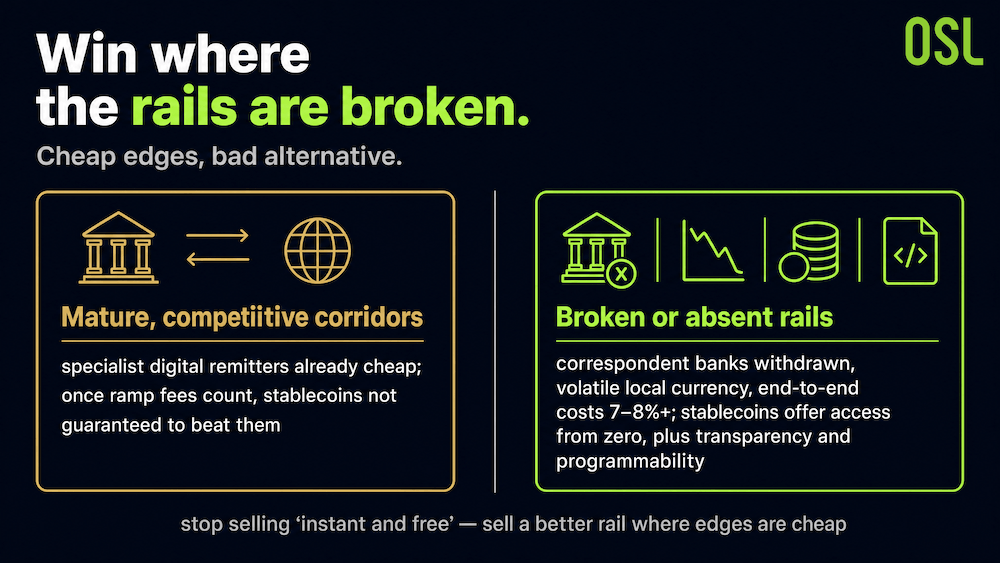
The useful reframing is this: stop selling stablecoins as "instant and free." Sell them as a better rail for the specific corridors where the edges are cheap and the alternative is genuinely bad. That story survives contact with the data.
FAQ
Q1: Are stablecoin payments actually free? A: No. On-chain gas is near-zero, but on-ramp and off-ramp conversions typically cost 0.1%–1.0% each and dominate the real cost of a cross-border payment.
Q2: Are stablecoin payments instant? A: The on-chain transfer is seconds to minutes. End-to-end, including fiat conversion at both ends, it can take hours or days, though still usually faster than SWIFT's one to five days.
Q3: What is the on-ramp / off-ramp? A: The on-ramp converts fiat into stablecoins at the sending end; the off-ramp converts stablecoins back into local fiat at the receiving end. These conversions carry most of the cost and time.
Q4: Is the $33 trillion stablecoin volume real payment activity? A: No. Most is exchange transfers, DeFi, and arbitrage. Real-world payment volume was roughly $390–400 billion in 2025.
References
Note: Industry analysis based on public sources and the cited report. Not investment advice.
Start your safe cryptocurrency journey now
OSL | Secure Ramps. Trusted Rails !
More topics
More topics
Latest
Why India's $620B Bond Pilot Changed Nothing Legal
SEBI and the RBI's Demat 2.0 pilot issues corporate bonds as digital tokens and settles them with the wholesale digital rupee, preserving existing legal terms while digitizing the infrastructure beneath a $620...
Why India's $620B Bond Pilot Changed Nothing Legal
Why S&P Global Leads Kaiko: Not Hype, But 24/7 Market Infrastructure
S&P Global led a $110 million extension of Kaiko's Series B to build data infrastructure for round-the-clock tokenized markets.
Why S&P Global Leads Kaiko: Not Hype, But 24/7 Market Infrastructure
When One Firm Holds 5% of Ethereum: Infrastructure Stress Test
Bitmine's accumulation of more than 5 million staked ETH raises questions about whether custody, audit, and validator infrastructure can support single-asset concentration at public-company scale.
When One Firm Holds 5% of Ethereum: Infrastructure Stress Test
Best Enterprise Stablecoin Payment Providers: A 2026 Evaluation Framework
Compare enterprise stablecoin payment providers by use case, legal entity, workflow, controls, integration, reconciliation, support, and contract terms.
Best Enterprise Stablecoin Payment Providers: A 2026 Evaluation Framework
How to Reconcile a USDGO Payment: An Illustrative Finance-Close Example
See how Finance can trace a USDGO payment from an approved obligation through payment records, recipient confirmation, reconciliation, and accounting close.
How to Reconcile a USDGO Payment: An Illustrative Finance-Close Example
A USDGO Reserve Review in Practice: Findings, Limits and Follow-up Questions
Review what the July 2026 USDGO reserve attestation establishes, what it does not prove, and which issuer, redemption, and liquidity questions remain.
A USDGO Reserve Review in Practice: Findings, Limits and Follow-up Questions
Recommended for you
More topics
More topics
