USDT vs USDC: Inside the Stablecoin Duopoly That Controls 82% of the Market
A Market Run by Two
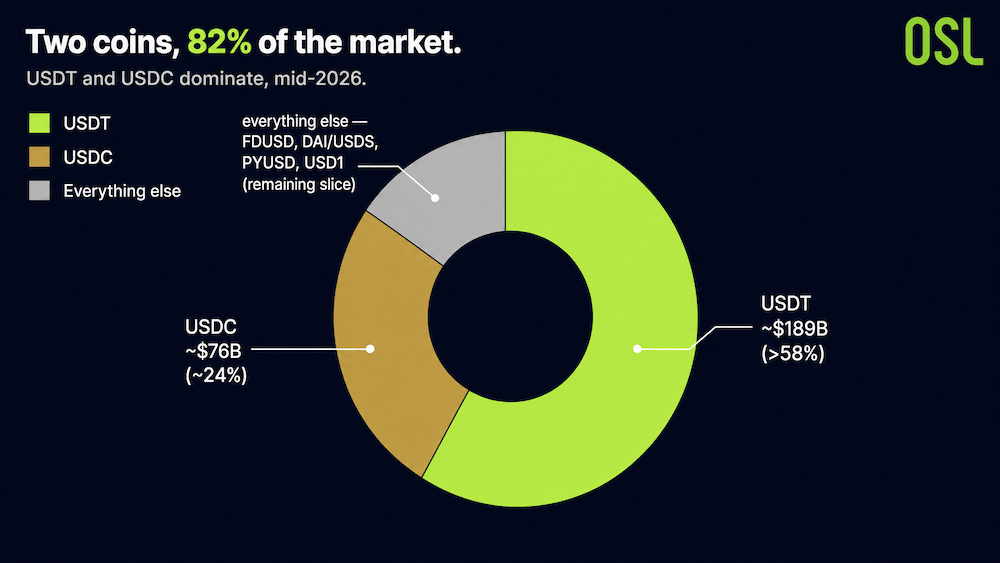
The stablecoin market looks crowded from a distance. Up close, it's a duopoly. According to DefiLlama and Gate's June 2026 data, USDT's supply sits around $189 billion (over 58% share) and USDC around $76 billion (about 24%). Together they control more than 82% of the market. Everything else, FDUSD, DAI/USDS, PYUSD, and Trump-affiliated USD1, splits the remaining slice.
Chart 1: Stablecoin Market Share
Source: DefiLlama, Gate's June 2026 data
That concentration is not an accident. It is the result of competition and risk-driven selection, and it has proven remarkably hard to break.
How They Actually Differ
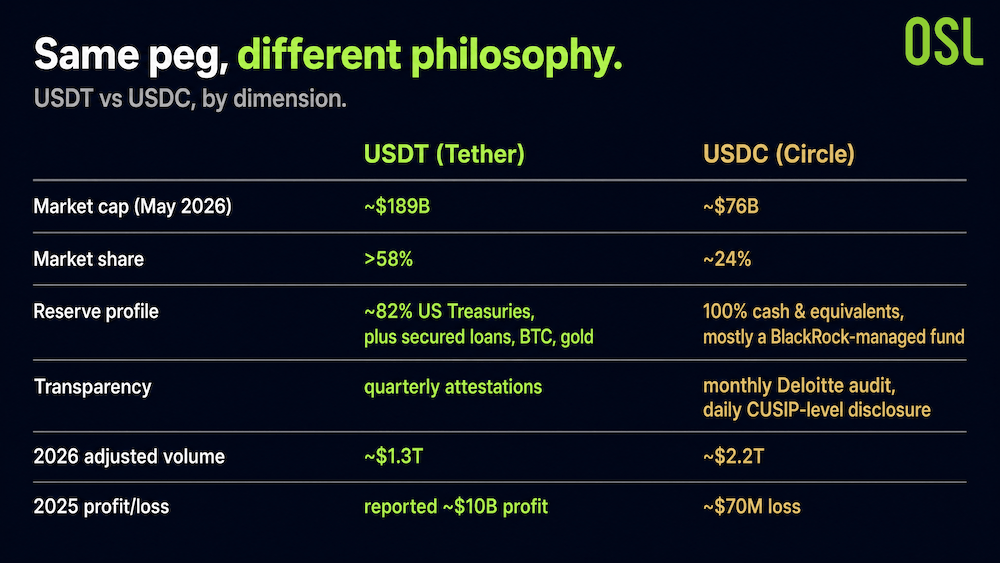
The two coins look identical on the surface, both pegged 1:1 to the dollar. Under the hood, they are built on different philosophies.
Chart 2: USDT vs USDC head to head
Source: Report: The Liquidity Hub of the Digital Economy (OSL × HKPU Faculty of Business)
USDT is the deeper pool of liquidity. Its daily trading volume has long run more than 5x USDC's, and its US Treasury holdings reportedly exceed the national holdings of Germany, placing Tether among the world's top 20 holders of US government debt. Its reserves also include riskier assets, secured loans, Bitcoin, and gold, which help drive the profits Tether reported at around $10 billion for last year. On transparency, Tether publishes quarterly attestations rather than the more frequent disclosures Circle offers.
USDC takes the opposite bet. Its reserves are 100% cash and cash equivalents, with over 80% held in the Circle Reserve Fund (managed by BlackRock, custodied at BNY Mellon). Deloitte attests monthly and BlackRock publishes holdings daily. That transparency builds institutional trust, but it also caps yield, and Circle recorded a roughly $70 million loss in 2025.
Winning on Different Axes
Here is the nuance most coverage misses: this is not a simple story of winner and loser.
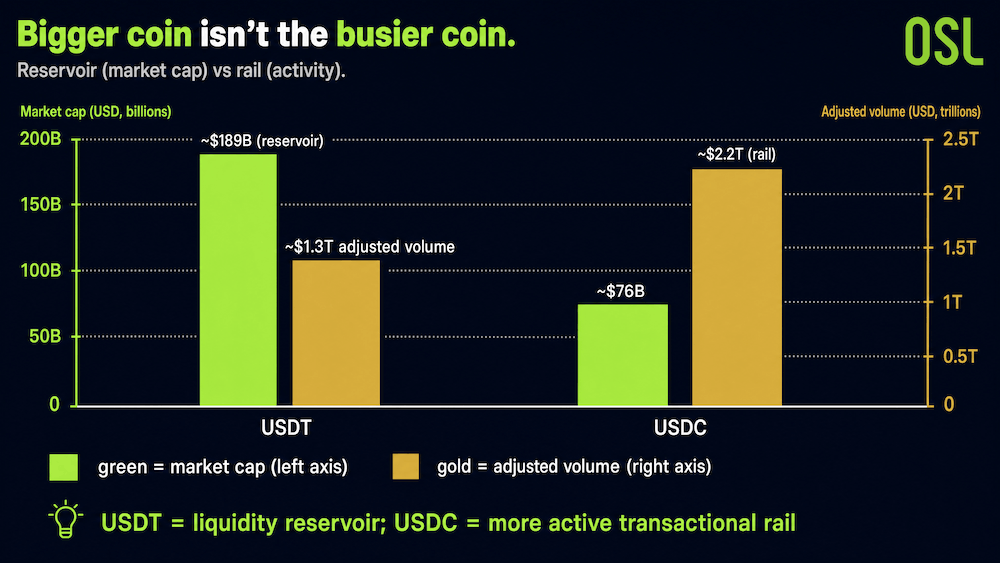
As The Chain Observer noted in April 2026, USDT is consolidating its lead as the market's preferred liquidity reservoir, now more than twice USDC's size. Yet USDC recorded about $2.2 trillion in adjusted transaction volume in 2026 against roughly $1.3 trillion for USDT, meaning Circle's coin is the more active transactional rail even as Tether holds the larger balance.
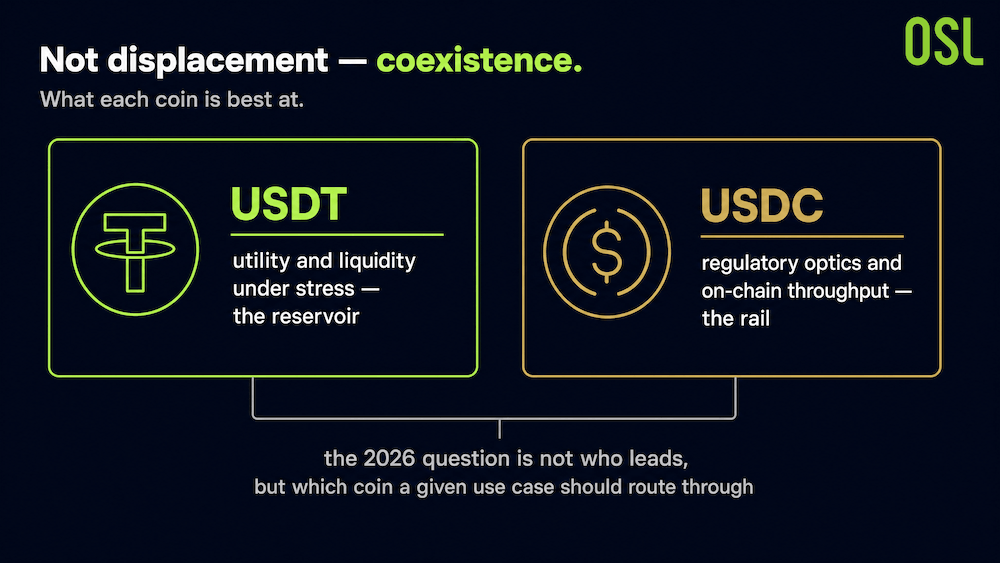
In other words, both are winning and losing at the same time, on different axes. Tether wins on utility and liquidity under stress. Circle wins on regulatory optics and on-chain throughput.
Chart 3: Reservoir vs rail
Source: The Chain Observer noted in April 2026
Why New Entrants Keep Bouncing Off
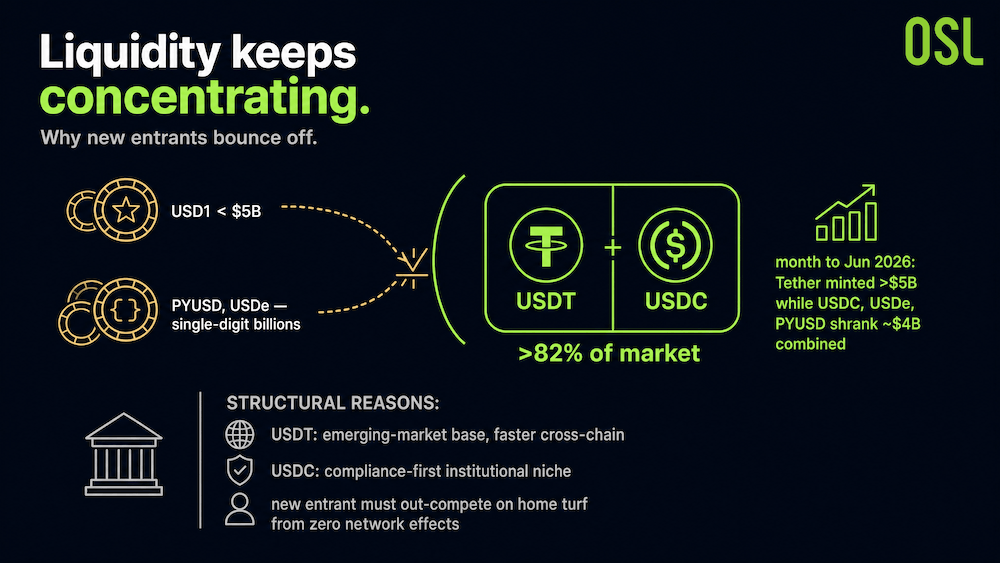
Plenty have tried. Trump-affiliated USD1 grew quickly but remains under $5 billion. PYUSD, USDe, and others hold single-digit-billion positions. None has meaningfully dented the duopoly.
The reasons are structural. USDT has a first-mover advantage in emerging-market user bases and scenario coverage, plus faster cross-chain deployment. USDC owns the compliance-first institutional niche. A new entrant has to out-compete one of them on its home turf, deeper liquidity or stronger compliance, while building network effects from zero. In the month to June 2026, Tether minted over $5 billion while USDC, USDe, and PYUSD collectively shrank by about $4 billion, a sign that liquidity is still concentrating toward the top, not dispersing.
Chart 4: New Stablecoin Entrants Struggle to Break the Duopoly
The likeliest outcome, as analysts across the board now frame it, is not displacement but long-term coexistence of the two. The interesting question for 2026 is no longer who leads, but what each coin is best at, and which one a given use case should route through.
Chart 5: The Long-Term Coexistence and Roles of USDT and USDC
FAQ
Q1: What share of the stablecoin market do USDT and USDC hold? A: Together more than 82% as of mid-2026, with USDT over 58% and USDC about 24%.
Q2: What is the main difference between USDT and USDC? A: USDT holds higher-yield, more varied reserves (including Treasuries, Bitcoin, and gold) and dominates liquidity; USDC holds 100% cash equivalents with monthly audits and prioritises compliance and transparency.
Q3: Is USDT or USDC more widely used for transactions? A: USDC recorded higher adjusted transaction volume in 2026 (~$2.2T vs ~$1.3T), while USDT holds the larger market cap.
Q4: Can a new stablecoin break the duopoly? A: Unlikely in the short term. New entrants like USD1 remain small, and liquidity continues concentrating toward USDT and USDC.
References
Note: Industry analysis based on public sources and the cited report. Not investment advice.
Start your safe cryptocurrency journey now
OSL | Secure Ramps. Trusted Rails !
More topics
More topics
Latest
Why India's $620B Bond Pilot Changed Nothing Legal
SEBI and the RBI's Demat 2.0 pilot issues corporate bonds as digital tokens and settles them with the wholesale digital rupee, preserving existing legal terms while digitizing the infrastructure beneath a $620...
Why India's $620B Bond Pilot Changed Nothing Legal
Why S&P Global Leads Kaiko: Not Hype, But 24/7 Market Infrastructure
S&P Global led a $110 million extension of Kaiko's Series B to build data infrastructure for round-the-clock tokenized markets.
Why S&P Global Leads Kaiko: Not Hype, But 24/7 Market Infrastructure
When One Firm Holds 5% of Ethereum: Infrastructure Stress Test
Bitmine's accumulation of more than 5 million staked ETH raises questions about whether custody, audit, and validator infrastructure can support single-asset concentration at public-company scale.
When One Firm Holds 5% of Ethereum: Infrastructure Stress Test
Best Enterprise Stablecoin Payment Providers: A 2026 Evaluation Framework
Compare enterprise stablecoin payment providers by use case, legal entity, workflow, controls, integration, reconciliation, support, and contract terms.
Best Enterprise Stablecoin Payment Providers: A 2026 Evaluation Framework
How to Reconcile a USDGO Payment: An Illustrative Finance-Close Example
See how Finance can trace a USDGO payment from an approved obligation through payment records, recipient confirmation, reconciliation, and accounting close.
How to Reconcile a USDGO Payment: An Illustrative Finance-Close Example
A USDGO Reserve Review in Practice: Findings, Limits and Follow-up Questions
Review what the July 2026 USDGO reserve attestation establishes, what it does not prove, and which issuer, redemption, and liquidity questions remain.
A USDGO Reserve Review in Practice: Findings, Limits and Follow-up Questions
Recommended for you
More topics
More topics
