Stablecoin Weekly Pulse | Vol. 20: The Stablecoin Express: Next Stop, Card

Data through August 5, 2026
Welcome to the Stablecoin Weekly Pulse Vol. 20. Subscribe for a 10-minute read highlighting the signals most relevant to institutions and businesses.
I. Weekly Stablecoin Payments Data
Stablecoin Market Overview
Total Supply Stable: As of August 5, the global on-chain stablecoin supply stood at US$312.2 billion (across 157 tokens), down slightly by 0.5% over the past 30 days.
On-Chain Activity Pulls Back: Daily transfer volume averaged US$167.8 billion (MoM -30.4%), daily transactions reached 62.4 million (MoM -10.8%), and daily active addresses totaled 4.5 million (MoM -7.1%).
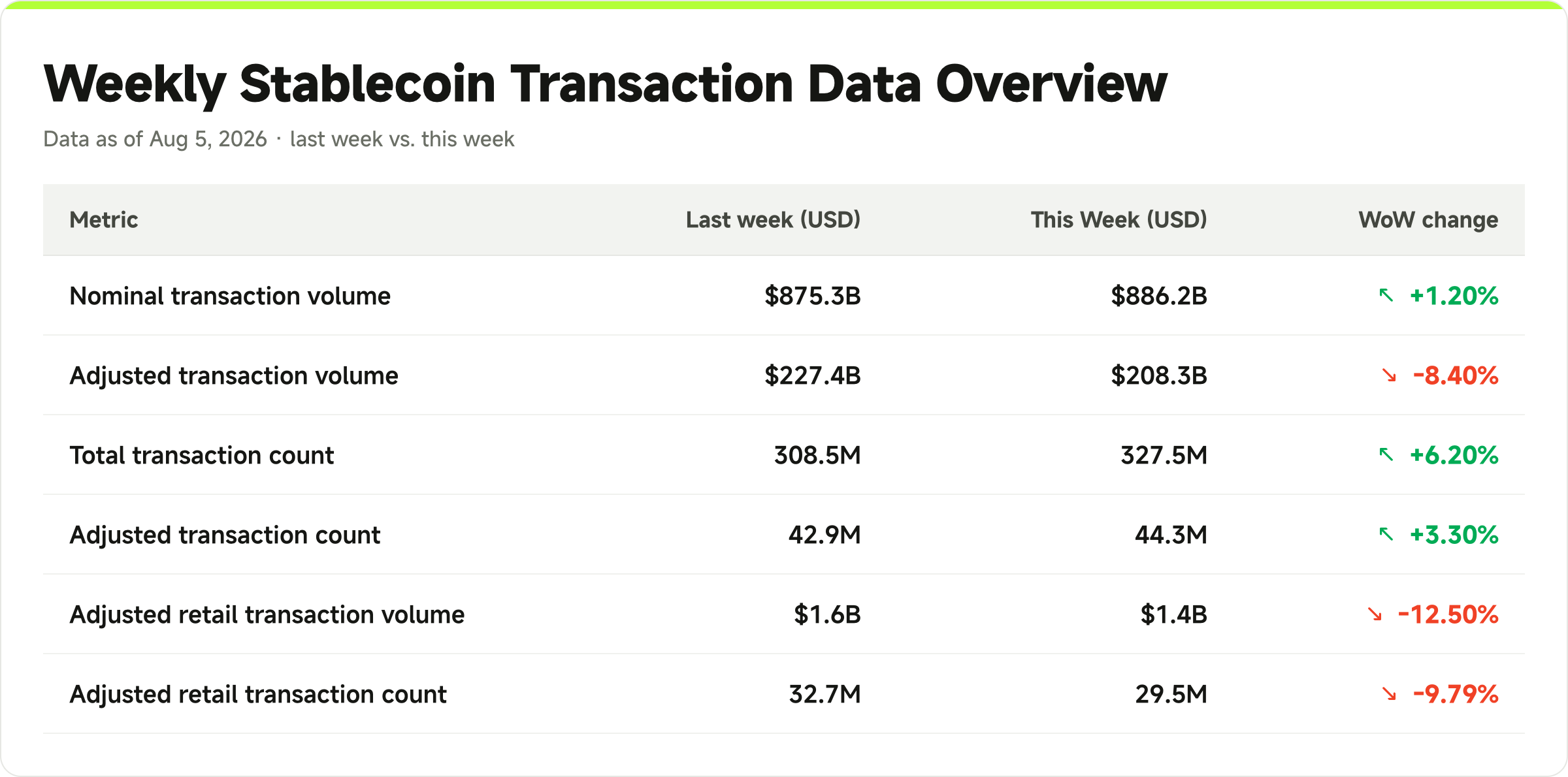
Adjusted Volume at 23.5%: Over the past seven days, nominal transaction volume reached US$886.2 billion, with adjusted real volume at US$208.3 billion (accounting for 23.5% of nominal volume); total transactions were 327.5 million, with adjusted real transactions at 44.3 million.
High-Frequency, Small-Ticket Retail Usage: Adjusted retail transaction volume was approximately US$1.4 billion (accounting for 0.7% of total adjusted volume), while transaction count reached 29.5 million (67% of total adjusted transactions).
Weekly Transaction Overview
Decline Across All Key Metrics: All six core metrics dropped week-on-week, with declines concentrated between 9% and 14%.
Faster Contraction in Non-Retail Transactions: The drop in transaction volume (Nominal -12.2%, Real -14.1%) outpaced transaction count (Nominal -10.5%, Adjusted -9.3%) — average ticket size and frequency shrank simultaneously, with non-retail transactions contracting more sharply.
Rebound Concentrated in Nominal and Count Metrics: Three metrics rose this week — nominal transaction volume (+1.2%), total transaction count (+6.2%), and adjusted transaction count (+3.3%) — while three others fell: adjusted transaction volume (-8.4%), adjusted retail transaction volume (-12.5%), and adjusted retail transaction count (-9.8%). Transactions became more frequent, but the value — particularly adjusted settlement and retail value — continued to decline. In other words, transaction counts increased as average ticket size moved lower, while adjusted economic settlement failed to keep pace with nominal activity.
Barbell Structure Persists: The market continued to exhibit a barbell structure, with small retail-sized transfers dominating by count and larger transactions dominating by value. Retail-sized transfers accounted for approximately 67% of adjusted transaction count, unchanged from the previous week, but only 0.7% of adjusted volume.
Falling Real Share Is the Key Signal: The adjusted-to-nominal ratio slipped from roughly 26% last week to about 23.5% this week — each real transaction now carries less economic weight. The uptick in nominal volume appears to be driven more by non-settlement activity than by an expansion in real economic transfer. Whether this rebound in on-chain activity holds will depend on whether real settlement turns positive as well.
Sources: Artemis, Visa, OSL Research
Definitions: Adjusted figures exclude arbitrage, fund transfers, market-maker round-trips, and similar noise. Visa classifies individual transactions below US$250 as retail and those of US$250 or above as non-retail.
II. Weekly Stablecoin Payments & Infrastructure News
A stablecoin card you can swipe. A settlement rail brought into the fold. The market is making stablecoins spendable — but not everyone gets a seat.
1. Mastercard Completes US$1.8 Billion Acquisition of BVNK
On August 3, Mastercard completed its acquisition of stablecoin infrastructure company BVNK for US$1.8 billion, nearly five months ahead of the year-end timeline set when the deal was announced on March 17. BVNK had previously fielded a US$2 billion offer from Coinbase in November 2025 that did not proceed.
Mastercard Chief Product Officer Jorn Lambert said in a statement that in a “multi-money world” where fiat, stablecoins and tokenized deposits coexist, the next payments paradigm will depend on how well different settlement rails connect. The company said the acquisition would support cross-border B2B payments, remittances, payouts, settlement and treasury management.
BVNK said the same day that the acquisition would not affect its existing operations or clients, and that it was already working to bring broader Mastercard capabilities — including expanded payment reach and card-network functionality — to BVNK’s customers. Founded in 2021, BVNK operates in 130 markets, holds more than 25 regulatory licenses, and processes roughly US$30 billion in payments annually.
2. Western Union and Rain Launch Stablecard
On August 4, Western Union and stablecoin infrastructure firm Rain launched Stablecard, linking Western Union’s own white-label stablecoin, USDPT, to a Visa-secured credit card and digital wallet. The product is live in 37 markets, with the company targeting more than 60 by year-end. USDPT is issued by Anchorage Digital Bank and runs on the Solana blockchain.
Western Union said customers can receive Western Union transfers directly onto Stablecard, pledge USDPT to secure a credit limit, and spend at any merchant that accepts Visa — without first converting the stablecoin into fiat currency.
The launch came four days after Western Union reported second-quarter 2026 results: revenue of US$1.01 billion, down 1% year on year, and a GAAP operating margin of 13%, down from 19% a year earlier. The company attributed the margin decline to weaker retail remittance volume in the Americas and to short-term costs from customers shifting from cash to digital wallets.
3. Yellow Card Raises US$40 Million
On August 4, African stablecoin infrastructure company Yellow Card announced that it had raised US$40 million in a strategic funding round led by Standard Chartered’s SC Ventures, Sony Innovation Fund, Polychain Capital and Blockchain Capital. The company has now raised more than US$120 million in equity funding to date.
Yellow Card said it would use the funding to expand its Global Dollar Account product, which operates in more than 50 countries and lets businesses hold dollars, manage treasury operations and pay or collect funds in local currency. Existing clients include Visa and Western Union.
The company also said it is in discussions with Mastercard about potential collaboration on cross-border remittances and business-to-business settlement.
4. Circle Reports Q2 2026 Revenue of US$701 Million
On August 5, Circle reported second-quarter 2026 revenue of US$701 million, up 7% year on year but below the roughly US$713 million analysts had forecasted. Net income was US$48 million, compared with a net loss of US$482 million a year earlier — a swing largely attributable to stock-based compensation tied to Circle’s initial public offering in the prior-year period. USDC in circulation grew 19% year on year to US$73.3 billion, and on-chain transaction volume rose 151% year on year to US$14.8 trillion.
Circle also doubled its full-year revenue guidance for Arc, its blockchain, to a range of US$310 million to US$330 million. Arc is Circle’s own layer-1 blockchain, built specifically for stablecoin transactions and designed to use USDC itself for transaction fees; it targets banks and institutions handling cross-border payments, foreign exchange and asset tokenization. Circle raised US$222 million in a token presale for Arc in May, led by venture firm a16z, valuing the network at US$3 billion.
Circle said Arc’s public mainnet will launch September 16, adding privacy features, a toolkit for programmable finance agents, and support for tokenized real-world assets. More than 100 institutions and ecosystem projects are already testing the network. Shares rose about 5.7% in premarket trading after the results, to above US$66.50, though they remain down roughly 20% for the year.
5. Tether Q2: Operating Profit US$150 Million, Excess Reserves Fall 50%
Tether released its BDO-audited reserve report for the second quarter of 2026 on July 31. Operating profit was US$150 million, up about 44% from US$104 million in the first quarter. But excess reserves fell to US$411 million from US$823 million — a decline of roughly 50%.
Tether said the drop was not driven by redemptions: USDT in circulation actually grew during the quarter, by about US$446 million, to roughly US$184.6 billion. The decline instead reflected unrealized losses on Tether’s gold and bitcoin holdings, which fell in value by about 15% and 14%, respectively, during the quarter. On a comprehensive basis, the company’s first-half loss could exceed US$4 billion.
The report also noted that as of July 1, no MiCAR-licensed exchange in the European Economic Area offers USDT trading pairs. Tether has not applied for authorization as an electronic money institution (EMI) under the EU’s Markets in Crypto-Assets Regulation (MiCAR); therefore, USDT has not been designated a compliant e-money token (EMT).
6. Coinbase Q2: Record US$20 Billion Average USDC on Platform
On July 30, Coinbase reported second-quarter 2026 revenue of US$1.22 billion, down 13.5% from the prior quarter, and a net loss of US$359.5 million, narrower by 8.8% quarter on quarter. Average USDC held on the platform reached a record US$20 billion, more than 30% of USDC’s global circulating supply.
7. Revolut Stops Accepting USDT Deposits
On July 30, Revolut stopped accepting USDT deposits. Transfers sent to the platform after that date are automatically rejected. Users can still sell existing USDT holdings or move them to external wallets until August 31, when Revolut fully delists the token and converts any remaining balances into customers’ home currency at that day’s exchange rate.
8. Morgan Stanley Downgrades Circle to “Underweight”
On August 3, Morgan Stanley downgraded Circle to “underweight,” cutting its price target to US$38 from US$106 — a 64% reduction. The bank cited slowing USDC growth and rising competition from tokenized money-market funds, including BlackRock’s newly launched products, which it said could weigh on Circle’s stablecoin reserve income.
9. Kulipa Denies Insolvency After Abrupt Shutdown
On August 3, Kulipa denied that it was insolvent. CEO Axel Cateland said the company’s abrupt shutdown on July 29 reflected a “corporate restructuring,” not financial distress, and hinted at “exciting things” to come, though he did not disclose details, citing legal constraints. Kulipa is a French startup that provides white-label card-issuing infrastructure for stablecoins. It holds operating licenses in the EU, Argentina and Nigeria, serves about 20 wallet and fintech clients, and had issued more than 120,000 cards before all of them stopped working the moment the company shut down.
10. BlackRock Launches Tokenized Money-Market Funds for Stablecoin Reserves
On August 3, BlackRock launched two tokenized money-market funds designed as stablecoin reserve assets, BSTBL and BRSRV. CFO Martin Small told analysts on an earnings call that BlackRock’s goal is to become “the reserve manager of choice” for the stablecoin industry.
11. South Africa Publishes Draft Cross-Border Crypto Rules
On August 3, South Africa’s Treasury and central bank published draft rules on cross-border crypto-asset transactions. The rules would require asset transfers out of the country to go through licensed service providers and be reported to the central bank’s foreign-exchange regulator. The comment period runs through September 30.
12. Netstars to Power Lawson Stablecoin Pilot in Tokyo
On August 3, Netstars said it would provide the technology behind a Lawson convenience-store stablecoin pilot set for August 17 at a store in Tokyo’s Gate City Osaki Atrium. The trial will add USDC and USDT alongside the yen-pegged stablecoin JPYC, with all three payable through the store’s existing point-of-sale scanners. Netstars is Japan’s leading QR-payment aggregator, operating more than 700,000 point-of-sale terminals nationwide.
13. Flare’s FXRP Approved as Collateral in RLUSD Lending Vault
On August 3, Flare said its wrapped XRP asset, FXRP, had been approved as collateral in an RLUSD lending vault managed by Sentora on the Morpho protocol — the first time an XRP-linked asset has been accepted as collateral on an institutional-grade Ethereum lending market. Flare is a layer-1 blockchain built to bring assets without native smart-contract support, such as XRP and bitcoin, into DeFi.
14. BPI and TCH Object to FDIC Stablecoin AML Rule Wording
On August 4, the Bank Policy Institute and The Clearing House Association wrote jointly to the Federal Deposit Insurance Corporation (FDIC), objecting to the wording of its proposed stablecoin anti-money-laundering and sanctions-compliance rule. The groups warned that if the FDIC, the Office of the Comptroller of the Currency (OCC) and the Federal Reserve finalize inconsistent rules, issuers will simply register through whichever regulator sets the lowest bar — creating a regulatory arbitrage.
15. Binance Sues RedotPay for US$470 Million
On August 5, Binance sued three co-founders of RedotPay, a stablecoin card issuer, in Hong Kong, alleging the company diverted more than 470,000 Binance Pay users to its own product in breach of a 2025 agreement, and seeking roughly US$472.8 million in damages. RedotPay denied the claims and said it would defend itself in court. The card issuer is preparing a US IPO that could raise more than US$1 billion.
III. Analyst Commentary
The Stablecoin Express: Next Stop, Card
The real value of the stablecoin card issuance isn’t from transactions, but from balances. Whoever’s ledger the money sits on effectively controls the capital deployment right.
Western Union and Rain launched Stablecard this week. Mastercard closed a $1.8 billion acquisition. Neither was about buying transactions. Let’s explore why.
What Stablecard Actually Is
By Western Union’s own description, this is neither a prepaid card nor a bank account. It doesn’t offer a deposit account, earns no interest, and carries no claim on FDIC-insured funds. What you can spend is capped strictly by however much USDPT — Western Union’s dollar-pegged stablecoin — you’ve locked up as collateral.
USDPT is Western Union’s white-label, compliant dollar stablecoin, issued by Anchorage Digital Bank, the first federally chartered crypto bank in the US. It launched on May 4, 2026, runs on Solana, and currently has a circulating supply of roughly $5.9 million.
Western Union’s legacy business model is essentially a pass-through: collect a fee, deliver the money to the recipient, settle within minutes, and the company’s relationship ends there. Stablecard is trying to rewrite that ending — funds sit in a USDPT wallet and get spent down gradually instead of cashing out on arrival.
That shift makes a lot of sense given the timing. Just days before the card’s launch, Western Union reported Q2 2026 earnings showing revenue down 1% year over year and operating margin down 6 percentage points, to 13%, driven by softening retail remittance volumes in the Americas and short-term cost pressure from customers migrating from cash.
From Tolls to Parking Fees
The real value of this move isn’t selling more cards — it’s converting Western Union from a company that collects tolls into one that collects parking fees.
And there’s one thing Western Union has that almost nobody else in this space can match: volume of real-world access points. Over 360,000 cash pickup locations across more than 200 countries and territories. That means, even in markets where Visa acceptance is thin and cash still rules — think Argentina, where the local currency keeps taking hits — customers get a three-way combination that pure digital wallets simply can’t offer: hold value on-chain, spend it on a card, or cash out in person.
The Float Economy
Strip the card business down to its core, and what’s really being redistributed isn’t from transactions, but from balances. The money sitting untouched between arrival and spending. In finance, that’s called float: whoever’s ledger the money sits on effectively controls its deployment for the duration.
Stablecoin did not invent this. Insurers have long invested the float from premiums collected upfront but not yet paid out in claims. Western Union itself has quietly benefited from similar dynamics for decades, through the brief windows when remittances sit in transit.
The USDPT Flywheel
Stablecard’s real significance isn’t the card itself — it’s the flywheel it creates with USDPT. Western Union has been explicit: your spending limit is a direct function of how much USDPT you lock up as collateral. In other words, if you want a higher limit, you need to deposit more USDPT — which mechanically grows the stablecoin’s circulating supply. As long as new USDPT deposits keep outpacing the USDPT redeemed and burned through cardholder spending, Western Union keeps collecting — and potentially growing — interest income on its reserve assets, on top of whatever else it can do with that float.
Making Float Visible
What’s also changing is visibility. Issuing a stablecoin-backed card makes this value legible and quantifiable for the first time — and therefore fair game. Historically, nobody outside a bank knew how long their money sat idle or what value that idle time generated. The value stayed inside the bank’s own books. Stablecoins turn “holding funds” into something on-chain, programmable, and deliberately tunable — issuers can use collateral requirements, cashback terms, and onboarding thresholds to engineer products that keep money parked longer. What used to be an invisible bank-side windfall has become an open, contested resource everyone’s racing to claim a piece of.
What Mastercard Is Really Buying
Mastercard’s $1.8 billion acquisition of stablecoin infrastructure firm BVNK wasn’t really about buying card-issuing technology — it was buying more than 25 regulatory licenses and a direct pipe into euro clearing rails. In effect, Mastercard converted connectivity that used to be rented from a third party into an asset it now owns outright. The 140-plus-member OpenUSD stablecoin alliance has an equally blunt agenda: spread the value generated by parked funds across the coalition, rather than letting it concentrate with a single issuer.
These industry moves and Western Union’s card launch are about buying the right to hold balances. Card issuance just happens to be the loudest, most visible layer of it
The Barrier to Entry
The fight for balances is loud, but the barrier to entry is higher — and two recent incidents make that clear.
Kulipa’s abrupt shut down, instantly disabled over 120,000 cards. The company denied insolvency, though partners said the likely cause was a balance-sheet shortfall. Whatever the exact cause, it exposed a structural weakness: the middle layer of the card-issuing stack — the players handling technical integration, compliance frameworks, and clearing — runs on thin margins and depends almost entirely on downstream transaction volume to cover its costs.
When volume doesn’t scale as fast as projected, it’s rarely the front-facing issuer with a recognizable brand and existing user base that breaks first. It’s the invisible pipes underneath. The lesson for anyone entering this space: a solid tech stack isn’t enough. Without deep capital reserves or durable cash flow, it’s easy to collapse right in the middle of the scale-up phase.
Days later, Binance sued stablecoin card company RedotPay for roughly $470 million, alleging it funneled hundreds of thousands of Binance users into its own card product through deposit channels that were never authorized for that purpose. RedotPay denies the allegations and says it will fight the suit. This case highlights a different kind of survival risk: in a space where rules around who “owns” balances and customers are still murky, whether a company can source and retain funds and users through its own independent, compliant, and sustainable channels — rather than borrowing someone else’s — may decide who is still standing.
Disclaimer and Disclosure
1. Nature of Document
This document (“Document”) has been prepared by OSL personnel for informational purposes only and does not constitute investment, legal, tax or any other professional advice, nor should it be relied upon as such. No part of this Document may be reproduced, distributed or transmitted in any form without the prior written permission of OSL.
2. No Reliance
The information, opinions and analysis contained herein are based on publicly available sources and internal OSL judgments and do not take into account any recipient’s individual objectives, financial situation or needs. This Document does not constitute a personal recommendation, an offer or solicitation to buy, sell, or deal in any financial instrument, product or service. Recipients should obtain independent professional advice before acting on any information herein.
3. Accuracy, Completeness and Limitations
This Document has been prepared based on information that OSL believes to be reliable, but OSL has not independently verified its accuracy, completeness or fairness. While reasonable care has been taken to ensure the content is not false or misleading, OSL makes no representation or warranty, express or implied, as to the accuracy, completeness, fairness or reasonableness of the content. Market conditions, data and regulations may change after the date of publication.
4. Forward-Looking Statements
This Document may contain forward-looking statements that involve known and unknown risks, uncertainties and other factors. Actual results, performance or achievements may differ materially from those expressed or implied. OSL is under no obligation to update, revise or withdraw any forward-looking statements.
5. Conflicts of Interest
OSL, its affiliates and employees may hold positions in or engage in transactions related to the assets or entities discussed in this Document. Personnel involved in the preparation of this Document may receive compensation linked to OSL’s business performance. OSL has implemented policies and procedures to identify and manage potential conflicts of interest.
6. Intellectual Property and Use Restrictions
This Document is protected by copyright and is intended solely for the internal use of the designated recipient. Recipients may store, display, analyze, modify, reformat and print this Document for internal purposes, but may not, without OSL’s prior written consent:
Publish, post or otherwise make it available to third parties;
Commercially exploit the content;
Create derivative works for external distribution.
7. Limitation of Liability
To the maximum extent permitted by applicable law, OSL and its affiliates, officers, employees and agents shall not be liable for any direct, indirect, incidental, consequential or special damages arising from or related to the use of, reliance on, or interpretation of this Document, including but not limited to:
Investment losses or lost profits;
Business interruption;
Loss of data or information.
8. Global Distribution Notice
Recipients should ensure compliance with applicable local laws. Distribution of this Document may be restricted in certain jurisdictions. Recipients must ensure that this Document is not distributed to any person or entity that is not legally permitted to receive it.
More topics
More topics
Latest
Why India's $620B Bond Pilot Changed Nothing Legal
SEBI and the RBI's Demat 2.0 pilot issues corporate bonds as digital tokens and settles them with the wholesale digital rupee, preserving existing legal terms while digitizing the infrastructure beneath a $620...
Why India's $620B Bond Pilot Changed Nothing Legal
Why S&P Global Leads Kaiko: Not Hype, But 24/7 Market Infrastructure
S&P Global led a $110 million extension of Kaiko's Series B to build data infrastructure for round-the-clock tokenized markets.
Why S&P Global Leads Kaiko: Not Hype, But 24/7 Market Infrastructure
When One Firm Holds 5% of Ethereum: Infrastructure Stress Test
Bitmine's accumulation of more than 5 million staked ETH raises questions about whether custody, audit, and validator infrastructure can support single-asset concentration at public-company scale.
When One Firm Holds 5% of Ethereum: Infrastructure Stress Test
Best Enterprise Stablecoin Payment Providers: A 2026 Evaluation Framework
Compare enterprise stablecoin payment providers by use case, legal entity, workflow, controls, integration, reconciliation, support, and contract terms.
Best Enterprise Stablecoin Payment Providers: A 2026 Evaluation Framework
How to Reconcile a USDGO Payment: An Illustrative Finance-Close Example
See how Finance can trace a USDGO payment from an approved obligation through payment records, recipient confirmation, reconciliation, and accounting close.
How to Reconcile a USDGO Payment: An Illustrative Finance-Close Example
A USDGO Reserve Review in Practice: Findings, Limits and Follow-up Questions
Review what the July 2026 USDGO reserve attestation establishes, what it does not prove, and which issuer, redemption, and liquidity questions remain.
A USDGO Reserve Review in Practice: Findings, Limits and Follow-up Questions
Recommended for you
More topics
More topics
