Stablecoin Weekly Pulse | Vol. 19: The Market Potential for Compliant, Enterprise-Grade Stablecoins

Vol. 19 · Data through July 29, 2026 · Approximately 10 minutes
Welcome to Stablecoin Weekly Pulse Vol. 19. This issue highlights the weekly data, policy developments, and infrastructure signals most relevant to institutions and businesses.
I. Stablecoin Payments: This Week in Data
Stablecoin Market Overview
Flat total supply: On July 29, global on-chain stablecoin supply stood at US$313.3 billion across 157 tokens, down 0.6% over the preceding 30 days.
Cooling on-chain activity: Average daily transfer volume was US$189.6 billion, down 51.6% month over month. Daily transactions reached 62.7 million, down 15.0%, while daily active addresses totalled 4.5 million, down 12.3%.
Stablecoin Transaction Overview
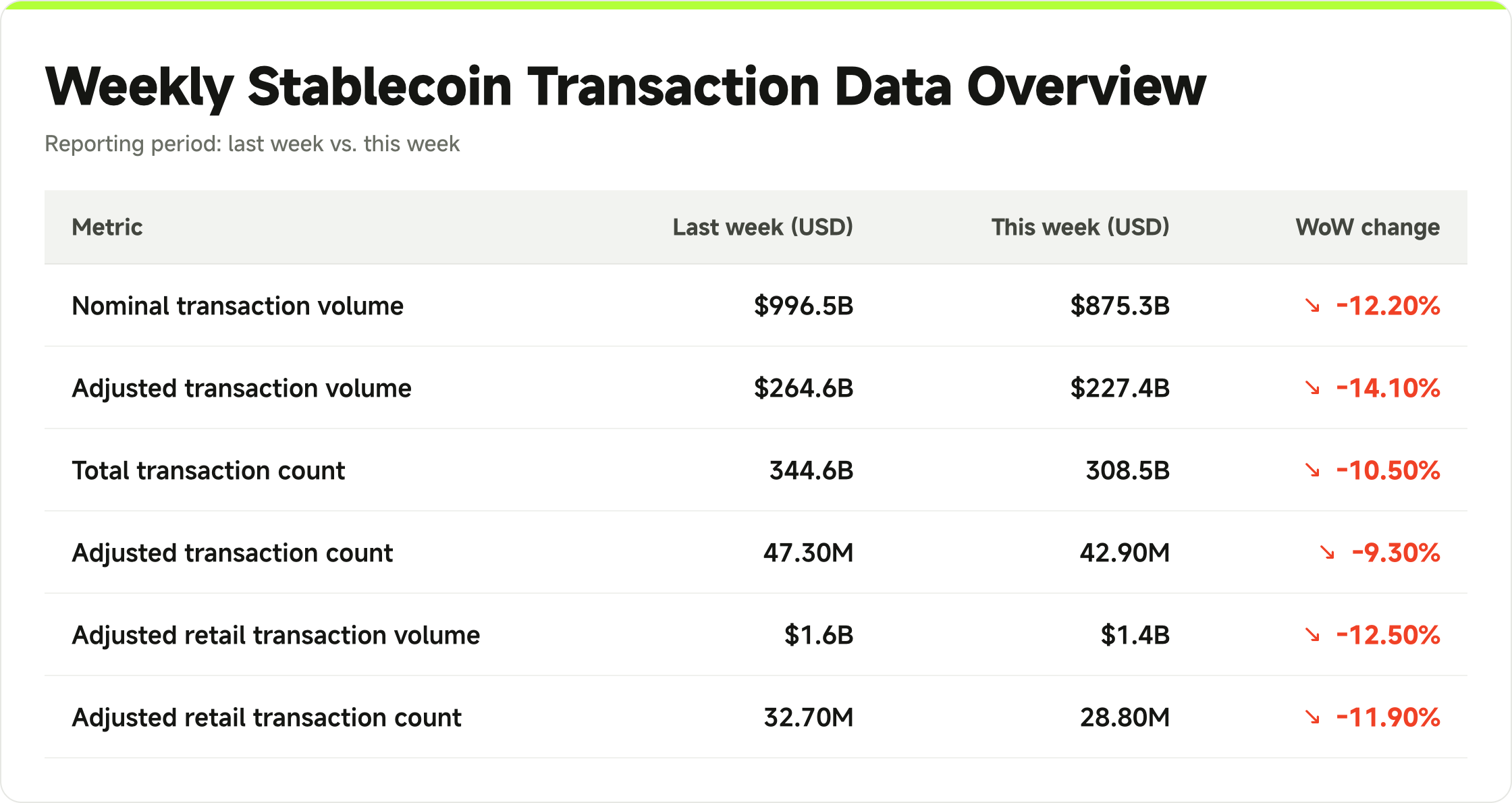
Adjusted volume represented 26% of nominal activity: Seven-day nominal transaction volume reached US$875.3 billion, while adjusted volume was US$227.4 billion. Total transaction count was 308.5 million, including 42.9 million adjusted transactions.
Retail remained high-frequency and small-ticket: Adjusted retail-sized volume was approximately US$1.4 billion, or 0.6% of adjusted volume. The 28.8 million retail transfers represented 67% of adjusted transaction count.
Week over Week: A Broad-Based Slowdown
All six core indicators declined: Every tracked metric fell from the prior week, with decreases ranging from 9% to 14%.
Non-retail activity contracted faster: Nominal and adjusted volume fell 12.2% and 14.1%, respectively, outpacing declines of 10.5% in nominal transaction count and 9.3% in adjusted count. Average ticket size and transaction frequency both fell, with a sharper contraction outside retail-sized transfers.
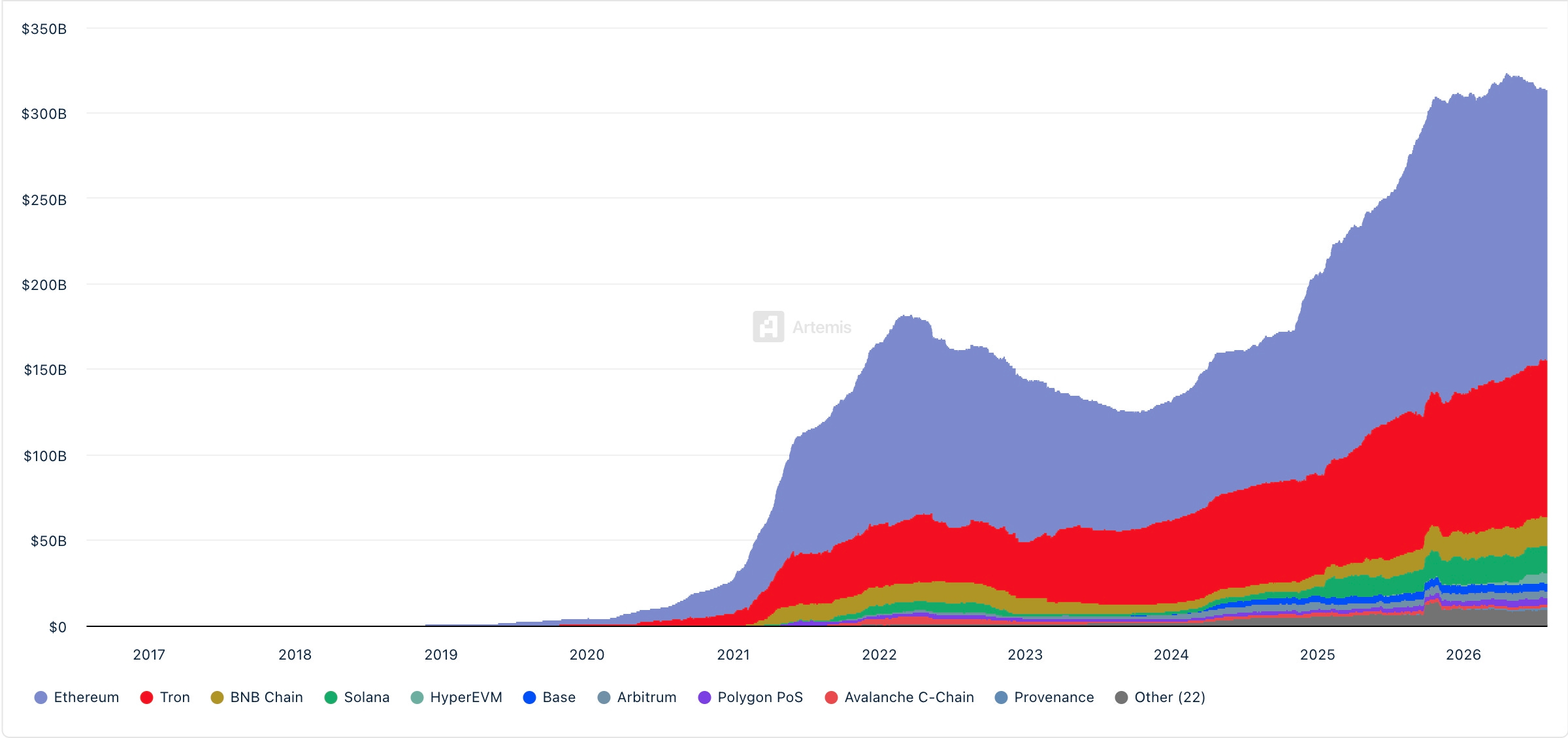
Stablecoin Supply Trend by Chain. Source: Artemis.
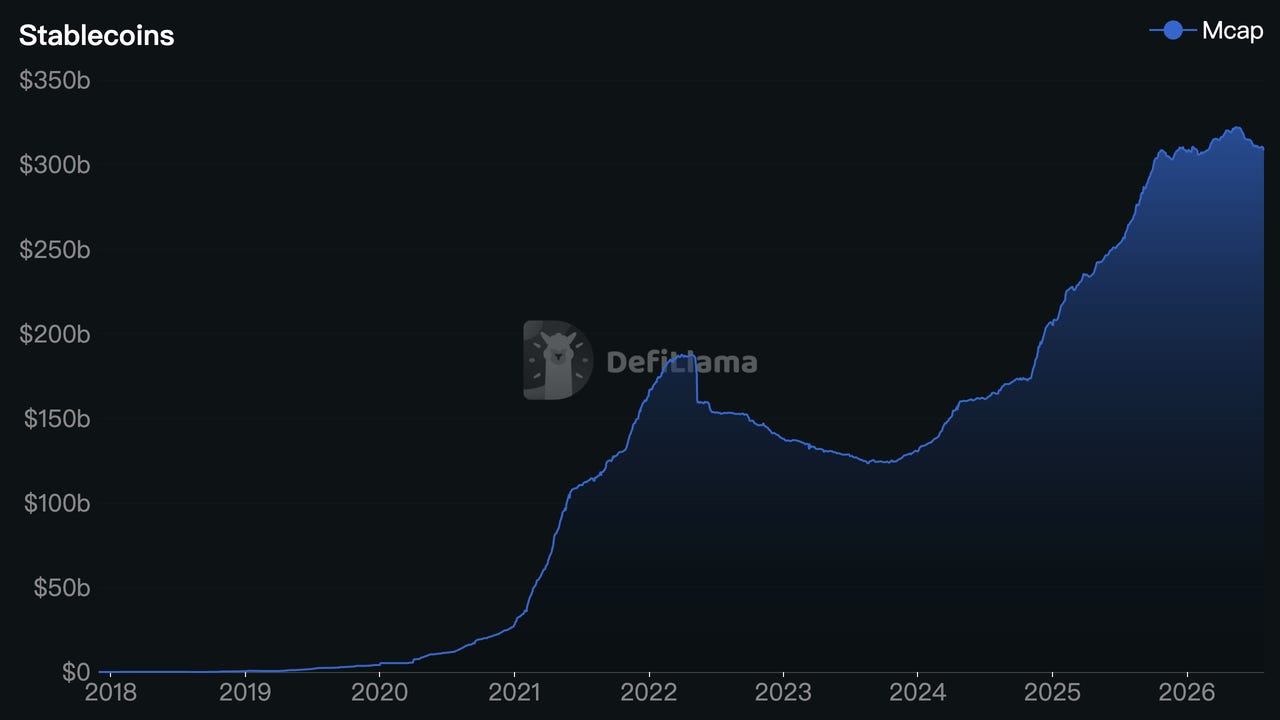
Stablecoin Supply Trend. Source: DefiLlama.
Data sources: Artemis, Visa, and OSL Research.
Definitions: Adjusted figures exclude arbitrage, fund transfers, market-maker round trips, and similar noise. Visa classifies transactions below US$250 as retail-sized and those of US$250 or above as non-retail.
II. This Week in Stablecoin Payments and Infrastructure
Payment instrument or deposit substitute? Who may issue? How far does a licence carry? Regulators are still deciding while the industry continues to invest.
1. Visa Cuts 2,600 Jobs While Continuing to Invest in Stablecoins
On July 28, Visa informed employees that it would eliminate about 2,600 positions, equal to roughly 7% of its workforce, primarily in technology and product teams. CEO Ryan McInerney said the reductions were intended to improve efficiency and redirect resources toward businesses with the greatest potential.
Visa employed approximately 34,100 people at the end of its latest fiscal year. The released resources are being directed toward consumer payments, commercial and money-movement solutions, and value-added services, including stablecoins, cross-border payments, and B2B products.
2. Coupang and Woori Bank Complete Won Stablecoin Settlement Test
On July 27, Coupang, South Korea’s largest retail platform, and Woori Bank completed a proof of concept for real-time payment and settlement using a won-denominated stablecoin. They also signed a strategic partnership covering blockchain payment technology. The companies described the exercise as South Korea’s first near-commercial test of the complete flow from payment and real-time settlement to two-way conversion between a stablecoin and Korean won.
The test used Coupang Eats orders. An order payment was converted into the stablecoin and settled with the merchant immediately. Woori Bank linked digital wallets with bank accounts, and the companies tested conversion in both directions on Tempo, a public blockchain designed for stablecoin payments.
Coupang handles more than 77 trillion won, or approximately US$55.6 billion, in annual payment volume. A commercial implementation could reduce merchant settlement from several business days to real time. The companies are also considering whether merchants could spend stablecoins received through Coupang services without first converting them to won. For Woori Bank, the collaboration adds a platform partner as Korean financial groups compete in won-denominated stablecoins.
3. US Banking Leaders Ask the Senate to Tighten Stablecoin Reward Rules
On July 29, 134 US banking-association officials and bank executives wrote to Senate Majority Leader John Thune and Minority Leader Charles Schumer. They asked the Senate to revise Section 10404 of the Clarity Act, which addresses yield and rewards for holding stablecoins, before final passage.
The signatories argued that rewards or incentives on payment-stablecoin balances could shift hundreds of billions of dollars away from bank deposits and weaken the funding base for local lending. They want payment stablecoins limited to transaction use rather than long-term savings. Senate Republicans aimed for a procedural vote before the August recess, but disagreement over rewards and government-ethics provisions made a delay until September likely.
4. FCA Study Identifies Cross-Border Payments as a Leading Use Case
On July 28, the UK Financial Conduct Authority released findings from its March industry exercise, the Stablecoin Sprint. Participants broadly identified cross-border payments as the clearest near-term stablecoin application.
Participants saw the strongest benefits in emerging markets where access to US dollars is limited. They considered the advantages less significant in major corridors where transfers are already fast and inexpensive.
The feedback informed the FCA’s cryptoasset rules published on June 30, including requirements for issuer capital, reserve assets, and redemption timing. Applications open on September 30; from October 25, 2027, only licensed firms will be permitted to operate in the UK.
5. CZ Supports Crypto-Licence Passporting Across ASEAN
On July 28, Binance co-founder Changpeng Zhao endorsed a passporting framework for crypto licences at the ASEAN Tech Summit Manila 2026. Lito Villanueva, founding chairman of FinTech Alliance PH, raised the proposal at the same event.
ASEAN member states currently regulate digital assets separately, requiring a company seeking regional coverage to file a full application in every market. A passporting arrangement could allow a licence from one member state to support a streamlined review elsewhere, while preserving each local regulator’s authority.
Zhao described cross-border coordination as largely a political problem. The ASEAN Capital Markets Forum already offers streamlined access for certain funds and investment advisers authorised in one member state. The EU’s MiCAR framework similarly allows an authorised firm to operate across the bloc after notifying its home regulator.
Binance withdrew its MiCAR application in Greece on June 24, suspended most European Economic Area services on July 1, and plans to apply again in France.
Get a concise weekly briefing on the data, regulation, and infrastructure shaping global stablecoin payments.
III. Analyst Deep Dive
Where Compliant Enterprise Stablecoins Find Real Demand
Many cross-border B2B corridors still lack a settlement system that is simultaneously efficient, predictable and cost-effective. The clearest opportunity for compliant enterprise stablecoins may therefore lie not where payments already work well, but where access to dollar settlement remains difficult.
On 28 July, the UK’s Financial Conduct Authority published findings from its Stablecoin Sprint, an industry exercise examining stablecoin use cases in remittances and retail payments. Participants identified cross-border payments—particularly in dollar-scarce corridors and emerging markets—as one of the clearest near-term applications.
The conclusion is not new. Its value lies in pulling the stablecoin discussion away from grand technological narratives and back to an older, more useful question: in the real commercial economy, who most needs a better way to settle in dollars?
The real problem is uncertainty
The clearest demand is unlikely to originate in markets where payment rails are already mature. It sits in corridors where moving money across borders remains expensive, slow and difficult to predict.
A B2B payment from North America to Southeast Asia, Europe to Africa or Latin America to Asia may pass through a correspondent bank, one or more intermediaries, a local clearing system and an FX conversion. Fees and spreads accumulate alongside compliance reviews and banking-hour cut-offs. The longer the chain, the less transparent the final cost; the more parties involved, the harder it becomes to predict when funds will arrive.
For businesses, the problem is not only cost. It is uncertainty.
Companies may not know which day the payment will arrive, how much will be deducted along the way or where the exchange rate will move while the funds are in transit. Businesses operating in these corridors are rarely short of trade demand or willingness to pay. What they often lack is dependable access to dollar settlement, supported by sufficient banking relationships, FX liquidity and workable clearing windows.
To keep transactions moving, companies and payment firms frequently pre-position capital across markets to cover time-zone gaps, clearing cycles and currency movements. That money is not funding growth. It is held defensively to keep an inefficient system operating.
Why stablecoins matter—and why they are not enough on their own
Stablecoins can provide a shorter route for tokenised dollar value to move. They can operate over 24/7 networks, reducing dependence on banking hours for the on-chain leg of a transaction. For payment providers, remittance firms, trade platforms and regional fintechs, this can support faster movement, clearer economics and more flexible liquidity management.
But stablecoins do not remove the need for regulated local collection, identity checks, transaction monitoring, FX conversion, bank-account settlement or reconciliation. A fast on-chain transfer is useful only if the recipient can access and use the funds in the required market and currency.
This distinction also explains why the most immediate opportunity may be in B2B rather than consumer payments. In many mature retail markets, existing payment methods are already convenient and inexpensive. Cross-border businesses, by contrast, still face fragmented systems, uncertain settlement times and substantial pre-funding requirements.
What USDGO’s US$1 billion milestone does—and does not—show
USDGO’s recent rise beyond US$1 billion in circulating supply can be considered in this context. The milestone does not, by itself, prove that a particular payment use case caused the growth. It is better understood as a signal that institutional and industry adoption of compliant stablecoin infrastructure is accelerating.
USDGO is issued by Anchorage Digital Bank N.A., a federally chartered US bank, and distributed by OSL Group. It is 1:1 USD-backed and third-party audited, and supports zero-cost minting and redemption subject to approved product terms. It is designed for payment and trading workflows across approved markets.
Those attributes are relevant to enterprises evaluating stablecoin infrastructure: they address questions about the issuer, backing, auditability, conversion mechanics and operational availability. OSL’s role as an Asia-based operator and distributor also places the product closer to markets where payment corridors, local liquidity and business requirements may differ materially from those in the United States.
The milestone should therefore not be presented as proof that emerging-market payments drove USDGO’s supply growth. It does, however, illustrate the growing market interest in compliant dollar infrastructure that can support institutional workflows beyond crypto trading alone.
From payments to treasury management
Cross-border settlement is only the first layer of demand. A larger opportunity may emerge if stablecoins help businesses manage liquidity more efficiently.
Cross-border trade relies on significant volumes of short-cycle capital. Payment providers may need to prefund receiving accounts. Remittance firms need to balance positions across markets. Trade platforms must keep goods, documents and payments aligned. These needs have traditionally been supported by balance-sheet capital, bank credit lines and bilateral facilities.
A better-connected stablecoin workflow may reduce the amount of capital that must be parked defensively across markets. It can also make the timing and movement of liquidity easier to observe and manage.
The more important benefit may not be moving one payment faster, but reducing uncertainty across the entire cash-conversion cycle.
Traditional finance already reorganises commercial cash flows through supply-chain finance, trade finance, factoring and receivables financing. Stablecoins may add a more programmable settlement and liquidity layer. Where regulation and product structures permit, that layer could support more efficient working-capital arrangements without changing the underlying commercial purpose of the financing.
Three areas of real demand
The potential demand for compliant enterprise stablecoins can therefore be organised into three layers:
Cross-border B2B settlement: Corridors where dollar access is limited, correspondent networks are thin and clearing windows remain restrictive.
Enterprise treasury and liquidity management: Reducing unnecessary pre-positioning and improving the visibility and timing of cross-market funds.
Trade finance and short-term working capital: Supporting funding gaps that have traditionally depended on bank credit, bilateral facilities or companies’ own balance sheets, where legally and commercially permitted.
What makes USDGO’s US$1 billion milestone worth examining is not only the number, but the market need surrounding it. A compliant US-dollar stablecoin, supported by regulated issuance and an Asia-based operating and distribution model, is testing demand in markets where traditional dollar settlement has not always served businesses efficiently.
If that model proves durable, stablecoins may become more than a faster way to pay. They could become part of how companies in emerging markets manage dollar liquidity—provided the surrounding infrastructure, controls and local access work as reliably as the asset itself.
USDGO availability, supported markets and product terms depend on the relevant entity, client eligibility, jurisdiction and applicable approvals. Circulating-supply growth is not presented as proof of any specific customer behaviour or use case.
Found this issue useful? Share it with colleagues working across stablecoins, payments, or digital financial infrastructure.
Want to catch up? Browse previous editions in the Stablecoin Weekly Pulse LinkedIn archive.
Sources
Stablecoin Weekly Pulse Vol. 19, July 30, 2026.
FCA Stablecoin Sprint, July 28, 2026.
Coupang and Woori Bank company information referenced in the settlement test.
ASEAN Capital Markets Forum passporting precedent.
Disclaimer and Disclosure
1. Nature of Document This document (the "Document") has been prepared by OSL internal personnel for informational purposes only and does not constitute investment, legal, tax, or any other professional advice, nor should it be relied upon as such. No part of this Document may be reproduced, distributed, or transmitted to any third party in any form without the prior written permission of OSL. This Document does not constitute an offer, solicitation, marketing material, product disclosure statement, or legal document, nor does it form the basis of any binding contract or commitment. This Document is intended solely to present OSL's observations and strategic insights into the industry and does not represent the official position, strategy, or decisions of OSL. The authors are not independent research analysts, and this Document does not constitute "investment research" as defined by applicable laws or regulations. Consequently, this Document has not been prepared in accordance with regulations designed to ensure the independence of investment research and is not subject to any prohibition on dealing ahead of the dissemination of investment research.
2. No Reliance The information, opinions, and analyses contained in this Document are based on public information and OSL's internal judgment, without regard to the personal objectives, financial situation, or needs of any recipient. This Document does not constitute a personal recommendation, nor does it constitute an invitation or solicitation to buy, sell, or engage in any financial instrument, product, or service. Recipients should consult their own independent advisors regarding their personal circumstances, objectives, experience, and financial resources before making any investment or other decision. All investments involve risk; values may fluctuate, and investors may recover less than the original investment amount. Past performance is not indicative of future results.
3. Accuracy, Completeness, and Limitations This Document has been prepared based on information OSL believes to be reliable, but OSL has not independently verified its accuracy, completeness, or fairness. Although reasonable care has been taken to ensure the content is not false or misleading, OSL makes no express or implied warranty as to the accuracy, completeness, fairness, or reasonableness of the content. OSL accepts no liability for any errors, omissions, or consequences of reliance caused by third-party information cited in the Document. The performance of any instruments, entities, or strategies mentioned may be significantly affected by market, regulatory, technical, or other factors.
4. Forward-Looking Statements This Document may contain forward-looking statements involving known and unknown risks, uncertainties, and other factors. Actual results, performance, or achievements may differ materially from those expressed or implied by such statements. OSL is under no obligation to update, revise, or withdraw any forward-looking statements.
5. Disclosure of Conflicts of Interest OSL, its affiliates, and employees may hold positions in or participate in transactions related to the assets or entities mentioned in this Document. The authors or related personnel may receive compensation related to OSL's business performance in this regard. OSL has implemented policies and procedures to identify and manage potential conflicts of interest.
6. Intellectual Property and Restrictions on Use This Document is protected by copyright and is for the internal use of the designated recipient only. Recipients may store, display, analyze, modify, reformat, and print this Document for internal purposes, but without OSL's prior written consent, may not:
Resell, redistribute, or use this Document commercially;
Reverse engineer, extract, or create derivative works, including for training or application in machine learning/artificial intelligence systems;
Publish or transmit this Document to third parties.
7. Limitation of Liability To the maximum extent permitted by applicable law, OSL and its affiliates, officers, employees, and agents shall not be liable for any direct, indirect, incidental, consequential, or special damages arising out of or in connection with the use, reliance, or interpretation of this Document, including but not limited to:
Loss of profits;
Business interruption;
Data corruption or loss;
Reputational damage.
8. Global Distribution Note Recipients should ensure compliance with applicable local laws. Distribution of this Document may be restricted in certain jurisdictions. Recipients must ensure this Document is not distributed to any person or entity prohibited by law from receiving it.
More topics
More topics
Latest
Why India's $620B Bond Pilot Changed Nothing Legal
SEBI and the RBI's Demat 2.0 pilot issues corporate bonds as digital tokens and settles them with the wholesale digital rupee, preserving existing legal terms while digitizing the infrastructure beneath a $620...
Why India's $620B Bond Pilot Changed Nothing Legal
Why S&P Global Leads Kaiko: Not Hype, But 24/7 Market Infrastructure
S&P Global led a $110 million extension of Kaiko's Series B to build data infrastructure for round-the-clock tokenized markets.
Why S&P Global Leads Kaiko: Not Hype, But 24/7 Market Infrastructure
When One Firm Holds 5% of Ethereum: Infrastructure Stress Test
Bitmine's accumulation of more than 5 million staked ETH raises questions about whether custody, audit, and validator infrastructure can support single-asset concentration at public-company scale.
When One Firm Holds 5% of Ethereum: Infrastructure Stress Test
Best Enterprise Stablecoin Payment Providers: A 2026 Evaluation Framework
Compare enterprise stablecoin payment providers by use case, legal entity, workflow, controls, integration, reconciliation, support, and contract terms.
Best Enterprise Stablecoin Payment Providers: A 2026 Evaluation Framework
How to Reconcile a USDGO Payment: An Illustrative Finance-Close Example
See how Finance can trace a USDGO payment from an approved obligation through payment records, recipient confirmation, reconciliation, and accounting close.
How to Reconcile a USDGO Payment: An Illustrative Finance-Close Example
A USDGO Reserve Review in Practice: Findings, Limits and Follow-up Questions
Review what the July 2026 USDGO reserve attestation establishes, what it does not prove, and which issuer, redemption, and liquidity questions remain.
A USDGO Reserve Review in Practice: Findings, Limits and Follow-up Questions
Recommended for you
More topics
More topics
