Zero to $500 Million in Four Months: Inside the USDGO Enterprise Stablecoin
A Growth Curve Worth Reading
Most stablecoin launches fade. USDGO did the opposite. Issued by Anchorage Digital Bank N.A. (the first federally chartered crypto bank in the US, OCC-regulated) and distributed by OSL across Asia-Pacific, it launched on 10 February 2026 with $50 million in initial liquidity.
What happened next is the interesting part.
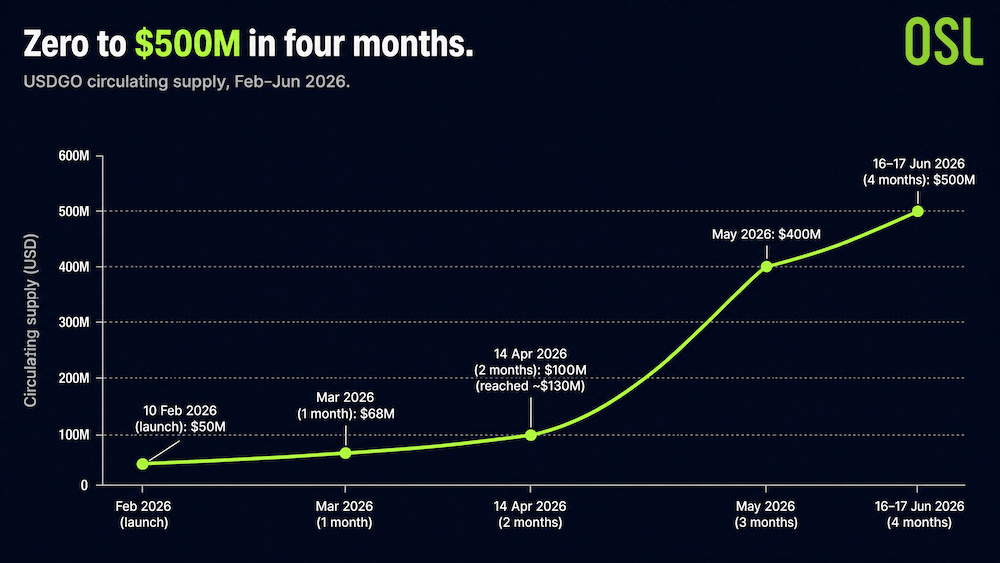
According to OSL's announcement via The Block, USDGO surpassed $500 million in circulation in mid-June 2026, four months after launch. The trajectory, $50M at launch, $68M after one month, $100M (reaching ~$130M) by 14 April, $400M in May, and $500M by mid-June, validates something the report argued in theory: there is genuine, unmet demand from Asia-Pacific institutions for a compliant US-dollar stablecoin built for business.
Chart 1: USDGO circulating supply (Feb–Jun 2026)
Source: OSL's announcement via The Block
Why CFOs Are Willing to Use It: The Dual Licence
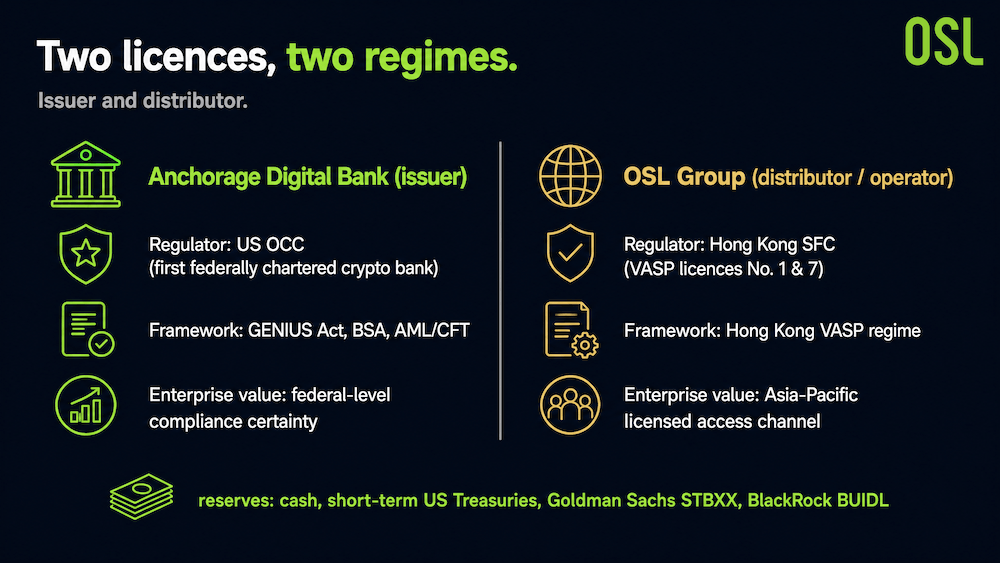
A treasury team cannot wire company money through an instrument its risk committee won't approve. USDGO's core design answer is a dual-licence structure that covers both major regulatory regimes: the issuer Anchorage operates under US OCC oversight and the GENIUS Act framework (alongside Bank Secrecy Act and AML/CFT obligations), while distributor OSL holds Hong Kong SFC VASP licences (No. 1 and No. 7) under the city's VASP regime.
Chart 2: USDGO's dual-licence architecture
Source: Report: The Liquidity Hub of the Digital Economy (OSL × HKPU Faculty of Business)
The reserves reinforce that posture: cash, short-term US Treasuries, Goldman Sachs' STBXX fund, and BlackRock's BUIDL fund. For a CFO, holding USDGO is closer to holding an institutional money-market instrument than a crypto token, which is precisely the point.
The $500K Payment Test
Theory is one thing. The report runs a concrete example: settling a $500,000 cross-border supplier payment.
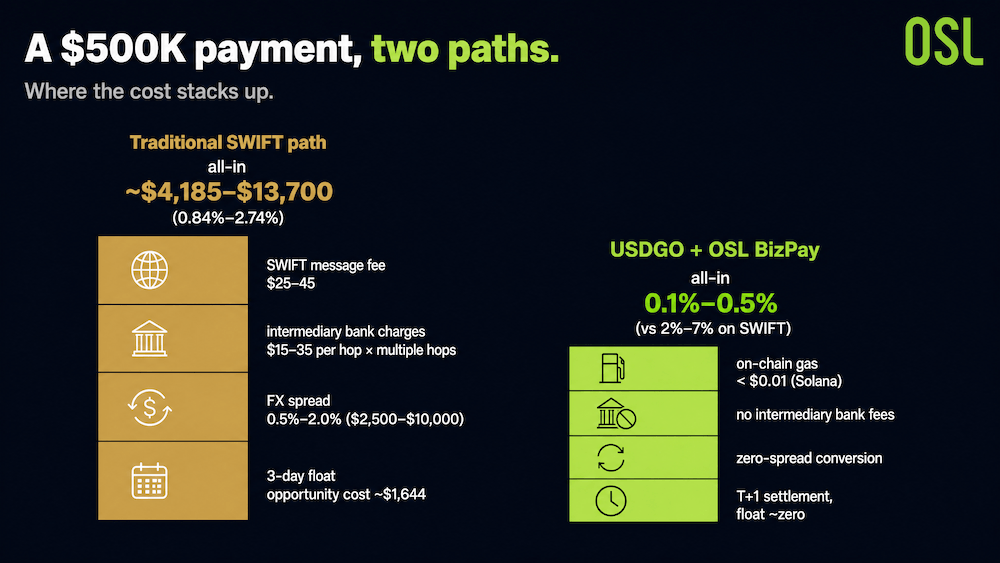
On the traditional SWIFT path, the all-in cost stacks up across SWIFT message fees ($25–45), intermediary bank charges ($15–35 per hop, multiple hops), an FX spread of 0.5%–2.0% ($2,500–$10,000), and the opportunity cost of a 3-day float (~$1,644). Total: roughly $4,185–$13,700, or 0.84%–2.74%.
The USDGO + OSL BizPay path collapses most of that. On-chain gas runs under $0.01 on Solana, there are no intermediary bank fees, conversion is zero-spread, and T+1 settlement brings the float opportunity cost close to zero. Across the report's corridor analysis, all-in costs drop to 0.1%–0.5% versus 2%–7% on SWIFT.
Chart 3: Comparison of Cross-Border Payment Costs for $500,000
Source: Report: The Liquidity Hub of the Digital Economy (OSL × HKPU Faculty of Business)
The Operating Stack Behind It
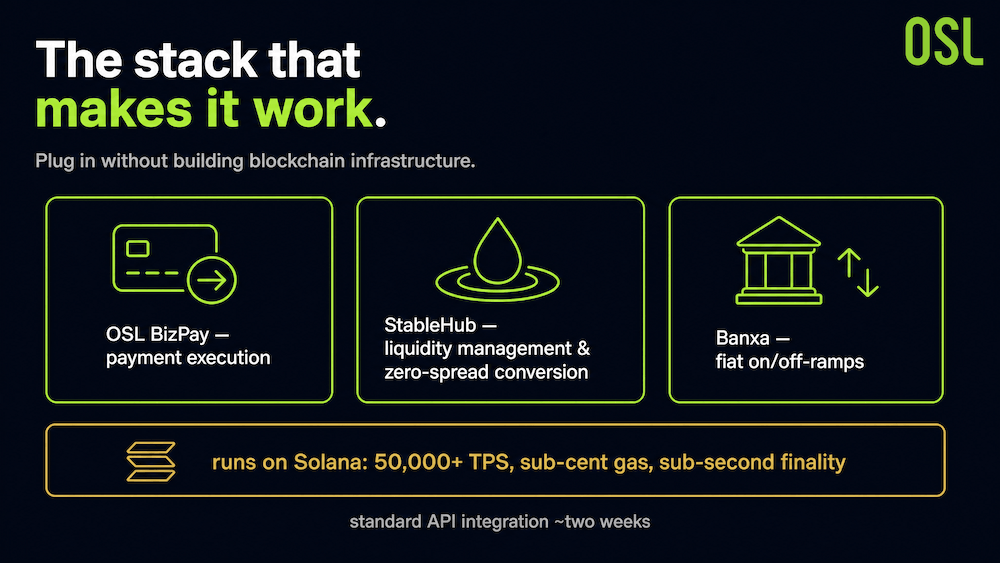
The cost numbers only matter if a business can actually plug in without building blockchain infrastructure. USDGO's ecosystem is designed around that: OSL BizPay handles payment execution, StableHub handles liquidity management and zero-spread stablecoin conversion, and Banxa handles fiat on/off-ramps. Standard API integration takes about two weeks, and USDGO runs on Solana (50,000+ TPS, sub-cent gas, sub-second finality), chosen for enterprise-grade throughput and predictable cost.
Chart 4: USDGO Operations Stack Architecture
The takeaway is not that USDGO has won anything yet. It's that a compliant, dual-licensed enterprise stablecoin, wired into a working payment stack, can scale to half a billion dollars in four months when it solves a real corridor problem. That is the signal worth watching.
FAQ
Q1: What is USDGO? A: A compliant enterprise stablecoin pegged 1:1 to the US dollar, issued by Anchorage Digital Bank (OCC-regulated) and distributed by OSL across Asia-Pacific, launched February 2026.
Q2: How fast did USDGO grow? A: From $50M at launch (Feb 2026) to $100M (April), $400M (May), and over $500M by mid-June 2026, about four months.
Q3: Why is USDGO considered compliant? A: It runs a dual-licence structure, US OCC (via issuer Anchorage) and Hong Kong SFC (via distributor OSL), under the GENIUS Act framework, with reserves in cash, Treasuries, Goldman Sachs STBXX, and BlackRock BUIDL.
Q4: How much does USDGO save on a cross-border payment? A: The report puts all-in costs at 0.1%–0.5% versus 2%–7% on SWIFT, with T+1 fiat settlement instead of 2–5 days.
References
Note: Industry analysis based on public sources and the cited report. Not investment advice.
Start your safe cryptocurrency journey now
OSL | Secure Ramps. Trusted Rails !
More topics
More topics
Latest
Why India's $620B Bond Pilot Changed Nothing Legal
SEBI and the RBI's Demat 2.0 pilot issues corporate bonds as digital tokens and settles them with the wholesale digital rupee, preserving existing legal terms while digitizing the infrastructure beneath a $620...
Why India's $620B Bond Pilot Changed Nothing Legal
Why S&P Global Leads Kaiko: Not Hype, But 24/7 Market Infrastructure
S&P Global led a $110 million extension of Kaiko's Series B to build data infrastructure for round-the-clock tokenized markets.
Why S&P Global Leads Kaiko: Not Hype, But 24/7 Market Infrastructure
When One Firm Holds 5% of Ethereum: Infrastructure Stress Test
Bitmine's accumulation of more than 5 million staked ETH raises questions about whether custody, audit, and validator infrastructure can support single-asset concentration at public-company scale.
When One Firm Holds 5% of Ethereum: Infrastructure Stress Test
Best Enterprise Stablecoin Payment Providers: A 2026 Evaluation Framework
Compare enterprise stablecoin payment providers by use case, legal entity, workflow, controls, integration, reconciliation, support, and contract terms.
Best Enterprise Stablecoin Payment Providers: A 2026 Evaluation Framework
How to Reconcile a USDGO Payment: An Illustrative Finance-Close Example
See how Finance can trace a USDGO payment from an approved obligation through payment records, recipient confirmation, reconciliation, and accounting close.
How to Reconcile a USDGO Payment: An Illustrative Finance-Close Example
A USDGO Reserve Review in Practice: Findings, Limits and Follow-up Questions
Review what the July 2026 USDGO reserve attestation establishes, what it does not prove, and which issuer, redemption, and liquidity questions remain.
A USDGO Reserve Review in Practice: Findings, Limits and Follow-up Questions
Recommended for you
More topics
More topics
