SWIFT Doesn't Actually Move Your Money: How Stablecoins Rebuild B2B Payments
The Misconception at the Heart of Cross-Border Payments
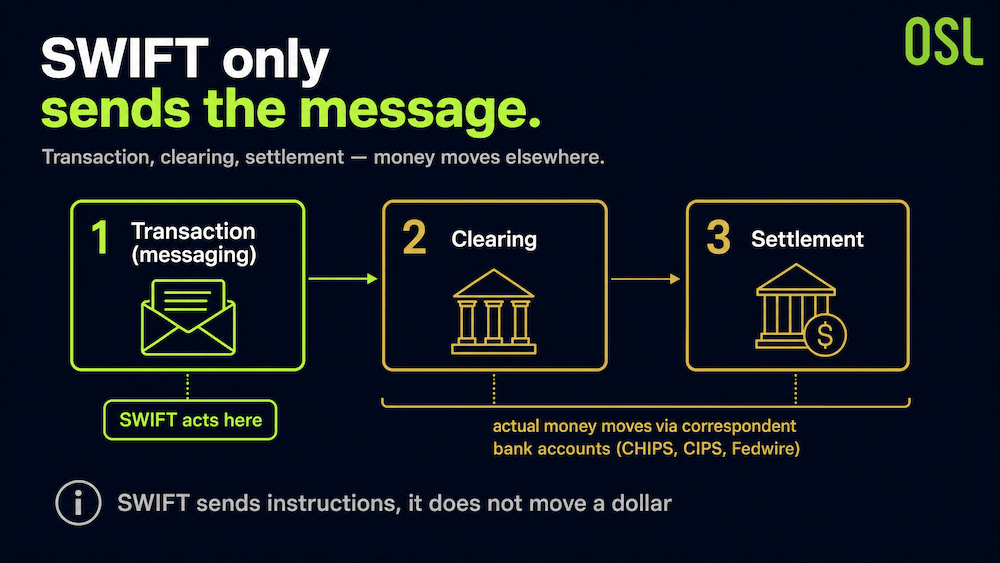
One fact reframes the whole debate: a cross-border payment has three stages—transaction, clearing, and settlement—and SWIFT only touches the first one.
SWIFT is a financial messaging network. It sends payment instructions between banks. It does not calculate who owes what, and it does not move a single dollar. The actual clearing and settlement happen elsewhere, in systems like CHIPS, CIPS, and Fedwire, and the money itself moves by being debited and credited along a chain of correspondent bank accounts.
That distinction matters enormously. It means the cost and delay in cross-border payments do not come from slow messaging. They come from the funds flow—money inching through layers of intermediary banks, each taking a fee and adding a delay point.
Chart 1: The Three Stages of Cross-Border Payments
The $27 Trillion Hiding in the Plumbing
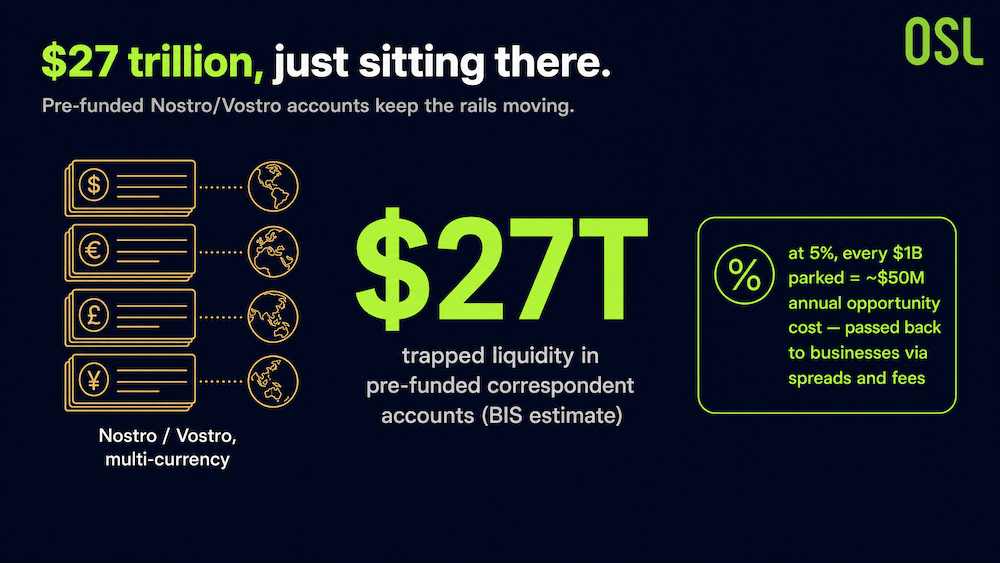
To make this chain work, banks pre-fund accounts with each other, called Nostro and Vostro accounts, in multiple currencies and jurisdictions. No money actually crosses borders; ledger entries do. But to guarantee settlement is always possible, banks must park enormous sums in these accounts.
According to BIS estimates cited in the report, roughly $27 trillion sits in these pre-funded accounts as "trapped liquidity"—capital that earns little and exists only to keep the rails moving. At a 5% rate, every $1 billion parked carries an annual opportunity cost of about $50 million. That cost ultimately flows back to businesses through spreads and fees.
Chart 2: Cross-Border Payments Stuck in a Liquidity Bind
Why SWIFT gpi Didn't Fix the Speed Problem
The usual counterargument is that SWIFT gpi already made things fast. The data tells a more revealing story.
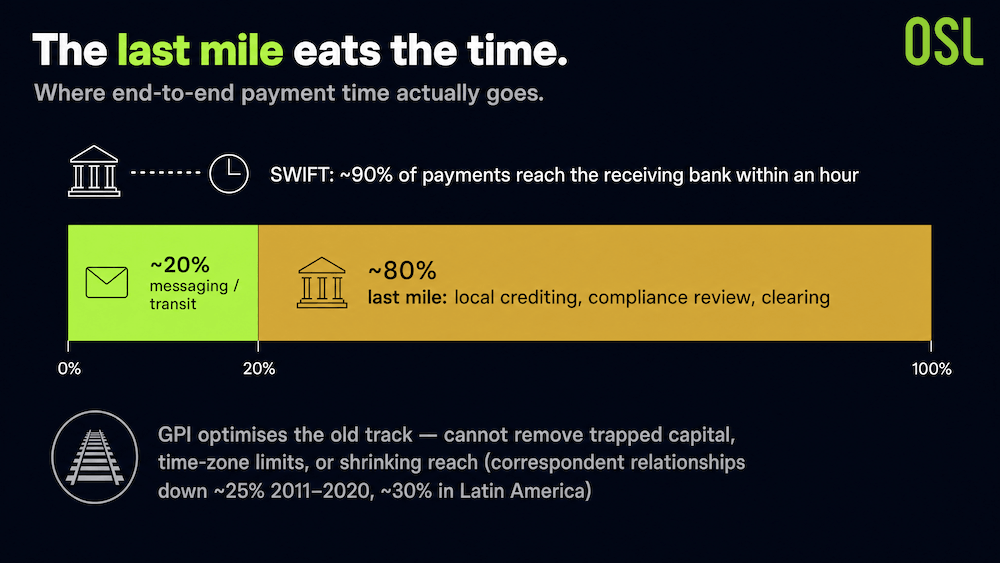
SWIFT's own figures show about 90% of cross-border payments reach the receiving bank within an hour. Impressive, until you read the next line: research shows roughly 80% of the end-to-end time is spent in the "last mile"—local crediting, compliance review, and clearing at the receiving end. gpi still runs entirely on the correspondent bank network, with the same fee variability and cut-off constraints.
In other words, gpi is an optimisation of the old track. It improves messaging efficiency and transparency, but it cannot remove the trapped capital, time-zone constraints, and shrinking reach baked into the "multi-level credit agent" architecture. And that reach really is shrinking: active correspondent banking relationships fell about 25% between 2011 and 2020 (nearly 30% in Latin America).
Chart 3: Breakdown of End-to-End Processing Times for SWIFT gpi
The Honest Framing: A Parallel Rail, Not a Replacement
Declaring SWIFT dead would be a mistake.
As the US Federal Reserve noted in March 2026, stablecoins can shorten the payment chain and cut costs at each node, including compliance, but the correspondent banking model may persist thanks to scale economies and multi-jurisdiction compliance advantages. Banks still control fiat access, credit, custody, local payout, and liquidity, and SWIFT itself is building distributed-ledger infrastructure.
The realistic 2026 picture is two rails running in parallel, with treasury teams choosing per corridor rather than switching wholesale. Stablecoins win where the existing route is slow, expensive, opaque, or dependent on many intermediaries. Where they do win, the gap is large: the report puts all-in costs at 0.5%–2% on the stablecoin path versus 2%–7% on traditional rails, a 50–70% reduction, with settlement compressed from T+1–T+5 to on-chain minutes plus T+1 fiat.
Chart 4: Comparison of Dual-Track Processes: SWIFT Path vs. Stablecoin Path
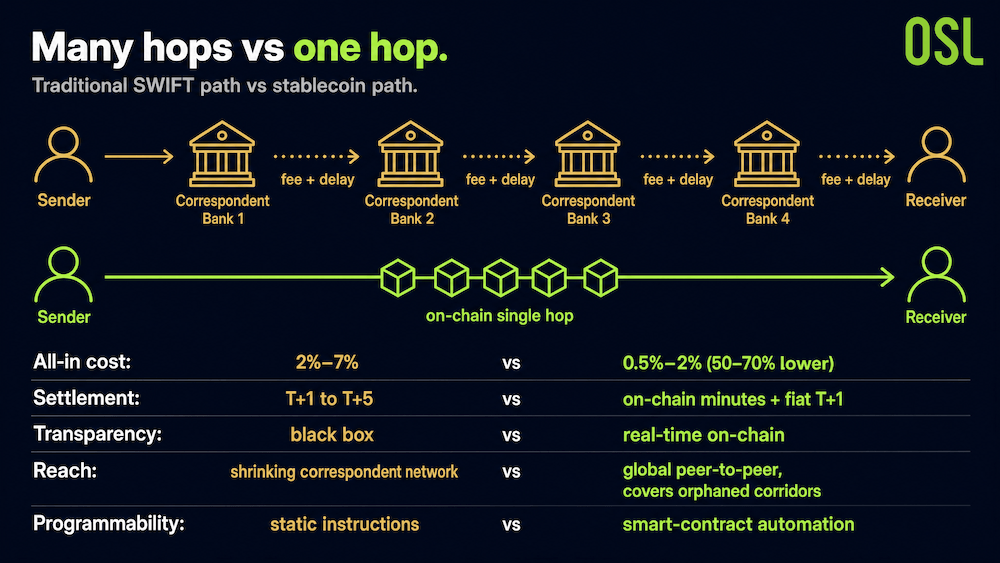
Source: Report: The Liquidity Hub of the Digital Economy (OSL × HKPU Faculty of Business)
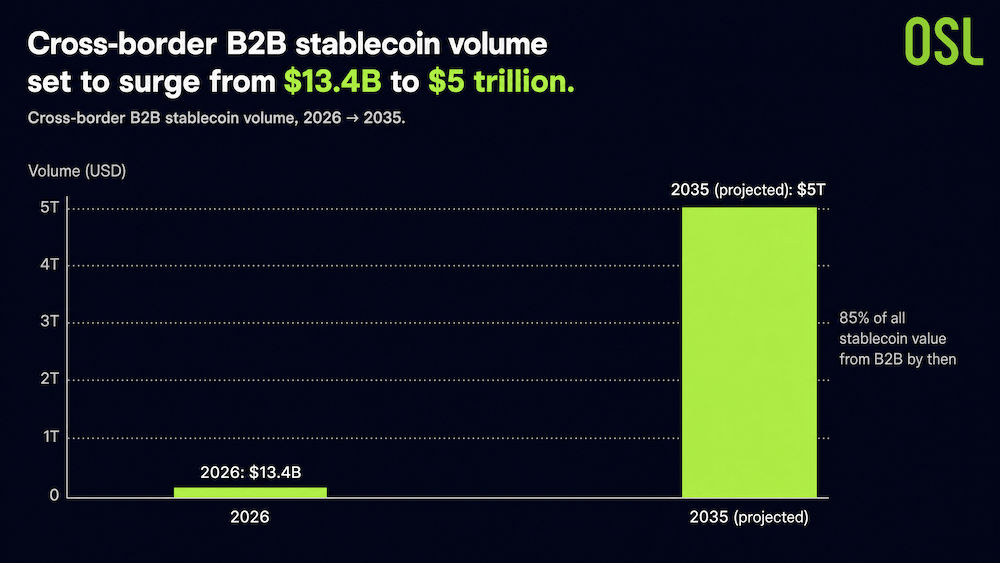
The trajectory, though, is clear. Juniper Research projects cross-border B2B stablecoin volume rising from $13.4 billion in 2026 to $5 trillion by 2035, with 85% of all stablecoin value coming from B2B by then. As Juniper's analyst put it, stablecoins "are not replacing payments infrastructure; they are being adopted where the advantages are most pronounced." For cross-border B2B, those advantages are hard to ignore.
Chart 5: Cross-border B2B stablecoin volume (2026 → 2035)
Source: Juniper Research projects
FAQ
Q1: Does SWIFT move money across borders? A: No. SWIFT is a messaging network that sends payment instructions. The actual money moves through correspondent bank accounts; clearing and settlement happen in systems like CHIPS, CIPS, and Fedwire.
Q2: What is trapped liquidity in cross-border payments? A: Banks pre-fund Nostro/Vostro accounts to enable settlement. BIS estimates roughly $27 trillion sits in these low-yield accounts, a cost ultimately passed to businesses.
Q3: How much cheaper is stablecoin settlement for B2B? A: The report puts all-in costs at 0.5%–2% versus 2%–7% for traditional rails, a 50–70% reduction, with settlement in minutes rather than days.
Q4: Will stablecoins replace SWIFT? A: Not wholesale. The realistic 2026 view is two parallel rails, with treasury teams choosing per corridor. Stablecoins win where legacy routes are slow, costly, or opaque.
References
Note: Industry analysis based on public sources and the cited report. Not investment advice.
Start your safe cryptocurrency journey now
OSL | Secure Ramps. Trusted Rails !
More topics
More topics
Latest
Stablecoin Weekly Pulse | Vol. 22: Welcome to the “Trump Resort”
Even once the rules are set, who really wins? When the high rollers cash out, will they tip off whoever’s left at the table that it’s time to go too?

Stablecoin Weekly Pulse | Vol. 22: Welcome to the “Trump Resort”
From Bank Killer to Bank Builder: Kraken's Strange Turn
Payward, the parent company of crypto exchange Kraken, is exploring how to become a "full bank" outside the United States.
From Bank Killer to Bank Builder: Kraken's Strange Turn
Stablecoin Weekly Pulse | Vol. 21: Tokenized Deposits vs Stablecoins
As tokenized deposits and stablecoins converge, the battle over financial infrastructure intensifies — each side sees the other's missing piece, but neither will surrender its core moat.

Stablecoin Weekly Pulse | Vol. 21: Tokenized Deposits vs Stablecoins
Stablecoin Weekly Pulse | Vol. 20: The Stablecoin Express: Next Stop, Card
Stablecoins aren’t just an issuance game — the real battle is over infrastructure, channel capital, and users.

Stablecoin Weekly Pulse | Vol. 20: The Stablecoin Express: Next Stop, Card
Stablecoin Weekly Pulse | Vol. 19: The Market Potential for Compliant, Enterprise-Grade Stablecoins
Stablecoin activity cooled while firms kept investing. Vol. 19 examines regulation and enterprise demand across emerging-market payment corridors.

Stablecoin Weekly Pulse | Vol. 19: The Market Potential for Compliant, Enterprise-Grade Stablecoins

Recommended for you
More topics
More topics
