Hong Kong Stablecoin Licensing: How Cap.656 Positions the City as APAC's Clearing Hub
Introduction: Why Hong Kong Secured the World's First Stablecoin Licenses
While major global financial centers are still debating stablecoin legislation, Hong Kong has taken the lead by completing the full cycle of "legislation, licensing, and implementation."
On April 10, 2026, the Hong Kong Monetary Authority (HKMA) officially issued stablecoin issuer licenses to two institutions, marking the first case among major financial hubs to close the loop at the issuance licensing level. As stablecoins evolve into new infrastructure for cross-border payments, this move positions Hong Kong at the forefront of the global stablecoin regulatory race.
This article addresses three core questions:
What makes Hong Kong's Stablecoin Ordinance (Cap.656) a leader?
When will HKD stablecoins launch and who are the key players?
Can Hong Kong convert its regulatory lead into a position as Asia-Pacific's clearing hub?
1. The First Licensees: A High Bar for Entry
According to the HKMA official announcement (April 10, 2026), the first two licensed entities are:
Anchorpoint Financial Limited — A joint venture between Standard Chartered (Hong Kong), HKT (PCCW), and Animoca Brands (License No. FRS01).
HSBC — The Hongkong and Shanghai Banking Corporation Limited (License No. FRS02).
HKMA Chief Executive Eddie Yue noted that 36 institutions applied before the September 2025 deadline. The key criteria for licensing were: robust risk management, a clear commitment to compliance, and a viable, differentiated business plan with credible use cases.
Quote from HKMA inSight: "Licences are granted to Anchorpoint and HSBC which have demonstrated their capabilities to properly manage risks with credible use cases and development plans."
Secretary for Financial Services and the Treasury, Christopher Hui, emphasized in a Legislative Council Q&A (June 10, 2026) that the licensing threshold will remain high, and the total number of licenses will be "extremely limited." This makes the license a highly scarce resource.
2. Launch Timeline: Mid to Late 2026
Both licensees plan to issue HKD-pegged stablecoins initially. According to Legislative Council records and HKMA briefings:
HSBC: Plans to integrate HKD stablecoins into PayMe and the HSBC HK App by H2 2026, targeting both retail and corporate users.
Anchorpoint: Plans a phased rollout starting Q2 2026, focusing on cross-border payments, tokenized asset settlement, and supply chain finance.
Overall Pace: Regulated stablecoins are expected to launch as early as mid-2026, following technical testing and the implementation of risk management protocols.
Furthermore, the HKMA has relaxed certain requirements. Per Charltons' analysis of the May 27, 2026 HKMA circular, "high liquidity" requirements no longer apply to Relevant Stablecoins, and SFC-registered firms may now provide advisory services for them, lowering the barrier for institutional participation.
Four Primary Initial Use Cases identified by HKMA
Cross-border Payments: Utilizing global networks for efficient, transparent, low-cost settlement.
Local Payments: Leveraging existing customer bases to accelerate adoption by individuals and merchants.
Tokenized Asset Trading: Serving as a settlement tool for real-time, on-chain tokenized asset transactions.
Innovation: Exploring programmable features for conditional payments and supply chain finance.
3. Global Regulatory Race: Hong Kong's Institutional Edge
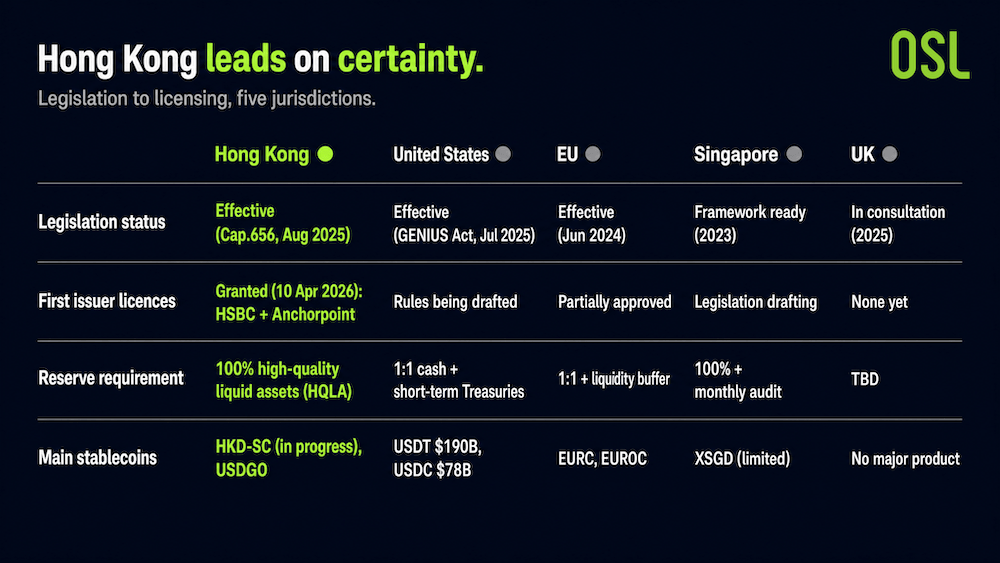
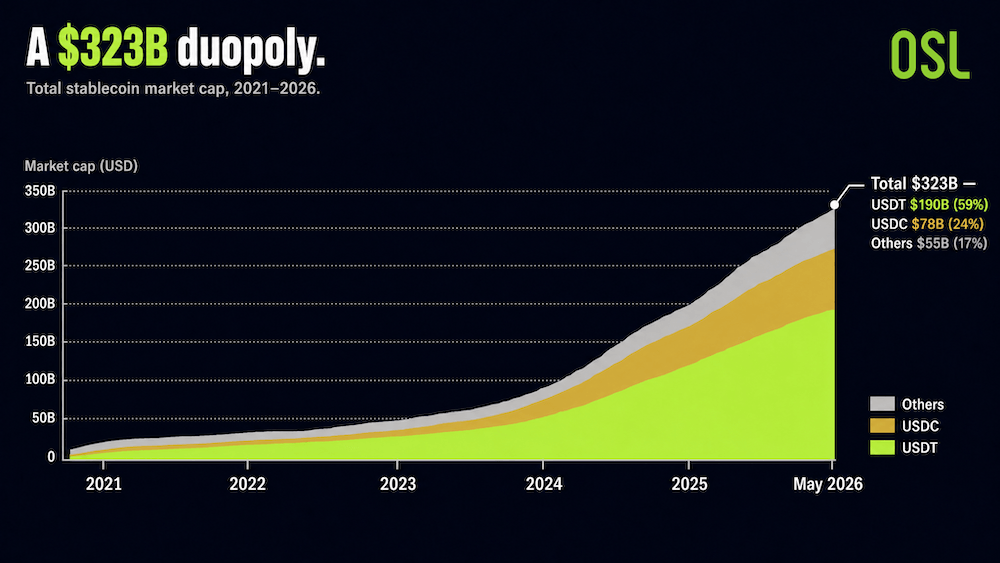
Hong Kong's competitive advantage lies in institutional certainty. By May 2026, the global stablecoin market cap exceeded $323 billion, with annual settlement volumes surpassing $33 trillion—exceeding Visa's annual processing volume. In this context, major financial hubs are competing for regulatory dominance.
Chart 1: Comparison of Global Regulatory Progress
Source: THE LIQUIDITY HUB OF THE DIGITAL ECONOMY
While the US GENIUS Act has been signed, implementation details (from the OCC, FDIC, and Treasury) are not expected until 2027. Hong Kong remains the only major financial center to have completed the regulatory loop at the issuance licensing level.
4. Asia as the Engine for Stablecoin Payments
Stablecoin demand is surging in Asia. In 2025, Asia-originated stablecoin payments reached $245 billion, accounting for 60% of the global total. In Southeast Asia, 43% of B2B cross-border payments are now settled via stablecoins.
Chart 2: The Duopoly Structure of the Global Stablecoin Market Cap (May 2026)
Source: THE LIQUIDITY HUB OF THE DIGITAL ECONOMY
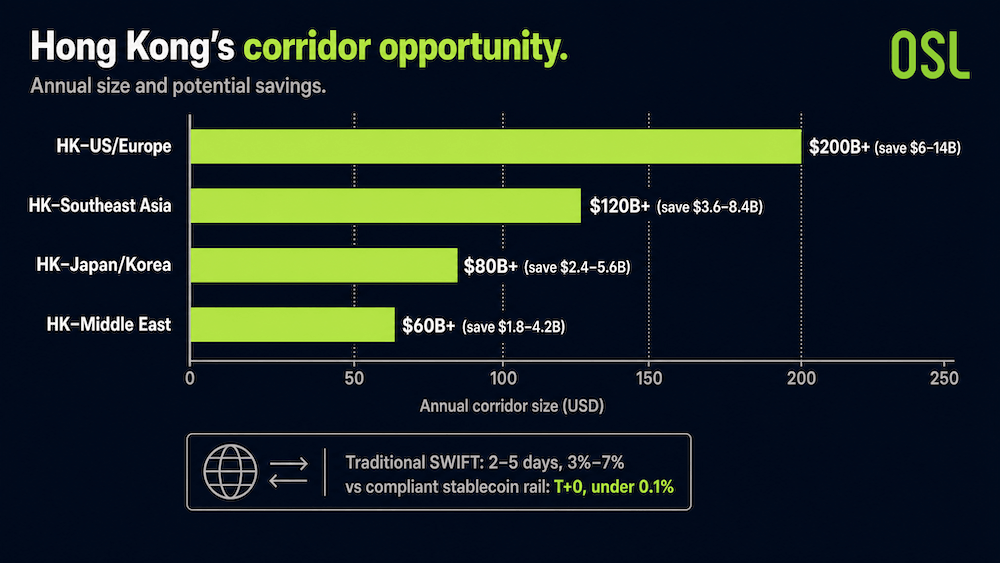
Chart 3: Major APAC B2B Payment Corridors and Stablecoin Opportunities
Source: THE LIQUIDITY HUB OF THE DIGITAL ECONOMY
Comparative Analysis: Traditional SWIFT corridors typically take 2–5 days with fees ranging from 3%–7%. In contrast, compliant stablecoin channels (such as OSL BizPay) achieve T+0 settlement with fees below 0.1%. B2B stablecoin payment volumes grew 30-fold over a 30-month period.
5. Market Validation: The Growth of USDGO
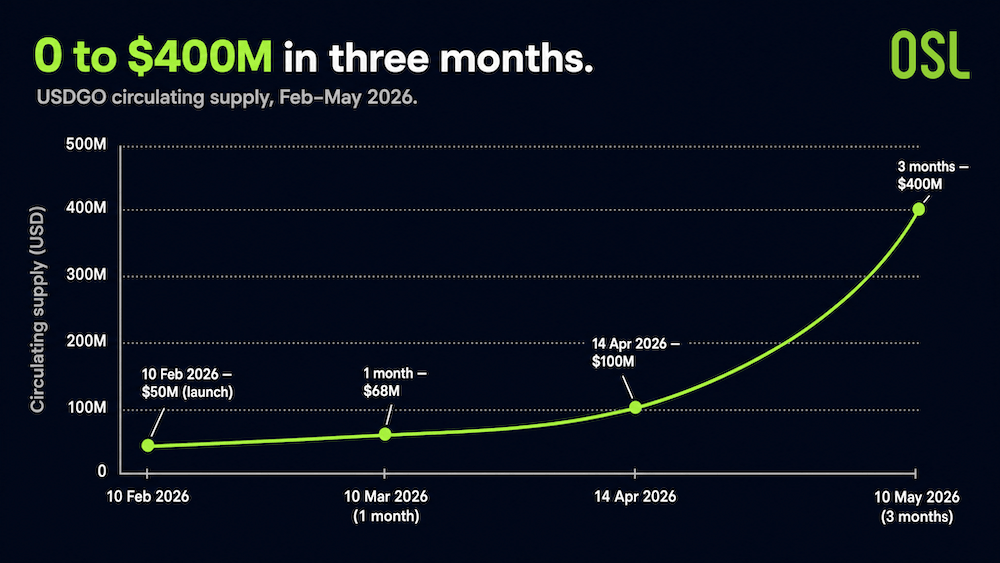
Regulatory advantages are translating into commercial density. The compliant corporate stablecoin USDGO, for example, saw significant growth between February and May 2026. This validates the demand for compliant USD stablecoins among institutional clients in Asia-Pacific and underscores Hong Kong's potential as a regional distribution hub.
Chart 4: USDGO Circulation Growth Curve (Feb-May 2026)
Source: THE LIQUIDITY HUB OF THE DIGITAL ECONOMY
6. Hong Kong's "Dual-Anchor" Strategy
Hong Kong's potential is backed by its capital market depth. According to the GFCI 39 (March 2026), Hong Kong scored 765 points, ranking 3rd globally and 1st in Asia-Pacific. It leads globally in banking, insurance, and fintech.
Hong Kong's ecosystem utilizes a "Dual-Anchor Structure":
HKD Stablecoins: For local and GBA retail/corporate use cases.
USD Stablecoins (USDGO / USDC / USDT): For international commercial settlement across APAC.
Both must meet Cap.656's 100% reserve and licensing requirements. Combined with OSL's SFC VASP license, Hong Kong offers a unique "full-stack compliant stablecoin operation."
7. Challenges: From Regulatory Leader to Ecosystem Leader
The core challenge is ecosystem density. With only two licensees currently, the infrastructure is still maturing. Over the next 18–24 months, Hong Kong must expand its licensee base, refine tax and accounting frameworks, and standardize cross-chain interoperability.
Chart 5: Hong Kong Stablecoin Strategic Risk Matrix
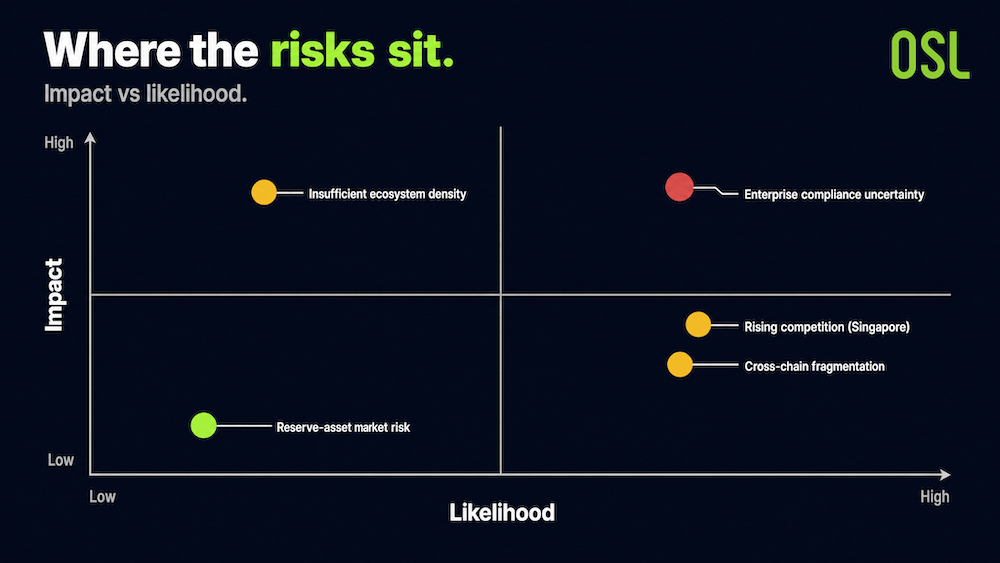
Positively, the percentage of businesses citing "regulatory uncertainty" as a primary barrier fell from 72% in 2024 to 41% in 2026, indicating that compliance is becoming the new standard.
Conclusion: The 18-Month Window for Success
Hong Kong has established the most comprehensive stablecoin regulatory framework among global financial centers. The next 18–24 months will determine if it can translate this regulatory lead into commercial depth and scale. Bridging the gap between regulation and ecosystem leadership is the next phase of Hong Kong's stablecoin journey.
FAQ
Q1: When were the first licenses issued?
The HKMA issued the first licenses on April 10, 2026, to HSBC and Anchorpoint.
Q2: When did the Stablecoin Ordinance (Cap.656) take effect?
It became effective on August 1, 2025.
Q3: When will HKD stablecoins be available?
Regulated HKD stablecoins are expected as early as mid-2026.
Q4: Will more licenses be issued?
Yes, but the HKMA has indicated the number will be limited and the criteria will remain stringent.
References
HKMA inSight:Robust development of the regulated stablecoin ecosystem in Hong Kong(2026-04-10)
HKMA 新闻稿:Granting of stablecoin issuer licences(2026-04-10)
香港政府新闻公报 LCQ6:Development and regulation of stablecoins(2026-06-10)
Charltons:HKMA Circular Relaxes Requirements for Licensed Stablecoins(2026-06-12)
Note: This analysis is based on public data and does not constitute investment advice.
Start your safe cryptocurrency journey now
OSL | Secure Ramps. Trusted Rails !
More About Topics
More About Topics


Latest
60-Vote Hurdle for CLARITY Act Exposes Limits of Legislative Hope
The CLARITY Act's September 15 procedural vote exposes why implemented regulatory frameworks may offer institutions more operational certainty than pending U.S. legislation.
60-Vote Hurdle for CLARITY Act Exposes Limits of Legislative Hope
XRP Rebounds 30% Then Slips: DeFi Infrastructure Faces Volatility Exam
XRP Ledger's $1.1 billion stablecoin expansion and new lending protocol foundation face an immediate stress test as XRP price swings 30% monthly.
XRP Rebounds 30% Then Slips: DeFi Infrastructure Faces Volatility Exam
$0.325 SKY Forecast: Valuation Model or Institutional Wish?
Standard Chartered's $0.325 price target on Sky's governance token applies bank-style valuation to on-chain credit infrastructure, but the forecast depends on USDS adoption and borrowing expansion that remains nascent.
$0.325 SKY Forecast: Valuation Model or Institutional Wish?
SEC Custody Rewrite Hits White House, Jurisdictional Gap Widens
The SEC's proposed crypto custody rewrite entered White House review on August 25, 2026, leaving U.S. institutional frameworks unresolved while banks and custodians position services under divergent national rule stacks.
SEC Custody Rewrite Hits White House, Jurisdictional Gap Widens
India's $100M Bond Tokenization: A Rights Structure Stress Test
SEBI's Demat 2.0 pilot issued over $100 million in tokenized bonds using digital rupee settlement, but its phased rollout from institutional pilots to secondary trading and retail access tests whether off-chain...
India's $100M Bond Tokenization: A Rights Structure Stress Test
Recommended For You
More About Topics
More About Topics