The RWA Trillion-Dollar Narrative Enters the Realization Phase: 2026 Tokenized Asset Data and the Compliance Watershed
Data source: CoinGecko RWA Report 2026. All market figures cited in this article are drawn from that report; the original link is provided at the end. This article is for informational reference only and does not constitute investment advice.
Introduction: RWA Is No Longer a Narrative — It's Data
For the past two years, "Real World Asset tokenization" (RWA) has been one of the most-repeated phrases in crypto. But starting in 2025, it shifted from a concept into a sector you can describe with hard numbers.
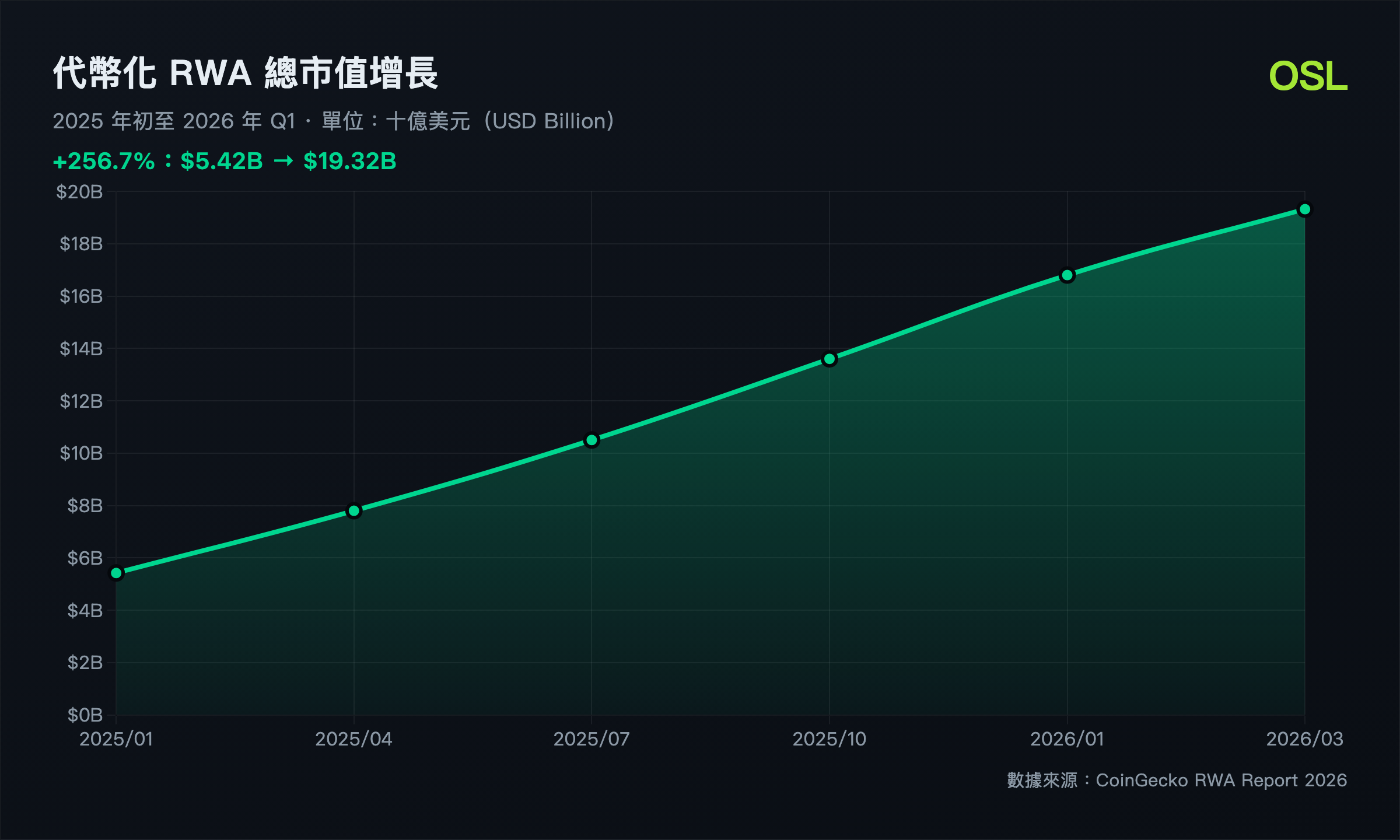
According to CoinGecko's RWA Report 2026, the total market capitalization of tokenized RWAs grew 256.7% over fifteen months — from $5.42 billion at the start of 2025 to $19.32 billion as of March 31, 2026. Just as telling: RWAs as a share of the stablecoin market rose from 2.7% to 6.4%, meaning RWA growth outpaced stablecoins over the past year.
The report sums up 2025 in a single phrase: a watershed year for RWAs. As regulatory clarity improved, traditional finance (TradFi) institutions began entering in earnest, early experiments hardened into repeatable playbooks, and the pace of tokenization visibly accelerated.
1. The Four Asset Classes: A Market That's Diversifying
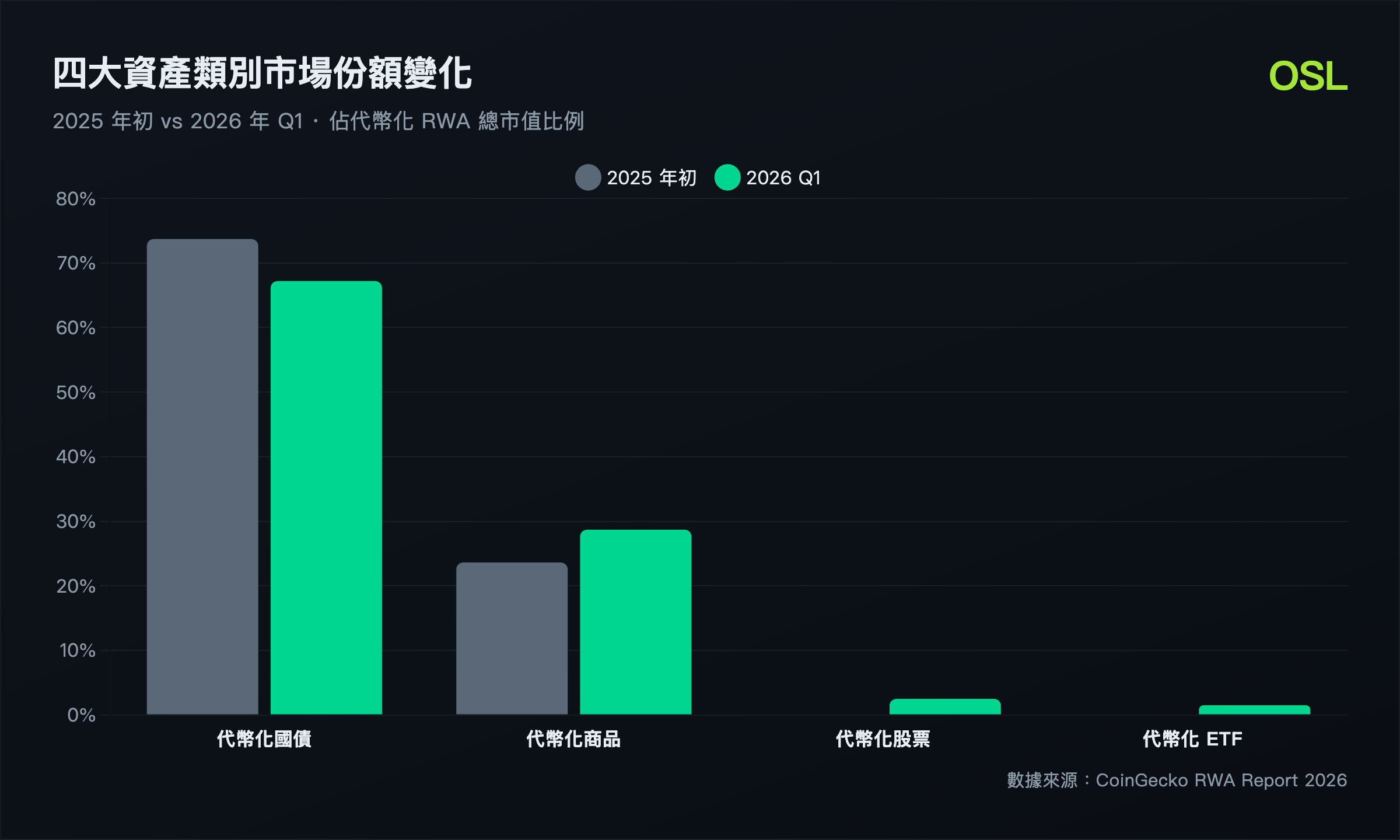
According to CoinGecko, as of Q1 2026 tokenized RWAs are made up primarily of four asset classes — and the internal balance is shifting.
Tokenized Treasuries — still the largest, but losing share Treasuries added $9.00 billion (+225.5%) over the period, accounting for more than half of the sector's total market-cap growth, and crossed $10 billion for the first time on February 11, 2026. Yet their market share slipped from 73.7% to 67.2% — not because they slowed, but because other classes caught up quickly.
Tokenized Commodities — the fastest grower, dominated by gold Commodities rose from $1.43 billion to $5.55 billion (+289.1%), now 28.7% of the sector. But the structure is highly concentrated: Tether's XAUT ($2.52B market cap) and Paxos' PAXG ($2.32B) — both gold-backed tokens — contributed 89.1% of the growth, mirroring the rally in spot gold over the past year.
Tokenized Stocks — small base, strong momentum Since launching in mid-2025, tokenized stocks scaled from $2.09 million to $486.69 million, led by tech tickers. Circle is currently the largest tokenized stock ($171.39M market cap, 35.2% share), followed by Tesla, Nvidia and Alphabet.
Tokenized ETFs — smallest, but with a broad long tail ETFs reached about $297.5 million, roughly half the size of tokenized stocks. Unlike stocks, ETFs have no clear single leader — growth has been broad-based, with a sizable long tail of smaller products.
The landscape in one line: Treasuries remain the ballast, commodities (especially gold) are the current growth engine, and stocks and ETFs — small as they are — are now entering the field.
2. The Trading Signal: Both Spot and Perpetuals Are Surging
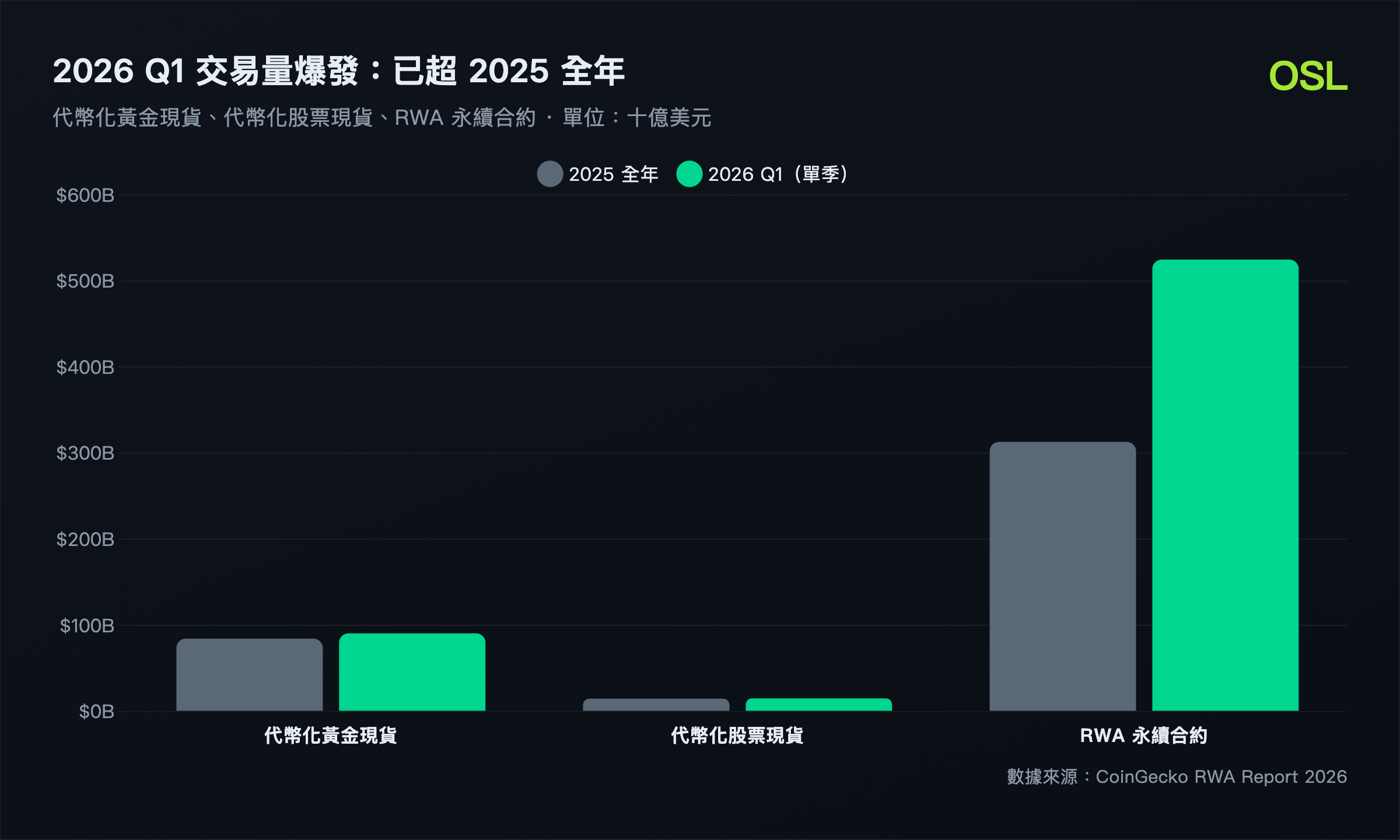
If market cap reflects "stock," trading volume reflects "heat." According to CoinGecko, Q1 2026 saw a clear step-change in trading activity.
Tokenized gold:Q1 spot volume reached $90.7 billion , already surpassing the $84.6 billion traded in all of 2025.
Tokenized stocks:Q1 spot volume of $15.1 billion , overtaking the $14.8 billion recorded across the second half of 2025.
RWA perpetuals:Q1 volume jumped to $524.8 billion, far above the $313 billion for all of 2025 — a fourth consecutive quarterly increase. Average daily open interest rose from $0.85 billion last year to $4.82 billion, more than 5x.
There's one detail here that's easy to overlook but matters enormously to investors: CoinGecko's report makes clear that centralized exchanges (CEXs) account for the large majority of spot trading in tokenized assets.
In other words, the "assets" live on-chain, but most people's "trading" entry point still routes back to an exchange. That moves the question away from "which asset is rising" toward something far more practical:
which platform are you using to participate?
3. The OSL View: The Real Divide Is "Compliance" and "Distribution"
There's a judgment in CoinGecko's report worth dwelling on: as competition intensifies, RWA issuers now differentiate on three things — regulatory standing, asset coverage, and distribution reach.
That sentence carries more weight than any single market-cap figure.
When the RWA sector was small, the market cared about whether something could be built. But when a sector grows nearly 2.6x in fifteen months and posts hundreds of billions in quarterly trading volume, the question becomes whether it's built compliantly, held safely, and made accessible in a way users can trust.
Tokenized assets, by their nature, bring real-world value on-chain. That inevitably touches a chain of traditional-finance regulatory questions: securities classification, custody responsibility, KYC/AML, investor protection. The larger the scale, the less these can be bypassed. Put simply:
The next phase of RWA competition won't be won by "who launches first," but by "who can give users safe, compliant access to these assets."
This is precisely where OSL sits. As Hong Kong's first SFC-licensed digital asset platform and a company listed on the Main Board of the Hong Kong Stock Exchange (stock code: 863), OSL holds 50+ licenses and registrations across multiple jurisdictions, and provides institutional-grade custody, segregated client assets, and compliant trading infrastructure.
In a market where "regulatory standing, asset coverage, and distribution reach" decide the outcome, licensing and compliance aren't a nice-to-have — they're the ticket to play.
4. What This Means for Hong Kong and Asia-Pacific
The RWA surge and the expansion of stablecoins are two sides of the same storyline — the former solves "how assets get on-chain," the latter "how value is settled and moved."
Hong Kong's position on this storyline is becoming clear. With the Stablecoins Ordinance taking effect and the virtual-asset licensing regime maturing, Hong Kong is building the conditions to become a compliant digital-asset and RWA hub for Asia-Pacific: a clear regulatory framework, deep ties to traditional finance, and globally oriented distribution capacity.
For OSL, that implies a dual role: a compliant trading and custody infrastructure, and a bridge connecting traditional assets to the on-chain world. As institutions and high-net-worth users begin to seriously consider allocating to tokenized assets, what they need is not the busiest platform, but the most trustworthy one.
5. A Reality Check: The Limits Beyond the Hype
The numbers are impressive, but a professional stance requires seeing their limits, too. According to CoinGecko's report:
Tokenized stock trading volume is still under 1% of the real-world trading volume of the same underlying stocks.
Despite listings across multiple CEXs, the asset class remains very early.
Tokenized commodities are heavily reliant on gold and concentrated in two tokens
— hardly diversified. Commodity market cap peaked in February 2026, then retraced roughly 20.6%, showing real sensitivity to sentiment and macro conditions.
The rapid growth of perpetuals
means leverage and volatility risks scale in tandem — these instruments are not suitable for every investor.
RWA is a real and accelerating trend, but it remains early. For any asset class, understanding its mechanics and risks should always come before chasing the hype.
FAQ
Q1: What exactly is RWA (Real World Asset tokenization)?
RWA refers to recording real-world assets — such as Treasuries, gold, stocks, and ETFs — as tokens on a blockchain, so they can be held, transferred, and traded on-chain. The goal is to bring the value of traditional assets into a more efficient, programmable on-chain environment.
Q2: Are tokenized assets compliant?
It depends on the asset type and jurisdiction. Many tokenized assets carry securities characteristics and are subject to local securities regulation. When participating, whether a platform is licensed and meets KYC/AML and investor-protection requirements is key to assessing compliance.
Q3: How can I access digital assets compliantly in Hong Kong?
Prioritize platforms licensed by Hong Kong's Securities and Futures Commission (SFC). Licensed platforms are subject to regulatory requirements on segregated client assets, custody security, and compliant trading, offering users stronger protection. OSL is Hong Kong's first SFC-licensed, HKEX-listed digital asset platform.
Q4: How do tokenized assets differ from buying traditional assets directly?
Tokenized assets typically offer 24/7 trading, fractional ownership, and on-chain programmability — but they also introduce new risks around on-chain custody, smart contracts, and counterparties. Each has trade-offs; the right choice depends on your needs and risk tolerance.
Data Source & Disclaimer
Data source: All market data in this article is cited from CoinGecko's RWA Report 2026. Original report:
https://www.coingecko.com/research/publications/rwa-report-2026
Disclaimer: This article is provided for general informational purposes only and does not constitute, and should not be relied upon as, investment, financial, legal, or tax advice, nor an offer or solicitation to buy, sell, or subscribe to any financial product. Digital asset prices are highly volatile, and past performance is not indicative of future results. Investment involves risk; you should conduct your own assessment and seek professional advice where necessary before making any investment decision.
Start your safe cryptocurrency journey now
OSL | Secure Ramps. Trusted Rails !
More About Topics
Latest
60-Vote Hurdle for CLARITY Act Exposes Limits of Legislative Hope
The CLARITY Act's September 15 procedural vote exposes why implemented regulatory frameworks may offer institutions more operational certainty than pending U.S. legislation.
60-Vote Hurdle for CLARITY Act Exposes Limits of Legislative Hope
XRP Rebounds 30% Then Slips: DeFi Infrastructure Faces Volatility Exam
XRP Ledger's $1.1 billion stablecoin expansion and new lending protocol foundation face an immediate stress test as XRP price swings 30% monthly.
XRP Rebounds 30% Then Slips: DeFi Infrastructure Faces Volatility Exam
$0.325 SKY Forecast: Valuation Model or Institutional Wish?
Standard Chartered's $0.325 price target on Sky's governance token applies bank-style valuation to on-chain credit infrastructure, but the forecast depends on USDS adoption and borrowing expansion that remains nascent.
$0.325 SKY Forecast: Valuation Model or Institutional Wish?
SEC Custody Rewrite Hits White House, Jurisdictional Gap Widens
The SEC's proposed crypto custody rewrite entered White House review on August 25, 2026, leaving U.S. institutional frameworks unresolved while banks and custodians position services under divergent national rule stacks.
SEC Custody Rewrite Hits White House, Jurisdictional Gap Widens
India's $100M Bond Tokenization: A Rights Structure Stress Test
SEBI's Demat 2.0 pilot issued over $100 million in tokenized bonds using digital rupee settlement, but its phased rollout from institutional pilots to secondary trading and retail access tests whether off-chain...
India's $100M Bond Tokenization: A Rights Structure Stress Test
Recommended For You
More About Topics