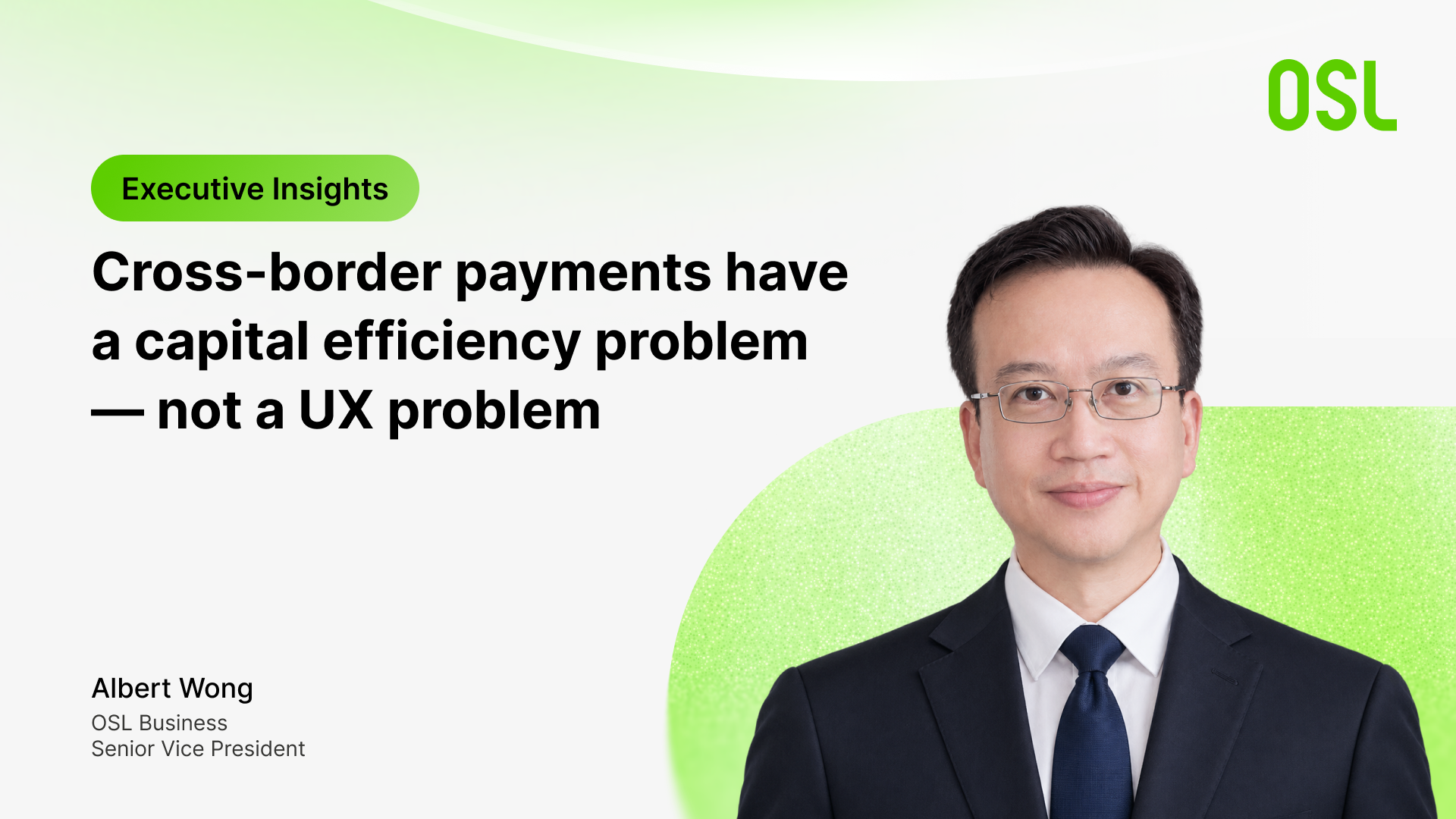
Every Company Needs a Stablecoin Strategy

Twenty years ago, every company was told it needed an internet strategy. Very few of them actually turned into internet technology companies. A retailer still sold clothes. A manufacturer still made parts. What changed was not the business itself, but the infrastructure underneath it.
Today, it is fair to say that every company has become an internet-based business. Many of those that recognised this early in the internet era, and positioned themselves with foresight, have reaped the rewards of being first movers and grown into leaders in their fields.
I believe we are at a similar moment with money.
Across the real economy, stablecoins are still widely seen as something that belongs to the crypto industry: interesting, perhaps, but someone else's business. This year, I have talked about stablecoins with many business leaders, and their first reaction is often strikingly similar. One business owner in cross-border trade asked me directly: does using stablecoins mean holding volatile tokens, managing crypto wallets, or even turning the company into a Web3 business?
My answer was simple: not at all. And as I see it, holding on to that assumption will only grow more costly, because how smoothly a company moves money across borders is becoming one of the key factors in its competitive advantage, or disadvantage.
That is why I believe that, today, every company needs a stablecoin strategy of its own.
The financial friction we have learned to live with
I often ask finance leaders a simple question: how long does an international supplier payment take? The answer is usually "a few days". Ask what it costs, and many find it hard to pin down, because the cost is spread across FX spreads, intermediary bank fees and deductions that only appear when the money lands. Worse still, the amount received often does not match the amount sent, and someone has to trace the gap after the fact. Until the money lands, suppliers often will not ship, so production and delivery plans slip too.
What strikes me is that most businesses have stopped questioning any of this. Instead, they treat it like rent and utilities: a default cost of doing business globally.
Yet the visible costs are only part of the story. To keep operations running, many overseas subsidiaries hold a few extra weeks of cash as a buffer in case cross-border funds are late. A company selling well abroad may wait a while before it can bring revenue home for the next round of inventory. Others look at a new market, add up the cost of moving money in and out, and stop there. None of this appears as a line item called "payment friction", but all of it shapes how fast a business can grow.
Why this has become a strategic question
Why do problems that have existed for so long, and that almost every company has learned to accept, matter so much today? Because the infrastructure underneath global payments and money movement is undergoing a fundamental change.
Regulated stablecoins are becoming a new layer of payment plumbing: as a tokenised, on-chain form of fiat currency, they are not bound by banking hours or time zones, settle in minutes or even seconds, and leave every movement clearly visible. Just as importantly, the rules are catching up. Major financial centres are putting regulatory frameworks for stablecoins in place, giving businesses and their banks the confidence to use them.
Contrary to what many people imagine, among the companies I meet, many of those actually putting them to work are not crypto start-ups but thoroughly traditional businesses: logistics firms settling freight with overseas partners, travel platforms paying hotels around the world, brands paying factory deposits ahead of peak season. What they care about is not the technology, but whether the money arrives on time and predictably.
That is why I often tell business leaders: when your peers are already moving money faster and more cheaply, waiting has a cost of its own.
What a stablecoin strategy is, and is not
A stablecoin strategy does not have to start with a big leap. For many companies, the first step is simply giving money that already moves a faster route. In most of the payment flows running today, a business pays in its local currency, and its counterparty receives local currency on the other side. The stablecoin handles only the cross-border stretch in between, like an invisible bridge, while people on both sides keep paying and receiving in their own currencies. It is often called the stablecoin sandwich. For the recipient on the other end, the change usually comes down to one thing: the money arrives faster.
How far to go beyond that is a choice each company should make deliberately. Some will use stablecoins purely as a payment rail. Others may, over time, bring them into how they hold and manage working capital, as the accounting and regulatory treatment becomes clearer. A strategy is what allows a company to make that choice on its own terms, rather than by default.
Nor does building one have to start with reorganising your finance team. When I talk with companies, I prefer to start with a few management questions. Where does our money get stuck? Which corridors are the slowest and most expensive? How much capital are we holding in reserve just to keep payments flowing? For most companies, the honest answers point to one or two corridors, and that is where a sensible strategy begins: a single pilot, measured against a real baseline.
But there is one thing I always insist on: compliance has to be taken seriously from day one. Wide use in a market does not mean it is safe to operate there; you need to know the rules where the money starts and where it lands. That is why the choice of partner is part of the strategy itself. A partner with mature, end-to-end infrastructure and capabilities, covering licensing, local on- and off-ramps, banking relationships and deep liquidity, is crucial and foundational for turning a fast digital middle into a payment that actually lands.
To help companies work through these questions, we recently published a practical playbook on how businesses can use, and are already using, stablecoins today and what to plan for before their stablecoin strategies go live. But as companies read it, what I hope for most is that each one first talks it through internally: where and how its money moves, and how it could move more smoothly.
Why OSL made it its own strategy
OSL's own path followed the same logic. We evolved from a digital asset exchange into a global stablecoin infrastructure company, because we believe the lasting demand for stablecoins will come from moving money for businesses. Today, according to Frost & Sullivan, OSL is the world's largest stablecoin payment infrastructure company by B2B stablecoin payment volume.
As I see it, stablecoins are part of something larger: global money operations, the everyday work of collecting, converting, holding and paying out money across markets. Every company that does business across borders runs these operations, whether it calls them that or not. The question is no longer whether stablecoins will become part of how those operations run. It is whether your company will have a plan for it.
Our mission at OSL is to let money move as freely as information. The internet did that for information, and the companies that took it seriously early did not become technology companies. They rode that wave of change to become better at what they already did.
The same will be true, in the years ahead, of the companies that start building a stablecoin strategy today.
Disclaimer
This article is for informational purposes only and does not constitute, and shall not be construed as, an offer, solicitation, invitation, recommendation, or inducement to buy, sell, subscribe for, or otherwise deal in any digital assets, securities, or financial products. It does not constitute financial, investment, legal, tax, accounting, or other professional advice and should not be relied upon as such. The views, statements, and information contained herein do not necessarily reflect the official positions or commitments of OSL Group or any of its affiliates. Any descriptions of products, services, promotions, or programmes are for general reference only. Participation in any products, services, or promotions mentioned is subject to applicable terms, conditions, and regulatory requirements. This article may contain forward-looking statements or indicative information. Actual outcomes may differ materially, and OSL Group assumes no obligation to update such information.
See how OSL can support your business
Talk to our team about your specific needs