Cross-border payments have a capital efficiency problem — not a UX problem

Our industry has spent a decade making cross-border payments look instant. It has spent far less time making them instant underneath. Someone's balance sheet pays for the difference, and I think that is the real problem with payments today.
I came to payments from logistics. At Amazon, I ran operations and supply chains, and by then shipping a parcel across the world was routine. Getting paid for it was not. In some markets, sending money took longer than sending the physical package.
When I left Amazon to join cross-border payments pioneer WorldFirst in 2015, the fintech industry was largely focused on building a better customer experience. Startups were building cleaner dashboards and faster onboarding flows to help global merchants collect money abroad.
Looking under the hood, however, almost all of that early innovation was happening strictly on the surface — what we refer to as the "wrapper" level. Beneath those modern interfaces, money was still moving across the exact same legacy SWIFT rails, taking anywhere from one to three business days to clear.
To deliver instant payouts to merchants, businesses put their own money into the destination market first: pre-funding.
Why pre-funding breaks down at scale
In cross-border payments, pre-funding means parking a company’s own cash in local bank accounts across every destination market ahead of time.
Assume a UK e-commerce merchant needs to pay a supplier in Hong Kong. The payment provider collects GBP in London and pays out HKD from a cash reserve already parked in their Hong Kong bank account — days before the actual British pounds finish moving across the SWIFT network to replenish that balance.
That model was tolerable when corridors were few and interest rates were near zero. Today, it has become a major liability for payment companies trying to scale:
The balance sheet becomes the ceiling: Operating across 20 corridors means maintaining 20 separate pools of idle liquidity. Globally, Keyrock estimates around $27 trillion sits trapped in pre-funding accounts. In a higher-rate environment, the carrying cost — and the opportunity cost of not deploying that capital into product or market expansion — directly affect margins.
Emerging markets magnify the friction: In major currency pairs, payment volume is relatively predictable. In emerging markets across South-east Asia, Latin America, and Africa — where banking calendars vary widely and long public holidays distort payment flows — treasury teams are forced to guess future volume spikes and over-fund local accounts just to keep corridors from stalling.
The shift to invisible settlement rails
Over the past year, I’ve observed a marked shift in how payment service providers and enterprises approach this bottleneck. Rather than raising more capital or taking on expensive credit lines to feed pre-funded accounts, many forward-looking operators are replacing the underlying settlement rail itself.
Unlike SWIFT, blockchain-based stablecoins settle globally in real time by default. More importantly, traditional institutions do not need to become crypto-facing businesses to use them.
In practice, PSPs are increasingly adopting what we refer to as a "stablecoin sandwich"—keeping fiat currency at both ends of the transaction while using stablecoins purely as the backend settlement bridge:
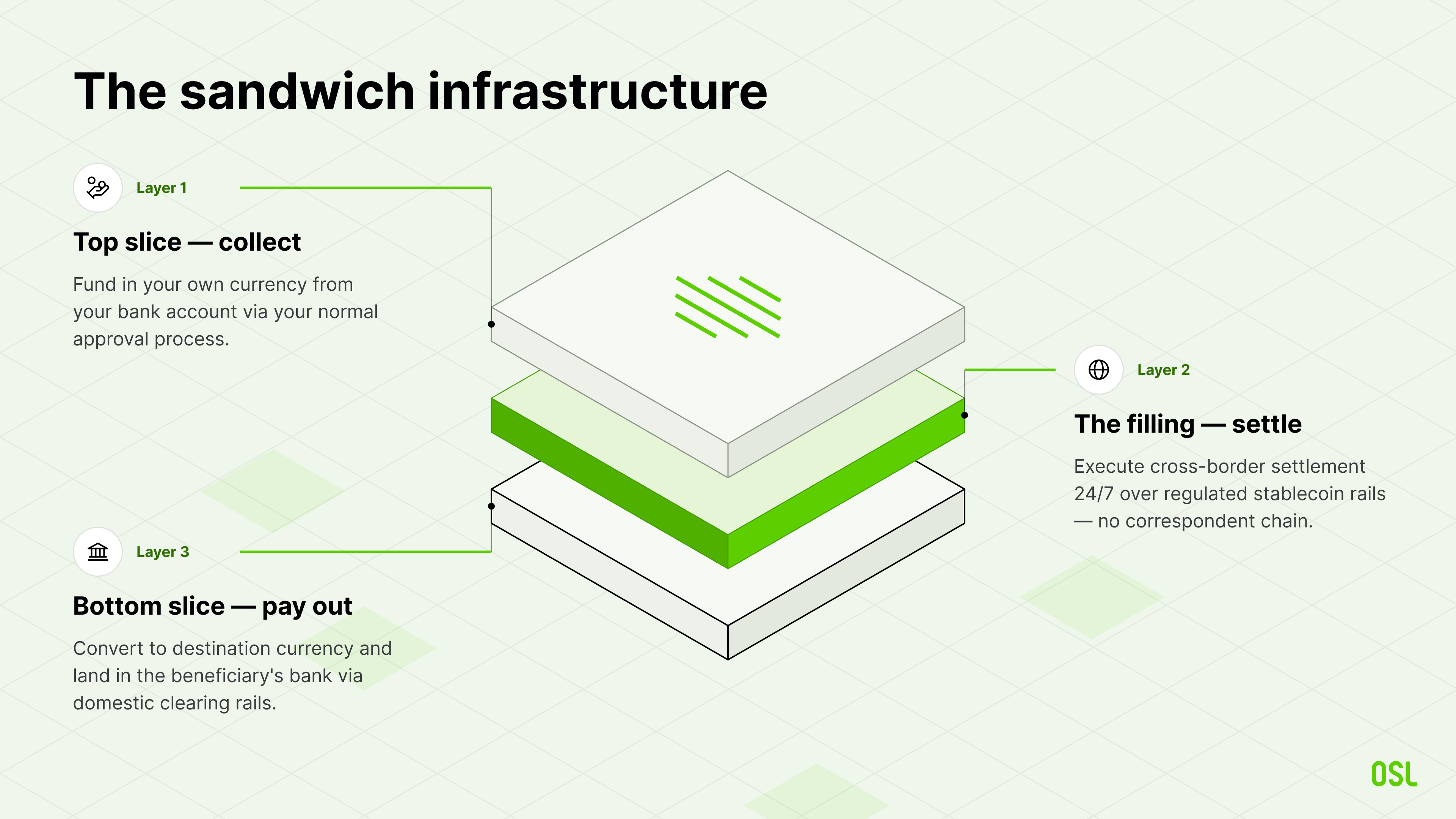
Collection (the first mile): A PSP sends local fiat — such as GBP in the UK — into a regulated local banking rail.
Settlement (the bridge): Those funds are converted into a regulated stablecoin and moved globally in near real time.
Payout (the last mile): The stablecoin is converted back into local destination currency — such as HKD in Hong Kong — and settled directly into the recipient’s bank account.
The end-merchant never touches crypto and is oftentimes unaware that stablecoins were even used at all. For the PSP, however, the unit economics change overnight: they deliver the exact same instant fiat experience without locking up millions in local Nostro accounts. This is why we launched OSL Business Payments last year.
What treasury leaders should ask from a partner
Moving stablecoins from one place to another is the easiest part for us. In my experience, the hard part is the first mile and the last mile: getting local fiat reliably into and out of the digital rail across fragmented regulatory regimes.
For executives re-evaluating their cross-border infrastructure, I suggest narrowing the selection criteria down to two non-negotiables:
The right licence in each market: Regulatory clarity is tightening across major hubs like Hong Kong, Singapore, and the UAE. Working with an unlicensed intermediary to save a few basis points creates existential compliance risk.
First- and last-mile capability: Moving a token is commoditized; local liquidity is not. Payment leaders should look for partners with established local banking relationships, direct payout rails, and deep FX liquidity in the specific emerging corridors they plan to grow into.
This is where we have put our effort. Our exchanges in Hong Kong and Indonesia give us local liquidity, and we are particularly strong in Asia and emerging markets.
Cross-border payment is transitioning from a balance-sheet game — where scale is dictated by how much idle cash a firm can park around the world — to an infrastructure game. I think that is changing. The winners in the next decade won't be the companies with the largest pre-funded accounts, but the ones whose capital works hardest.
Disclaimer
This article is for informational purposes only and does not constitute, and shall not be construed as, an offer, solicitation, invitation, recommendation, or inducement to buy, sell, subscribe for, or otherwise deal in any digital assets, securities, or financial products. It does not constitute financial, investment, legal, tax, accounting, or other professional advice and should not be relied upon as such. The views, statements, and information contained herein do not necessarily reflect the official positions or commitments of OSL Group or any of its affiliates. Any descriptions of products, services, promotions, or programmes are for general reference only. Participation in any products, services, or promotions mentioned is subject to applicable terms, conditions, and regulatory requirements. This article may contain forward-looking statements or indicative information. Actual outcomes may differ materially, and OSL Group assumes no obligation to update such information.
See how OSL can support your business
Talk to our team about your specific needs