Develop a Stablecoin Strategy for Your Business

A practical guide to accelerating your global money operations.
Start here
Money moves slower than the businesses that depend on it.
You initiate a payment through your commercial bank, take a 3% to 5% hit on the spread, and spend several days fielding emails from suppliers asking where their cash is. If a holiday lands on either end, everything freezes. Meanwhile, your balances sit trapped in transit, doing nothing for your balance sheet.
That friction is no longer the price of doing business internationally.
Behind the scenes, global payment rails are undergoing an infrastructure replatforming. Regulated stablecoins are becoming standard, 24/7 payment plumbing — and the businesses putting them to work aren't crypto-native startups. They are importers, marketplaces, PSPs, and treasury teams who simply got tired of waiting days for their own money.
The data backs up the shift: EY-Parthenon found that corporate stablecoin adoption has doubled, with 18% of surveyed corporations now live in production (up from 9% in 2025), while 18% of financial institutions are already actively offering stablecoin services with another 51% planning to launch within the next two years. Sitting on the sidelines is no longer a conservative move — it means absorbing banking friction your competitors are already skipping.
And that is why every company needs a stablecoin strategy now more than ever.
Knowing you need a strategy is one thing; building it is another.
This guide cuts through the noise, bridging the gap between stablecoin theory and enterprise reality. We break down:
The mechanics: How regulated stablecoin payments actually work under the hood.
Actionable applications: High-impact ways businesses can use stablecoins to solve cross-border friction.
Market readiness: An overview of where global adoption is accelerating.
Product capability: How OSL's institutional-grade infrastructure connects your business to digital assets.
Taking it live: What you need to plan for before going live.
1. How regulated stablecoin settlement works
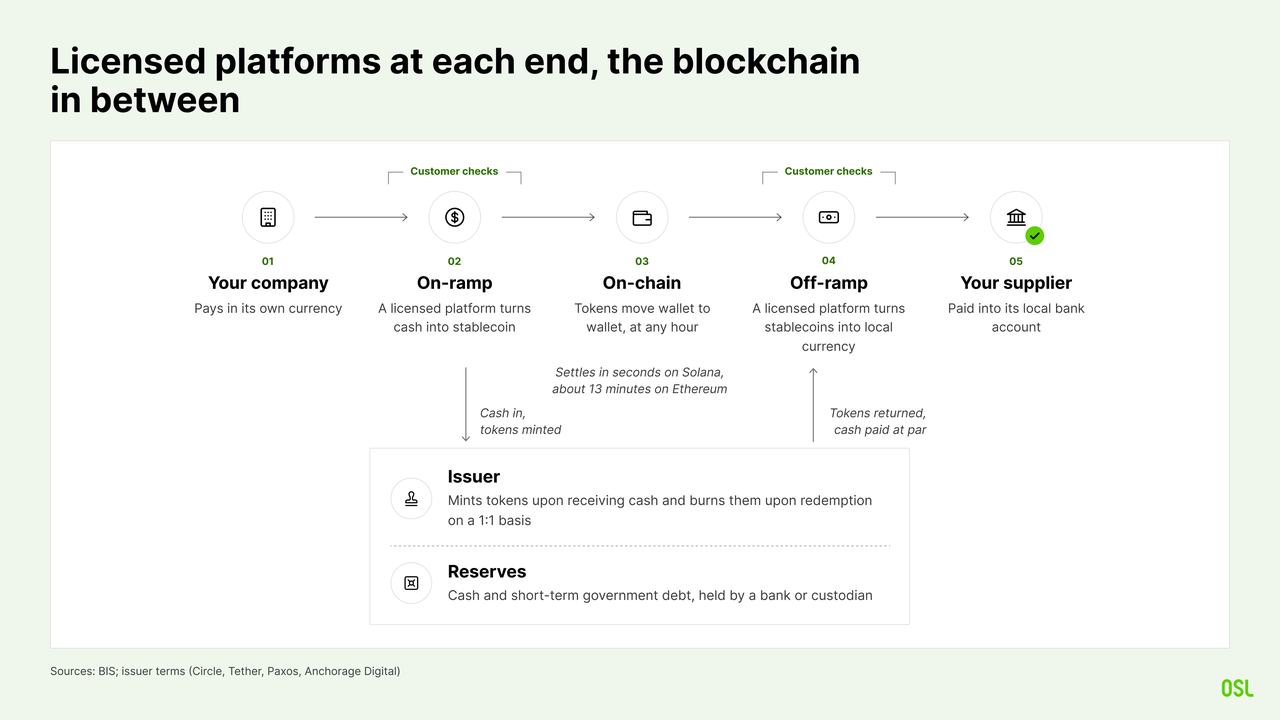
The stablecoin sandwich, explained
If you take one concept from this guide, take this one. It is the model behind most stablecoin payment flows running today — and the reason why adoption has moved so fast in businesses with no interest in crypto. The stablecoin sandwich has three layers:
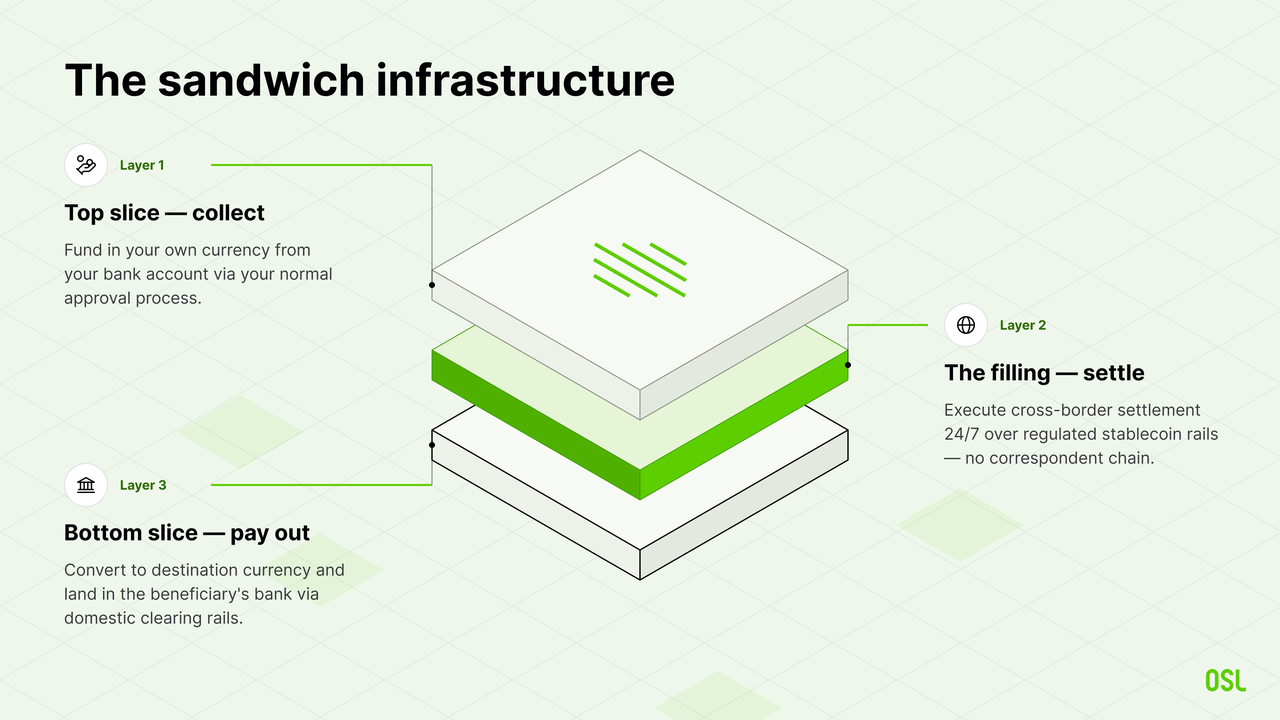
The stablecoin exists only in the middle, for the part of the journey where traditional rails are slowest and most expensive.
What this means in practice:
Your supplier does not need to adopt anything. You are not asking 40 vendors across six countries to do something new.
Fewer intermediaries, tighter spreads. You're removing the correspondent chain from the middle of the transaction, not negotiating harder with it.
You can see where the money is, in real time.
Every workflow in the next section is this same sandwich with a different filling. Only the slices change: who pays in, and who gets paid.
2. Five ways companies use stablecoins today
Getting those rails right unlocks speed and cost efficiency where traditional banking struggles most: cross-border payouts, after-hours settlement, and fragmented local schemes.
Rather than replacing their entire treasury stack, businesses usually embed stablecoins directly into these high-friction workflows. Today, five production use cases dominate enterprise adoption — each using an instant, 24/7 onchain settlement leg to bridge domestic payment rails worldwide.
B2B supplier payments
Best for: Importers, manufacturers, and global trading firms.
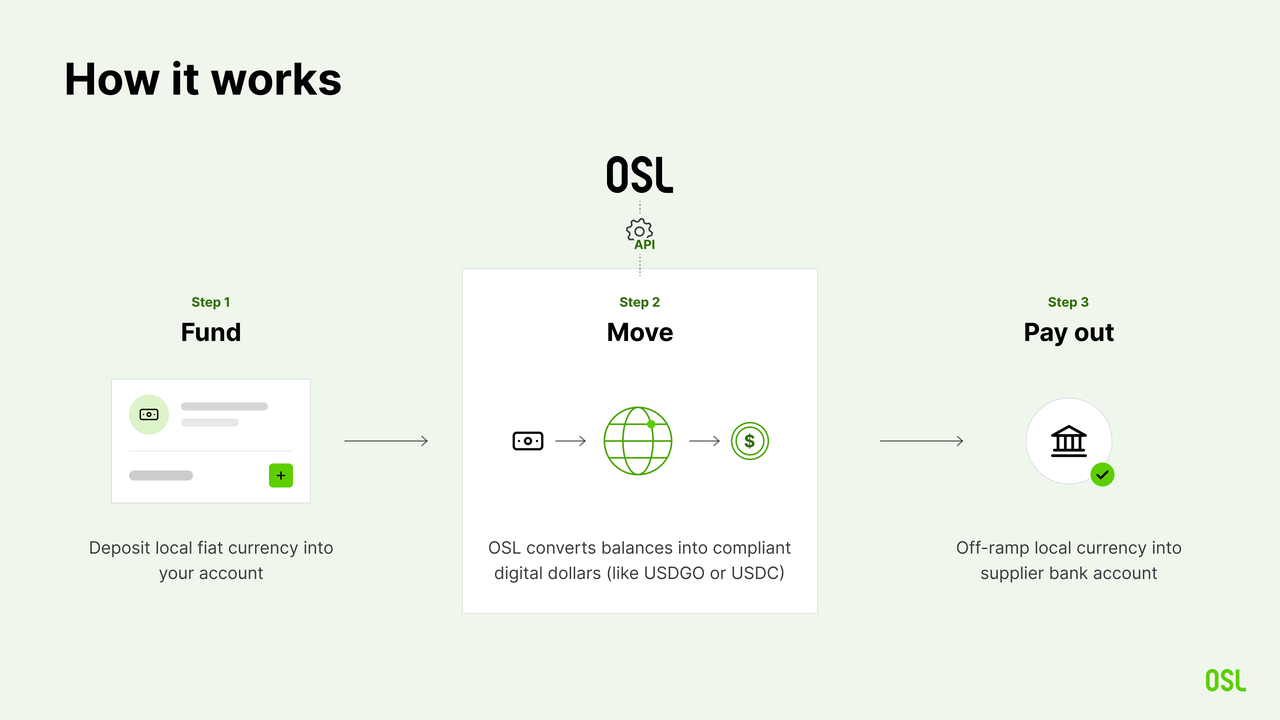
Fund: You deposit local fiat currency directly into your account. Your current approval flow stays the same.
Move: OSL's infrastructure converts balances into compliant digital dollars (like USDGO or USDC), executing 24/7 onchain settlement across the corridor in minutes.
Pay out: Funds off-ramp into local currency and land in your supplier's bank account via domestic clearing networks.
Why it matters
Settlement in minutes: Multi-day transit times drop to minutes, including weekends and public holidays.
Capital efficiency: Both you and your supplier free up working capital — you stop financing funds stuck in transit, and suppliers stop waiting on open receivables.
Direct dollar access: Overseas suppliers can receive dollars without needing a domestic bank with US correspondent access.
Illustrative case study:
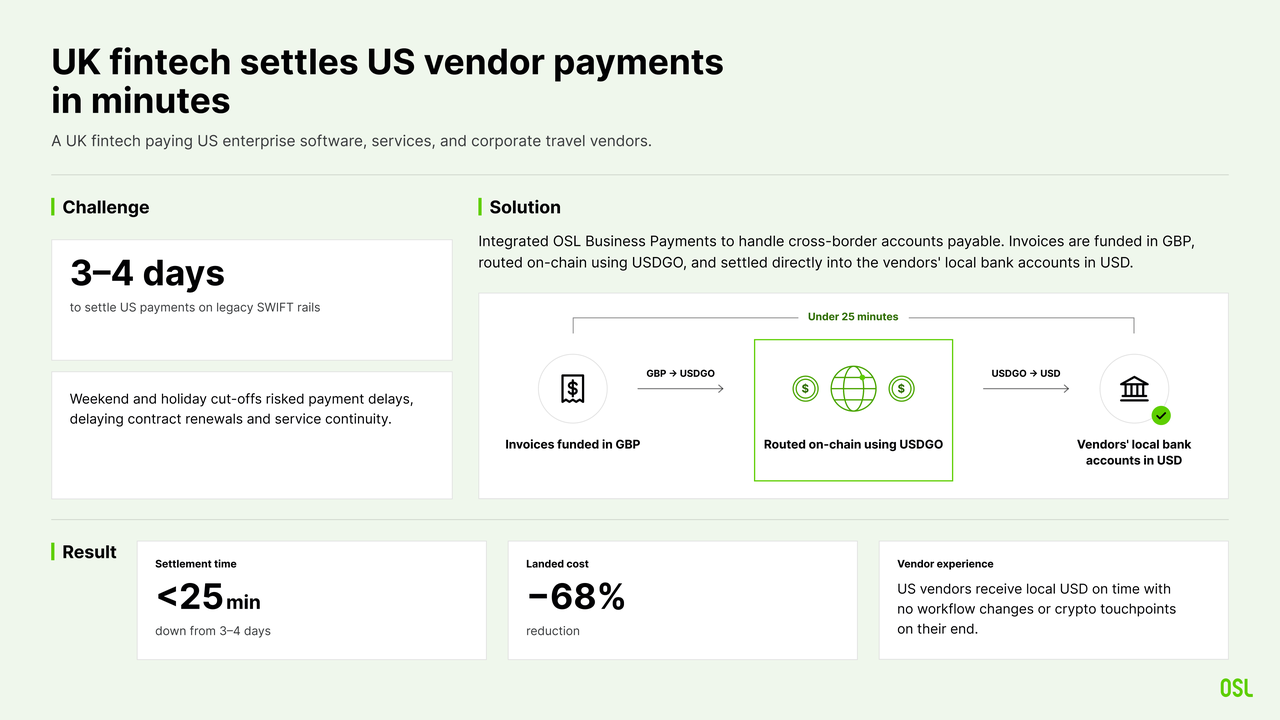
* Note: Illustrative scenario based on representative commercial metrics. Past performance and indicated savings are not a guarantee of future operational results; actual settlement times and fee reductions vary by corridor, volume, and banking rails.
Seller and contractor payouts
Best for: Marketplaces, gig platforms, and creator networks, as well as business process outsourcing (BPO) providers, shared-services operators, and any company running payroll across several countries.
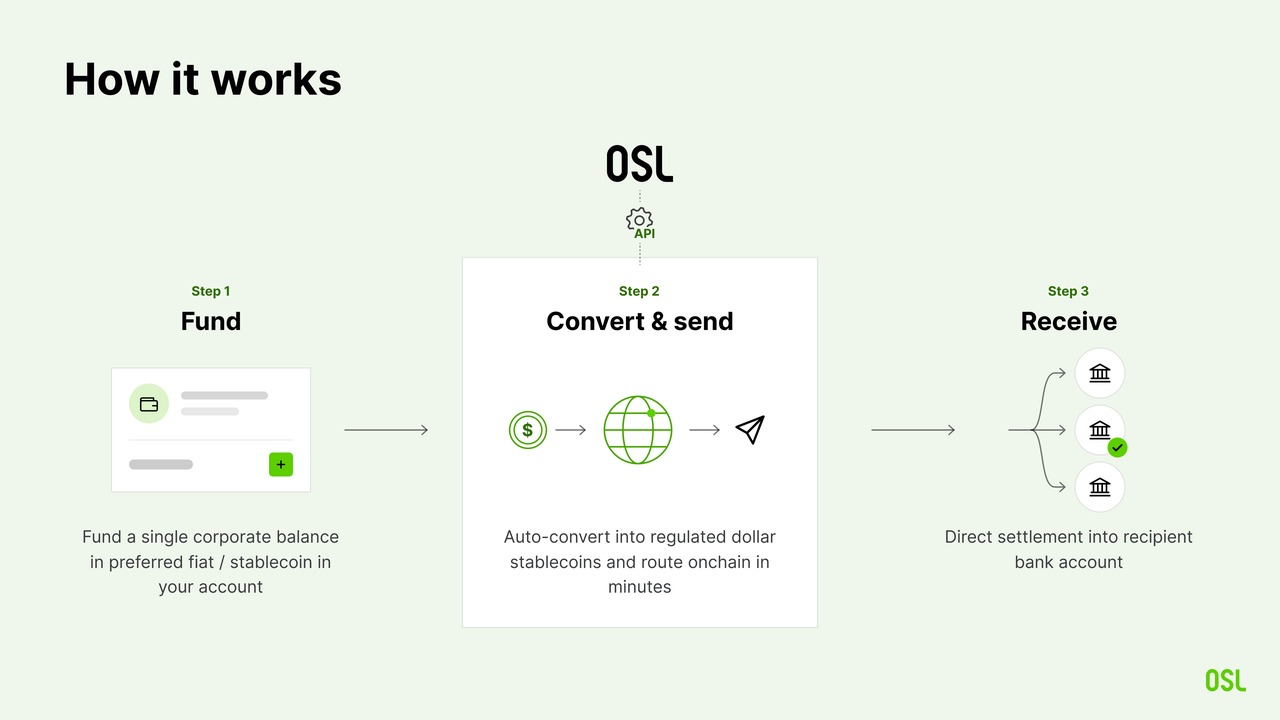
Fund: You fund a single corporate balance in your preferred fiat currency / stablecoin directly into your account, removing the need to manage prefunded accounts in each destination market.
Convert & send: Balances convert automatically into regulated dollar stablecoins and route onchain in minutes via OSL’s infrastructure — 24/7, programmable, and batch-ready.
Receive: Value settles directly into the recipient's domestic bank account.
Same sandwich as supplier payments. Only the bottom slice changes: thousands of recipients instead of one.
Why it matters
Payouts in minutes: Move away from slow weekly or bi-weekly payment runs to real-time, on-demand payouts.
Higher sales volume: 76% of marketplace sellers report better sales volume after accepting stablecoins, and in the same report 73% of freelancers note an improved ability to take on overseas clients.
Core household income: For recipients paid this way, stablecoin disbursements account for about a third of total annual earnings — this is a significant share of income, not an experimental channel.
Global dollar accounts: Named virtual accounts give non-US sellers a dollar account matching their legal business name in minutes, without the complexity or cost of setting up a US entity.
One balance replaces five. Capital stops being scattered across destination-market float.
Illustrative case study:
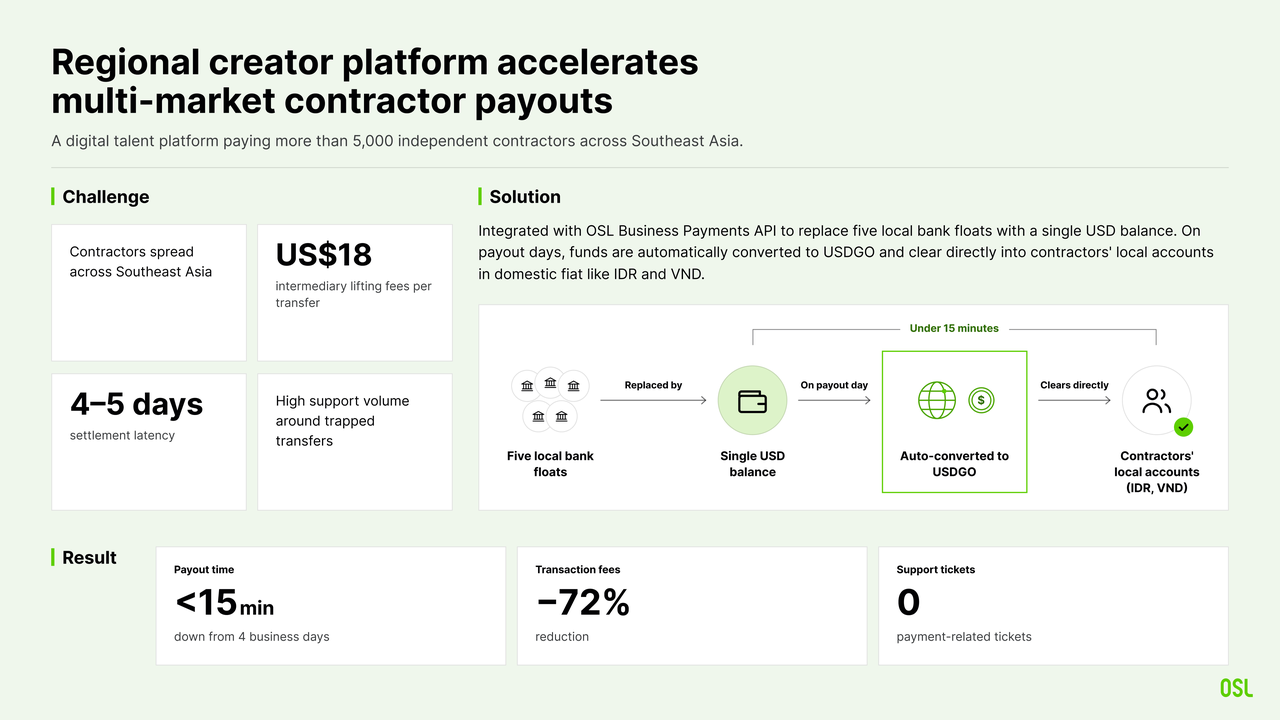
* Note: Illustrative scenario based on representative commercial metrics. Past performance and indicated savings are not a guarantee of future operational results; actual settlement times and fee reductions vary by corridor, volume, and banking rails.
Corridor settlement without prefunding
Best for: Payment service providers (PSPs), fintech, remittance operators, and money transfer networks.
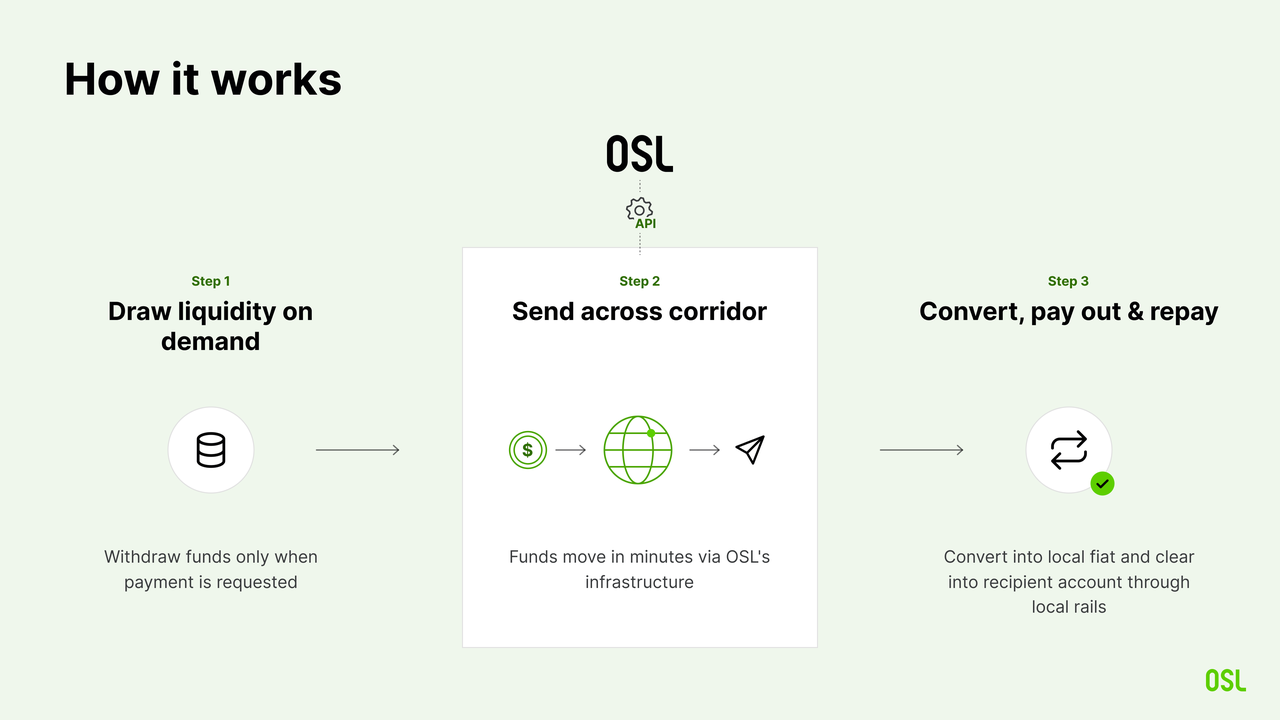
Draw liquidity on demand: You draw the funds only when a payment is requested. Nothing sits abroad waiting for business that may not arrive.
Send it across the corridor: The money moves in minutes through OSL's infrastructure, at any hour, on any day.
Convert, pay out & repay: Funds convert into the local currency and clear into the recipient's account through local rails. You repay the operational credit line over the following days.
The sandwich again, with your own treasury on the top slice.
Why it matters
Higher capital turnover: The real upside here is balance sheet velocity rather than just fee cuts. While traditional money transfer operators average an annualized capital turnover of 1–2x, stablecoin rails can hit monthly turnover rates of up to 11x. Because settlement cycles take minutes instead of days, the same working capital can be deployed repeatedly.
Growth stops being a funding exercise: If capital recycles in minutes, adding a corridor no longer means committing proportionally more float.
Streamlined operational alignment: Designed to interface with your existing domestic clearing licences, subject to jurisdiction-specific regulatory requirements. The first and last miles continue to clear through licensed domestic payment schemes in each respective market.
Illustrative case study
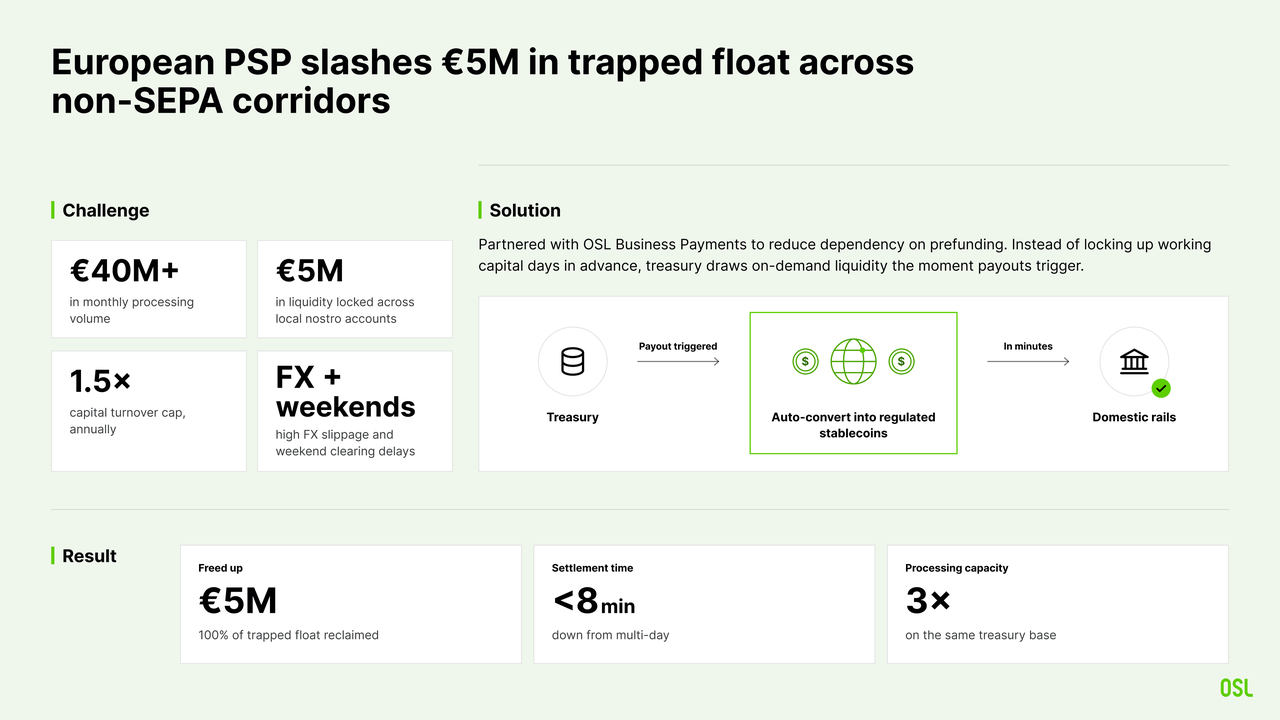
* Note: Illustrative scenario based on representative commercial metrics. Past performance and indicated savings are not a guarantee of future operational results; actual settlement times and fee reductions vary by corridor, volume, and banking rails.
Collections in hard-to-reach regions
Best for: Platforms, exporters, and service businesses earning revenue in markets where getting paid out is harder than getting paid.
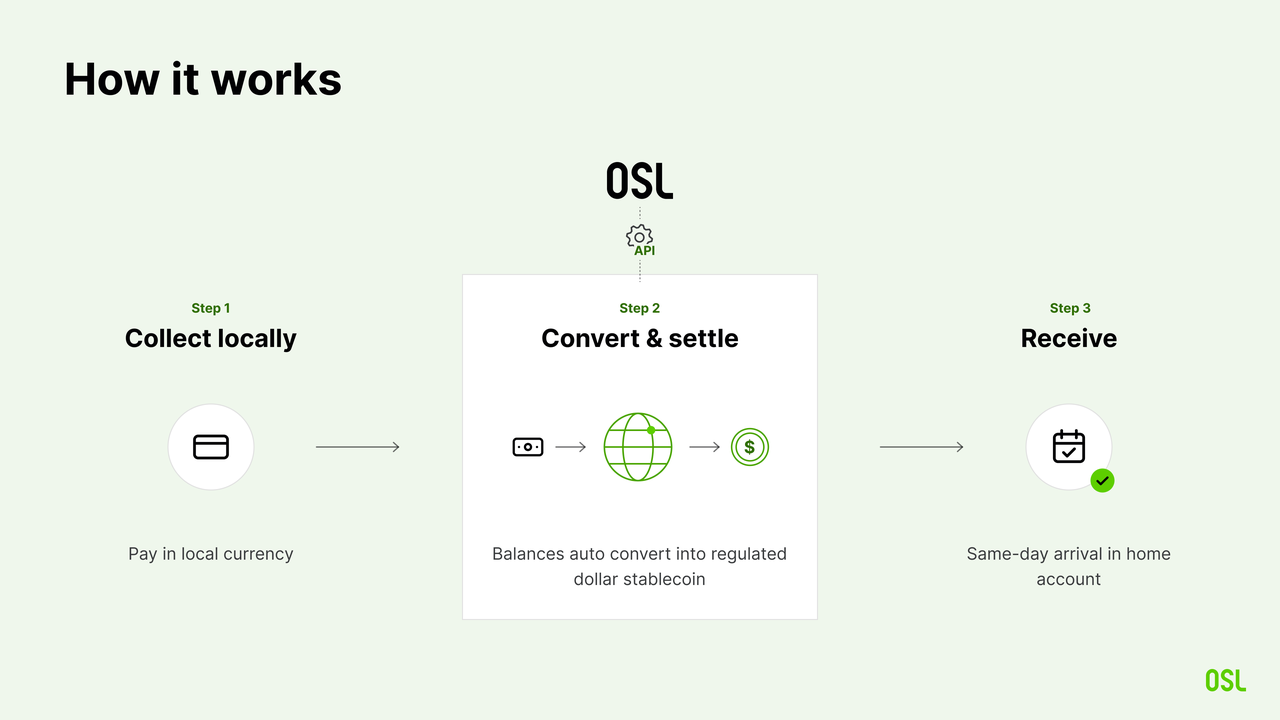
Collect locally: Your customers pay in local currency through the domestic rails they already use.
Convert and settle: Collected balances convert into a regulated dollar stablecoin and settle across the corridor on-chain in minutes, 24/7.
Receive it where you need it: Value arrives in your home currency, in your own corporate account or a named virtual account — available to use the same day.
Why it matters
Revenue stops aging in a local account. The lag between earning and being able to deploy collapses from days to minutes.
Dollar access without a US banking relationship. For a business operating in a depreciating currency, converting revenue to dollars quickly is risk management, not opportunism.
Markets become addressable. A corridor that was uneconomic to serve becomes serviceable, which changes where you are willing to sell.
Visibility. You can see collections arriving and settling in real time, rather than reconciling a batch sweep after the fact.
Illustrative case study:
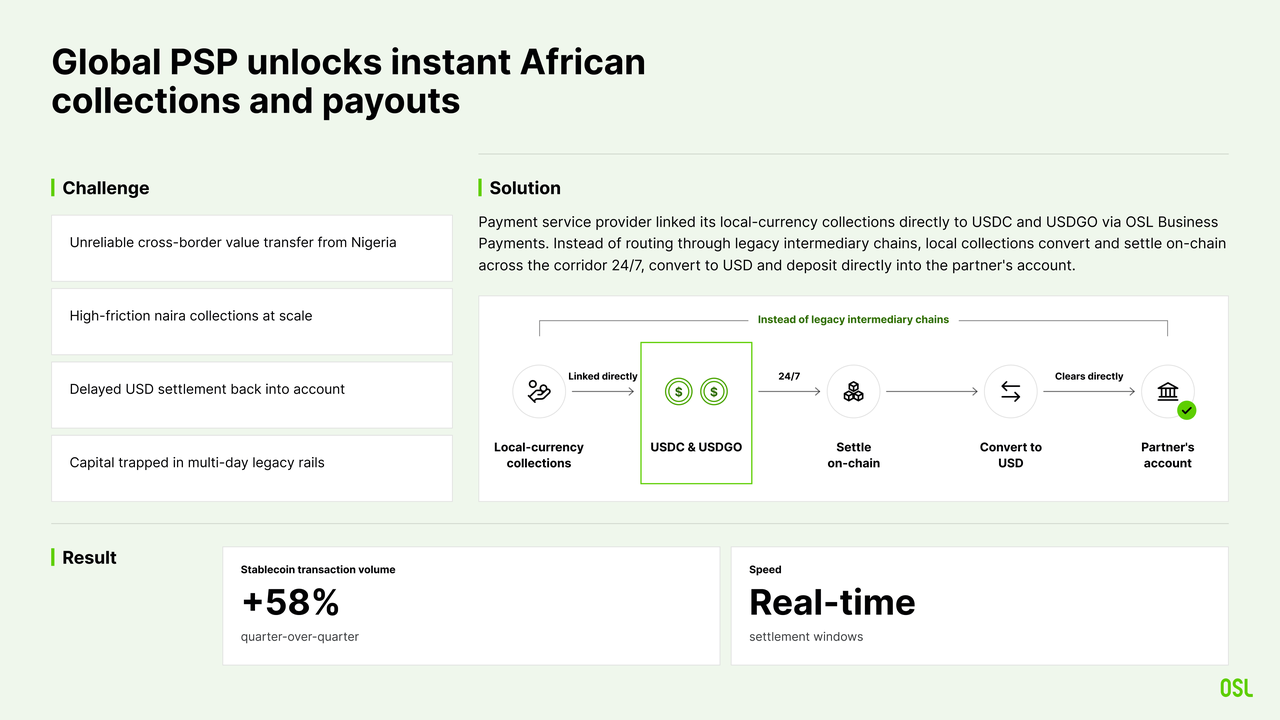
* Note: Illustrative scenario based on representative commercial metrics. Past performance and indicated savings are not a guarantee of future operational results; actual settlement times and fee reductions vary by corridor, volume, and banking rails.
Treasury management and named dollar accounts
Best for: Corporate treasurers, financial institutions, and multinational businesses.
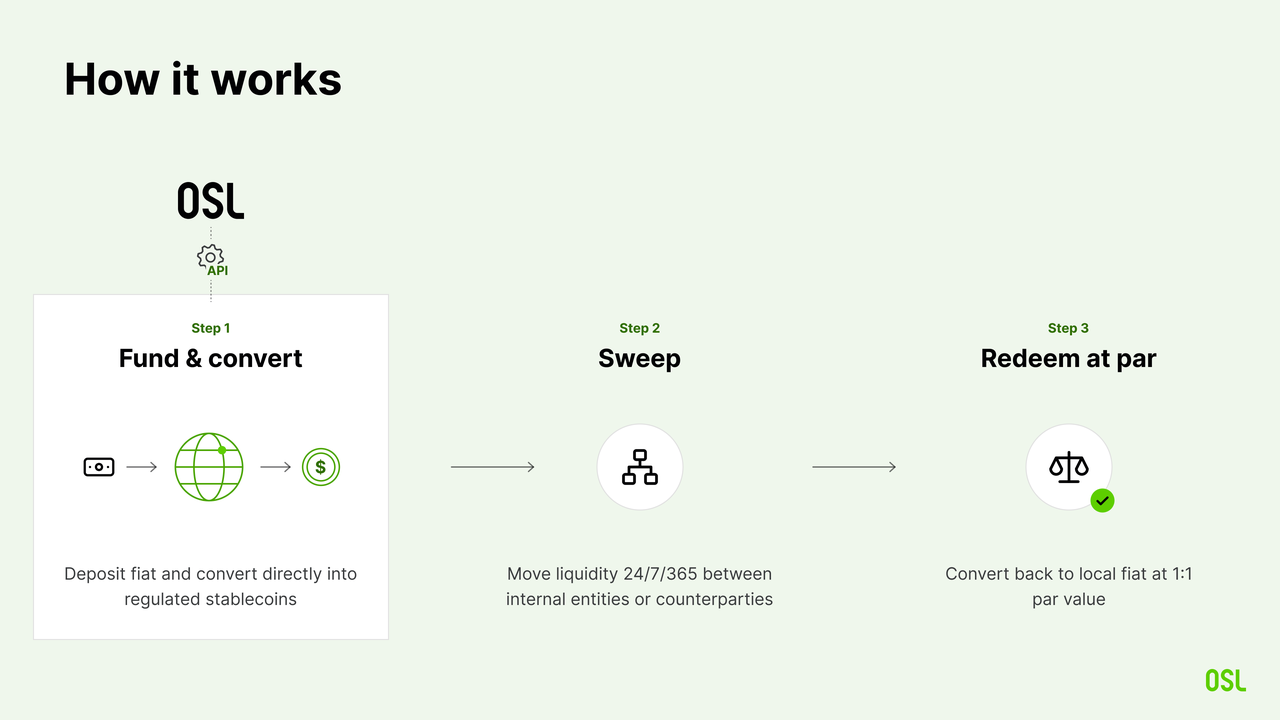
Fund & convert: You transfer balances into your OSL Business Account to convert fiat directly into regulated stablecoins, such as USDGO.
Sweep. Move liquidity between internal entities or counterparties 24/7/365 via OSL, bypassing bank cut-offs and holidays.
Redeem at par: OSL enables conversion back to local fiat via prevailing issuer mechanisms, subject to market liquidity, cutoff times, and issuer redemption terms.
Why it matters
Always-on intra-group sweeps: Move liquidity across your corporate network instantly, without waiting for regional banking windows to open.
Smaller buffers. If a subsidiary can be funded in minutes at any hour, it no longer needs to hold against a three-day worst case.
Instant virtual accounts: Named virtual accounts give your subsidiaries a dedicated dollar account in their own corporate name within minutes, removing the need to incorporate local entities just to hold liquidity.
Zero reconciliation friction: Because incoming wires match the legal entity's name directly, payment attribution is automatic — reducing the manual reconciliation bottlenecks common with shared, pooled collection accounts.
Capital efficiency focus: Major regulatory frameworks often prohibit issuers from paying interest on stablecoin balances. Treat your holdings as pure transactional working capital sized to immediate operational needs, not idle cash deposits.
Illustrative case study:
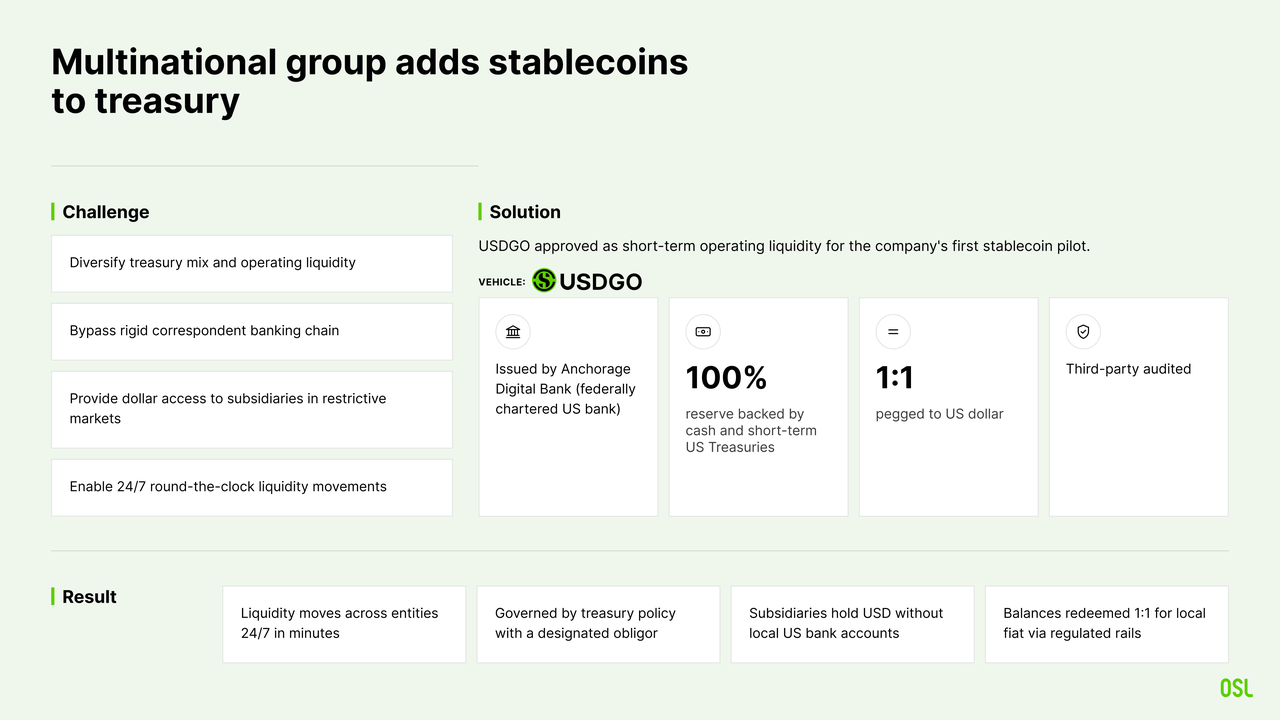
* Note: Illustrative scenario based on representative commercial metrics. Past performance and indicated savings are not a guarantee of future operational results; actual settlement times and fee reductions vary by corridor, volume, and banking rails.
Not sure which approach is for you? Bring your corridor list and your current all-in costs. That is usually enough to size the opportunity in a first conversation. |
|---|
3. Where adoption actually is
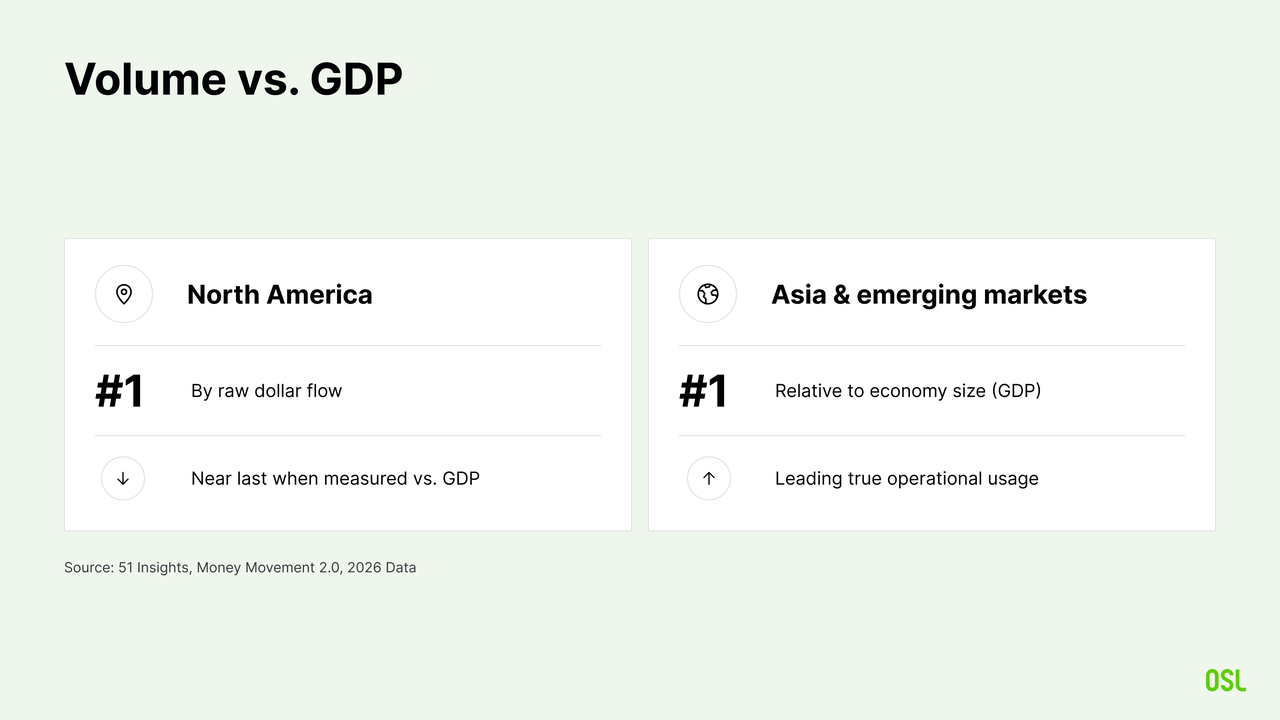
The adoption paradox:
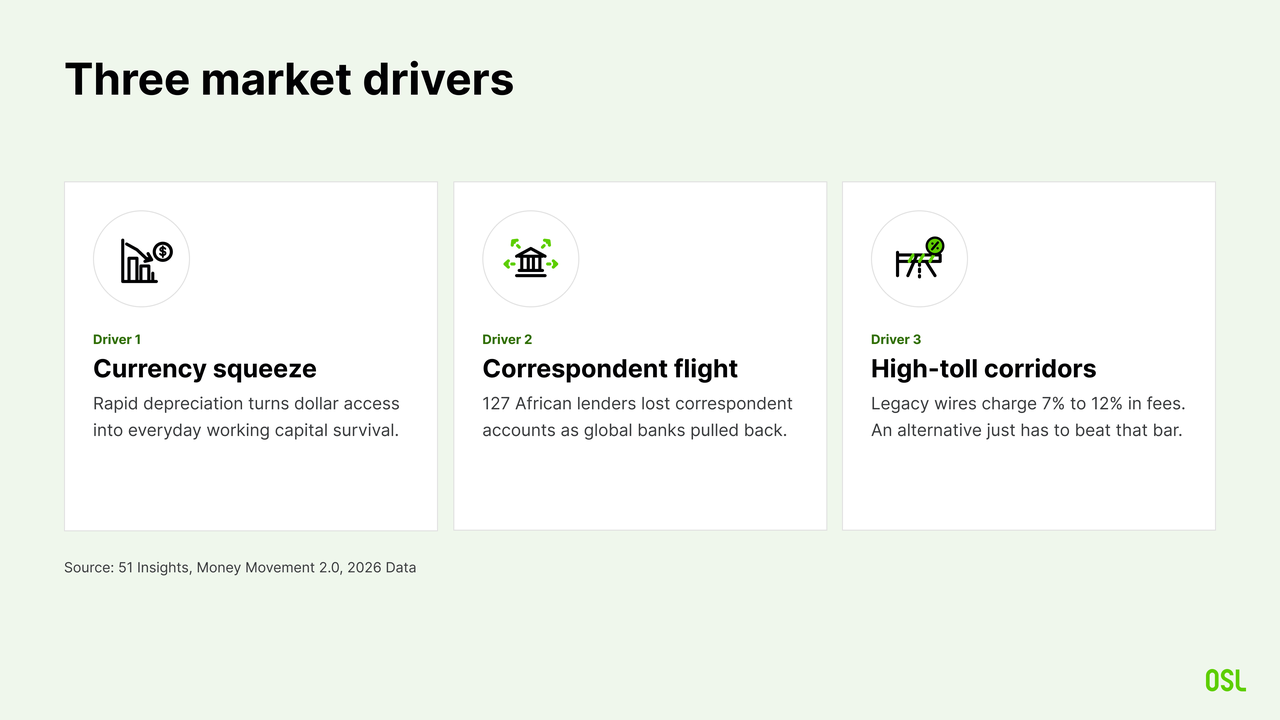
Why the map flips:
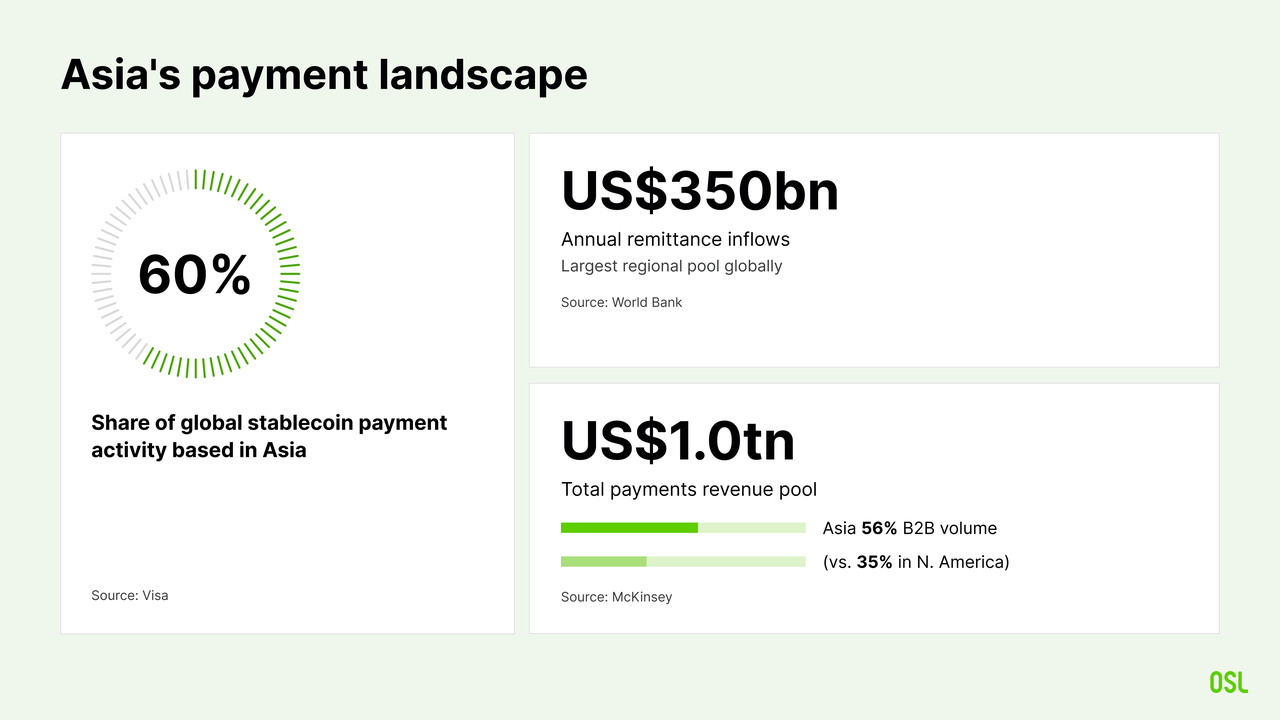
Asia is the world’s B2B engine:
Regulatory readiness: Market demand vs. licensing
Where demand is surging and where the rules allow you to operate don’t always align. Before scoping a new corridor, check both ends of the flow against this matrix*:
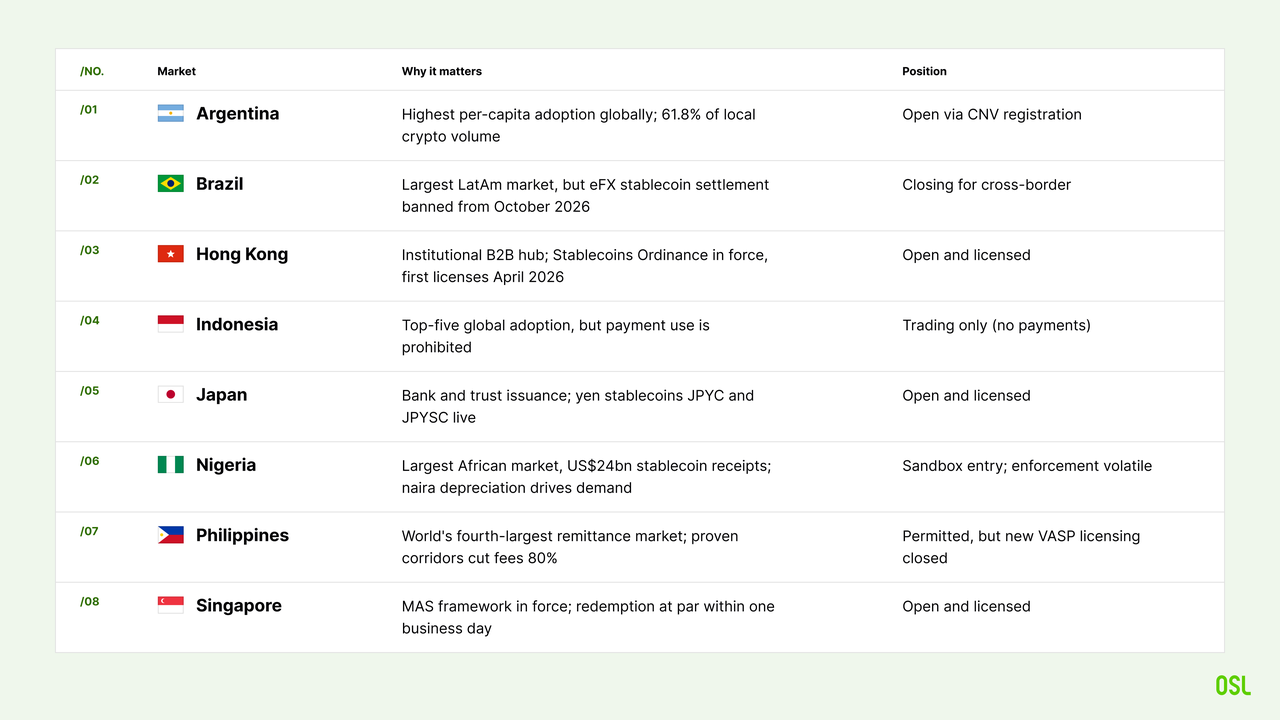
HIGH ADOPTION IS NOT PERMISSION Check the specific activity you intend, in the specific market, at both ends of the corridor. Then write down what the business does if the rule changes — because in this market, sometimes it does. |
|---|
This is also the best reason to run corridors through a licensed partner rather than assembling them yourself. The regulatory position at both ends is something you want monitored, not researched once.
* Enterprise users operating in these corridors must ensure their settlement flows strictly adhere to applicable local foreign exchange and payment regulations, and should seek independent local legal advice.
4. What OSL connects
A regulated core, deep liquidity, and end-to-end corridors with a single counterparty.
Where you are licensed and where you settle don't have to be the same place. The best setups keep licences and bank relationships in heavily regulated financial hubs where oversight is clear and institutional liquidity is deep — then pay out directly into markets where legacy cross-border fees run prohibitively high and correspondent banks are hard to find.
Regulated at the start, practical at the end. That is exactly what OSL runs.
Our four connection points
Global reach, local delivery
OSL connects supported fiat currencies and local payment rails to global payout capability, so value arrives in a beneficiary's own bank account through domestic clearing rather than stopping at the border.
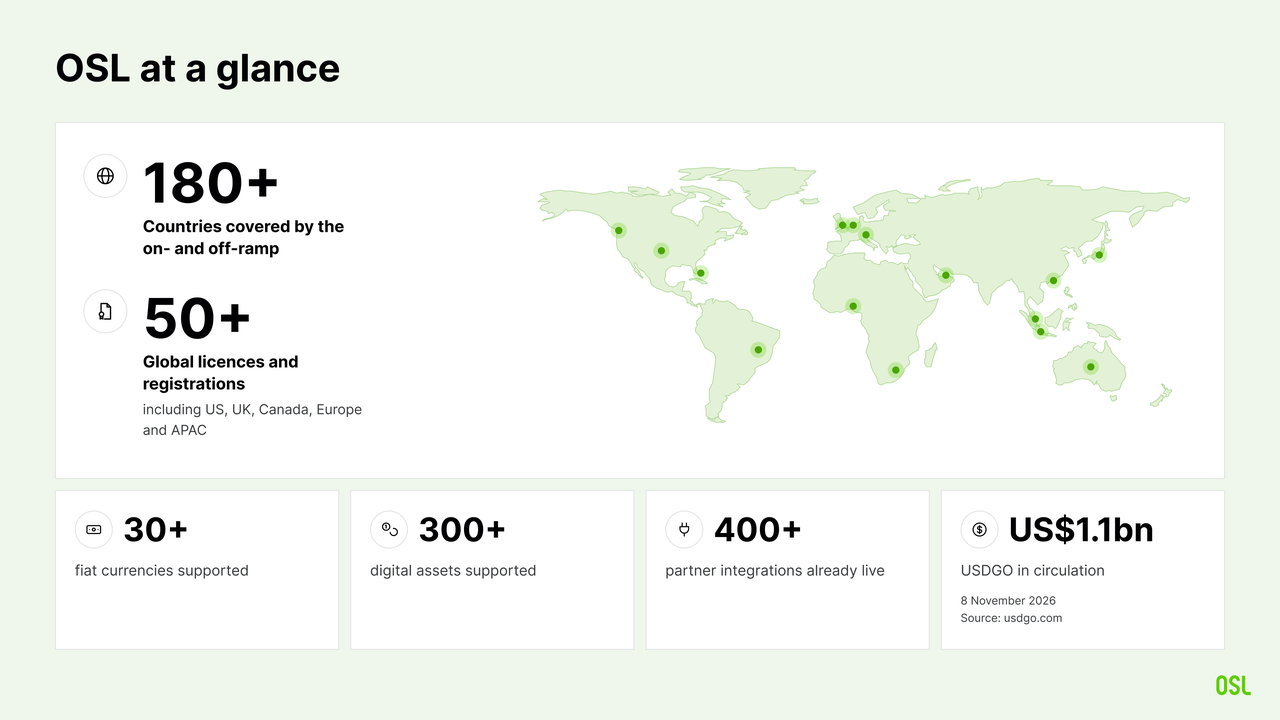
OSL runs dedicated payment corridors in active regions like Australia, Nigeria and Indonesia (where OSL Indonesia operates as a locally licensed entity).
Fiat-to-stablecoin connectivity
The stablecoin sandwich in production: fiat in, on-chain settlement where it helps, fiat out. Your counterparties never touch a token. With OSL Business, accept stablecoins globally, settle instantly, and pay out suppliers or customers in their local currency over everyday domestic rails.
You may choose to settle payments in USDGO, which OSL distributes. It is issued by Anchorage Digital Bank N.A., a US federally chartered bank. USDGO started with US$50M, crossed US$1B in circulation in July 2026.
Institutional liquidity and FX
A payment rail without real liquidity quotes spreads it can't honor at scale. OSL embeds deep institutional FX and treasury capabilities directly into the settlement layer — ensuring tight pricing holds as volume grows.
Conversion and liquidity connected to the payment route, not sourced separately beside it.
Depth in APAC and emerging-market pairs, where corridor economics are actually decided.
Execution available at the hours stablecoin rails actually run.
Infrastructure that fits your business model
56% of corporates want embedded treasury APIs — only 2% want self-hosted wallets — and 70% would be more willing to adopt them if stablecoins were integrated into their ERP. The core architectural decision is simple: how instructions leave your systems, and how reconciliation returns.
Intelligent routing: OSL's system automatically selects the optimal network, asset, and path. No manual chain selection.
Audit-ready controls: Multi-sig approvals, role-based permissions, velocity limits, and allowlists that mirror your corporate mandates.
Round-the-clock operations: Stablecoins settle 24/7/365, which means your escalation line needs to be awake too. Ask us for it by name and response time.
5. What to plan for before launching
Move from business case to production with institutional controls.
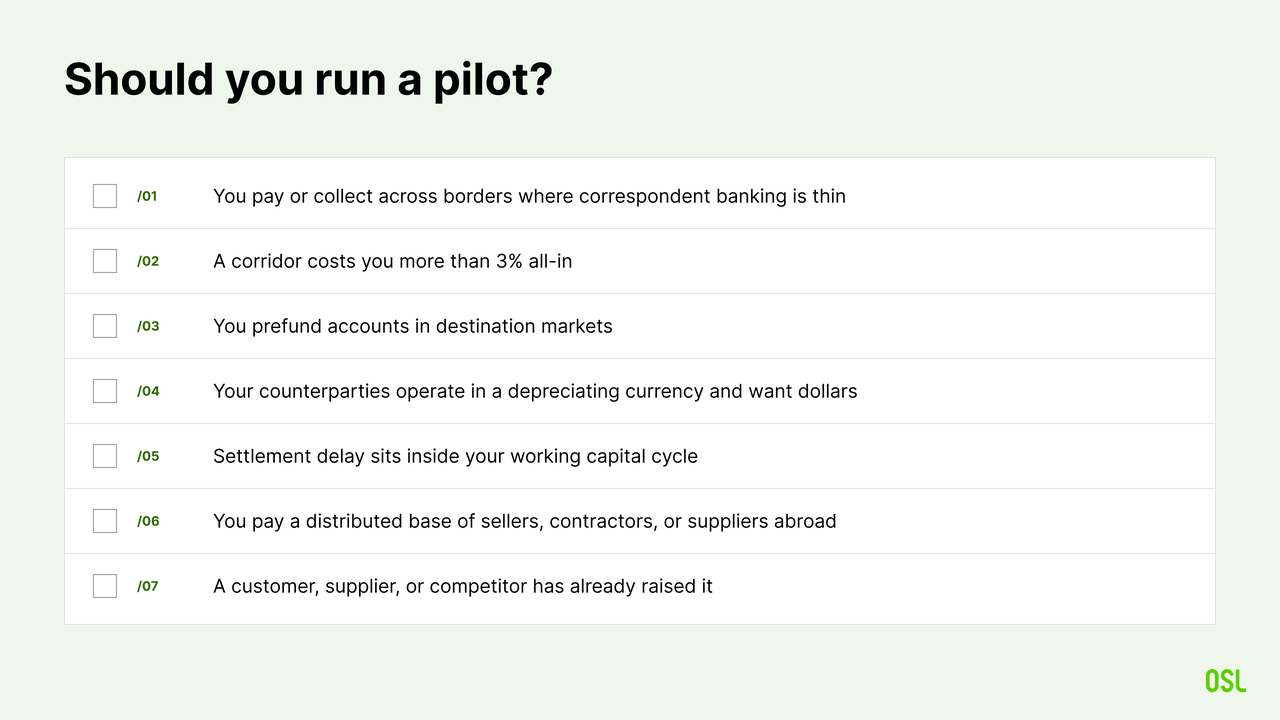
Does your business have a case?
Three or more of these pointing "yes" and you have a pilot worth running:
Things to lock down before going live
Beneficiary onboarding. How an address is received, verified independently of the channel it arrived on, test-transferred and whitelisted. This is the single most important new control, because address substitution fraud targets exactly this step.
Approval thresholds mapped to your existing payment authority matrix, with multi-signature approval above a defined level.
Direct integration so reconciliation is automatic rather than relocated. A platform that produces a file someone keys in has moved the work, not removed it.
Automatic routing across chains and tokens. Nobody on your team should choose a network per payment.
HOLD THE PILOT TO A REAL NUMBER 75% of corporate non-users say they would expect a saving of 10% or more before adopting. Among firms already using stablecoins, 41% report savings at or above that level – a bar cleared in practice. Measure landed cost including FX spread against the baseline recorded before you started. Count the capital released from prefunded float separately: it is usually the bigger number, and it lands on the balance sheet rather than in a cost line. |
|---|
Next step: Talk to the OSL team
To make the conversation practical right away, bring two numbers:
Your active cross-border corridors
Your current all-in costs per corridor (including FX spreads and bank deductions)
OSL unifies the entire stack: local fiat access, regulated stablecoins, deep institutional liquidity, and domestic payout rails. One connected infrastructure layer to collect, convert, settle, and pay out globally.
Start with one corridor We will review your corridors, confirm the regulatory position at both ends, and scope a pilot. |
|---|
Download Full Report
Click the button below to download the full stablecoin playbook by OSL.
Disclaimer
This guide is published by OSL Group for informational purposes only. It does not constitute professional advice, nor an offer, solicitation, or binding commitment regarding any digital assets or payment services. Digital asset transactions and stablecoins involve counterparty, liquidity, and regulatory risks, while cross-border capabilities remain subject to local regulations, licensing, and network availability. Actual results may differ materially from forward-looking statements, which OSL Group assumes no obligation to update. Furthermore, products and services are available only in jurisdictions where legally permitted. In Hong Kong, referenced products may constitute Specified Stablecoins under the Stablecoin Ordinance (Cap. 656). The issuers and OSL Group are not licensed for Regulated Stablecoin Activities; however, as a Permitted Offeror, OSL Group offers these products in Hong Kong exclusively to verified professional investors.
See how OSL can support your business
Talk to our team about your specific needs
Related
Beyond payments: How stablecoin lending is becoming a 24/7 credit rail
Swapping Swaps for Stablecoins: How LatAm Corporations Left T+3 Behind