Stablecoin Payment Weekly Vol. 15: The Strength of Stablecoins Lies in the Last Mile of Payment
OSL Research Trainee Analyst
Kelly Wang Email: [email protected]
I. Weekly Stablecoin Payment Data
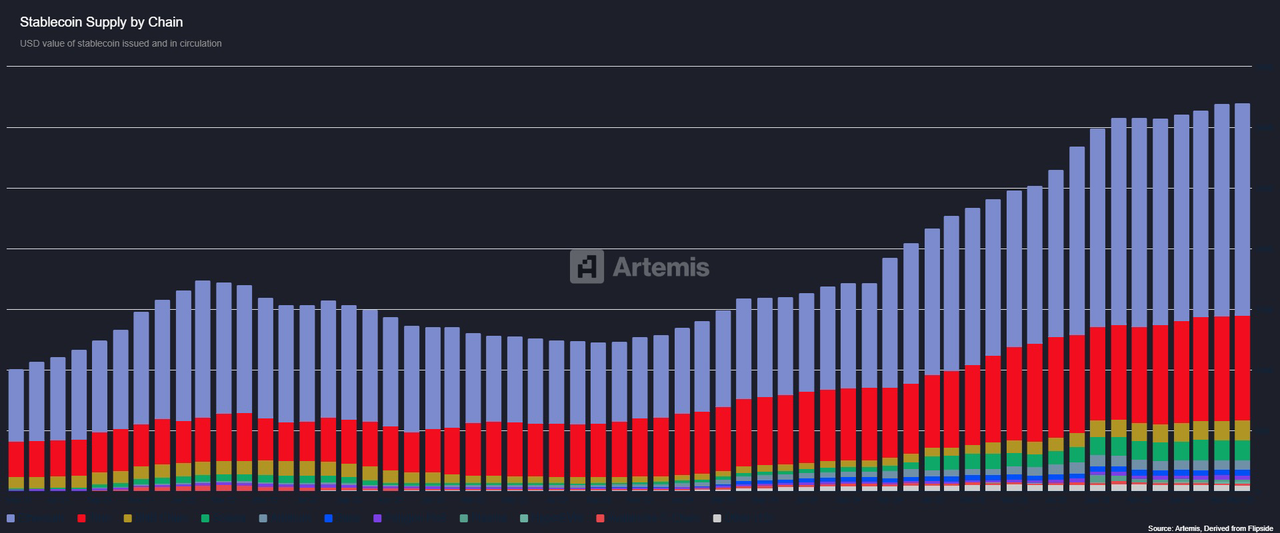
As of 2026-04-09 (7-day rolling window), the total market capitalization/supply of stablecoins is approximately $320.5 billion, remaining stable within the $320 billion plateau.
Messari observations indicate continued active stablecoin transfers, with cumulative volume exceeding $10.80 trillion over the past 30 days, fluctuating between $330 billion and $360 billion daily. On a 7-day basis, total transfer volume remains within the $2.3–$2.5 trillion range.
After excluding market making, wash trading, and bot activity, OSL Research estimates the "effective" volume to be approximately one-fifth of the total, corresponding to a range of $460-$500 billion over the last 7 days.
Top 3 Stablecoins by Market Cap Growth This Week:
Global Dollar (+9.11%; Weekly Volume $1.62B, -30.78%)
Monerium EUR emoney (+4.91%; Weekly Volume $32.15M, -64.21%)
Frax USD (+3.76%; Weekly Volume $118M, -8.40%)
OSL Research Growth Insights:
Global Dollar (USDG): Market cap grew by 9.11% this week. Issued by Paxos Digital Singapore and regulated by the Monetary Authority of Singapore (MAS), USDG is backed 1:1 by USD reserves. Approximately 97% of reserve income is distributed to Global Dollar Network (GDN) partners (e.g., Kraken, Robinhood, Anchorage) to incentivize institutional participation in liquidity building.
Monerium EUR emoney (EURe): Market cap grew by 4.91%. As a regulated electronic money issued by an authorized Icelandic EMI, its main advantage lies in SEPA instant transfers (<60s, zero fees). Growth is driven by Euro-denominated payment demand, shifting from active turnover to "sticky" holdings for cross-border payroll and settlement scenarios.
Frax USD: Market cap grew by 3.76%. Backed 1:1 by tokenized US Treasuries (e.g., BlackRock BUIDL) and cash equivalents. The core driver is the "day-one" default stablecoin listing on Aave V4 and its yield-sharing mechanism, attracting significant DeFi liquidity and institutional allocation.
II. Stablecoin Payment & Infrastructure Highlights
Chainalysis Predicts Stablecoin Annual Volume to Reach $1,500 Trillion by 2035
Chainalysis reports that stablecoins processed $28 trillion in actual economic activity in 2025. Driven by intergenerational wealth transfer and infrastructure expansion into offline retail, volumes are projected to surge by 2035, matching Visa and Mastercard in transaction frequency.
Observation: Stablecoins are structurally eroding traditional finance's core business as a payment infrastructure, evolving from liquidity tools to systemic payment rails.
2. Bitget to Offer OpenAI and Other IPO Subscriptions via Stablecoins
Bitget plans to allow high-net-worth clients to subscribe to high-valuation private equities like OpenAI using platform-native stablecoins, challenging traditional investment banks and OTC platforms.
Observation: This model accelerates the binding of RWA with crypto-native capital, forcing a transition toward on-chain settlement in traditional markets.
3. White House Economist: Stablecoin Yields Do Not Harm Bank Interests
According to Bloomberg, White House economists suggest stablecoin yields have a negligible crowding-out effect on bank deposits, noting that banning yields would only increase lending by 0.02%.
Observation: This narrative seeks to downplay systemic risks, providing a policy buffer for stablecoin expansion in the U.S. while tacitly acknowledging the existence of a high-yield parallel system.
4. FDIC Proposes Stablecoin Regulatory Rules for Reserves and Redemption
The FDIC has drafted new regulations requiring issuers to meet standards in reserves, capital, and custody. While reserve deposits are insured, this protection does not extend directly to stablecoin holders.
Observation: This framework builds indirect credit backing while securing a strategic position for traditional banks in the on-chain custody and reserve management space.
5. South Korean Financial Institutions Pilot Stablecoin Payments for Foreign Users
Hana Financial and BC Card, among others, are collaborating with Circle and Crypto.com to test USDC payments via a "regulatory sandbox" approach, bypassing local legislative delays to build cross-border infrastructure.
Observation: Institutions are utilizing policy vacuums to validate business models and secure early-mover advantages in global liquidity entry points.
6. Polymarket to Launch Native Polymarket USD
Polymarket announced a major upgrade to its trading engine, including the introduction of Polymarket USD (backed 1:1 by USDC) to reduce gas costs and optimize matching efficiency.
Observation: This represents vertical integration of trading infrastructure to lock in institutional capital through enhanced security and efficiency standards.
7. Clarity Act to Approach Committee Review in Late April
Compromises between the crypto industry and the banking sector regarding stablecoin yield mechanisms appear imminent, potentially shifting legislative focus toward DeFi and asset tokenization.
Observation: Regulators are signaling optimism to bridge gaps, using legislative delays as a strategic buffer to prioritize key issues like DeFi and token classification.
8. USDT Issuance on Ethereum Surpasses Tron
USDT issuance on the Ethereum network has recently overtaken Tron, sparking views that Ethereum will become the financial backbone of Wall Street-driven on-chain infrastructure.
Observation: The focus of institutional deployment is shifting from native token price volatility to the control of USD liquidity gateways.
III. Regulatory & Policy Signals
U.S. Treasury to Propose New AML Rules for Stablecoins FinCEN and OFAC intend to require stablecoin issuers to establish robust AML and sanctions compliance systems, including the ability to freeze suspicious transactions. This aligns with the GENIUS Act to secure central control over USD liquidity.
2. South Korea Proposes Digital Asset Basic Act The ruling party’s bill categorizes stablecoins as a special asset class, requiring issuers to obtain licenses and meet strict capital and reserve requirements. This aims to establish South Korea as a regional leader in crypto compliance.
IV. Analyst Commentary: The Strength of Stablecoins Lies in the Last Mile of Payment
By Kelly Wang, Junior Analyst at OSL Research
In 2025, the on-chain transaction volume of stablecoins has surged to $33 trillion, with a market capitalization firmly standing at $300 billion, far exceeding many sovereign currencies. But what truly alerts me is not these grand figures, but an invisible yet fatal crack in user behavior: a large number of holders no longer treat stablecoins as a "shadow of the dollar in a wallet," but as an extension of real income—freelancers, gig workers, and cross-border sellers treat stablecoins directly as their pay stubs; they want to spend it as soon as they receive it, with an extremely strong intent to circulate.
The logic behind this shift is not complex, yet it is overlooked by many. Traditional finance "traps" money in accounts, where users can only passively accept risks of devaluation, delays, and freezes; over time, they develop a defensive habit of "hoarding it for later." Stablecoins, however, "release" the money. They solve three structural problems that trouble users most in one go: hedging against local currency devaluation, instant arrival of cross-border payments, and low-cost global accessibility. Consequently, user behavior has undergone a fundamental change—from passive holding to active circulation.
Money is no longer a reserve lying in a wallet, but flowing fuel: stablecoins received today might be used tomorrow to buy goods, pay bills, or even conduct cross-border procurement. This "hot money" attribute is the result of users voting with their feet. It’s not that they don’t understand the risks, but they clearly see that stablecoins have unified "value preservation" and "usability" for the first time, finally allowing currency to possess both a sense of security and immediacy. The psychological liberation brought by this sense of unity is far deeper than surface-level convenience: for the first time, users feel their income is no longer a passive asset "custodied" by the banking system, but an active resource they can control at any time.
Looking deeper, this behavioral upgrade actually exposes the psychological gap between crypto users and traditional finance users. Traditional users treat the US dollar as a "safety cushion" and prefer to leave it untouched for a long time because, in their minds, they divide money into two distinct drawers—"savings" and "consumption"—fearing that any movement will expose them to risk. Stablecoin users, however, treat it as "operational cash."
Why?
Because in their real world, stablecoins are not investment products, but income tools. They directly fill the gap left by traditional banks: freelancers no longer have to wait three days for cross-border payments, and gig workers don't have to worry about their local currency suddenly devaluing by 20%. Users internalize stablecoins as "modern pay stubs"—as soon as the money arrives, they start planning how to spend it, with a circulation velocity far exceeding that of ordinary bank deposits. This behavior is not an impulse but a rational rebound after long-term accumulation of pain points. Users have finally found a form of currency that can both preserve value and be mobilized at any time. It breaks the "liquidity dilemma" of traditional currency: previously, the safer it was, the harder it was to use; the easier it was to use, the less safe it was. Now, users possess both safety and convenience for the first time. This is not just a change in payment methods, but a re-answering by users to the question of "why money exists"—the meaning of money's existence is no longer pure reserve, but to truly flow in life.
More importantly, the user stickiness brought by this liquidity is something traditional finance struggles to rival: when stablecoins truly become part of daily cash flow, user dependence on them will far exceed any speculative asset because they have become embedded in the actual rhythm of the user's life.
But it is precisely here that stablecoins are stuck at the "last mile."
User intent has long exploded, but it is severely dragged down by payment paths. What they truly want is an exit that is "as seamless as swiping a card." They don't care about stablecoins lying in their wallets, but they hate having to think about the network, calculate gas fees, worry about irreversible risks, and face the embarrassment of merchant non-acceptance every time they spend.
Behavioral economics provides a more blunt explanation here: user payment decisions follow the "principle of least effort" and "loss aversion"—they are too lazy to do it if there's an extra step, and any potential loss seems particularly terrifying. The result is that a large amount of stablecoins remain in a "semi-liquid" state: users clearly want to spend them but can only convert them to fiat first before consuming, losing time, exchange rates, and patience in the process.
It’s not that users are immature, but that existing product designs have turned the last mile into a muddy path, forcibly locking "hot money" that should flow smoothly inside wallets. More importantly, this bottleneck will conversely affect users' long-term behavior: they start to reduce their reliance on stablecoins, turning to them only when necessary, which ultimately greatly discounts the true utility of stablecoins and may even push some users back into the arms of traditional finance.
By carefully deconstructing the barriers to user behavior, one can see how triple frictions turn intent into empty talk.
The first friction is operational complexity. At the moment of payment, users must simultaneously deal with network selection, fee estimation, and the psychological pressure of irreversibility; a single consumption instance instantly becomes mental labor. What should have been a pleasant card-swiping moment becomes a process of calculation and trade-offs, which directly consumes the user's decision-making energy.
The second friction is low merchant acceptance. Users have stablecoins but find that merchants do not accept them, forced to take an extra step to convert to fiat. This essentially reverts the greatest advantage of "instant payment" back to its original form and makes users feel they are still using something "fringe," further weakening their trust in stablecoins.
The third friction is the gap in trust and protection. Especially in mature markets, users care deeply about consumer rights and reversibility; they worry that when problems arise, the "dollar equivalent" attribute of stablecoins cannot provide the same refund protection as traditional credit cards.
These triple frictions stacked together form systemic resistance: user behavior is clearly ready, but is stuck dead by product paths. Worse, it creates a vicious cycle—the more troublesome users find it, the less they try; seeing insufficient demand, merchants are even less willing to integrate, ultimately locking stablecoins forever in the position of "wallet assets," leaving something that should have become a mainstream payment tool stuck in the niche experimental stage. The danger of this vicious cycle lies in its gradual erosion of user confidence in the entire crypto ecosystem: after repeated frustrations, users might think, "No matter how good stablecoins are, they are still not 'daily' enough," thereby transferring more funds back to traditional bank accounts.
This mismatch is particularly evident among users in different global regions, further proving the underlying logic that "local pain points determine the speed of behavior."
In APAC and Africa, where traditional infrastructure is weakest, user behavior is most aggressive. They directly use stablecoins as the default currency for remittances, payroll, shopping, and daily consumption, following a "leapfrog" path: skipping outdated banking systems and using stablecoins as a closed-loop tool for income and expenditure. The last mile is actually the shortest here because the demand is most primitive and urgent—users need a tool that can truly be "spent," not another crypto app to learn. They treat stablecoins as a lifeline rather than an optional asset, pushing the intent to circulate to its peak. In these markets, users even proactively educate friends around them to use stablecoins because it is no longer a "crypto toy" but real-life infrastructure.
Conversely, in mature European and American markets, users are more conservative. They value reversibility and regulatory endorsement, so while their payment intent is high, their actual actions are more cautious, preferring a way that integrates seamlessly into traditional payments. They repeatedly weigh "what if something goes wrong," thus demanding higher consumer protection from products. Regional differences are not isolated examples but natural results of the same user logic in different soils: the deeper the pain point, the more users treat stablecoins as a "lifesaving tool"; the more mature the environment, the more users need "seamless embedding."
This also reminds us that the length of the last mile is never globally uniform; it is determined collectively by local economic structures, cultural trust, and infrastructural history. Ignoring this, any product design will hit a wall in different markets and even miss out on the user groups with the most growth potential.
Connecting these clues, the last mile of stablecoin user behavior becomes clear: it is easy for users to complete the cognitive leap from "wallet asset" to "hot money tool"; they will treat stablecoins as income, cash flow, and payment fuel, eager to let them flow in daily life. But friction often jams the intent on the path, leading to a severe mismatch between supply and demand.
The core lies in the fact that it was never "insufficient intent" on the user side, but "insufficient paths." What users need is not education, but for products to bundle all backend complexities (conversion, compliance, reconciliation, risk control) and return the frontend to the most familiar experience—as natural, seamless, and reversible as swiping any card. Only then can users completely treat stablecoins as a daily payment tool rather than "spare change" moved occasionally.
Furthermore, this last mile actually tests the user-centric thinking of the entire industry: do we continue to dump complexity onto the user, or do we bravely keep complexity in the backend so that the user only feels simplicity? If the industry cannot complete this shift in thinking, user behavior will remain in a "semi-finished" state, and the massive potential of stablecoins will never be fully released.
For the last mile of stablecoins, users are already prepared for daily payments, just waiting for products to completely smooth out the friction.
This is not a technical competition, but true respect for the logic of user behavior. Whoever understands this layer first will hold the key to the next generation of payment tracks. After all, in the face of user behavior, all grand narratives must eventually land on that one simple, smooth consumption experience. Only when users truly treat stablecoins as "money in their pocket" used every day, rather than "wallet assets" checked occasionally by opening an app, will the last mile of stablecoins be truly completed.
Disclaimer and Disclosure
1. Nature of Document
This document (“Document”) has been prepared solely by internal personnel of OSL for informational purposes. It does not constitute investment, legal, tax, or other professional advice and should not be relied upon as such. No part of this Document may be reproduced, distributed, or transmitted to any third party in any form without the prior written consent of OSL.
This Document does not constitute an offer, solicitation, marketing material, product disclosure, or legal document, nor does it form the basis of any binding contract or commitment. It is intended solely to provide OSL’s observations and strategic insights on the industry and does not represent OSL’s official opinions, strategies, or decisions.
The authors are not independent research analysts, and this Document does not constitute “investment research” as defined under applicable laws and regulations. Accordingly, it has not been prepared in accordance with legal requirements designed to promote the independence of investment research and is not subject to any pre-dissemination trading restrictions.
2. Non-Reliance
The information, opinions, and analyses contained herein are based on publicly available information and OSL’s internal judgment. They do not take into account the individual objectives, financial circumstances, or needs of any recipient. This Document is not a personal recommendation or solicitation to buy, sell, or otherwise transact in any financial instrument, product, or service.
Before making any investment or other decision, recipients must consult their own independent advisors, considering their individual circumstances, objectives, experience, and resources. All investments involve risk; values may fluctuate, and investors may receive less than the original invested amount. Past performance is not indicative of future results.
3. Accuracy, Completeness, and Limitation of Information
This Document is based on information that OSL considers reliable; however, OSL has not independently verified its accuracy, completeness, or fairness. Reasonable care has been taken to ensure that the content is not false or misleading, but OSL makes no representation or warranty, express or implied, regarding its accuracy, completeness, fairness, or reasonableness.
OSL is not responsible for any errors, omissions, or consequences arising from reliance on third-party information referenced herein. Performance of any discussed instruments, entities, or strategies may be materially affected by market, regulatory, technical, or other factors.
4. Forward-Looking Statements
This Document may contain forward-looking statements that involve known and unknown risks, uncertainties, and other factors. Actual results, performance, or achievements may differ materially from those expressed or implied. OSL does not undertake any obligation to update, revise, or withdraw any forward-looking statements.
5. Conflicts of Interest
OSL, its affiliates, and employees may hold positions in, or engage in transactions involving, the assets or entities discussed herein. The authors or other personnel involved in the preparation of this Document may receive compensation that is linked to the performance of OSL’s business. OSL has implemented policies and procedures to identify and manage potential conflicts of interest.
6. Intellectual Property and Restrictions on Use
This Document is protected by copyright and is intended solely for the designated recipient. Recipients may store, display, analyze, modify, reformat, and print this Document for their own internal use only. Recipients may not, without OSL’s prior written consent:
Resell, redistribute, or commercially exploit this Document;
Reverse engineer, extract, or create derivative works, including for training or use in machine learning/artificial intelligence systems;
Publish or transmit this Document to third parties
7. Limitation of Liability
To the maximum extent permitted by applicable law, OSL, its affiliates, officers, employees, and agents shall not be liable for any direct, indirect, incidental, consequential, or special damages arising from or in connection with the use of, reliance upon, or interpretation of this Document, including but not limited to:
Loss of profits;
Business interruption;
Data loss;
Reputational harm.
8. Global Distribution Notes
Recipients are responsible for compliance with local laws. Distribution of this Document may be restricted in certain jurisdictions. Recipients must ensure that it is not distributed to any person or entity to whom such distribution would be unlawful.
Start your safe cryptocurrency journey now
OSL | Secure Ramps. Trusted Rails !
More topics
More topics
Latest
Stablecoin Weekly Pulse | Vol. 22: Welcome to the “Trump Resort”
Even once the rules are set, who really wins? When the high rollers cash out, will they tip off whoever’s left at the table that it’s time to go too?

Stablecoin Weekly Pulse | Vol. 22: Welcome to the “Trump Resort”
From Bank Killer to Bank Builder: Kraken's Strange Turn
Payward, the parent company of crypto exchange Kraken, is exploring how to become a "full bank" outside the United States.
From Bank Killer to Bank Builder: Kraken's Strange Turn
Stablecoin Weekly Pulse | Vol. 21: Tokenized Deposits vs Stablecoins
As tokenized deposits and stablecoins converge, the battle over financial infrastructure intensifies — each side sees the other's missing piece, but neither will surrender its core moat.

Stablecoin Weekly Pulse | Vol. 21: Tokenized Deposits vs Stablecoins
Stablecoin Weekly Pulse | Vol. 20: The Stablecoin Express: Next Stop, Card
Stablecoins aren’t just an issuance game — the real battle is over infrastructure, channel capital, and users.

Stablecoin Weekly Pulse | Vol. 20: The Stablecoin Express: Next Stop, Card
Stablecoin Weekly Pulse | Vol. 19: The Market Potential for Compliant, Enterprise-Grade Stablecoins
Stablecoin activity cooled while firms kept investing. Vol. 19 examines regulation and enterprise demand across emerging-market payment corridors.

Stablecoin Weekly Pulse | Vol. 19: The Market Potential for Compliant, Enterprise-Grade Stablecoins

Recommended for you
More topics
More topics
