USDGO and Stablecoin Payments: Building Compliant Cross-Border Settlement

Welcome to Issue 11: Essential Updates in Stablecoin and Payments
Hello subscribers—thank you for joining our weekly deep dive into traditional payments and digital asset flows. This edition highlights artificial intelligence agents completing 1.4 billion payments in nine months (98.6% via USDC), Mastercard's new crypto partners program with 85 participants including Circle and Binance, and Wells Fargo's WFUSD trademark filing.
2026 update: what readers should check first
This refresh turns the article into a practical stablecoin decision guide. Readers should verify reserve quality, redemption access, jurisdiction, liquidity, fees, and compliance fit before choosing a token, exchange, or payment route.
Question | What to check | Why it matters |
|---|---|---|
Reserve and issuer | Issuer disclosures, reserve composition, attestations, and redemption terms. | Weak transparency can raise depeg or liquidity risk. |
Liquidity and network | Supported chains, spreads, withdrawal costs, and settlement time. | A stablecoin is only useful if it can move and redeem efficiently. |
Compliance fit | Jurisdiction, KYC, account records, and counterparty requirements. | Business payments and fiat exits depend on auditability. |
User action | Use regulated platforms, keep transaction records, and test small transfers first. | Operational mistakes are often more costly than headline fees. |
Related reading: USDT and USDC comparison | Stablecoin payments vs banking rails | Fiat-to-crypto on-ramp guide.
FAQ: stablecoin safety and use cases
Is the stablecoin fully backed, and where can users verify the reserve information?
Which network should users choose for lower fees and fewer operational mistakes?
Can the stablecoin be redeemed or converted to fiat through a regulated route?
What records should businesses keep for compliance and reconciliation?
We also explore regulatory advancements in Hong Kong, the United Kingdom, and Australia. As always, we deliver detailed data, news summaries, and expert analysis to equip fintech leaders, payment experts, and cryptocurrency strategists with the insights needed to navigate evolving markets. If you are new, subscribe to receive these professional updates directly in your inbox each week.
Quick Share Tag: AI agents rack 1.4B payments (98% USDC), Mastercard partners 85+, Wells Fargo WFUSD—regs tighten. OSL USDGO builds compliant ecosystem.
1. This Week's Stablecoin Payment Data
As of March 12, 2026 (7-day rolling basis), the total stablecoin market capitalization and supply stands at approximately $313.2 billion, maintaining its position in the $310 billion range. This steady level reflects resilient demand in a dynamic market.
Messari data indicates continued transfer activity, with cumulative volumes over the past 30 days exceeding $8.81 trillion. Daily averages range from $291 billion to $300 billion; extrapolating, the past 7 days likely saw totals between $1.8 trillion and $2 trillion. These figures highlight stablecoins' key role in high-volume on-chain transactions.
Adjusting for long-term noise, OSL Research estimates the "effective" volume—excluding market-making, self-transactions, and automated bots—at roughly one-fifth of the total, placing the past 7 days around $360 billion to $400 billion. This adjusted metric focuses on genuine economic transfers, providing a clearer picture of real-world utility beyond automated noise.
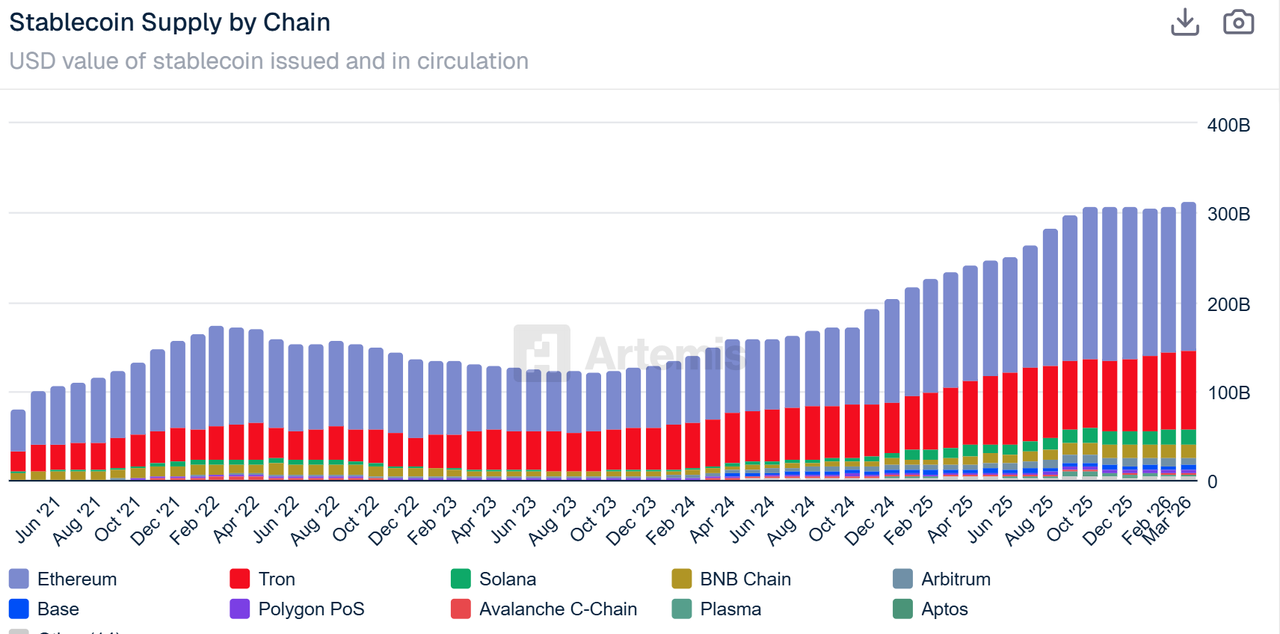
(Data sources: Messari, Artemis, OSL Research)
("Effective" = adjusted data, excluding non-economic noise.)
OSL Research Growth Observations
This week's top three stablecoin/protocol growers by market capitalization:
1. Monerium EUR emoney (+7.42%; weekly transfers $1.69M, -38.51%)
The weekly growth is driven by institutional capital inflows. This stablecoin operates under a compliant electronic money institution model with 1:1 euro backing. The 7.42% increase in market capitalization primarily reflects large deposits rather than trading. Transfers dropped, diverging from gains—suggesting "hold and settle" behavior for treasury or cross-border needs, not active DeFi.
2. Cap USD (+4.46%; weekly transfers $24.76M, +21.60%):
Growth stems from Cap Protocol's role as a reliable financial guarantee engine for stablecoins. It introduces external yield sources and risk transfer mechanisms to restructure yield distribution: Depositors get low-risk base rates, operators capture diverse strategy yields, and re-stakers earn shares while bearing failure risks. Funds exhibit "flow and turnover" characteristics, primarily in lending pools.
3. Sky Dollar (+3.75%; weekly transfers $13.43B, -48.63%):
Driven by high yields from sUSDS savings pool (APY ~7.75-8.00%: SSR base 3.75-4.00% + Sky Token Rewards 3.99%). Sky Protocol is Ethereum's top revenue earner, with net profits fueling expansion. Scale needs stronger backing to avoid depegs. March 10 governance proposal adjusts SKY buybacks, redirecting ~67.5% excess profits to reserves for USDS security while keeping staking appealing.
2. This Week's Stablecoin Payments and Infrastructure News
1.Artificial Intelligence Agents Complete 1.4 Billion Payments in 9 Months, 98.6% USDC
The x402 protocol—backed by Coinbase and others—embeds stablecoin payments into internet layers for artificial intelligence agent auto-transfers. Currently, about half of on-chain transactions are tests or games, with real commerce in early stages. Circle's Peter Schroeder cited Enterprise Onchain: In the past 9 months, artificial intelligence agents handled 140 million payments totaling $43 million, with 98.6% settled in USDC and an average of $0.31 per transaction. More than 400,000 agents now have buying capabilities.
Insight:
x402's embedded design aims to integrate artificial intelligence micro-transactions into internet stacks—a potential battle for artificial intelligence payments standards, similar to HTTP's evolution. It amplifies USDC liquidity; the 140 million transactions at 99% USDC and $0.31 average highlight stables' edge in automated micros.
2. Bernstein: Circle Stock Has 60% Upside from Stables/Artificial Intelligence Finance
Bernstein report: USDC issuer Circle (CRCL) stock could hit $190—60% upside from recent doubles—driven by stable adoption and agentic finance. Despite volatility, USDC near $78B high.
Insight:
Stables decoupling from crypto cycles; strong in digital payments (Visa integrations, Circle Payments Network for cross-border). Artificial intelligence agent transactions surge—stables as machine infrastructure. "1 cent, 1 second, 1 click" vision.
3. BNB Chain Hits 15.1M Monthly Unique Stable Senders
February 2026: BNB Chain's monthly unique stablecoin senders reached 15.1 million—top among chains. Holds ~5% global supply but processes 40% volumes; 82% transfers < $1K. Stable volumes +133% YoY; peak daily $21.7B.
Insight:
BNB Chain leverages low gas and Binance ecosystem for circulation speed—strategic high ground in stable flows. Focuses retail small-payments over institutional bulk; early-stage but regulatory scrutiny rises with frequency.
4. International Regulators Warn on Stables/Non-Custodial Wallets for Sanctions / Laundering
FATF report: Stables via non-custodial wallets P2P transfers risk AML/CFT/CPF bypass. Recommends risk assessments, enhanced KYC, blockchain analytics; limits/restrictions on non-custodial transactions; collaboration suggestions.
Insight:
FATF flags non-custodial as prime AML amplifier for stables—systemic warning on decentralized payments. Regulations will shift from cross-jurisdiction issues; pushes layered licensing, transaction caps, mandated regulated inter-flows.
5. Insurance Giant Aon Tests Stable Premiums with Coinbase/Paxos
Global broker Aon completed stablecoin premium settlement PoC with Coinbase / Paxos —using USDC (Ethereum) and PayPal USD (Solana). First major global broker testing stables for premiums (controlled).
Insight:
Traditional premiums via banks take days cross-border; blockchain stables minutes + transparent records. Tests reflect stables expanding in TradFi—costs from regulations cross-jurisdiction.
6. Societe Generale Deploys EURCV to Stellar
法国兴业银行's crypto unit deployed euro stable EURCV to Stellar. Launched 2023 on Ethereum; now Solana/XRP Ledger/Stellar. MiCA-compliant; cap ~$45M.
Insight:
Stellar's low fees/fast finality amps EURCV in micro-payments/P2P; cap far below USD stables but multi-chain expands liquidity aggregation. Eurozone regulations tighten—institutional edge in tokenized RWAs.
7. Wells Fargo Trademarks "WFUSD" for Stables/Digital Assets
富国银行 filed "WFUSD" trademark with USPTO—covers digital asset software, crypto exchanges, stable/transaction processing, tokenization platforms. Classes 009/036/042. Status pending. Past investments: Elliptic / Talos.
Insight:
Replicates JPM Coin path—systemic bank from observe to layout USD anchors via GENIUS. "WFUSD" points bank-grade deposit token/stable over payment tool.
8. X Money "X Card" Visa Debit: 3% Cashback, US Beta Applicants Open
X Money's physical "X Card" debit—Visa-issued, US beta users apply. Custom covers, 3% cashback all spends, cross-border FX, metal card w/ X username.
Insight:
Cuts into retail payment/social monetization—loyalty to sticky pools. On-regulated Visa network from non-bank digital assets.
9. Mastercard Crypto Partners Program: Circle/Binance +85 Join
Mastercard launched global partners program—85+ DA firms / payment / institutions ( Circle / Binance / Gemini etc.) join to scale assets into payments. Offers card programs, global merchant acceptance, cross-border settles. Stables alt to traditional networks; Mastercard/Visa layout since 2021—bridge to existing systems.
Insight:
Card networks from defense to ecosystem alliance—standard interfaces/compliance channel on-chain pays to merchant networks. Avoids stables bypassing traditional infra.
4. Analyst Observation: OSL's New Pivot: USDGO Builds Compliance-Driven Cross-Border Payments Ecosystem
Analyst: Kelly Wang, Junior Analyst,
OSL Research
In the rapidly evolving global digital asset and stablecoin market, with regulatory frameworks becoming increasingly defined, OSL Group—as one of Hong Kong's first licensed digital asset platforms—is accelerating its transformation from a single-focus trading service provider to a comprehensive digital financial infrastructure operator driven by both trading and payments. USDGO stands as the core pillar supporting this strategic upgrade.
USDGO is issued by the U.S. federally regulated digital bank Anchorage Digital Bank, with OSL Group serving as the brand operator and official distributor. The entire process strictly adheres to regulatory requirements such as the U.S. GENIUS Act, ensuring a solid compliance foundation. The product primarily focuses on three key enterprise needs: B2B cross-border trade settlements, global corporate fund transfers, and payment channels in emerging markets. It aims to efficiently bridge the barriers between traditional finance (Web2) and digital finance (Web3), providing global enterprises with compliant, swift liquidity and standardized settlement tools.
OSL's core competitive advantage stems from its Hong Kong licensing credentials and a long record of zero compliance risks, which is rare in the industry and provides a firm trust foundation for stablecoin operations. Over the past few years, the group has not relied solely on digital asset trading. Instead, it has emphasized fiat on-ramps and off-ramps centered on stablecoins, involving conversions between fiat and mainstream stablecoins like USDT and USDC. This segment accounts for approximately 70% of the group's trading volume, with growth rates consistently leading the industry, demonstrating strong business resilience and market demand.
At the industry level, regulatory frameworks for stablecoins are aligning more closely with practical applications. In Hong Kong, the first stablecoin issuer licenses are expected in March 2026, with fewer than four approvals from 36 applications. This cautious approach emphasizes full reserves, asset isolation, mandatory redemptions, and transparency. OSL's "compliance-first" long-term layout grants USDGO a significant first-mover advantage. In February 2026, the initial 50 million USD USDGO was minted, and OSL invested over $20 million in ecosystem promotion. The same month, USDGO listed on the licensed Hong Kong exchange OSL HK, allowing professional investors to trade pairs like USDGO/USD, USDGO/USDT, and USDGO/USDC. In March, it went live on OSL Global and launched holding rewards on StableHub. These rapid deployments mark USDGO's shift from preparation to scale-up phase.
Currently, OSL has formed three complementary business matrices: OSL Exchange (licensed professional trading), OSL BizPay (enterprise cross-border payments), and StableHub (multi-stablecoin trading hub). These are linked by USDGO as the core connector, enabling synergistic effects.
StableHub: Multi-Stablecoin Hub and USDGO's Liquidity Engine
StableHub is OSL's platform for global users, designed to provide secure, efficient, low-cost stablecoin liquidity solutions and complete the group's ecosystem loop. It supports seamless 1:1 conversions between mainstream dollar stablecoins and USD, with no slippage and zero fees, ensuring fairness and transparency. It also introduces holding reward mechanisms to enhance user retention and overall liquidity, particularly suited for enterprise fund management needs.
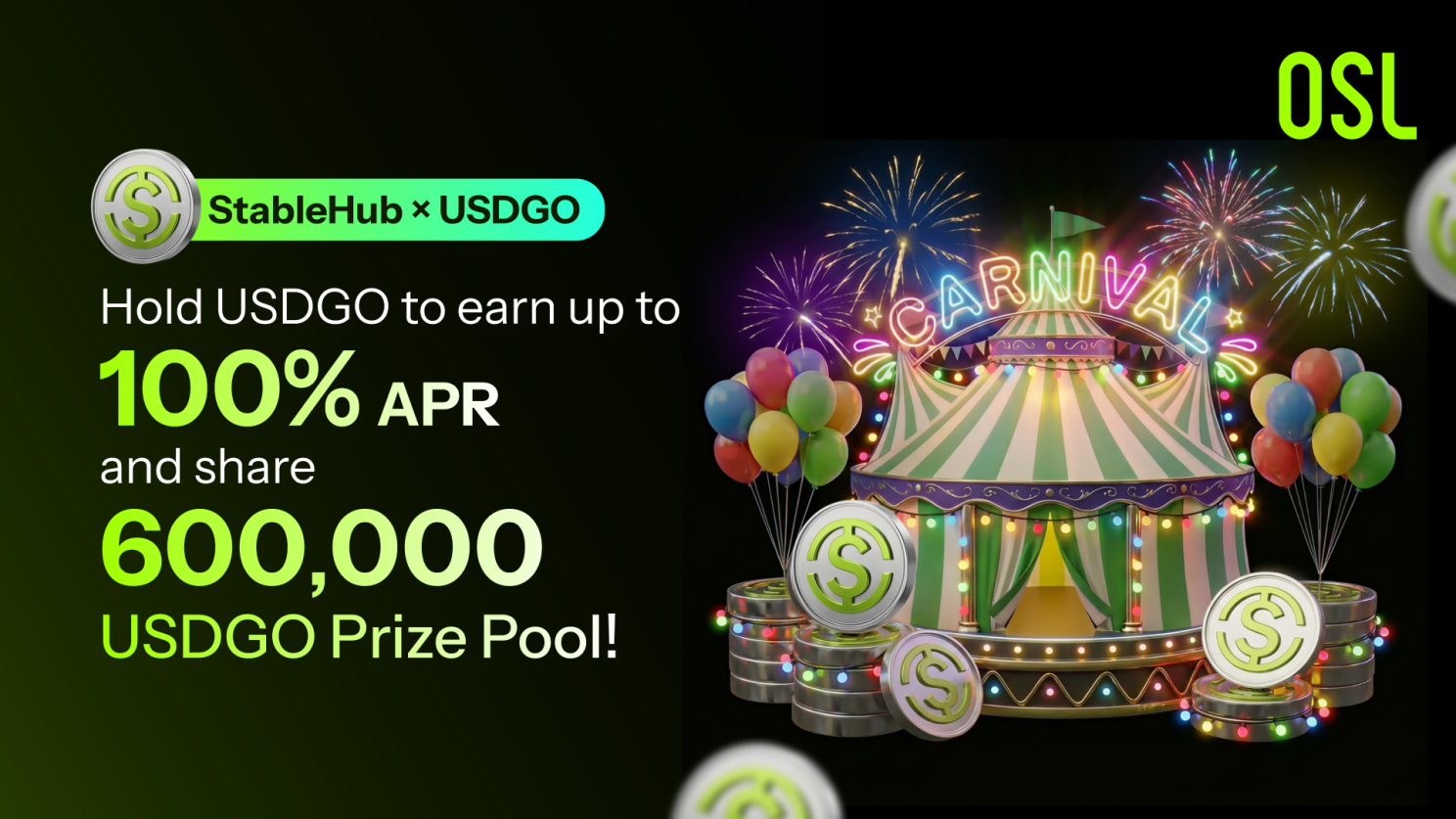
In March 2026, USDGO officially launched on StableHub and became the featured product in the rewards carnival. The activity period is from March 10 to April 10, with two modules (new user exclusive + general user benefits), non-overlapping holding limits, and stackable rewards.
New user activity: 100% annualized rewards, holding limit of 1,000 USDGO, cycle of 7 days, total reward pool of 100,000 USDGO.
General user activity: First 30,000 USDGO enjoy 18% APR, excess at 3% APR, total reward pool of 500,000 USDGO.
Through daily snapshots and automatic distributions, the activity quickly boosts USDGO circulation and market depth, laying a liquidity foundation for subsequent enterprise applications.
Introducing USDGO (USDGO) on OSL StableHub Rewards Carnival! Enjoy 18%–100% Rewards!
OSL BizPay: Infrastructure Innovation for B2B Cross-Border Payments
OSL BizPay is positioned as enterprise-level cross-border payment infrastructure. It does not create entirely new scenarios but uses blockchain technology to specifically address traditional pain points, building a compliant bridge between Web2 and Web3.
The core scenarios align closely with USDGO: cross-border trade settlements, global fund transfers, and payment channels in emerging markets. Target clients include traditional payment institutions, outbound enterprises, and internet platforms. By exporting licenses and technology, it lowers the threshold for partners to enter Web3 payments.
It has already established seed user layouts, integrated APIs with leading Asia-Pacific payment companies, and built channels like Africa-Europe and Africa-Hong Kong, achieving normalized transactions. The next phase will fully cover global outbound enterprises, focusing on solving compliance, efficiency, and cost issues in emerging markets.
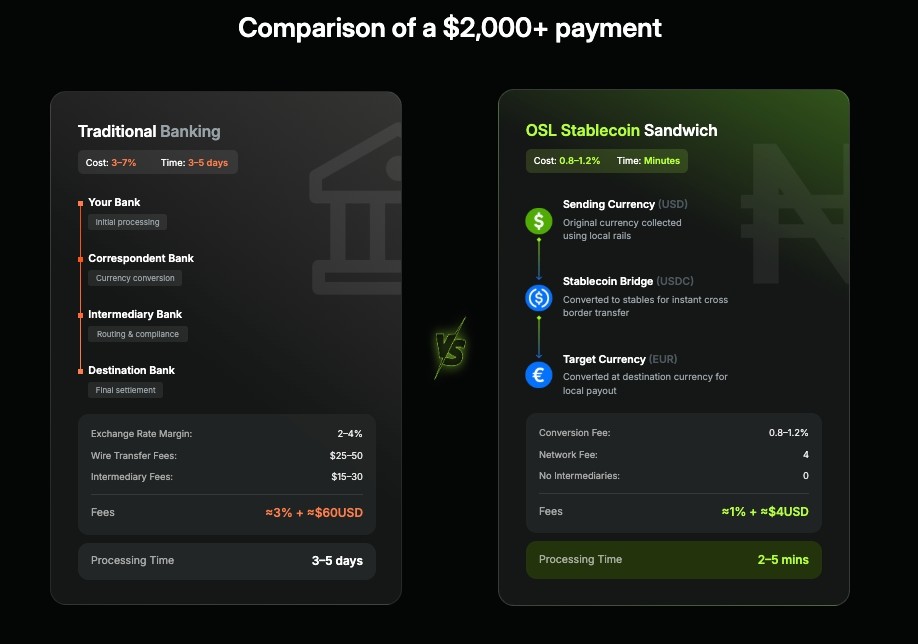
Compared to traditional systems' months-long integration cycles, BizPay standardizes scenarios to complete full processes in just two weeks, with complex customizations also responding quickly—demonstrating clear efficiency advantages.
USDGO's Core Barriers: Compliance + Cost + Efficiency
Competition in stablecoins ultimately boils down to compliance credentials, operational costs, and settlement efficiency—three dimensions where USDGO, leveraging OSL resources, builds hard-to-replicate barriers.
1. Compliance Barrier (Hardest to Replicate):
Global multi-licenses + zero-risk history + "U.S. issuance, global circulation, group backing" model fully match enterprise risk controls. Strict KYC/KYB from the source ensures manageable operations.
2. Efficiency Barrier:
Traditional cross-border payments involve multiple steps, high costs, and long cycles (T+1 to T+2). USDGO achieves same-day or even 3-hour arrivals, with full transparency, significantly improving fund turnover efficiency and reducing financial costs.
3. Scenario Barrier:
Precisely addresses emerging market pain points—exchange fluctuations, dollar shortages, long account periods—through USD anchoring for value preservation + real-time settlements + programmability, optimizing enterprise treasury management.
The global stablecoin industry is moving toward dual drivers of regulatory normalization and application scaling. In the next 1-2 years, non-compliant products will gradually exit, and institutional/enterprise adoption rates will accelerate. Vast opportunities exist in blockchain's disruption of cross-border payments: Breaking time/space limits, compressing costs, addressing emerging market gaps. Challenges include non-bank growth amid regulatory differences.
Short-term, StableHub rewards and BizPay channel expansions will continue to solidify foundations; long-term, as regulations improve, OSL is poised to rank among top enterprise-level digital financial infrastructure providers, with USDGO evolving from a crypto tool to a mainstream payment carrier. Despite remaining regulatory uncertainties, OSL's differentiated compliant path fully demonstrates USDGO's long-term potential and will contribute to the global stablecoin industry's shift toward normalization and serving the real economy.
Disclaimer and Disclosure
1. Nature of Document
This document (“Document”) has been prepared solely by internal personnel of OSL for informational purposes. It does not constitute investment, legal, tax, or other professional advice and should not be relied upon as such. No part of this Document may be reproduced, distributed, or transmitted to any third party in any form without the prior written consent of OSL.
This Document does not constitute an offer, solicitation, marketing material, product disclosure, or legal document, nor does it form the basis of any binding contract or commitment. It is intended solely to provide OSL’s observations and strategic insights on the industry and does not represent OSL’s official opinions, strategies, or decisions.
The authors are not independent research analysts, and this Document does not constitute “investment research” as defined under applicable laws and regulations. Accordingly, it has not been prepared in accordance with legal requirements designed to promote the independence of investment research and is not subject to any pre-dissemination trading restrictions.
2. Non-Reliance
The information, opinions, and analyses contained herein are based on publicly available information and OSL’s internal judgment. They do not take into account the individual objectives, financial circumstances, or needs of any recipient. This Document is not a personal recommendation or solicitation to buy, sell, or otherwise transact in any financial instrument, product, or service.
Before making any investment or other decision, recipients must consult their own independent advisors, considering their individual circumstances, objectives, experience, and resources. All investments involve risk; values may fluctuate, and investors may receive less than the original invested amount. Past performance is not indicative of future results.
3. Accuracy, Completeness, and Limitation of Information
This Document is based on information that OSL considers reliable; however, OSL has not independently verified its accuracy, completeness, or fairness. Reasonable care has been taken to ensure that the content is not false or misleading, but OSL makes no representation or warranty, express or implied, regarding its accuracy, completeness, fairness, or reasonableness.
OSL is not responsible for any errors, omissions, or consequences arising from reliance on third-party information referenced herein. Performance of any discussed instruments, entities, or strategies may be materially affected by market, regulatory, technical, or other factors.
4. Forward-Looking Statements
This Document may contain forward-looking statements that involve known and unknown risks, uncertainties, and other factors. Actual results, performance, or achievements may differ materially from those expressed or implied. OSL does not undertake any obligation to update, revise, or withdraw any forward-looking statements.
5. Conflicts of Interest
OSL, its affiliates, and employees may hold positions in, or engage in transactions involving, the assets or entities discussed herein. The authors or other personnel involved in the preparation of this Document may receive compensation that is linked to the performance of OSL’s business. OSL has implemented policies and procedures to identify and manage potential conflicts of interest.
6. Intellectual Property and Restrictions on Use
This Document is protected by copyright and is intended solely for the designated recipient. Recipients may store, display, analyze, modify, reformat, and print this Document for their own internal use only. Recipients may not, without OSL’s prior written consent:
Resell, redistribute, or commercially exploit this Document;
Reverse engineer, extract, or create derivative works, including for training or use in machine learning/artificial intelligence systems;
Publish or transmit this Document to third parties
7. Limitation of Liability
To the maximum extent permitted by applicable law, OSL, its affiliates, officers, employees, and agents shall not be liable for any direct, indirect, incidental, consequential, or special damages arising from or in connection with the use of, reliance upon, or interpretation of this Document, including but not limited to:
Loss of profits;
Business interruption;
Data loss;
Reputational harm.
8. Global Distribution Notes
Recipients are responsible for compliance with local laws. Distribution of this Document may be restricted in certain jurisdictions. Recipients must ensure that it is not distributed to any person or entity to whom such distribution would be unlawful.
Start your safe cryptocurrency journey now
OSL | Secure Ramps. Trusted Rails !
More topics
More topics
Latest
Best Enterprise Stablecoin Payment Providers: A 2026 Evaluation Framework
Compare enterprise stablecoin payment providers by use case, legal entity, workflow, controls, integration, reconciliation, support, and contract terms.
Best Enterprise Stablecoin Payment Providers: A 2026 Evaluation Framework
How to Reconcile a USDGO Payment: An Illustrative Finance-Close Example
See how Finance can trace a USDGO payment from an approved obligation through payment records, recipient confirmation, reconciliation, and accounting close.
How to Reconcile a USDGO Payment: An Illustrative Finance-Close Example
A USDGO Reserve Review in Practice: Findings, Limits and Follow-up Questions
Review what the July 2026 USDGO reserve attestation establishes, what it does not prove, and which issuer, redemption, and liquidity questions remain.
A USDGO Reserve Review in Practice: Findings, Limits and Follow-up Questions
Stablecoin Payment Platform vs Traditional Cross-Border Provider: Evaluating OSL Business Payments
Compare stablecoin platforms and traditional cross-border providers by service scope, recipient responsibility, records, controls, and support.
Stablecoin Payment Platform vs Traditional Cross-Border Provider: Evaluating OSL Business Payments
Recommended for you
More topics
More topics
