SOL Price Outlook 2026-2040: Scenarios, Drivers, and Key Risks
Solana has matured into one of the most prominent high‑throughput blockchains, so scenario‑based SOL price forecasts now extend well into the 2030s. These forecasts vary widely, so this article focuses on what independent analysts are saying about 2026, 2030, and 2040—and, crucially, which assumptions drive those numbers—rather than attempting to make definitive calls.
Solana’s Role in the Next Cycle
2026 refresh: scenario framework and risk checks
This update reframes the article as scenario analysis rather than a single-point price forecast. Crypto price outlooks can change quickly, so readers should treat the numbers as directional context and verify market data before making decisions.
Scenario | What would need to happen | Key risk |
|---|---|---|
Bull case | Stronger liquidity, positive ecosystem catalysts, and broader risk-on sentiment. | Momentum can reverse quickly if liquidity weakens. |
Base case | Moderate adoption with price mostly driven by market beta and project-specific updates. | Sideways markets can reduce search and trading interest. |
Bear case | Macro weakness, token unlock pressure, regulatory stress, or security concerns. | Downside can be amplified in thin liquidity. |
Related reading: Bitcoin price outlook | Bitcoin as digital gold
Sources to verify during editorial review: CoinMarketCap market data | Official project documentation
FAQ: reading this price outlook
Is this a financial prediction?
No. It is a scenario framework based on public market context. It should not be read as investment advice or a guaranteed target.
What can invalidate the outlook?
Liquidity changes, token unlocks, protocol events, macro shocks, and regulatory developments can all invalidate prior assumptions.
Solana is architected as a high‑performance smart contract platform optimized for speed and low fees, hosting an ecosystem that spans DeFi, NFTs, consumer applications, payments, and early experiments in real‑world asset tokenization. Its rapid growth in users, developers, and on‑chain activity has led some commentators to frame it as a leading “monolithic” chain for consumer‑grade crypto applications, while others underscore its relatively short operational history and historic network outages as execution risks.
In that context, “sol price prediction 2026‑2030‑2040” pieces from research sites and asset managers present broad scenario ranges: from conservative trajectories tied to overall market cycles to more aggressive forecasts if Solana captures a disproportionately large share of Web3 activity. The most informative work tends to prioritize model inputs such as user growth, protocol revenue potential, and competitive positioning—rather than headline price figures alone.
How Analysts Model Solana’s Long‑Term Value
Analysts apply familiar valuation lenses to Solana, but tailor them to its performance characteristics, fee economics, and ecosystem dynamics:
Network revenue and “crypto‑equity” style models: Frameworks such as the VanEck Solana valuation approach begin with projections of potential revenue across DeFi, NFTs, consumer Web3, payments, and infrastructure layers, then apply margins and multiples to create bear, base, and bull scenarios.
Adoption and ecosystem models:Specialist research sites link SOL’s long‑term value to on‑chain indicators like monthly active users, total value locked in DeFi, NFT trading volumes, and the diversity of consumer apps built on Solana.
Technical and cycle analysis: Understanding the price prediction 2026 is crucial for evaluating Solana's performance. Other analysts emphasize historical price structures, support/resistance zones, and correlations with broader crypto cycles—especially when framing nearer‑term (e.g., 2026) outlooks.
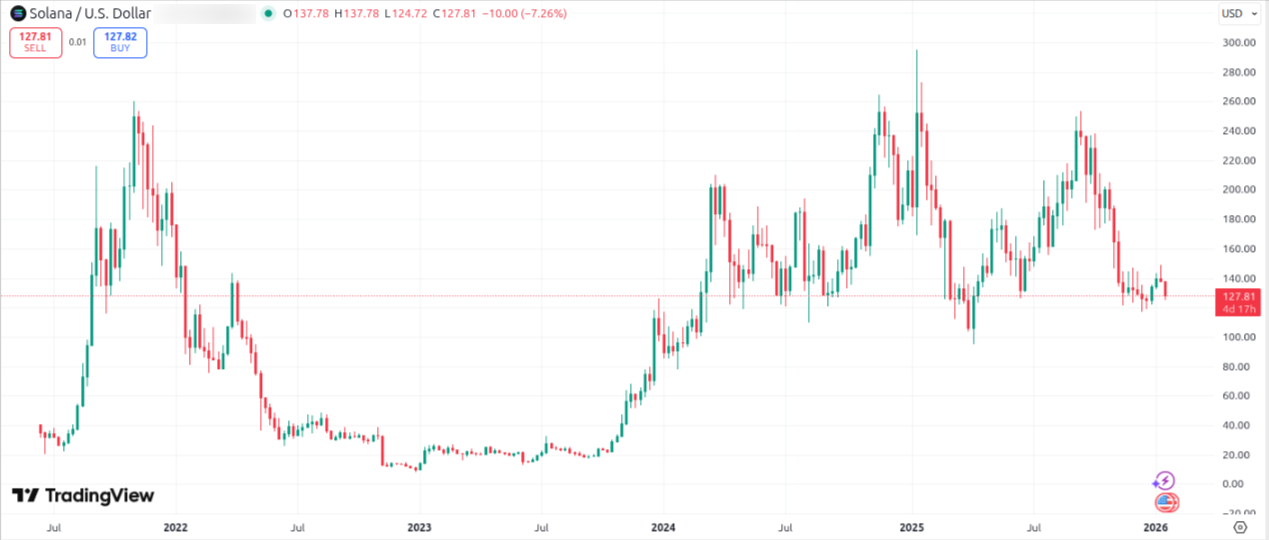
Long‑dated projections to 2030 and 2040 are especially sensitive to assumptions about Solana’s ability to sustain performance, minimize outages, compete with other chains, and adapt to evolving regulatory frameworks. This uncertainty is why credible analyses present wide scenario bands instead of definitive point targets, including varying predictions for the price of Solana and the price prediction 2040.
Solana Price Outlook for 2026
Summary of 2026 Forecast Ranges
Third‑party forecasts for Solana in 2026 span a broad range, reflecting different views on how quickly its ecosystem can grow and how the next crypto cycle unfolds. A detailed 2026‑2028 outlook from InvestingHaven, for example, frames possible Solana price paths with conservative scenarios anchored in the low to mid‑three‑digit range, and more ambitious scenarios pointing toward the mid‑$400 area, depending on broader crypto market trends and technical structures.
Other macro‑oriented commentary, such as AInvest’s discussion of Solana’s 2025‑2026 prospects, suggests that successful execution on institutional catalysts and scaling upgrades could support moves into the low‑to‑mid‑$200s—while acknowledging downside risk if sentiment or liquidity deteriorates. Forecast aggregators and technical‑pattern services likewise tend to cluster 2026 Solana projections within double‑ or low triple‑digit ranges, rather than implying four‑figure prices in the near term.
2026 Drivers: Performance, Ecosystem, and Institutional Interest
Analysts focusing on 2026 Solana scenarios consistently highlight a few core drivers:
Performance and reliability upgrades:Roadmap items such as client diversification and validator‑level improvements aim to bolster Solana’s uptime, throughput, and resilience—directly addressing reliability concerns from prior outages, which could impact the price of Solana. Bullish 2026 scenarios generally assume these upgrades materially reduce operational risk.
Ecosystem strength in DeFi, NFTs, and consumer apps: Forecasts emphasize the need for sustained or growing activity across Solana’s DeFi protocols, NFT marketplaces, and consumer‑facing applications such as gaming and payments, which are critical for accurate price prediction 2026. Strong transaction counts and robust on‑chain volumes are viewed as leading indicators that demand for SOL as both a gas token and collateral asset can keep pace with supply, influencing the price prediction for 2026.
Institutional and structured‑product catalysts: Several 2025‑2026 outlooks discuss the potential impact of structured products, index inclusion, research coverage, and institutional investment vehicles on the price prediction for 2026.While they stop short of assuming large ETF‑driven inflows as a base case, these factors are nevertheless treated as possible contributors to demand breadth.
Taken together, these drivers underpin the spread of 2026 Solana prediction ranges: models that assume more successful delivery on reliability and adoption trends generally show higher upper bands.
Solana Price Outlook for 2030
Analyst and Model‑Based 2030 Targets
By 2030, most non‑exchange analyses shift from short‑term technical structures to Solana’s potential role within a mature Web3 stack. VanEck’s A widely referenced Solana valuation note, for instance, outlines explicit bear, base, and bull scenarios for 2030 tied to revenue estimates across multiple verticals, including the minimum price of Solana. While specific numbers vary by revision, the general pattern ranges from a low‑end scenario with SOL nearer low double digits, through a base case in the low‑to‑mid hundreds, to a bull case above $3,000 per SOL if Solana captures significant market share.
Educational and research‑oriented sites like tastycrypto contextualize this work, highlighting that VanEck’s upper‑bound 2030 projection assumes Solana becomes a leading “high‑throughput institutional‑grade blockchain” with meaningful presence across DeFi, NFTs, payments, and consumer use cases. Other long‑term outlooks featured in financial media and independent platforms present 2030 ranges from the high‑hundreds to low‑thousands of dollars, typically framing four‑figure targets as contingent on strong technology execution and supportive macro conditions.
Core Assumptions in 2030 Models
The wide spread in 2030 Solana price prediction ranges reflects differences in several key assumptions, including varying predictions for the price prediction 2030.
End‑market size and Solana’s share: Frameworks like VanEck’s decompose potential crypto revenues across sectors—DeFi, NFTs, consumer apps, payments, and infrastructure—and then estimate the percentage that Solana might capture in each. Bull cases assume Solana becomes a dominant platform in multiple segments, while bear cases assume limited share, impacting the future price of SOL.
Users and transaction volumes: Some 2030 forecasts envision hundreds of millions of users and very high throughput on Solana, with a substantial portion of global on‑chain activity happening on the network, potentially affecting the price of Solana. More conservative models assume slower adoption and less robust engagement.
Economics and valuation multiples: Long‑term projections depend on assumptions about fees, validator rewards, protocol “take rates,” operating margins, and appropriate valuation multiples for a more mature Solana ecosystem in 2030, particularly in the context of the price prediction 2040.
Execution and competition risk: The future price of SOL remains uncertain due to various execution and competition risks. As noted in several research frameworks, Solana’s future could be “either very big or minimal,” reflecting a dynamic where failure to scale reliably or defend market share leaves it materially undervalued relative to high‑growth scenarios.
Because each of these levers can materially change outcomes, even small shifts in assumptions can move Solana’s 2030 forecast from low triple digits into the low thousands—or back toward much lower ranges.
Longer‑Term Scenarios: Solana in 2040
Why 2040 Projections Are Highly Speculative
Only a limited number of public sources extend explicit Solana price predictions all the way to 2040, including potential maximum price scenarios. Where they do, these projections are usually extrapolated from 2030 scenarios rather than based on detailed 2040‑specific models. Some long‑horizon narratives suggest that if Solana evolves into core global blockchain infrastructure, four‑figure prices per SOL could be sustained or exceeded by 2040—but these are framed as speculative paths, not central expectations.
Analysts generally acknowledge that by 2040, the technology stack, regulatory regimes, and competitive landscape may look substantially different from today, making precise numerical forecasts more akin to scenario thought experiments than rigorous project‑finance models.
Structural Factors Shaping 2040 Outlook
Several structural themes commonly underlie 2040 Solana scenarios:
Long‑term technology execution: planning for the maximum price of Solana in 2027. Solana’s ability to maintain high throughput, low latency, and robust security over many years—across evolving hardware, client implementations, and validator sets—is central to any thesis about it becoming core infrastructure.
Position in a multi‑chain world: understanding how the price of Solana could fluctuate in relation to other networks. Whether Solana remains a leading general‑purpose chain, specializes in particular verticals (for example, consumer apps or gaming), or cedes share to other L1s and L2 rollups will strongly influence its long‑term relevance.
Regulatory and macro environment:The way DeFi, tokenized assets, and Web3 platforms are regulated globally—and broader macro trends—will shape how institutions and end users interact with Solana in 2040, influencing demand for SOL as a resource asset.
Given uncertainty across all these dimensions, credible sources treat 2040 price figures as scenario markers rather than firm predictions.
Key Risks and Uncertainties Across 2026‑2030‑2040
Across these horizons, independent research highlights several recurring risk areas for Solana:
Technical and reliability risk can significantly affect the price history of Solana and its future predictions. Solana’s history of outages and performance incidents is frequently cited as a major risk factor, potentially affecting the future price of SOL. Bullish projections typically assume that upgrades and greater client diversity reduce the likelihood and impact of future disruptions.
Ecosystem and competition risk: The evolving landscape poses challenges for Solana's price prediction 2027, especially when considering the forecast for 2026. Strong growth scenarios assume that Solana maintains developer engagement, user participation, and liquidity against competition from Ethereum’s rollup ecosystem and alternative high‑throughput L1s, which could drive the maximum price of Solana higher.
Regulatory and market‑structure risk: Classification of SOL, treatment of staking, and evolving regulatory frameworks around DeFi and tokenized assets will all influence institutional comfort in building on or gaining exposure to Solana, particularly regarding the price of Solana.
Model risk and dispersion:The wide gap between bear, base, and bull scenarios—for example, a hypothetical 2030 range spanning roughly $10 to more than $3,000—illustrates how sensitive SOL forecast work is to underlying assumptions.
For readers, grasping these risk vectors is as important as knowing the nominal price ranges attached to any given scenario, especially the average price of Solana.
How to Buy, Trade, and Sell Solana (SOL) on OSL
OSL is Asia’s leading regulated digital asset trading and payments infrastructure provider, offering secure and compliant services to institutions, businesses, and individual investors. Rather than providing investment advice, OSL delivers the infrastructure that enables clients to access digital assets such as Solana within their own strategies and risk frameworks, including the option to buy Solana.
On OSL, Solana (SOL) can be accessed and traded in several ways, depending on users’ experience level and trading needs:
Flash Trade (Simple Buy, Sell, or Convert SOL)
For users looking for a straightforward way to buy or sell SOL, OSL’s Flash Trade offers a simplified trading experience with zero trading fees. Users can purchase SOL with USD, sell SOL back to USD, or convert between supported tokens at a quoted price that is displayed before confirmation.
SOL Flash Trade is designed to be completed in just a few steps, making it easier for users to buy Solana quickly.
Select SOL and choose USD as the payment currency.
Enter either the amount of USD you want to spend or the amount of SOL you want to buy or sell.
Review the quoted price and confirm the transaction.
Flash Trade is available via the SOL/USD Flash Trade page and is intended for users who prioritise ease of use and price transparency.
Spot Trading (Market-Based SOL Trading)
For users who prefer greater control over trade execution, OSL also offers SOL spot trading through its regulated spot market. On the SOL/USD spot market, users can place market or limit orders, view real-time order books, and manage positions based on prevailing market prices.
Spot trading is typically used by more active traders who wish to buy or sell SOL at specific price levels and respond dynamically to market movements.
Perpetual Futures (Advanced SOL Trading)
OSL additionally supports SOL perpetual contracts for users seeking more advanced trading strategies. SOL perpetual futures allow traders to gain exposure to Solana price movements without an expiry date and may be used for hedging or tactical positioning.
Due to the use of leverage and the higher risk involved, this product is generally suited to experienced traders who have a solid understanding of derivatives markets.
Scenario Thinking Over Single‑Number Targets
Across non‑exchange sources, Solana price prediction ranges for 2026, 2030, and 2040 span from relatively conservative, cycle‑linked paths to highly optimistic trajectories that assume successful execution and major market‑share gains. For an evolving ecosystem like Solana, focusing on scenario analysis—understanding the drivers, assumptions, and risks behind each range—offers more insight than fixating on any single numerical target for a given year.
Start your safe cryptocurrency journey now
OSL | Secure Ramps. Trusted Rails !
More topics
More topics
Latest
Why India's $620B Bond Pilot Changed Nothing Legal
SEBI and the RBI's Demat 2.0 pilot issues corporate bonds as digital tokens and settles them with the wholesale digital rupee, preserving existing legal terms while digitizing the infrastructure beneath a $620...
Why India's $620B Bond Pilot Changed Nothing Legal
Why S&P Global Leads Kaiko: Not Hype, But 24/7 Market Infrastructure
S&P Global led a $110 million extension of Kaiko's Series B to build data infrastructure for round-the-clock tokenized markets.
Why S&P Global Leads Kaiko: Not Hype, But 24/7 Market Infrastructure
When One Firm Holds 5% of Ethereum: Infrastructure Stress Test
Bitmine's accumulation of more than 5 million staked ETH raises questions about whether custody, audit, and validator infrastructure can support single-asset concentration at public-company scale.
When One Firm Holds 5% of Ethereum: Infrastructure Stress Test
Best Enterprise Stablecoin Payment Providers: A 2026 Evaluation Framework
Compare enterprise stablecoin payment providers by use case, legal entity, workflow, controls, integration, reconciliation, support, and contract terms.
Best Enterprise Stablecoin Payment Providers: A 2026 Evaluation Framework
How to Reconcile a USDGO Payment: An Illustrative Finance-Close Example
See how Finance can trace a USDGO payment from an approved obligation through payment records, recipient confirmation, reconciliation, and accounting close.
How to Reconcile a USDGO Payment: An Illustrative Finance-Close Example
A USDGO Reserve Review in Practice: Findings, Limits and Follow-up Questions
Review what the July 2026 USDGO reserve attestation establishes, what it does not prove, and which issuer, redemption, and liquidity questions remain.
A USDGO Reserve Review in Practice: Findings, Limits and Follow-up Questions
Recommended for you
More topics
More topics
