T+0 Settlement Explained: How Real-Time Clearing Improves Enterprise Liquidity

In an environment where cash visibility, working capital efficiency, and risk control are strategic priorities, T+0 settlement and instant settlement rails are reshaping how enterprises move money. T+0 settlement gives finance and treasury teams same-day or near real-time finality, reducing idle float and improving liquidity control across entities and jurisdictions.
What is T+0 Settlement?
Definition and financial meaning
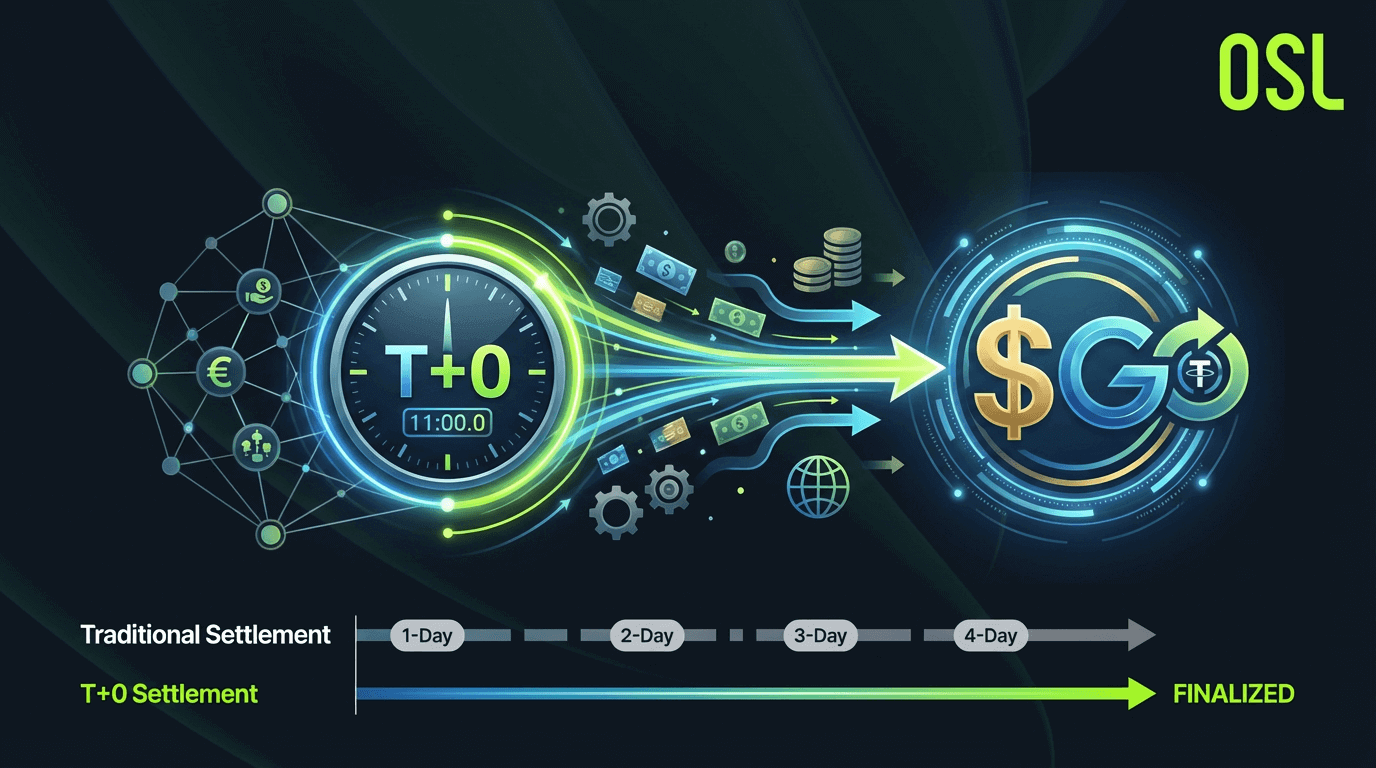
In simple terms, T+0 settlement means that the trade date (T) and the settlement date (the point at which cash and assets are finally exchanged) occur on the same day, often within seconds or minutes. In a business context, this translates into cash being received, usable, and reflected in balances essentially in real time rather than after a delay. This stands in contrast to legacy arrangements, where settlement may be scheduled for the next business day (T+1) or two days later (T+2).
Real-time settlement vs batch settlement
Traditional financial rails are built around batch processing. Transactions are collected over a period, netted, and then settled in bulk at predetermined times (for example, end-of-day or several windows per day). This is why many domestic and cross-border payment systems effectively operate on T+1 or T+2 cycles, especially when cut-off times, time zones, and correspondent banks are involved.
By contrast, real-time or instant settlement processes each transaction individually, typically using modern payment infrastructures or blockchain-based rails. Instead of waiting for a batch to close, funds are transferred and finalized transaction by transaction, often within seconds.
Why Faster Settlement Matters for Enterprise Liquidity
Capital efficiency – how T+0 frees up working capital
Under T+1 and T+2 models, enterprises effectively maintain a liquidity buffer to account for funds “in transit.” Treasury teams must hold extra cash to cover payments that have left their accounts but have not yet settled, as well as incoming funds that are not yet usable. This float can be significant for businesses that operate high-volume payment flows, manage multiple subsidiaries, or settle across borders.
With T+0 settlement, these buffers can be reduced. For example, consider a company that regularly makes 10 million USD in supplier payments every week under a T+2 cycle. If funds sit in transit for two days, the company might maintain several days’ worth of additional cash to avoid overdrafts and ensure commitments are met. With T+0, the same organization can often reduce the required float because outflows are finalized immediately and inflows become usable more quickly. Over time, this can lower reliance on short-term credit lines, cut interest expenses, and allow capital to be redeployed to revenue-generating activities.
Predictability and risk reduction
Faster settlement directly reduces settlement risk and counterparty exposure. When payments linger between institutions, there is a window in which operational issues, counterparty defaults, or market disruptions can affect completion. T+0 settlement compresses this window, which can be particularly important in volatile markets or when dealing with a diverse set of global counterparties.
Real-time cash flow visibility
Real-time settlement goes hand in hand with real-time visibility. When transactions settle instantly and are reflected immediately in treasury dashboards, enterprises can monitor cash positions across subsidiaries, currencies, and jurisdictions on a near 24/7 basis. This is especially valuable for businesses operating across time zones, where traditional banking hours and cut-offs can fragment visibility.
Traditional Settlement Cycles Explained
How T+1 and T+2 work
In standard financial practice, T+1 and T+2 settlement cycles are used to allow time for transaction validation, netting, and interbank funding. For example, in a T+2 securities trade executed on Monday, the final exchange of cash and securities will typically occur on Wednesday. Between trade execution and settlement, the transaction passes through clearing systems and risk checks, and counterparties prepare to deliver cash or securities.
For corporate payments, similar timing issues arise. A cross-border transfer initiated on Friday afternoon may miss cut-off windows, be processed in batches over the weekend, and only be credited to the recipient on Monday or Tuesday. This creates a lag between when cash leaves one account and when it is available in another, impacting working capital planning.
Limitations of traditional payment rails in enterprise context
From an enterprise perspective, these traditional cycles present several challenges:
Settlement delays: Funds may be unavailable for one or more business days, limiting flexibility.
Pre-funding requirements: Enterprises often must pre-fund accounts in certain jurisdictions or currencies to avoid delays, tying up capital.
FX and cross-border delays: Multiple intermediaries, correspondent banks, and FX conversions add time and complexity, increasing operational risk and cost.
As global business moves toward always-on, multi-region operations, these constraints become more visible and more costly.
Enabling Real-Time Settlement in Practice
Technology and infrastructure – blockchain and atomic settlement
Modern settlement infrastructures increasingly leverage blockchain or distributed ledger technology to enable atomic settlement. Atomic settlement means that delivery of assets and payment occur in a single, indivisible transaction: either both sides complete, or neither does. This eliminates many forms of settlement risk where one party has delivered assets but has not yet received cash, or vice versa.
By recording transactions on a shared ledger, blockchain rails can also shorten reconciliation windows. Instead of each participant maintaining separate records that must be reconciled at the end of a cycle, a common, time-stamped record of transfers can be accessed by authorized participants. This helps reduce disputes, manual reconciliations, and post-trade adjustments, which in turn supports T+0 settlement in a more reliable and controlled way.
Stablecoins as settlement rails
Enterprise-grade stablecoin settlement platforms play a critical role in translating the speed of blockchain rails into real-world, compliant financial operations. For enterprises, this requires more than instant transfer — it requires regulated access to USD liquidity, institutional custody, and the ability to operate across multiple jurisdictions without fragmenting capital or controls.
Within OSL’s regulated ecosystem, USDGO serves as an institutional liquidity and settlement infrastructure purpose-built for these requirements. By combining regulated banking connectivity, compliant stablecoin usage, and enterprise-grade custody standards, USDGO enables businesses to use USD-denominated stablecoins and fiat as a unified settlement asset — supporting T+0 or near-instant money movement across entities, regions, and payment channels.
Rather than treating stablecoins as standalone digital tokens, infrastructures like USDGO position them as financial plumbing: a settlement layer that improves liquidity efficiency, reduces settlement risk, and aligns real-time payment capability with enterprise compliance and treasury governance.
Example enterprise use cases
Real-time, T+0 settlement via stablecoin rails can support several high-impact enterprise use cases:
Cross-entity liquidity routing: Moving funds between group entities or treasury centers in different regions within minutes, rather than days.
Supplier and partner payout processing: Paying vendors, content creators, or partners in multiple markets with predictable, near-instant settlement.
Cross-border treasury operations: Rebalancing liquidity between currencies and jurisdictions in response to intraday needs, while maintaining compliance and auditability.
Enterprise Treasury Benefits
Reduced capital costs and float
For corporate treasurers, the most immediate benefit of T+0 settlement is a reduction in idle float and associated capital costs. With faster settlement, less cash needs to be parked as a buffer in multiple accounts and currencies. Treasury teams can right-size their liquidity cushions, which can reduce the need for external borrowing, overdrafts, or holding large non-yielding balances.
Operational efficiency gains
Real-time settlement also streamlines operations. When transactions settle and are recorded immediately, reconciliation processes can be simplified and accelerated. Finance teams spend less time tracking “in transit” items, chasing exceptions, and resolving timing-related discrepancies between systems.
Better supplier and partner relationships
Timely, predictable payments are a cornerstone of strong supplier and partner relationships. With T+0 settlement and instant settlement capabilities, enterprises can offer counterparties faster access to funds, improving trust and potentially unlocking better commercial terms.
Risk, Compliance & Implementation Considerations
Compliance and regulatory requirements
Any move toward T+0 settlement must operate within applicable legal and regulatory frameworks. For digital asset-based rails, this includes robust AML and KYC programs, transaction monitoring, and adherence to sanctions rules. Enterprises must ensure that their settlement partners are appropriately regulated in the jurisdictions where they operate and that data and activities meet local requirements.
Cross-jurisdiction operations further complicate matters. Different regulators may have varying expectations for digital assets, stablecoins, and cross-border payments. Legal and compliance teams should be closely involved in assessing how real-time settlement solutions map to local licensing, reporting, and consumer protection rules.
Operational challenges for adoption
Implementing T+0 settlement at scale involves more than changing a payment rail. Enterprises must integrate new systems with existing ERP, treasury management, and banking platforms. Internal change management is critical: processes for approvals, limits, and controls need to be adapted to an environment where transactions complete in seconds rather than days.
Staff training, updated policies, and clear escalation paths are essential to ensure that real-time capabilities do not undermine internal control frameworks. Pilot programs and staged rollouts can help organizations manage this transition.
Risk controls and safeguards
To fully realize the benefits of T+0 while maintaining safety, enterprises should prioritize settlement infrastructures that provide robust safeguards. This includes segregation of client assets, institutional-grade custody, clear legal frameworks for ownership, and transparent reserve or backing structures where stablecoins are used.
In evaluating settlement solutions, enterprises increasingly assess not just speed but also compliance, resiliency, and operational safeguards. Platforms like USDGO are designed to offer this combination, providing a unified liquidity and settlement interface backed by regulated infrastructure and institutional standards.
What’s Next? Future Trends
Global adoption trajectory
The momentum toward T+0 and faster settlement rails is visible across markets and asset classes. Some regulators and market infrastructures have begun experimenting with optional T+0 models or accelerated cycles, reflecting demand for reduced risk and greater efficiency. This evolution is likely to continue as more enterprises and financial institutions gain experience with real-time settlement technologies.
As adoption grows, interoperability between traditional systems and new rails will become increasingly important. Enterprises will look for ways to orchestrate T+0 settlement across both digital asset networks and conventional banking channels in a consistent, controlled way.
Stablecoin payments and treasury transformation
Stablecoin-based settlement is a key driver of this shift. Programmable, always-on payment rails enable treasurers to move from static, calendar-based planning to a more dynamic model of liquidity sovereignty—controlling where capital sits, when it moves, and how it is deployed in near real time.
Infrastructure providers such as USDGO aim to make this accessible in a compliant, enterprise-ready form, connecting banks, blockchains, and payment networks into a single operational layer for money movement. For CFOs, treasury leaders, and compliance officers, understanding T+0 settlement and instant settlement is no longer a theoretical exercise; it is a practical foundation for the next generation of corporate finance operations.
FAQs
What is T+0 settlement and how does it differ from T+1/T+2?
T+0 settlement means that transactions are fully completed on the same day they are initiated, often within seconds or minutes, providing immediate finality.
How does real-time settlement improve working capital efficiency?
Real-time settlement reduces the amount of cash tied up in transit and the buffers enterprises hold to manage timing mismatches.
Are stablecoins suitable for enterprise settlement?
Stablecoins can be suitable for enterprise settlement when used through regulated, institutional-grade infrastructures that provide strong compliance, custody, and risk controls.
What are the main compliance challenges for real-time settlement?
The main challenges include meeting AML/KYC requirements at speed, monitoring transactions in real time, and navigating different regulatory regimes for digital assets and cross-border payments.
How is USDGO different from USDT or USDC?
USDT and USDC are stablecoins issued directly as digital tokens, whereas USDGO is positioned as an institutional liquidity and settlement infrastructure that connects fiat, stablecoins, banks, and blockchains into one operational system.
Start your safe cryptocurrency journey now
OSL | Secure Ramps. Trusted Rails !
More topics
More topics
Latest
Why India's $620B Bond Pilot Changed Nothing Legal
SEBI and the RBI's Demat 2.0 pilot issues corporate bonds as digital tokens and settles them with the wholesale digital rupee, preserving existing legal terms while digitizing the infrastructure beneath a $620...
Why India's $620B Bond Pilot Changed Nothing Legal
Why S&P Global Leads Kaiko: Not Hype, But 24/7 Market Infrastructure
S&P Global led a $110 million extension of Kaiko's Series B to build data infrastructure for round-the-clock tokenized markets.
Why S&P Global Leads Kaiko: Not Hype, But 24/7 Market Infrastructure
When One Firm Holds 5% of Ethereum: Infrastructure Stress Test
Bitmine's accumulation of more than 5 million staked ETH raises questions about whether custody, audit, and validator infrastructure can support single-asset concentration at public-company scale.
When One Firm Holds 5% of Ethereum: Infrastructure Stress Test
Best Enterprise Stablecoin Payment Providers: A 2026 Evaluation Framework
Compare enterprise stablecoin payment providers by use case, legal entity, workflow, controls, integration, reconciliation, support, and contract terms.
Best Enterprise Stablecoin Payment Providers: A 2026 Evaluation Framework
How to Reconcile a USDGO Payment: An Illustrative Finance-Close Example
See how Finance can trace a USDGO payment from an approved obligation through payment records, recipient confirmation, reconciliation, and accounting close.
How to Reconcile a USDGO Payment: An Illustrative Finance-Close Example
A USDGO Reserve Review in Practice: Findings, Limits and Follow-up Questions
Review what the July 2026 USDGO reserve attestation establishes, what it does not prove, and which issuer, redemption, and liquidity questions remain.
A USDGO Reserve Review in Practice: Findings, Limits and Follow-up Questions
Recommended for you
More topics
More topics
