Cross-Border Stablecoin Payments: Costs, Speed, Compliance, and Enterprise Fit

For globally active enterprises, cross-border payments are no longer just a back-office task—they are a strategic lever for managing liquidity, supplier relationships, and operating margins. Traditional international payment rails, however, remain slow, opaque, and costly, especially when funds must pass through multiple intermediaries and time zones in cross-border transactions. Stablecoin-based cross-border payments offer an alternative: faster settlement, lower friction, and improved transparency, delivered on a 24/7 basis, allowing enterprises to send and receive funds more efficiently.
2026 update: what readers should check first
This refresh turns the article into a practical stablecoin decision guide. Readers should verify reserve quality, redemption access, jurisdiction, liquidity, fees, and compliance fit before choosing a token, exchange, or payment route.
Question | What to check | Why it matters |
|---|---|---|
Reserve and issuer | Issuer disclosures, reserve composition, attestations, and redemption terms. | Weak transparency can raise depeg or liquidity risk. |
Liquidity and network | Supported chains, spreads, withdrawal costs, and settlement time. | A stablecoin is only useful if it can move and redeem efficiently. |
Compliance fit | Jurisdiction, KYC, account records, and counterparty requirements. | Business payments and fiat exits depend on auditability. |
User action | Use regulated platforms, keep transaction records, and test small transfers first. | Operational mistakes are often more costly than headline fees. |
Related reading: USDT and USDC comparison | Stablecoin payments vs banking rails | Fiat-to-crypto on-ramp guide.
FAQ: stablecoin safety and use cases
Is the stablecoin fully backed, and where can users verify the reserve information?
Which network should users choose for lower fees and fewer operational mistakes?
Can the stablecoin be redeemed or converted to fiat through a regulated route?
What records should businesses keep for compliance and reconciliation?
This article explains the core challenges in traditional cross-border payments, how stablecoins address those pain points, and what enterprise finance, treasury, and compliance teams should consider when evaluating stablecoin-based solutions.
Challenges in Traditional Cross-Border Payments
Delays and costs in traditional systems
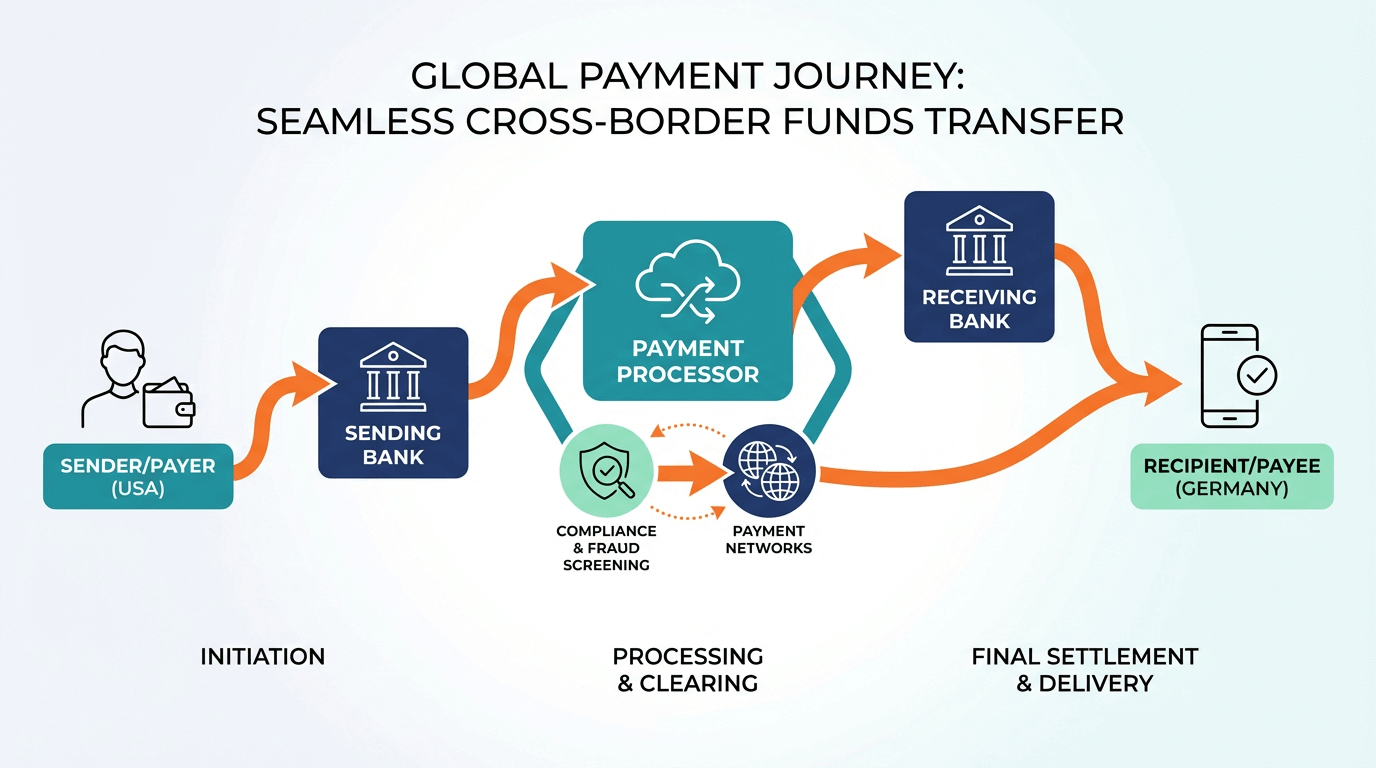
Conventional cross-border payments typically rely on a chain of correspondent banks and messaging networks. Each intermediary adds time and potential friction to the transaction. Settlement timelines are often T+1 or T+2, meaning funds may only be finally credited one or two business days after the payment is initiated, with further delays around weekends and public holidays.
These structures also embed multiple layers of cost. Correspondent banking fees, lifting fees, and FX spreads accumulate as funds move through different interbank systems and currencies. For enterprises handling high volumes of international payments, these costs can materially affect margins in their bank accounts and complicate their overall payment solution. In addition, the need to compensate for timing and FX uncertainty can lead to wider pricing buffers and less competitive commercial terms.
Operational complexity
Beyond direct costs, traditional cross-border payment methods create operational complexity. Enterprises must manage multi-currency accounts, each with its own reconciliation processes and cut-off times to enhance cross-border payments. Treasury and finance teams spend considerable effort matching inflows and outflows, dealing with timing mismatches, and resolving exceptions when payments arrive short due to unexpected fees.
Transparency is limited.In many cases, once a payment leaves the originating bank, visibility is minimal until it reaches the beneficiary in the global payment network.Tracking payments requires manual follow-up with banks, and confirming the status of a payment can be slow and resource-intensive, particularly in cross-border payments. This creates uncertainty for internal stakeholders and external partners, especially when funds are time-sensitive in the global payment landscape.
How Stablecoins Improve Cross-Border Payments
Faster settlements
Stablecoins, particularly when used on high-throughput blockchain networks, enable cross-border payments that can settle within minutes rather than days. Instead of waiting for multiple banks to process a payment across cut-off windows, enterprises can transfer tokenized USD value directly between digital wallets or accounts with near-instant finality.
Critically, these rails operate 24/7. This always-on nature allows enterprises to move liquidity outside of traditional banking hours and across time zones without waiting for the next business day. For treasury teams, this means same-day or near-instant liquidity access, which can improve working capital efficiency and reduce reliance on intraday credit facilities through efficient payment systems.
Reduced costs
Stablecoin-based cross-border payments also help lower transaction costs in the payment networks. Because transfers can occur directly on-chain, bypassing some of the intermediaries in traditional correspondent banking, network and processing fees are often significantly lower. This can be particularly impactful for high-volume, lower-value payments where per-transaction fees matter in the payment system.
In addition, stablecoin rails can reduce the need for pre-funding accounts in multiple jurisdictions, enhancing the payment process. Instead of maintaining large cash balances across several local banks to ensure timely payments, enterprises can centralize liquidity and move it on demand, as transactions are needed. This reduces idle capital and the overhead of managing fragmented balances.
Transparency and traceability
Every on-chain transaction leaves an auditable, time-stamped record. This provides real-time visibility into payment status, including when a transaction was initiated, when it was confirmed, and which address received it.For finance and treasury teams, this level of transparency in the payment process simplifies reconciliation and reduces the time spent investigating payment queries.
Traceability also supports stronger controls and compliance reporting in cross-border transactions. Enterprises can integrate blockchain data into their existing monitoring and analytics tools, enabling more precise oversight of cross-border flows. This combination of transparency and programmability helps align stablecoin-based payments with internal audit, risk, and regulatory requirements.
Enterprise Use Cases
Supplier payments
For enterprises with global supply chains, stablecoin-based cross-border payments can materially improve supplier relationships. Faster settlement means vendors receive funds sooner and with fewer deductions from intermediary bank fees. This can support better cash flow management for suppliers, which may translate into more favorable pricing or priority treatment for the buyer.
In markets where local banking infrastructure is less efficient, stablecoin rails can offer a more reliable path to get value to suppliers. This reduces the likelihood of delayed or failed bank transfers and helps maintain continuity in critical supply relationships.
Payroll and contractor payments
Enterprises increasingly rely on distributed teams, contractors, and service providers across multiple jurisdictions to tap into new markets. Stablecoin-based payouts enable organizations to pay workers and contractors globally with predictable timing, regardless of local banking holidays or cut-off times.
For payroll teams, this can reduce uncertainty and complaints about delayed payments through effective domestic payment solutions. For workers, receiving funds steadily and on schedule through real-time payment systems can improve trust and retention. Stablecoins also allow enterprises to standardize USD-denominated payouts while still offering local off-ramp options where compliant, simplifying internal processes for remittance.
B2B customer payouts
Many enterprises need to make cross-border payments back to customers: refunds, rebates, incentives, or partner revenue shares. Doing this across borders via traditional rails can be slow and require complex coordination between finance, customer support, and local teams.
Using stablecoins, enterprises can streamline these payout flows and process payments more efficiently. Customers or partners with compatible infrastructure can receive funds quickly, without waiting days for international wires. This can be particularly useful in digital-first industries, such as platforms, marketplaces, and fintechs, where user expectations for speed and transparency are high.
Key Considerations for Enterprises
Compliance and legal requirements
While stablecoin-based cross-border payments can offer significant efficiency gains, they must be implemented within robust payment networks. compliance and legal frameworks. Enterprises need to ensure that all relevant AML and KYC obligations are met, both for their own operations and through any third-party financial institutions they rely on.
Jurisdictional considerations are central. Different countries and regions treat digital assets and stablecoins differently from a regulatory standpoint. Legal teams should assess how specific stablecoins are regulated in target markets, what licensing requirements apply to service providers, and how cross-border flows are classified for tax, reporting, and capital control purposes.
Operationalizing Stablecoin-Based Cross-Border Payments
Successfully integrating stablecoin-based cross-border payments also requires operational readiness. Treasury, finance, and IT teams need to connect new rails to existing systems such as ERP platforms, treasury management systems, and banking partners. Controls, approval workflows, and segregation of duties must be adapted to accommodate faster, potentially 24/7 payment capabilities.
Liquidity management processes may need to evolve as financial institutions adapt to new payment methods. With access to near-instant, global rails, treasury teams can redesign how they manage working capital, FX exposures, and regional funding strategies. Clear policies around when and how to use stablecoin rails, as opposed to traditional payment methods, help ensure consistency and control.
Translating these operational requirements into real-world cross-border payment flows requires more than access to blockchain rails alone. Enterprises must ensure that faster settlement capabilities are aligned with regulatory requirements, treasury governance, and existing operational controls.
Within OSL’s regulated ecosystem, USDGO serves as an institutional-grade liquidity and settlement infrastructure that enables enterprises to put these principles into practice. By connecting regulated banking systems, compliant stablecoin usage, and enterprise-grade custody, USDGO allows businesses to move USD-denominated value across borders with same-day or near-instant settlement—without fragmenting liquidity, controls, or compliance frameworks.
Positioned as financial infrastructure rather than a speculative crypto product, USDGO helps enterprises integrate stablecoin capabilities into existing treasury and payment workflows, supporting faster settlement, improved liquidity management, and more predictable cross-border operations.
FAQ
How much faster are stablecoin cross-border payments?
In many cases, stablecoin-based transfers can settle within minutes instead of the one to two business days associated with traditional cross-border wires. Exact timings depend on the underlying blockchain network, infrastructure providers, and any internal approval processes, but the difference in liquidity availability is often substantial.
Are stablecoin cross-border payments compliant with Asian regulations?
Compliance depends on the specific stablecoin, jurisdiction, and service providers involved in the cross-border payment methods. Many Asian regulators are actively defining frameworks for digital assets and stablecoins, and regulated platforms operate under these regimes. Enterprises should work with partners that hold appropriate licenses in relevant markets and ensure that their own policies align with local AML, KYC, and reporting requirements.
Which industries benefit most from stablecoin-based cross-border payments?
Industries with high volumes of international, time-sensitive payments often see the greatest benefits in the global economy. This includes sectors such as global trade and manufacturing, digital platforms and marketplaces, financial services, and the broader digital economy where payouts to suppliers, partners, and users span multiple regions and currencies.
Start your safe cryptocurrency journey now
OSL | Secure Ramps. Trusted Rails !
More topics
More topics
Latest
Why India's $620B Bond Pilot Changed Nothing Legal
SEBI and the RBI's Demat 2.0 pilot issues corporate bonds as digital tokens and settles them with the wholesale digital rupee, preserving existing legal terms while digitizing the infrastructure beneath a $620...
Why India's $620B Bond Pilot Changed Nothing Legal
Why S&P Global Leads Kaiko: Not Hype, But 24/7 Market Infrastructure
S&P Global led a $110 million extension of Kaiko's Series B to build data infrastructure for round-the-clock tokenized markets.
Why S&P Global Leads Kaiko: Not Hype, But 24/7 Market Infrastructure
When One Firm Holds 5% of Ethereum: Infrastructure Stress Test
Bitmine's accumulation of more than 5 million staked ETH raises questions about whether custody, audit, and validator infrastructure can support single-asset concentration at public-company scale.
When One Firm Holds 5% of Ethereum: Infrastructure Stress Test
Best Enterprise Stablecoin Payment Providers: A 2026 Evaluation Framework
Compare enterprise stablecoin payment providers by use case, legal entity, workflow, controls, integration, reconciliation, support, and contract terms.
Best Enterprise Stablecoin Payment Providers: A 2026 Evaluation Framework
How to Reconcile a USDGO Payment: An Illustrative Finance-Close Example
See how Finance can trace a USDGO payment from an approved obligation through payment records, recipient confirmation, reconciliation, and accounting close.
How to Reconcile a USDGO Payment: An Illustrative Finance-Close Example
A USDGO Reserve Review in Practice: Findings, Limits and Follow-up Questions
Review what the July 2026 USDGO reserve attestation establishes, what it does not prove, and which issuer, redemption, and liquidity questions remain.
A USDGO Reserve Review in Practice: Findings, Limits and Follow-up Questions
Recommended for you
More topics
More topics
