VIRTUAL Price Outlook 2026-2040: Scenarios, Drivers, and Key Risks
TL;DR
VIRTUAL is an early-stage AI-crypto token with highly divergent long-term price predictions.
2026 outlooks focus on adoption traction and AI narrative momentum rather than fundamentals alone.
2030 scenarios depend on whether on-chain AI agents achieve real economic usage.
2040 projections are highly speculative and best viewed as scenario analysis, not forecasts.
This article summarizes third-party prediction ranges and the assumptions behind them—without investment advice.
Virtuals Protocol (VIRTUAL) operates at the convergence of artificial intelligence and blockchain—two fast-moving domains with wide variance in long-term outcomes. As such, price forecasts for VIRTUAL across 2026, 2030, and 2040 depend less on momentum cycles and more on whether on-chain AI agents become a foundational layer of Web3 infrastructure or fade as a short-lived narrative. This article explores how third-party sources frame VIRTUAL price prediction ranges, alongside the assumptions and risks behind them—without offering investment advice.
AI Agents Meet Crypto
2026 refresh: scenario framework and risk checks
This update reframes the article as scenario analysis rather than a single-point price forecast. Crypto price outlooks can change quickly, so readers should treat the numbers as directional context and verify market data before making decisions.
Scenario | What would need to happen | Key risk |
|---|---|---|
Bull case | Stronger liquidity, positive ecosystem catalysts, and broader risk-on sentiment. | Momentum can reverse quickly if liquidity weakens. |
Base case | Moderate adoption with price mostly driven by market beta and project-specific updates. | Sideways markets can reduce search and trading interest. |
Bear case | Macro weakness, token unlock pressure, regulatory stress, or security concerns. | Downside can be amplified in thin liquidity. |
Related reading: Bitcoin price outlook | Bitcoin as digital gold
Sources to verify during editorial review: CoinMarketCap market data | Official project documentation
FAQ: reading this price outlook
Is this a financial prediction?
No. It is a scenario framework based on public market context. It should not be read as investment advice or a guaranteed target.
What can invalidate the outlook?
Liquidity changes, token unlocks, protocol events, macro shocks, and regulatory developments can all invalidate prior assumptions.
Virtuals Protocol positions itself as core infrastructure for autonomous, on-chain AI agents—digital entities that can own wallets, initiate transactions, and provide services in decentralized environments. The native token, VIRTUAL, underpins this system, functioning as both a utility token for payments and a governance asset for the broader ecosystem.
Given its recent launch and alignment with the broader AI narrative, VIRTUAL forecasts for 2026–2040 vary significantly across research platforms. Rather than focus on specific numbers, it's more insightful to examine how these predictions are built and what variables influence them.
What is Virtuals Protocol (VIRTUAL)?
Core Concept and Architecture
Virtuals Protocol describes itself as a network for productive AI agents—tokenized programs that can generate content, interact autonomously, and offer services on-chain. Each agent is represented by an “agent token,” which facilitates co-ownership and collaborative funding, with applications ranging from digital assistants and game NPCs to social media bots and entertainment tools.
The protocol is live on Ethereum’s Layer 2 Base and has expanded to Solana, allowing for high-frequency, low-cost transactions while benefiting from Ethereum’s security. This design supports real-time, micro-level commerce between agents and users while maintaining on-chain verifiability.
Tokenomics and Supply
VIRTUAL serves multiple roles within the ecosystem and is capped at a total supply of 1 billion tokens. According to project documentation, this supply is distributed across public sale, ecosystem incentives, team allocations, and liquidity provisioning.
Item | Detail |
|---|---|
Token name | Virtuals Protocol (VIRTUAL) |
Token standard | ERC‑20 (on Ethereum, bridged to Base and other networks) |
Max / total supply | 1,000,000,000 VIRTUAL (fixed, no planned future inflation) |
Circulating supply (approx.) | 655–656 million VIRTUAL (about 66% of max supply, varies over time) |
Public distribution | 60% (600,000,000 VIRTUAL) – in public circulation |
Ecosystem treasury | 35% (350,000,000 VIRTUAL) – DAO‑controlled treasury for incentives and growth |
Liquidity pool allocation | 5% (50,000,000 VIRTUAL) – set aside for protocol liquidity pools |
Treasury emissions rule | Treasury capped at up to 10% emissions per year for the first 3 years, subject to DAO/governance approval |
Issuance / inflation | Whitepaper and tokenomics docs describe a fixed 1B supply with no ongoing inflation; no PoW/PoS block rewards in VIRTUAL. |
Core utilities | Agent creation and bonding, base asset for agent token pairs, payments for AI‑agent services, governance (veVIRTUAL / DAO) |
Key use cases include:
Agent creation: Launching an agent requires locking a fixed amount of VIRTUAL, for example, 100 tokens, into a bonding curve, which shapes token issuance and scarcity.
Liquidity routing: Upon "graduation," agent tokens are paired with VIRTUAL in liquidity pools, making it the core asset for agent-related trades.
Payments and revenue distribution: Users pay for agent services in VIRTUAL, and revenues are shared with contributors or held in treasuries based on protocol-defined models.
This framework is intended to tie the token’s value to protocol activity, via demand for services and capital locked into agent pools, while moderating supply-side pressures.
How Analysts Approach VIRTUAL Price Prediction
Data Sources and Methods
Forecasts from platforms such as CoinCodex, AMB Crypto, Changelly, and Flitpay provide multi-year VIRTUAL price estimates using a combination of historical volatility, sentiment data, and trend-based modeling. These are typically presented in range format, minimum, average, and maximum values, to reflect uncertainty.
Narrative-driven platforms like Traders Union and 99Bitcoins add context by factoring in broader AI trends and tokenomics fundamentals, without claiming high-confidence precision. Together, these sources offer directional perspectives on the virtuals protocol price prediction while acknowledging the limitations of forecasting an emerging asset class.
Fundamental Drivers in VIRTUAL Valuations
Key valuation models often prioritize three dimensions:
Adoption and usage metrics: Forecasts track growth in agent creation, user engagement, transaction counts, and revenue through agent treasuries.
Token supply dynamics: With a fixed supply and token locks for agent creation, analysts assess how scarcity may evolve in tandem with usage.
Macro trends in AI and crypto: As a narrative-driven sector, broader interest in AI tokens and the health of the digital asset market strongly influence sentiment and modeling assumptions.
Disparities in how these factors are weighted largely explain the divergence in long-term predictions.
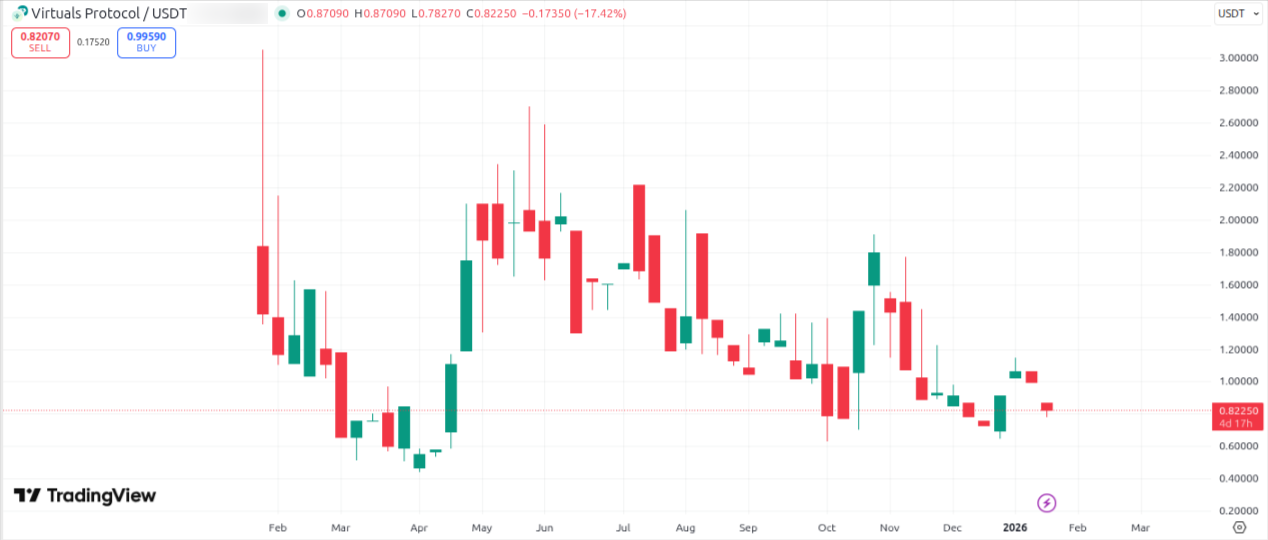
VIRTUAL Price Outlook for 2026
Summary of 2026 Forecast Ranges
Analyst projections for 2026 cluster around low-dollar to low single-digit ranges, with a spread that reflects varying assumptions about near-term adoption. CoinCodex and Changelly forecast VIRTUAL ranging from below $1 to low single digits, largely based on volatility patterns and market-cycle modeling.
Traders Union and 99Bitcoins also point to possible movement into the mid-single digits under constructive conditions—such as protocol traction and sustained AI hype—while more cautious views note the risk of sub-dollar performance if utility lags expectations.
2026 Drivers: Listings, Liquidity, and AI Hype
Forecast accuracy for 2026 hinges on several factors:
Protocol growth: A larger base of active agents, real user activity, and rising demand for AI services would naturally support higher price bands.
Market visibility and listings: Coverage by educational portals and listings on major tracking platforms (for example, CoinGecko, CoinMarketCap) can improve price discovery and institutional access.
Broader AI momentum: Continued investor enthusiasm for AI-linked assets is commonly baked into 2026 outlooks, although it's also a major source of downside risk if sentiment shifts.
As a result, most predictions for this period are conditional: upside depends on real traction beyond early hype, influencing the price prediction 2027.
VIRTUAL Price Outlook for 2030
Analyst and Model-Based 2030 Targets
By 2030, the range of forecasts expands meaningfully. Changelly and AMB Crypto forecast average prices in the low single-digit USD range, with upside scenarios reaching into mid or high single digits.Traders Union’s long-term view includes potential for double-digit prices under aggressive adoption and ecosystem expansion assumptions.
Others, such as StealthEX and 99Bitcoins, present a similar framework: base case scenarios hover near $1–$3, while bullish paths point to $10+ if Virtuals emerges as a dominant player in the AI-agent sector.
Core Assumptions in 2030 Models
Several core assumptions underpin these forecasts:
Scale of the AI-agent ecosystem: Many analysts assume that by 2030, AI agents are widely integrated across consumer apps, games, and virtual platforms, with significant demand for VIRTUAL-based services.
Effectiveness of token design: Bonding curves, fee routing, and agent liquidity pools are assumed to convert protocol growth into token demand. If these mechanisms prove leaky or misaligned, value capture could weaken.
Competitive landscape: Models often include implicit comparisons to alternative AI protocols or off-chain AI solutions, which could dilute Virtuals' market share and affect the price of virtuals protocol.
These variables mean that even similar narratives can yield very different price estimates, depending on the aggressiveness of each model’s assumptions.
Longer-Term Scenarios: VIRTUAL in 2040
Why 2040 Projections Are Highly Speculative
Few platforms venture into detailed 2040 VIRTUAL forecasts, and those that do (such as Traders Union) generally qualify their estimates as high-uncertainty extrapolations. While upper bands may extend into higher double-digit territory, such forecasts are more illustrative than predictive.
At this time scale, disruptive shifts in technology, policy, and AI integration make specific 2040 price calls more speculative than actionable.
Structural Factors Shaping 2040 Outlook
Still, a few key themes frame 2040 scenarios:
Mainstreaming of AI agents: If AI agents become standard across consumer and enterprise tools, early infrastructure providers like Virtuals could benefit from entrenched roles.
Governance evolution: The protocol’s ability to adapt, govern effectively, and upgrade across decades will shape its long-term viability.
Regulatory clarity: The legal status of AI agents, digital payments, and governance structures will heavily influence how, and where, Virtuals can operate.
Due to these dependencies, most credible 2040 scenarios are best interpreted as long-tail possibilities rather than formal projections.
Key Risks and Uncertainties Across 2026–2030–2040
Independent analysts consistently flag several structural risks:
Adoption and execution risk: Without critical mass in agents, users, or partner apps, VIRTUAL demand could remain weak relative to supply.
Token design and governance risk: Adjustments to bonding curves, fees, or treasury mechanics could dilute the link between utility and value accrual.
Technological and competitive risk: Competing AI-crypto platforms or entirely off-chain AI tools may erode Virtuals’ edge, especially in overlapping use cases.
Regulatory and macro risk: Global policy on AI, digital assets, and data governance may constrain growth or shape where the protocol can scale.
Forecast model risk: The wide range of predictions, from sub-dollar to multi-dollar territory, reflects how model-driven and assumption-sensitive these valuations are.
In a fast-evolving sector, understanding these risks is crucial for interpreting any multi-year outlook.
From VIRTUAL Insights to Practical Access with OSL
Price scenarios are only one part of a disciplined digital asset approach. For many market participants, the more important consideration is how to access and manage digital assets within a secure, well-controlled environment.
OSL is Asia’s leading stablecoin and digital-asset trading and infrastructure provider, backed by up to US$1 billion in insurance coverage. Through OSL, users can access VIRTUAL via institutional-grade infrastructure, benefit from insured custody, and integrate digital assets into broader, rules-based portfolio strategies, subject to applicable regulations.
VIRTUAL is supported on OSL through Flash Trade Convert, allowing users to convert VIRTUAL to USDT with a streamlined, quote-based experience and zero trading fees. All conversions are executed at a quoted price that can be reviewed before confirmation.
Scenario Thinking Over Single-Number Targets
Across independent sources, VIRTUAL price predictions for 2026, 2030, and 2040 reflect a spectrum of possibilities—from cautious single-digit scenarios to more ambitious valuations tied to large-scale AI-agent adoption. For a project as early-stage and fast-moving as Virtuals Protocol, focusing on the assumptions and drivers behind each scenario offers more clarity than anchoring to any fixed target.
Frequently Asked Questions (FAQs)
Q1: Is VIRTUAL a good long-term investment?
No definitive conclusion can be drawn. Long-term outcomes depend on whether on-chain AI agents achieve real adoption and sustained economic activity.
Q2: Can VIRTUAL reach $10 by 2030?
Some bullish scenarios suggest this is possible, but only under aggressive assumptions around adoption, ecosystem growth, and favorable market conditions.
Q3: What makes VIRTUAL different from other AI crypto tokens?
VIRTUAL focuses on autonomous, on-chain AI agents with tokenized ownership and native economic activity, rather than off-chain AI integrations.
Q4: Is VIRTUAL supply inflationary?
No. VIRTUAL has a fixed maximum supply of 1 billion tokens, with no planned ongoing inflation according to current documentation.
Q5: Why do VIRTUAL price predictions vary so widely?
Because forecasts rely heavily on assumptions about AI adoption, token utility, and future market sentiment rather than long historical data.
Q6: Where can VIRTUAL be traded?
VIRTUAL is available on selected digital asset platforms. Availability may vary by region and regulatory jurisdiction.
Start your safe cryptocurrency journey now
OSL | Secure Ramps. Trusted Rails !
More topics
More topics
Latest
Best Enterprise Stablecoin Payment Providers: A 2026 Evaluation Framework
Compare enterprise stablecoin payment providers by use case, legal entity, workflow, controls, integration, reconciliation, support, and contract terms.
Best Enterprise Stablecoin Payment Providers: A 2026 Evaluation Framework
How to Reconcile a USDGO Payment: An Illustrative Finance-Close Example
See how Finance can trace a USDGO payment from an approved obligation through payment records, recipient confirmation, reconciliation, and accounting close.
How to Reconcile a USDGO Payment: An Illustrative Finance-Close Example
A USDGO Reserve Review in Practice: Findings, Limits and Follow-up Questions
Review what the July 2026 USDGO reserve attestation establishes, what it does not prove, and which issuer, redemption, and liquidity questions remain.
A USDGO Reserve Review in Practice: Findings, Limits and Follow-up Questions
Stablecoin Payment Platform vs Traditional Cross-Border Provider: Evaluating OSL Business Payments
Compare stablecoin platforms and traditional cross-border providers by service scope, recipient responsibility, records, controls, and support.
Stablecoin Payment Platform vs Traditional Cross-Border Provider: Evaluating OSL Business Payments
Recommended for you
More topics
More topics
