Crypto Investing in Vietnam: Regulations, Market Trends & Risks (2026)
Vietnam is no longer a fringe crypto market. In 2026, it sits at the center of Asia’s retail digital-asset story: Reuters reported that Vietnam ranked fourth globally in Chainalysis’s latest adoption index, with transaction activity involving Vietnamese traders exceeding US$200 billion in the 12 months to June. At the same time, Hanoi is moving from a largely offshore, informal market structure toward licensed domestic exchanges under a pilot regime.
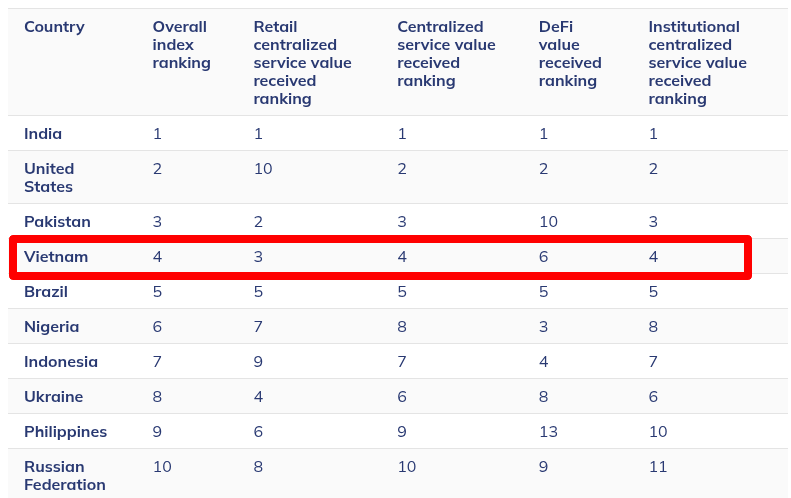
Source: Chainalysis
That combination matters for anyone researching crypto in Vietnam. The question is no longer simply whether Vietnamese investors are interested in digital assets; it is how they typically access the market, what the law now permits, and which safeguards matter in a country where adoption has moved faster than regulation. This article is informational and explains market practice, not whether any asset is suitable for a specific investor.
Why crypto has gained momentum in Vietnam
Vietnam’s crypto interest reflects a mix of market structure and digital behavior. The country had internet penetration of 84% in 2024, according to the World Bank, while personal remittances received were equal to 3.4% of GDP. Reuters also noted that Vietnamese households have relatively limited domestic investment options compared with deeper capital markets elsewhere, with savings often flowing into gold or property. In that environment, crypto has become another route for price exposure, liquidity, and access to global markets.
There is also a distinctly local retail dynamic. Chainalysis describes Vietnam as one of the leading grassroots adoption markets in Asia-Pacific, with broad participation across centralized and decentralized services. That helps explain why crypto in Vietnam is often discussed less as a niche technology theme and more as part of mainstream online investing behavior among digitally native users.
Stablecoins are an important part of that picture. Chainalysis says top-adopting countries, including Vietnam, are shaped by drivers such as remittances, investment, and savings use cases, while a Vietnam-focused market study from Tiger Research says Vietnamese users employ stablecoins for trading, peer-to-peer remittances, and payments. In practice, that means many investors do not view dollar-linked tokens only as speculative instruments; they also see them as a bridge between local currency savings and deeper global crypto liquidity.
Is crypto legal in Vietnam?
Vietnam’s legal position has become clearer, but it is still important to separate ownership and trading from payment use. The 2025 Law on the Digital Technology Industry, which took effect on January 1, 2026, gives digital assets a formal legal basis. The law defines digital assets and classifies them to include “virtual assets” used for exchange or investment purposes and “cryptographic assets” authenticated by cryptographic or similar digital technologies.
That does not mean crypto is legal tender in Vietnam. PwC’s December 2025 overview of Vietnam’s crypto framework states that cryptocurrencies are now recognized as legitimate instruments for exchange and investment, but are not permitted as a means of payment in Vietnam. Reuters likewise reported in March 2026 that digital assets are not recognized as money or a legal means of payment.
For investors, the two institutions to watch most closely are the State Bank of Vietnam (SBV) and the Ministry of Finance (MOF). The SBV remains central to the payment question and broader financial-system oversight, while the MOF has become central to market licensing. On January 20, 2026, the MOF issued Decision No. 96/QD-BTC to launch pilot administrative procedures for licensing crypto-asset trading market services under Resolution No. 05/2025/NQ-CP.
The practical takeaway is that crypto in Vietnam is moving out of a gray zone and into a supervised framework, but the framework is still being built. Reuters reported that the finance ministry is drafting rules that would prohibit Vietnamese nationals from using overseas platforms, and that five applicants had already passed an initial qualification round for local exchange licenses. So investors should treat 2026 as a transition year, not as the end of regulatory change.
How investors commonly buy crypto in Vietnam
Historically, Vietnamese investors have often accessed crypto through offshore platforms rather than a fully domestic regulated exchange ecosystem. Reuters reported that most Vietnamese traders currently use overseas centralized exchanges, which reflects how quickly local demand grew before licensing caught up. That backdrop is important because it explains why funding methods in Vietnam often developed around practical fiat on-ramps rather than around a mature domestic exchange stack.
The most familiar local funding behavior is still linked to bank transfers in VND. Vietnam’s broader payments market is heavily digitized, and domestic bank rails are widely used for online financial activity. In parallel, electronic wallets became officially recognized as a legitimate means of payment from July 1, 2025, alongside bank accounts and cards. Even where crypto purchases themselves are routed through third-party providers or platform intermediaries, Vietnamese users typically expect fast local transfers and mobile-first payment experiences.
Card payments also play a role, especially for smaller or convenience-driven purchases, but they are usually not the defining local characteristic of the Vietnam market. The more distinct feature is that many users have historically relied on exchange-linked transfers, P2P-style flows, or local intermediaries to move from VND into crypto because fully licensed local venues are only now emerging. That is likely to change gradually as the pilot licensing system expands.
For larger tickets, the local market has also supported OTC-style behavior, whether formal or informal. Bigger investors and businesses usually care less about one-click convenience than about liquidity, settlement certainty, and price execution. In a market like Vietnam, where offshore access, stablecoins, and large-value transfers have all been part of the ecosystem, block trading and relationship-based execution remain relevant for institutions and high-volume traders.
Risks investors should know about in Vietnam
Market risk matters, but local platform risk and fraud risk are just as important. VnExpress recently reported that police in Da Nang arrested suspects in a Cambodia-based scam that allegedly imitated Nasdaq and misappropriated VND14 billion from victims. Cases like that show how fake interfaces, impersonation, and social-media-led fraud can overlap with genuine investor interest.
Informal or loosely supervised channels create additional counterparty risk. When investors rely on unregulated intermediaries, private messaging groups, or cash-like settlement behavior, the main problems are not only bad pricing. They include non-delivery, forged payment proofs, frozen transfers, weak KYC, and limited recourse if something goes wrong. Those risks have been amplified in Vietnam because regulation has lagged adoption for years.
Regulatory change is another real risk. Vietnam now has a legal foundation for digital assets and a licensing pilot, but Reuters noted that supervision, taxation, and risk-management rules remain incomplete. Investors therefore need to pay attention not only to token markets, but also to platform eligibility, onboarding requirements, and any future restrictions on offshore access.
What to look for in a secure and regulated trading platform
In Vietnam’s current market, a secure platform should be assessed first on compliance, not on marketing. Investors should ask whether the platform operates under a recognizable regulatory framework, whether it applies AML and KYC controls, and whether it can explain how client assets, fiat movements, and transaction monitoring are handled. That is especially important in a market shifting from offshore access toward locally supervised channels.
The second test is asset protection. A serious platform should be able to explain custody design, segregation of client assets, withdrawal controls, and operational governance. In practical terms, Vietnamese investors should care less about headline promotions and more about whether the venue has the infrastructure to withstand fraud attempts, operational failures, or regulatory scrutiny.
The third test is execution quality and funding clarity. In Vietnam, where investors often begin with VND and move into global crypto markets, it matters whether a platform offers transparent fiat funding options, clear pricing, and appropriate solutions for both smaller trades and larger block transactions. Retail users may prioritize ease of funding and reporting, while institutions may place greater weight on OTC access, custody, and workflow support.
How investors can buy and trade on OSL
For investors who want a compliance-led alternative to informal channels, OSL is relevant because it combines regulated market access with institutional infrastructure. OSL Digital Securities Limited was the first virtual asset trading platform licensed by the Hong Kong Securities and Futures Commission, and the SFC publishes OSL on its list of licensed virtual asset trading platforms. Its custody setup has up to US$1 billion in insurance coverage.
In practice, eligible investors typically access OSL by completing onboarding and identity checks, funding through supported fiat channels where available, and then using the platform’s trading interface for spot activity. For larger or more complex flows, OSL offers personalized OTC services, while its broader business stack includes custody, Trading API, tokenization infrastructure, and payment-related services for enterprises. OSL’s website also states that availability is subject to applicable laws, terms, and risk disclosures.
FAQ
Is crypto legal in Vietnam?
Yes, owning and trading crypto now has a clearer legal basis under Vietnam’s 2025 Digital Technology Industry Law, but crypto is still not recognized as legal tender or a lawful means of payment.
Which regulator oversees crypto in Vietnam?
For investors, the key authorities are the State Bank of Vietnam on payment and financial-system issues, and the Ministry of Finance on the pilot licensing regime for crypto trading market services.
What is the biggest crypto risk in Vietnam?
Beyond price volatility, the main local risks are fake platforms, scam networks, informal counterparty arrangements, and the uncertainty that comes with a fast-changing regulatory framework.
Start your safe cryptocurrency journey now
OSL | Secure Ramps. Trusted Rails !
More topics
More topics
Latest
Why India's $620B Bond Pilot Changed Nothing Legal
SEBI and the RBI's Demat 2.0 pilot issues corporate bonds as digital tokens and settles them with the wholesale digital rupee, preserving existing legal terms while digitizing the infrastructure beneath a $620...
Why India's $620B Bond Pilot Changed Nothing Legal
Why S&P Global Leads Kaiko: Not Hype, But 24/7 Market Infrastructure
S&P Global led a $110 million extension of Kaiko's Series B to build data infrastructure for round-the-clock tokenized markets.
Why S&P Global Leads Kaiko: Not Hype, But 24/7 Market Infrastructure
When One Firm Holds 5% of Ethereum: Infrastructure Stress Test
Bitmine's accumulation of more than 5 million staked ETH raises questions about whether custody, audit, and validator infrastructure can support single-asset concentration at public-company scale.
When One Firm Holds 5% of Ethereum: Infrastructure Stress Test
Best Enterprise Stablecoin Payment Providers: A 2026 Evaluation Framework
Compare enterprise stablecoin payment providers by use case, legal entity, workflow, controls, integration, reconciliation, support, and contract terms.
Best Enterprise Stablecoin Payment Providers: A 2026 Evaluation Framework
How to Reconcile a USDGO Payment: An Illustrative Finance-Close Example
See how Finance can trace a USDGO payment from an approved obligation through payment records, recipient confirmation, reconciliation, and accounting close.
How to Reconcile a USDGO Payment: An Illustrative Finance-Close Example
A USDGO Reserve Review in Practice: Findings, Limits and Follow-up Questions
Review what the July 2026 USDGO reserve attestation establishes, what it does not prove, and which issuer, redemption, and liquidity questions remain.
A USDGO Reserve Review in Practice: Findings, Limits and Follow-up Questions
Recommended for you
More topics
More topics
