The CLARITY Act Senate Showdown: How 7 Key Votes Will Reshape US Crypto Regulation
Introduction
This Thursday, the US Senate Banking Committee hearing room will become the epicentre of global crypto liquidity. After months of stagnation following Coinbase’s withdrawal of support in January, the CLARITY Act—designed to establish definitive rules for digital assets—faces a make-or-break revision moment.
I. Legislative Inflection: The Gap Between DC’s Clock and Silicon Valley’s Innovation
Washington’s legislative clock has long ticked at a dangerously different pace than Silicon Valley’s rapid innovation. The CLARITY Act was initially hailed as the solution to end years of "blind men feeling an elephant" in US crypto regulation.
However, its vulnerability was exposed when industry leaders exited over concerns regarding Decentralized Finance (DeFi) restrictions and stablecoin interest bans. This is not merely a failure of corporate lobbying; it is a fundamental clash between Web3’s native financial logic and traditional DC regulatory mindsets.
II. The Critical Minority: The 7 "Dealmakers" Deciding the Bill’s Fate
According to the latest analysis from Galaxy Digital, breaking the legislative deadlock hinges on the political choices of seven key Democratic senators on the Banking Committee. Beyond the staunch opposition (such as Senators Elizabeth Warren and Jack Reed), the real battlefield has shifted to the "Dealmakers." Their stance will determine if the bill can secure the 60-vote threshold required in the full Senate.
Key Focus Areas of the CLARITY Act Revision
Open-Source Developer Immunity: Should developers be held liable for the illicit use of underlying protocols?
Stablecoin Yield Restrictions: Will issuers be permitted to pass interest income to holders?
The DeFi Perimeter: How should "regulated entities" be defined within decentralized protocols?
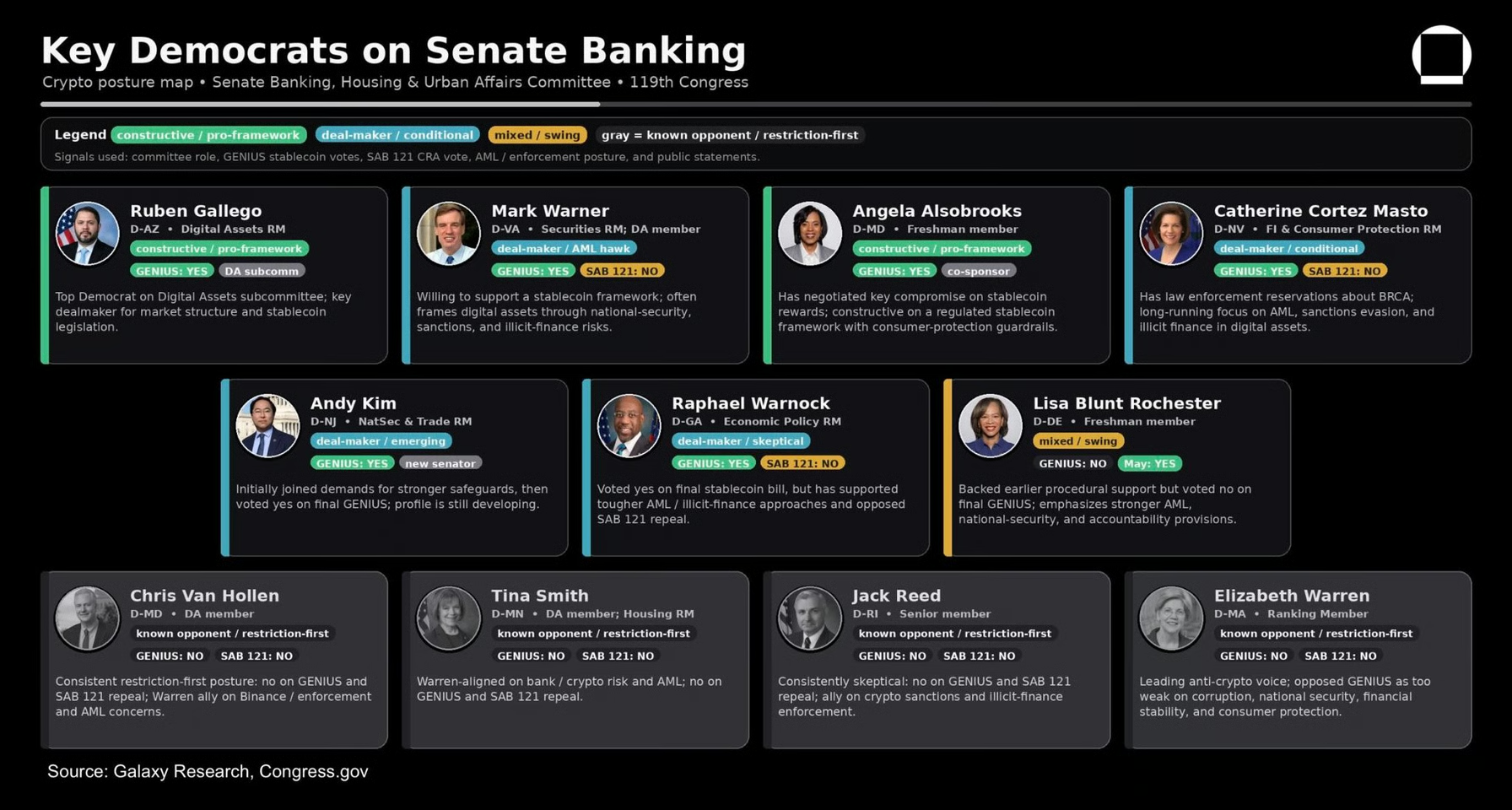
III. Compliance Anxiety: Translating Politics into Market Signals
Translating these political calculations into market terms reveals a profound "compliance anxiety." Legislators are not necessarily resistant to crypto assets themselves; they are resistant to uncontrolled capital flows and financial "black boxes" lacking accountable entities.
For institutional investors, the signal is clear: regardless of the final version of the CLARITY Act, the transition toward highly institutionalized and licensed crypto assets is irreversible.
The "safeguards" demanded by the dealmakers essentially define the core competitiveness of the next generation of digital asset infrastructure.
IV. Conclusion: Capital is Flowing to "Regulatory Safe Havens"
While the legislative process moves slowly through bipartisan friction, global capital flows do not wait. Forward-thinking institutions are moving away from betting on the probability of a bill’s passage and toward ecosystems that are inherently compliant with AML and regulatory requirements at the architectural level. The ultimate winner in the regulatory fog will be the infrastructure that mirrors traditional finance-grade risk management.
FAQ: Frequently Asked Questions about the CLARITY Act
Q1: What is the primary goal of the CLARITY Act?
A1: It aims to establish a clear legal framework for digital assets in the US, specifically stablecoins, by clarifying the jurisdictions of the SEC and CFTC and setting capital reserve requirements for issuers.
Q2: Why did Coinbase previously withdraw its support?
A2: The friction centered on overly broad definitions of DeFi protocols and prohibitions on stablecoin interest features, which were viewed as detrimental to the competitiveness of US-based crypto firms.
Q3: Does Thursday's hearing mean the law will go into effect immediately?
A3: No. This is a "markup" or revision session within the Senate Banking Committee. If successful, it must still pass a full Senate vote and be reconciled with the House of Representatives.
Start your safe cryptocurrency journey now
OSL | Secure Ramps. Trusted Rails !
More topics
More topics
Latest
Why India's $620B Bond Pilot Changed Nothing Legal
SEBI and the RBI's Demat 2.0 pilot issues corporate bonds as digital tokens and settles them with the wholesale digital rupee, preserving existing legal terms while digitizing the infrastructure beneath a $620...
Why India's $620B Bond Pilot Changed Nothing Legal
Why S&P Global Leads Kaiko: Not Hype, But 24/7 Market Infrastructure
S&P Global led a $110 million extension of Kaiko's Series B to build data infrastructure for round-the-clock tokenized markets.
Why S&P Global Leads Kaiko: Not Hype, But 24/7 Market Infrastructure
When One Firm Holds 5% of Ethereum: Infrastructure Stress Test
Bitmine's accumulation of more than 5 million staked ETH raises questions about whether custody, audit, and validator infrastructure can support single-asset concentration at public-company scale.
When One Firm Holds 5% of Ethereum: Infrastructure Stress Test
Best Enterprise Stablecoin Payment Providers: A 2026 Evaluation Framework
Compare enterprise stablecoin payment providers by use case, legal entity, workflow, controls, integration, reconciliation, support, and contract terms.
Best Enterprise Stablecoin Payment Providers: A 2026 Evaluation Framework
How to Reconcile a USDGO Payment: An Illustrative Finance-Close Example
See how Finance can trace a USDGO payment from an approved obligation through payment records, recipient confirmation, reconciliation, and accounting close.
How to Reconcile a USDGO Payment: An Illustrative Finance-Close Example
A USDGO Reserve Review in Practice: Findings, Limits and Follow-up Questions
Review what the July 2026 USDGO reserve attestation establishes, what it does not prove, and which issuer, redemption, and liquidity questions remain.
A USDGO Reserve Review in Practice: Findings, Limits and Follow-up Questions
Recommended for you
More topics
More topics
