From 4% to 76%: What Institutional Flows Reveal About the Regulated Stablecoin Shift
A few years ago, stablecoins were a small share of the institutional volume moving across Fireblocks. In 2026, they account for an expected 76% of a network moving US$7–8 trillion. In Episode 4 of The Borderless, Ran Goldi, Chief Payments and Networks Officer at Fireblocks, and Shaun Heng, Chief Product and Growth Officer at Banxa, discussed what sits behind that number: which stablecoins institutions are choosing, where payment flows originate and land, and which emerging use cases are already in production.
Based on The Borderless Episode 3
A shift measured in trillions, from a small base
Fireblocks provides digital asset infrastructure to around 3,000 institutional clients, including banks, payment service providers (PSPs), exchanges, and stablecoin issuers. That makes its network a useful indicator of how regulated institutions, rather than retail traders, are using digital assets.
According to Goldi, stablecoins accounted for roughly 4–5% of Fireblocks' volume when he took on his current role. In 2026, he expects them to represent 76% of all volume on the platform. Earlier, most activity on the network involved Bitcoin, Ether, and other volatile assets. Today, following the introduction of frameworks such as the EU's Markets in Crypto-Assets Regulation (MiCA) and the US GENIUS Act, the bulk of institutional activity is denominated in stablecoins.
That shift is significant, but it needs context. Total stablecoin supply reached around US$315 billion in the first quarter of 2026. Headline transaction figures are far larger, at up to US$35 trillion a year. McKinsey's analysis, however, finds that genuine payment activity is much smaller: about US$390 billion annualized, or roughly 0.02% of global payments volume, of which around US$226 billion is business-to-business.
Read together, the two views are consistent. Stablecoins have become the default settlement asset for institutions already active in digital assets. Their share of the wider payments market is still very small, which is why the more useful questions concern how adoption is happening, not whether it is.
Why regulated stablecoins are winning institutional flows
By market capitalization, USDT remains the largest stablecoin. On Fireblocks, however, USDC is the leading stablecoin, at around 70% of stablecoin volume. Goldi described this as the reverse of the wider market.
The explanation lies in who is now driving volume. Banks, incumbent payment companies, and regulated fintechs are, in Goldi's words, "adopting what they are allowed to adopt." Their choice of stablecoin is made by compliance and risk teams, and it follows the regulatory perimeter:
In the EU, MiCA sets authorization requirements for stablecoins offered to EU users. After its stablecoin rules took effect, major exchanges restricted USDT for users in the European Economic Area.
In the US, the GENIUS Act, signed in July 2025, created the first federal framework for payment stablecoins, with requirements on reserves, redemption, and anti-money-laundering controls. Its rules take full effect no later than January 2027. Tether's response has been to launch USAT, a separate US-regulated stablecoin issued by Anchorage Digital, while working toward compliance for USDT.
In Hong Kong, the Stablecoins Ordinance took effect in August 2025. The HKMA granted its first stablecoin issuer licenses in April 2026, to HSBC and to Anchorpoint Financial, a joint venture of Standard Chartered Bank (Hong Kong), HKT, and Animoca Brands.
The result is effectively two stablecoin markets. In the open global market, liquidity and network effects decide which stablecoins lead. In the regulated institutional market, licensing and the issuer's regulatory standing decide. For a treasurer or PSP, the relevant question is not which stablecoin is largest, but which ones counterparties in each market are permitted to hold, redeem, and settle in.
This is the rationale behind USDGO, the enterprise stablecoin distributed by OSL. USDGO is issued by Anchorage Digital Bank, a US federally chartered bank, and is designed for corporate payments, settlement, and treasury use.
Goldi does not expect the current ranking to hold. Over the next 18 months, he suggested, the leading stablecoin for institutional payments "will probably be maybe even a stablecoin that's not one of the top two or three right now."
Stablecoins and tokenized deposits: how banks are responding
For banks, Goldi sees two main paths: offering transactional banking services that use stablecoins, or issuing tokenized deposits. The two are often discussed together, but they work differently.
Stablecoin | Tokenized deposit | |
|---|---|---|
What it represents | A claim on a pool of reserve assets, held 1:1 in cash and high-quality liquid assets | A bank deposit recorded on a blockchain ledger |
Who can hold it | Any eligible holder, including people who are not customers of the issuer | Generally the issuing bank's own customers |
Where it works best | Across institutions, markets, and platforms | Within a single bank or a group of participating banks |
Balance sheet | Reserves are segregated and not lent out | Funds remain part of the bank's balance sheet and can support lending |
Because tokenized deposits work best inside a defined network, banks are increasingly joining together. Goldi described securing "a seat at the table" as the priority for many banks today. In Europe, Qivalis, a bank-owned venture building a MiCA-compliant euro stablecoin, grew from 12 founding banks to 37 by May 2026. It has applied to the Dutch central bank for an e-money license and is targeting launch in the second half of 2026. In the US, Early Warning Services, the bank-owned operator of Zelle, has launched a stablecoin, ZLUSD, with stablecoin payments to India planned in the Zelle app by the end of 2026.
Goldi's expectation for the next 18 months is that consortiums within each region will become interoperable. Tokenized deposits would circulate inside each network, with stablecoins acting as the bridge between them. On this view, the two instruments are complementary rather than competing.
Incumbent PSPs are also returning to the market. Goldi noted that large merchant acquirers, which process trillions of dollars a year, were slower to act in earlier cycles. Over the past six months, he has seen them approach digital assets "from the ground up," seeking their own licenses rather than relying only on third parties. Regulatory clarity has made that planning possible.
Where the money flows: the last mile
Goldi also shared a view of Fireblocks' payment traffic with trading, DeFi activity, smart-contract activity, and lending removed. On the sending side, roughly 40% of this payments volume comes from European entities paying outside Europe, with a similar share from the Americas. APAC accounts for about a fifth and Latin America for a few percent. On the receiving side, the picture is reversed: Latin America and APAC are the leading destinations.
This asymmetry explains where much of the industry's value is being built. Large companies in the US and Europe are connected to domestic and regional systems such as ACH, SWIFT, and SEPA. Paying out in emerging markets is different, because it requires access to local systems such as SPEI in Mexico, PIX in Brazil, or the Philippines' domestic rails. Each has its own licensing, banking, and compliance requirements.
Shaun Heng described the challenge in Asia: regulation differs between Thailand, Vietnam, Singapore, and Malaysia, and there is no single compliance model that covers them all. Banxa's approach is to add local partners and payment methods country by country. A recent example is VietQR in Vietnam, which allows users to pay from their banking app by scanning a QR code.
The conclusion matches one from Episode 2 of The Borderless, on pre-funding: moving value on-chain is the simpler part of a cross-border payment. The scarce capability is licensed, local connectivity at the first and last mile.
Build, buy, or partner: the on- and off-ramp question
As banks mature in digital assets, a natural question is whether they will build their own on- and off-ramps, given that they already hold banking licenses and local payment access. Shaun has seen several banks and fintechs explore this. In his experience, many such projects are scaled back within six to twelve months, once the full scope becomes clear.
A license is necessary but not sufficient. Running an on- and off-ramp at scale also requires:
identity verification, KYC, and onboarding;
fraud and risk management, including chargeback handling;
integration with custody and wallet infrastructure;
sourcing and supporting a wide range of digital assets; and
fast, reliable delivery to the end user.
Each of these improves with transaction history, which is why operating experience is difficult to replicate quickly. Goldi expects more banks to acquire rather than build. Several have already approached Fireblocks about potential targets. OSL Group's acquisition of Banxa, completed in January 2026, is one example of this convergence.
The customer base of ramp providers is changing too. Banxa's partners were once concentrated among crypto wallets. They increasingly include aggregators and fintechs that embed on- and off-ramp capabilities in their own products.
The next layers are developing at different speeds
Three themes are frequently discussed as the next phase of stablecoin payments. The conversation suggested they are at very different stages.
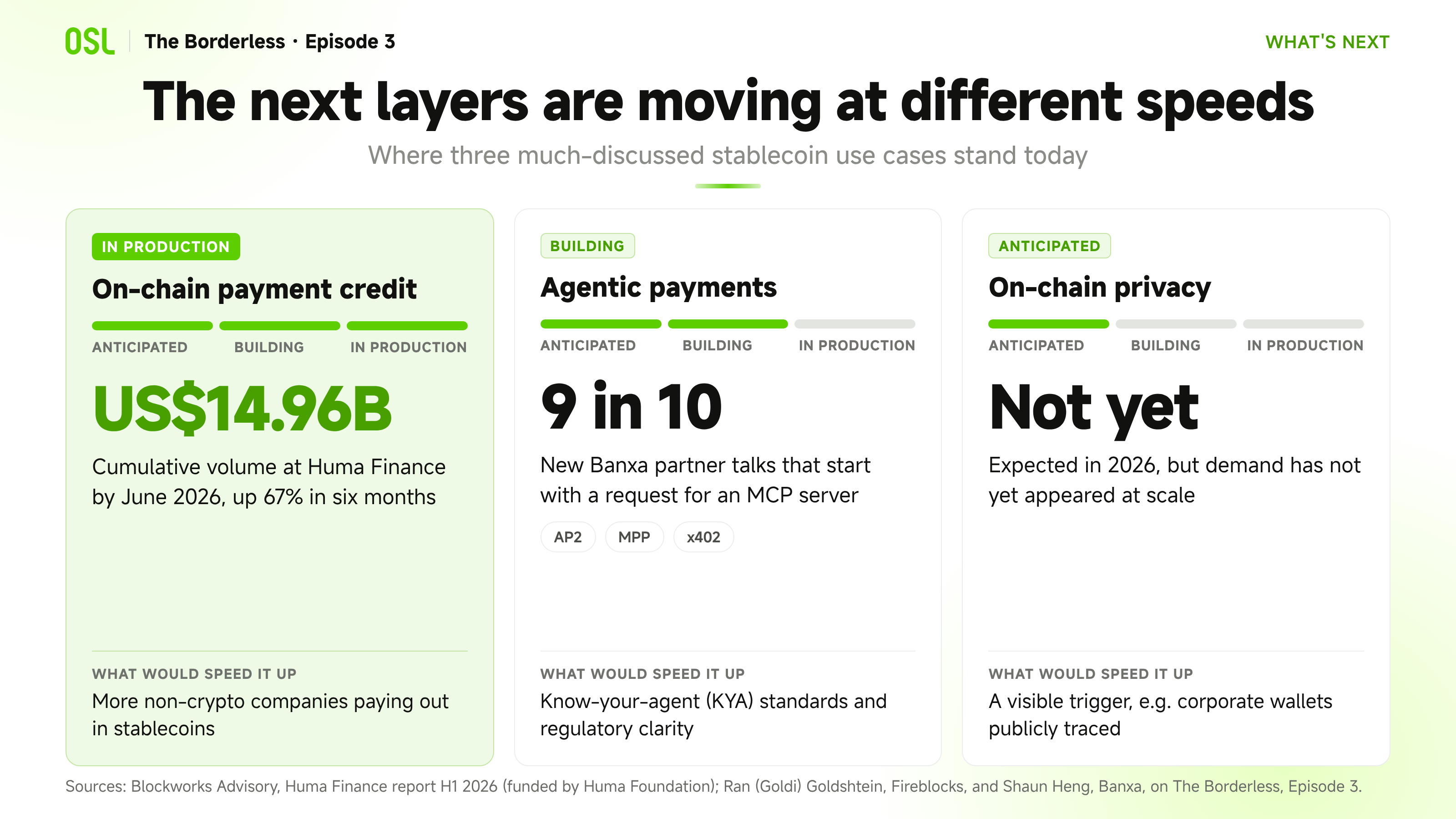
On-chain credit is the most mature, and it tackles the pre-funding problem from Episode 2 from a different direction. Instead of holding idle capital in every corridor, a payment company draws credit at the moment of payout and repays it once incoming funds settle.
Agentic payments have the infrastructure but not yet the demand. The harder questions are identity and liability: how to verify an AI agent acting for a customer, and how networks and regulators will recognize it. As Shaun put it, this is largely “a sequencing conversation.”
The regulatory outlook
Both guests expect regulation to remain the main factor shaping the pace of adoption.
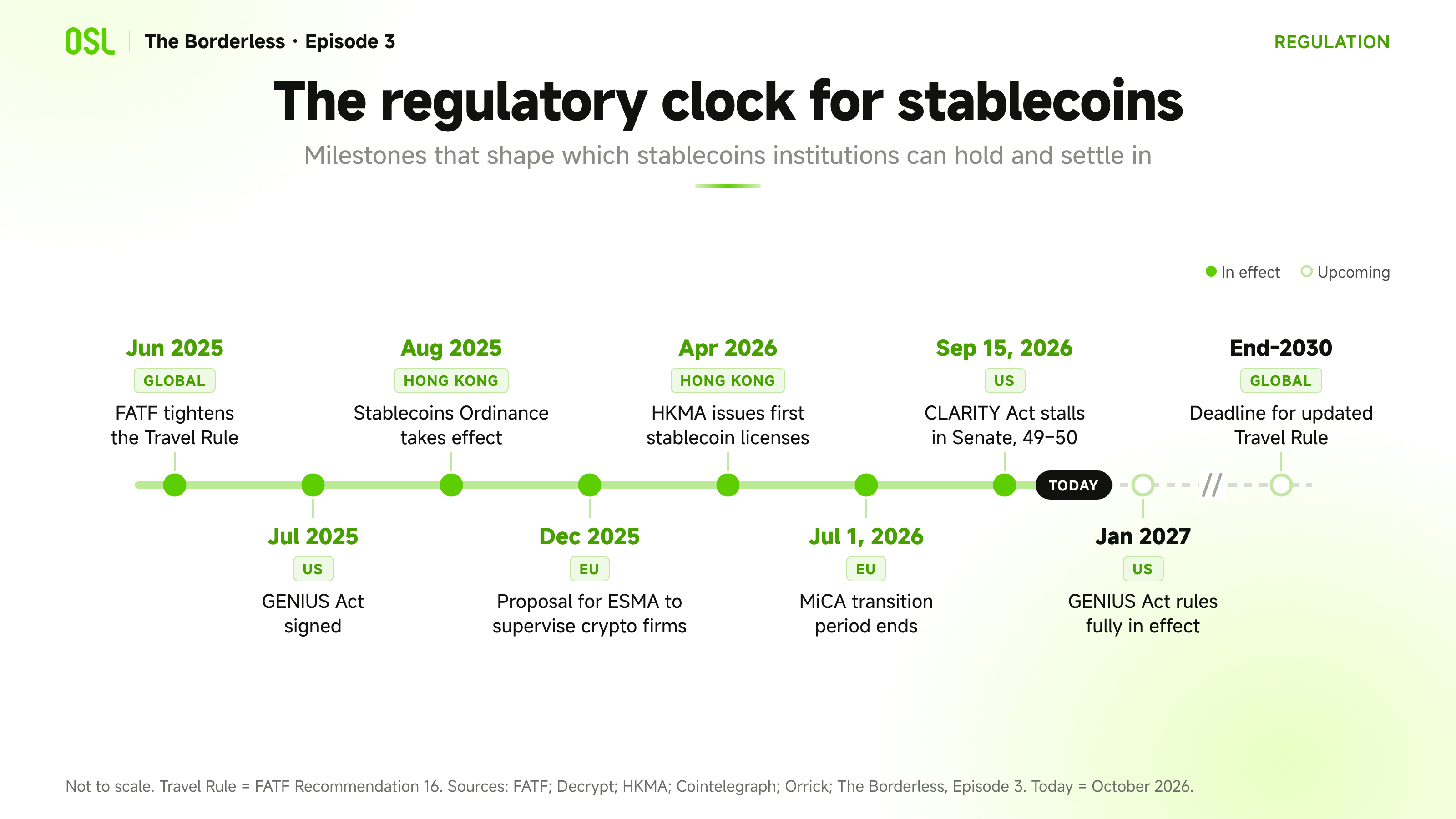
Europe. With MiCA’s transition period over, firms serving EU customers need full authorization, a step Shaun said has exposed providers that had not invested in compliance. Goldi expects further refinement, and supervision may move to ESMA.
The Travel Rule. Goldi described current implementation as inconsistent across the industry. The FATF’s 2025 update sets a common standard for the data that must travel with each payment.
The United States. With the CLARITY Act stalled in the Senate, rulemaking continues at the SEC and CFTC. Goldi’s main expectation is continuity: with banks now active participants, the industry is better positioned than in previous cycles.
Emerging markets. Regulators are watching Europe, and to some extent the UK, before setting their own approaches.
How OSL approaches it
The themes in this episode reflect how OSL has built its business: around the licensed first and last mile, rather than the on-chain transfer alone. Frost & Sullivan ranked OSL first worldwide by B2B stablecoin payment volume in 2025.
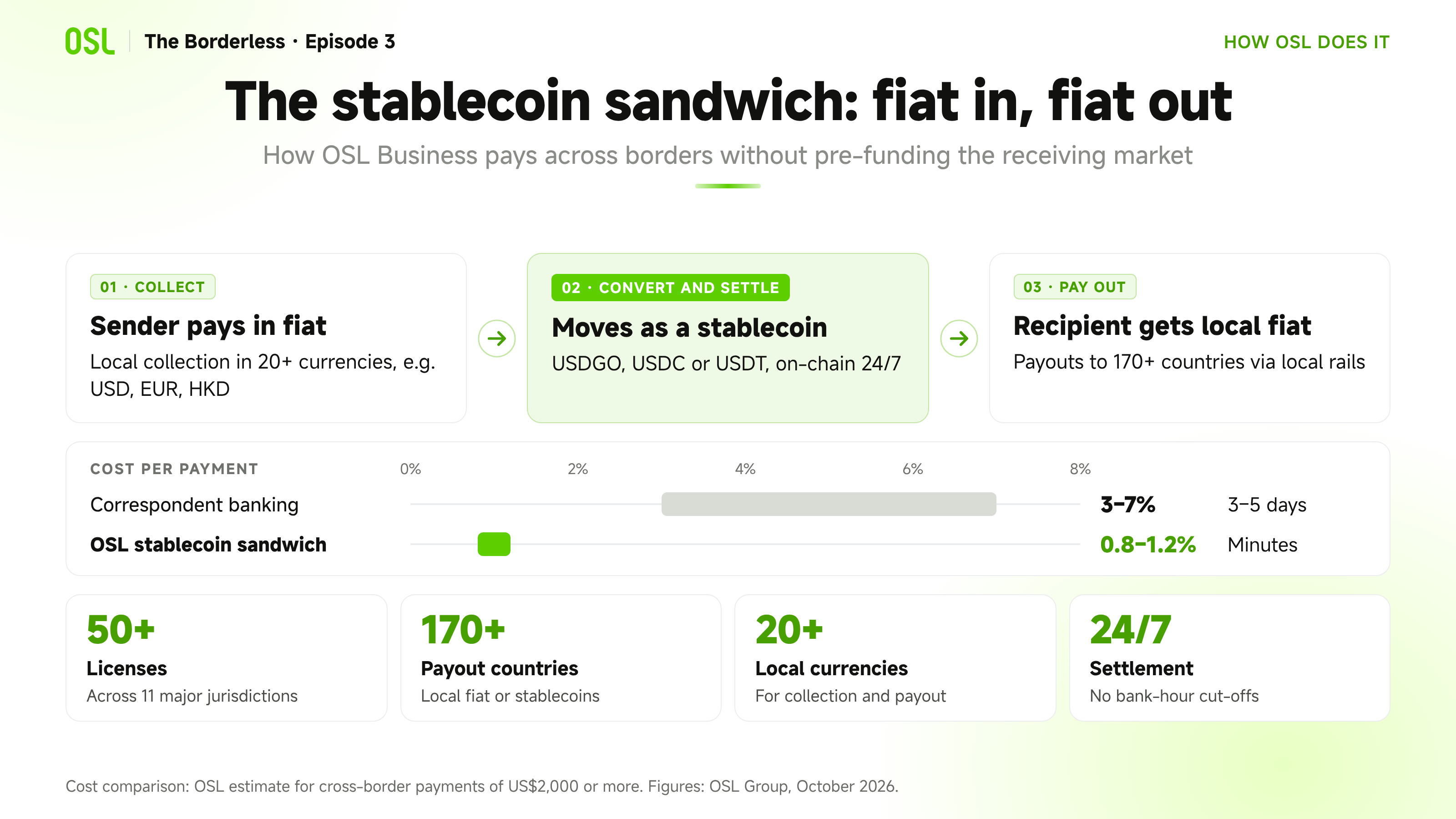
OSL Business gives enterprises one account to collect, convert, and pay out across fiat and stablecoins, without pre-funding accounts in the receiving market.
Banxa, part of OSL Group since January 2026, provides embedded on- and off-ramp infrastructure to more than 400 partners and continues to add local payment methods in emerging markets, such as VietQR.
USDGO is an enterprise stablecoin issued by Anchorage Digital Bank, a US federally chartered bank, and distributed by OSL, fully reserved 1:1 with monthly attestations.
OSL AgentPay, launched in August 2026, provides stablecoin payment infrastructure for AI agents. Developers can settle in USDT, USDC, or USDGO through an API, with support for protocols including x402, AP2, and MPP.
As with pre-funding, not every flow belongs on stablecoin rails. OSL's focus is helping institutions use them where they reduce cost, settlement time, or capital requirements, with the regulatory coverage that real-world payments need.
What this means for decision-makers
Banks: joining a consortium is a starting point, not a complete strategy. The operational work of stablecoin payments sits at the last mile. Decide early whether to build, acquire, or partner, and assess realistically how long building would take.
PSPs and fintechs: treat stablecoin selection as a compliance decision first. Evaluate partners on their licenses and payout coverage in your receiving markets.
Corporate treasurers: assess on-chain credit and stablecoin settlement as ways to reduce pre-funded balances. On current evidence, these are the most mature of the emerging use cases.
The bottom line
The growth of stablecoins on institutional networks is real, but it is being shaped less by technology than by regulation, local connectivity, and operating experience. Institutions that choose stablecoins their counterparties can hold, secure licensed access to the markets they pay into, and sequence their investment in newer areas such as agentic payments are likely to be best placed as adoption broadens.
Watch the full conversation
The Borderless is an OSL show about how money moves across payments, treasury and markets.
This article is for informational purposes only and does not constitute financial, legal or investment advice. Views expressed by guests are their own. Illustrative figures are hypothetical and do not represent client data. Third-party figures are as reported by their sources.



See how OSL can support your business
Talk to our team about your specific needs.