$27 Trillion Idle Capital: The Hidden Cost Behind "Instant" Cross-Border Payments
In some markets, sending money still takes longer than shipping a parcel. The reason is a decision most customers never see: pre-funding. In Episode 2 of The Borderless, Albert Wong, SVP of OSL Business, and Donato Giarnera, Head of Business Development for the Middle East & APAC at Arf, unpacked how pre-funding works, what it costs, and the alternative models.
Based on The Borderless Episode 2
A logistics problem that turned out to be a money problem
Before moving into payments, Albert Wong ran operations, supply chain and logistics at Amazon and other multinationals. By then, getting goods across borders had become routine. A merchant in China knew exactly how to ship to the US, Europe or Latin America.
Getting paid was another matter. "In some of the markets, sending money may take longer than sending a physical package," Albert recalls. That gap drew him into fintech in 2015, at WorldFirst, one of the early providers helping cross-border e-commerce merchants collect money from around the world.
What he noticed there still shapes the industry. "The innovation is at the wrapper level," he says. "The underlying technology is still the same SWIFT infrastructure." Fintechs built far better customer experiences on top of the rails, but the rails themselves still moved money in one to three days.
To close that gap, payment companies turned to pre-funding.
What pre-funding is, and where the money sits
Pre-funding means placing your own money in the destination market before your customer's funds arrive. A customer in the UK pays a supplier in Hong Kong, and the supplier is credited almost immediately. That only works because the payment company already has Hong Kong dollars sitting in a local account, ready to pay out. The customer's pounds follow later over the slower correspondent rails.
Donato Giarnera describes the mechanics: financial institution A pre-funds financial institution B, and B executes the payout on A's behalf. "The pre-funding sits in the account of the financial institution that is going to do the payout." In banking terms, these are nostro accounts: money one institution holds with another, in the local currency, to settle payments.
For the end customer, the experience feels instant. For the payment company, it means capital tied up in every corridor it serves.
Why it gets expensive fast
Across the industry, the scale is enormous. Keyrock estimates that around US$27 trillion sits in Nostro and Vostro accounts worldwide to support cross-border settlement (Keyrock). At the level of a single payment company, Albert points to two compounding problems.
The first is idle capital. Every corridor needs a buffer large enough to cover payouts while the inbound leg is still in transit. Serve 20 countries and you are running 20 separate cash buffers, each forecast and managed on its own. Donato calls it "very inefficient from a global treasury perspective to actually allocate capital efficiently across all those accounts."
The second is the off-time. Every country has its own bank holidays. Before a long closure in one market, a payment company has to estimate how much volume will flow through that corridor and fund all of it in advance, because it cannot top up while local banks are closed. Weekends and month-end salary runs create the same spikes.
Then there is the operational bill. Keyrock's research describes treasury teams topping up local accounts every one to three days and paying an FX spread each time, banks that charge to hold idle foreign-currency balances or require minimum thresholds, and fintechs that "spend millions each year just on reconciliation" across dozens of local accounts. And because no one forecasts perfectly, most firms over-provision. Every extra buffer is more capital sitting idle.
An illustrative example shows how quickly this adds up. The figures below are hypothetical, not client data:
Scenario | Assumption | Capital pre-positioned |
|---|---|---|
One corridor, normal week | US$1m in daily payouts, 2-day settlement lag | ~US$2m |
Same corridor, before a 5-day holiday | Holiday volume funded up front | ~US$5–7m |
20 corridors, normal week | Same profile in each | ~US$40m |
Carrying cost | 4–8% cost of capital on US$40m | ~US$1.6–3.2m a year, before opportunity cost |
For reference, Keyrock's report uses a 5% cost of capital, or US$50 million a year for every US$1 billion held in nostro accounts, and puts the total cost of prefunding, including overhead, at 3–5% a year.
As Albert puts it, when interest rates are higher, "the cost of the capital actually means higher," and that is before counting what the same money could earn if it were deployed elsewhere.
There is also a less obvious cost. Donato points out that "the idle capital that they were able to provide was de facto a cap to how much volume they could generate." For a growing payment company, the size of its pre-funding pool quietly sets the ceiling on its growth.
The numbers bear this out. Keyrock's analysis of annual reports from leading listed remittance fintechs finds that they turn their capital over only about one to two times a year. That ties up roughly US$0.45–0.79 of float for every US$1 of annual payment volume.
Why the problem has lasted so long
Faster, cheaper cross-border payments have been a stated policy goal for years. The G20 set targets for 75% of cross-border payments to be credited within one hour by the end of 2027 (FSB). The Financial Stability Board's 2025 progress report concluded that "it is unlikely that satisfactory improvements at the global level will be achieved in line with the 2027 Roadmap timetable" (FSB, October 2025).
As long as the underlying rails settle slowly and close on weekends and holidays, someone has to hold the float. The question is who, and at what cost.
Three ways to handle pre-funding
The conversation surfaced three broad approaches. Most payment companies end up using a combination of them.
Approach | How it works | Best suited for | Trade-off |
|---|---|---|---|
1. Fund it yourself | Hold your own capital in nostro accounts in each corridor | Firms with cheap capital and a few stable corridors | Idle capital; growth capped by the size of the float |
2. Borrow the float | Draw short-term working capital from a liquidity provider, for base volume, peaks or both | Growing PSPs, MSBs and OTC desks; large institutions topping up for peaks | Credit requirements; still pre-positions money |
3. Redesign settlement | Convert fiat to stablecoin, move it on-chain, and pay out local fiat on the other side | Multi-corridor payment flows where speed and capital efficiency matter | Depends on licensed first- and last-mile partners in each market |
Borrowing the float: base volume and peaks
As a Swiss-regulated global treasury and liquidity platform, Arf provides short-term working capital, enabling payment companies, as Donato describes it, to “not have to pre-fund each and every account to each and every partner that they have worldwide."
Two patterns stood out in his description of how clients use their services.
The first is on-demand liquidity for peaks. Larger institutions often already have access to cheap bank debt, but, in Donato's experience, banks "may be more reluctant to provide liquidity for peaks, or only for weekends or for holidays." That creates an awkward paradox: "When everyone wants liquidity, then, of course, it becomes more difficult to obtain it." Weekends, holidays and the first and last five days of the month, when salaries are paid, are when on-demand facilities earn their keep.
The second is gradually replacing base volume. Many firms start with peak cover only, then move their base volume onto external liquidity once they see what their own equity costs them sitting idle. "It is very expensive, actually, to use your own equity to finance, basically, pre-funding," Donato says.
This is where the economics change most. Borrowed liquidity is drawn only when a payout needs it and repaid once the inbound fiat settles, so the same dollar can fund many payouts. Huma Finance, which provides on-chain liquidity to licensed financial institutions, reports that most of its liquidity settles back within one to six days (Artemis). By Keyrock's figures, stablecoin-native payments company Mansa averages 11x capital turnover a month, and Arf averaged around 56x capital turnover across 2024. That compares with one to two times a year for traditional fintechs.
Who qualifies matters too. Donato was clear that providers like Arf work only with licensed financial institutions, typically with at least two years of audited financials and meaningful annual revenue. The sweet spot is Series A to C companies that need liquidity to scale but are not yet mature enough to get easy access to bank credit.
Redesigning settlement: the stablecoin "sandwich"
The third approach removes the need to pre-position money at all.
"Unlike SWIFT, stablecoin by nature, because using blockchain, is global and real-time by nature," says Albert. OSL's model uses that property in what the team calls the sandwich solution. "Why sandwich? Because it's fiat on both sides."
Using Albert's example of a UK-to-Hong Kong payment:
Fiat in: the payment company sends GBP to OSL in the UK.
Stablecoin across: GBP is converted into a stablecoin such as USDC, USDT or USDGO and moved on-chain.
Fiat out: in Hong Kong, the stablecoin is converted into HKD and paid out to the recipient.
The payment company sends pounds and, near real-time, Hong Kong dollars arrive on the other side. It delivers the same instant experience to its customers, without a pre-funded Hong Kong account.
This model depends on deep local liquidity at both ends. OSL's exchanges in Hong Kong, Indonesia, Japan and Australia, where clients buy and sell stablecoins in their local currencies, provide that liquidity.
The hard part is not the stablecoin
It would be easy to read the sandwich model as a technology story. Albert argues the opposite. "Moving the stablecoins from one to another, I guess in a way for us it's the easiest part."
The real work sits at what he calls the first mile and last mile: getting fiat into the system and back out again, across different regulators, banking partners and local payment rails in every market. That is where licensing, compliance and banking relationships matter far more than blockchain throughput.
That also explains one of the more telling trends Albert shared. A growing number of payment companies work with OSL without offering stablecoins to their own customers at all. They use the infrastructure purely to free up pre-funding capital. For them, stablecoins are simply plumbing, invisible to the end user.
How OSL approaches it
This thinking underpins OSL Business, launched last year as more payment service providers approached OSL with the pre-funding problem. OSL Business lets enterprises collect, convert, settle and pay out fiat and stablecoins, including:
named virtual accounts in 20 fiat currencies;
payouts to more than 170 countries in 129 currencies;
access to local rails including FPS, SEPA, CHAPS, ACH and Fedwire.
All of it runs under OSL's regulatory licences/registrations across Asia-Pacific and beyond, including Hong Kong, Japan, Indonesia, Europe, US, Canada and Australia.
The point is not that every flow should move to stablecoin rails. Pre-funding, borrowed liquidity and stablecoin settlement each have a place. OSL's focus is the part Albert identifies as hardest: the licensed first and last mile that makes the model work in practice.
Before you choose a partner: a quick checklist
Both guests came back to the same few questions.
Licensing, market by market. Is the partner licensed in every jurisdiction your flows touch? Donato was clear that working with an unlicensed provider is a compliance risk, not a shortcut.
First- and last-mile coverage. Can they actually get your fiat in and out in each corridor, through local rails and banking partners? That is what makes a solution end-to-end.
Liquidity depth. How large a facility, or how much local-currency liquidity, can they support at your peaks, not just on an average day?
Operating hours. Do their fiat legs run through weekends and holidays, or only the stablecoin leg? This is where the holiday problem either disappears or quietly returns.
Fit with your model. Do you need peak cover, base-volume replacement, or a settlement redesign? Many firms benefit from a mix.
The bottom line
Pre-funding does not remove the complexity of cross-border payments. It moves the complexity onto your balance sheet. Get the strategy wrong and, in Donato's words, you end up "allocating capital in markets in which that capital is not needed," which is expensive and a drag on growth. Get it right, whether through borrowed liquidity, stablecoin settlement or both, and the same capital can go toward what Donato calls "what really matters, like growing the company."
Watch the full conversation
The Borderless is an OSL show about how money moves across payments, treasury and markets.
This article is for informational purposes only and does not constitute financial, legal or investment advice. Views expressed by guests are their own. Illustrative figures are hypothetical and do not represent client data. Third-party figures are as reported by their sources.
Related

From Sibos to TOKEN2049 - Stablecoins Mature as Storytelling Fades
From 4% to 76%: What Institutional Flows Reveal About the Regulated Stablecoin Shift
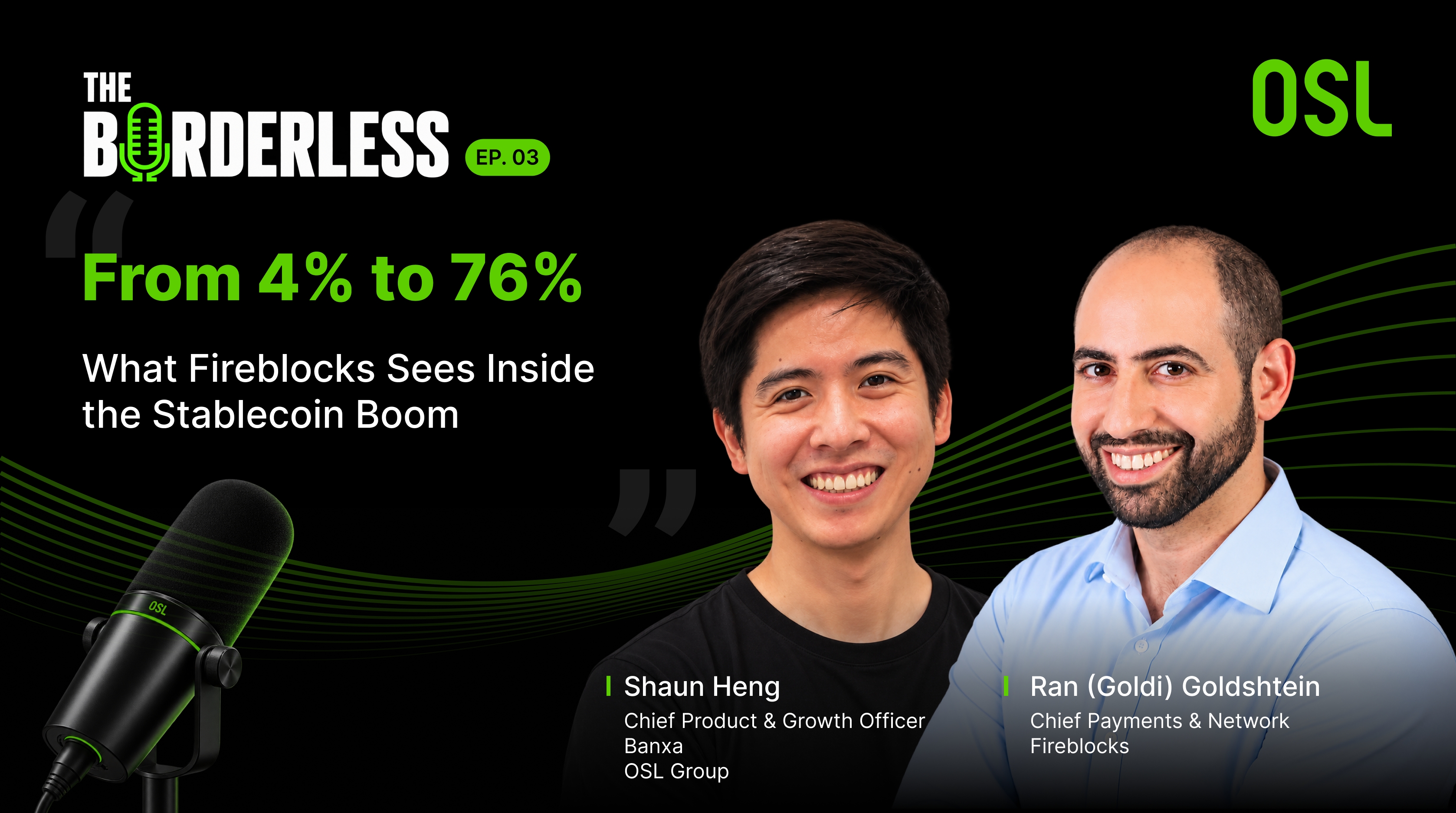
From 4% to 76%: What Fireblocks Sees Inside the Stablecoin Boom
See how OSL can support your business
Talk to our team about your specific needs.