Stablecoin Weekly Pulse | Vol. 22: Welcome to the “Trump Resort”

Data through August 19, 2026
Welcome to the Stablecoin Weekly Pulse Vol. 22. Subscribe for a 10-minute read highlighting the signals most relevant to institutions and businesses.
I. Stablecoin Payments: This Week in Data
Stablecoin Market Overview
Total Supply Flat: As of August 19, the global on-chain stablecoin supply stood at US$311.4 billion (across 157 tokens), down slightly by 0.5% over the past 30 days.
On-Chain Activity Rebounds Across the Board: Daily transfer volume averaged US$206.9 billion (MoM +43.7%), daily transactions reached 63.2 million (MoM +8.1%), and daily active addresses totaled 4.6 million (MoM +1.6%). All three activity metrics turned positive simultaneously, reversing months of declining activity.
Stablecoin Transaction Overview
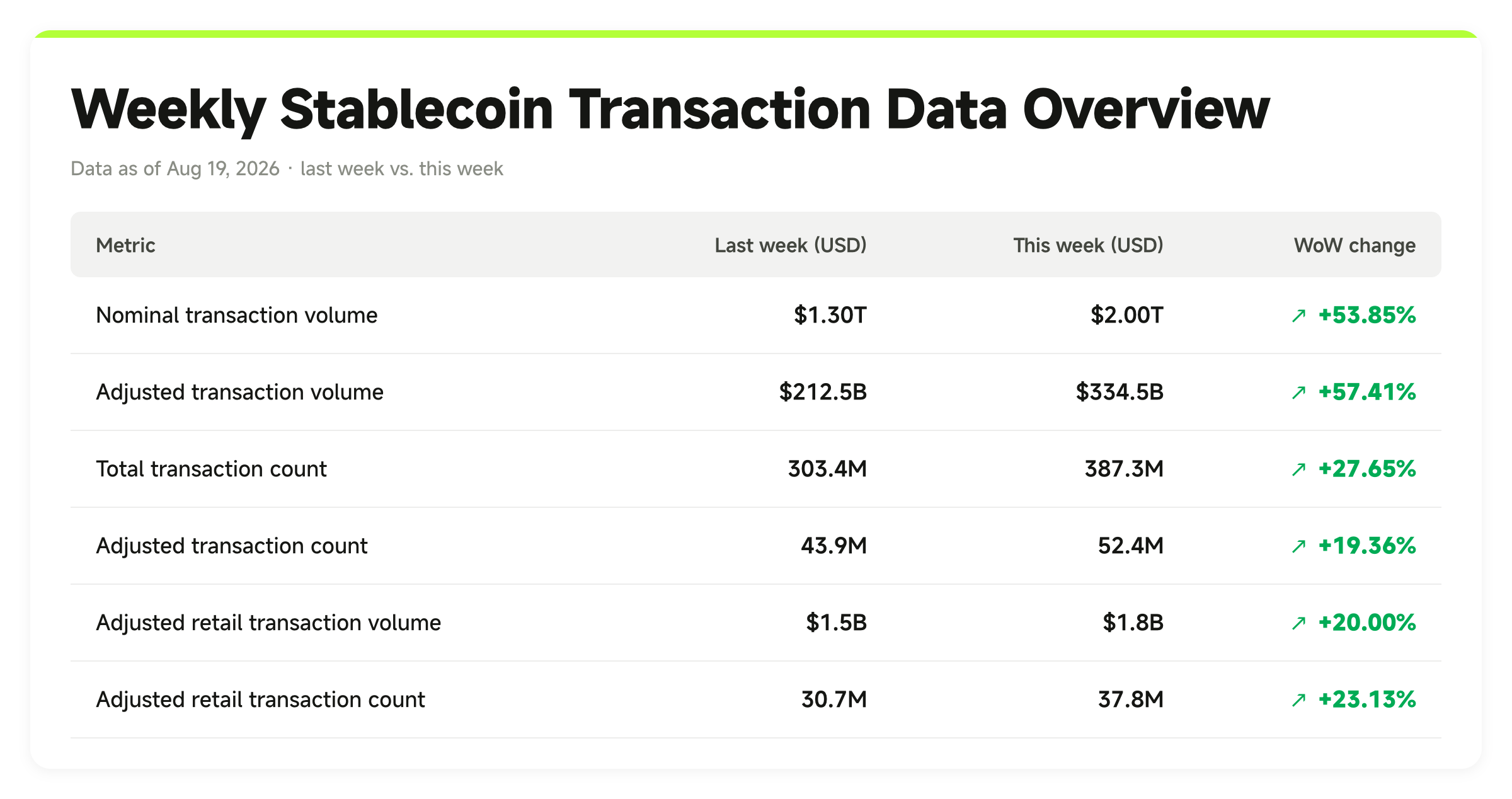
Adjusted Volume at 16.7%: Over the past seven days, nominal transaction volume reached US$2.0 trillion, with adjusted volume at US$334.5 billion (accounting for 16.7% of nominal volume); total transactions were 387.3 million, with adjusted transactions at 52.4 million.
High-Frequency, Small-Ticket Retail Usage: Adjusted retail transaction volume was approximately US$1.8 billion (accounting for 0.5% of total adjusted volume), while transaction count reached 37.8 million (72% of total adjusted transactions).
Week over Week: Nominal Rebounds, Real Settlement Pulls Back
Broad-Based Upside Across All Six Metrics: As of August 19, nominal and adjusted volumes, transaction counts, as well as retail volume and count all rebounded, marking the first comprehensive volume expansion across all metrics in recent weeks.
Volume Expansion Without Quality Loss: Nominal transaction volume grew by 53.8% week-on-week, while adjusted transaction volume surged by 57.4%, with real settlement growth slightly outpacing nominal volume. The adjusted-to-nominal ratio stood at 16.7% this week, broadly flat with last week’s 16.3%. This expansion was not driven purely by non-settlement noise, as real economic delivery grew proportionally - a stark contrast to the previous week’s pattern of “soaring nominal volume alongside flat real settlement.”
Structural Analysis: Real Delivery Accompanies Volume Expansion, Retail Share Climbs Further
Real Settlement Keeping Pace Is the Key Signal: Unlike last week’s pattern of soaring nominal volume alongside flat real settlement, adjusted real transaction volume (+57.4%) and nominal transaction volume (+53.8%) expanded in tandem this week, keeping the adjusted-to-nominal ratio stable. The uptick in on-chain activity is no longer confined to non-settlement noise; real economic delivery expanded synchronously, with the overall “quality” of volume growth recovering noticeably from last week.
Barbell Structure Persists as Retail Share Rises to 72%: The barbell held, dominated by small-ticket retail transactions in count and large-value institutional transactions in volume. Real retail transactions rose to approximately 72% of total adjusted real count (up from 67% last week), while retail volume accounted for around 0.5% of total adjusted real volume. High-frequency, small-ticket activity strengthened further, while volume remained heavily dominated by institutional transactions.
Monthly and Weekly Data Align to Reaffirm Trend: According to Artemis’ 30-day metrics, daily transfer volume (+43.7%), daily transactions (+8.1%), and daily active addresses (+1.6%) all turned positive simultaneously, aligning with the direction of the weekly broad-based expansion. Meanwhile, total supply remained down slightly by 0.5% over the same 30 days, indicating that this rebound represents an increase in transaction activity rather than supply-side expansion; further observation is required to determine whether this momentum in volume and real settlement can be sustained.
Sources: Artemis, Visa, OSL Research
Definitions: Adjusted figures exclude arbitrage, fund transfers, market-maker round-trips, and similar noise. Visa classifies individual transactions below US$250 as retail and those of US$250 or above as non-retail.
II. This Week in Stablecoin Payments and Infrastructure
The hand that deals the cards is the hand that takes the pot.
1. OCC Conditionally Approves Trump-Linked Stablecoin Firm for Federal Trust Bank Charter
On August 14, the Office of the Comptroller of the Currency conditionally approved World Liberty Trust Company (WLTC) to organize a national trust bank dedicated to stablecoin operations. The decision drew sharp political controversy because of the Trump family’s 38% stake in WLTC’s affiliate, World Liberty Financial (WLF).
Once WLTC receives final approval to operate, it will assume minting and custody of USD1, a white-label stablecoin currently issued by BitGo Bank & Trust and distributed by WLF. USD1 has a market capitalization exceeding US$4 billion, making it the world’s fifth-largest stablecoin.
2. US Treasury Department Proposes Rule to Define “Issuance” and “Sale” of Payment Stablecoins
On August 17, the US Department of the Treasury published a Notice of Proposed Rulemaking seeking to define what constitutes “issuing a payment stablecoin in the United States” and “offering or selling” one to persons in the US, under section 3 of the GENIUS Act. The proposal opens a 60-day public comment window.
Under the proposed framework, a stablecoin is deemed issued in the United States whenever the issuer or the initial recipient of the minted asset is located domestically; the issuer would then require a federal or state license.
The rule would also treat any crypto-asset service provider that solicits or advises a buyer on how to evade location-detection or restriction mechanisms as conducting a sale within US jurisdiction. Where a token is not a licensed payment stablecoin under the GENIUS Act, such conduct would constitute an unlawful sale.
3. FASB Proposes Allowing Companies to Classify Qualifying Stablecoins as Cash Equivalents
On August 18, the Financial Accounting Standards Board published a proposed accounting standards update that would, for the first time, allow qualifying stablecoins to be classified as cash equivalents under US Generally Accepted Accounting Principles (US GAAP).
The proposal is open for public comment for approximately three months, closing November 19. If finalized, companies holding qualifying stablecoins could report them alongside Treasury bills and money-market funds under “cash and cash equivalents” on their balance sheets. Stablecoins held by companies are currently recorded as “other digital assets” and excluded from liquidity-ratio calculations.
4. SEC Creates First Legal Fundraising Pathway for Digital Assets
On August 18, the Securities and Exchange Commission published proposed rules titled “Regulation Crypto Assets,” offering for the first time a securities-registration exemption for “selling non-security crypto assets that are subject to an investment contract”. Under US securities law, an investment contract is a type of security, but tokens themselves have never been explicitly classified as securities. In the absence of a workable registration framework, projects that sold tokens through investment-contract arrangements without registering under that category have long faced SEC enforcement risks.
SEC Chair Paul Atkins said congressional legislation remains indispensable because agency-made rules could be “unwound by a future rogue regulator”, while durable legislation would protect the framework this Commission is building. The SEC will continue to support Congress in delivering the CLARITY Act to the President.
5. Trump Calls on Congress to Pass a “Fair Version” of the CLARITY Act
On August 19, US President Donald Trump met with digital-asset industry executives and financial regulators at the White House, saying Congress must pass a “fair version of the CLARITY Act” to ensure America’s global leadership in innovation and global competition. The Senate is set to hold a procedural vote on September 15, 2026, to determine whether the bill advances to a final vote, which it is widely expected to pass if it clears that hurdle.
Coinbase Chief Executive Officer Brian Armstrong told the meeting that the upcoming Senate vote is the most important next step. Attendees included leaders from major crypto and traditional exchanges, stablecoin and blockchain firms, venture capital and industry associations, as well as the SEC and CFTC.
Traditional banks, whose opposition to the bill’s stablecoin-yield provisions have strained relations with the White House, were not invited to the meeting.
This Week in Brief
On August 13, Citigroup Chief Executive Officer Jane Fraser told Fox Business that Citi continues to push for revisions to the CLARITY Act’s stablecoin-reward provisions, but hopes the bill ultimately passes, citing it would be excellent for the US financial system. She warned that allowing deposit-like rewards on stablecoins could erode the funding base of smaller banks, weakening their capacity to lend in rural communities.
On August 13, Tether said that KPMG US had completed the first full independent audit of Tether International, S.A. de C.V., the issuer of USDT, covering its 2025 financial statements and issuing an unqualified opinion.
On August 13, the European Central Bank published its latest survey on enterprise cash usage, covering 8,205 companies across 21 eurozone countries. Only 0.2% of online sellers accept digital assets or stablecoins payment; acceptance at physical points of sale was only 1%. Cash and bank cards are still Europe’s dominant payment methods, while mobile-payment acceptance rose notably from 36% in 2024 to 68% in 2026.
On August 13, Singapore-based cross-border payments infrastructure unicorn Thunes announced the integration of Circle’s MiCAR-compliant euro stablecoin EURC. Eligible members of its Direct Global Network can now use EURC for cross-border euro prefunding, enabling round-the-clock settlement across Ethereum, Solana, Base and Stellar.
On August 13, Bloomberg reported that US neobank Chime is exploring adding stablecoin wallet capabilities to its consumer banking app, which would let users send and receive stablecoins without opening a separate account. Stablecoin infrastructure firm Rain is among the solution providers Chime has approached; Chime is also a signatory to the Open USD stablecoin consortium.
On August 14, the Wall Street Journal reported that PayPal re-engaged with Stripe and private-equity firm Advent International over a potential buyout with a bidding price higher than the original one of US$60.50 per share that valued the company at roughly US$53 billion. A new deal could materialize within weeks, although there are no guarantees for an agreement and the M&A is likely to trigger rigorous antitrust scrutiny in both the United States and Europe.
On August 14, Bloomberg reported that stablecoin card issuer RedotPay had postponed its planned 2026 US IPO - previously targeting a valuation above US$4 billion and a fundraising of more than US$1 billion — to 2027 or later. The delay reportedly stemmed from a roughly US$473 million lawsuit filed by Binance against RedotPay’s founders, as well as the company’s incomplete license applications across multiple jurisdictions.
On August 20, OSL Group announced that its compliant enterprise stablecoin USDGO was live on Kraken, with a USDGO/USD spot pair now available for direct dollar liquidity. Institutional digital-asset custodian Ceffu also announced support for USDGO the same week, offering independent third-party custody. Separately, Circle said that USDC circulation on StableHub, a stablecoin liquidity hub operated by OSL, has surpassed US$200 million.
III. Analyst Deep Dive
Welcome to the “Trump Resort”
Never before has the overlap between rule-maker and rule-beneficiary been laid bare with such clarity, on a track this new.
The resort isn’t finished yet, but the neon light is already up. Security hasn’t been hired, but the keys to the VIP suite have already gone to the owner’s relatives. The front desk is still arguing over which chips to accept, while the accounting department — several steps removed from the action but unable to escape it — is already puzzling over whether the tokens spat out by the slot machines count as revenue.
This isn’t Las Vegas. It’s what Washington has been doing all week. The Treasury, the Securities and Exchange Commission and the Office of the Comptroller of the Currency have each taken turns trying to build an official framework of definitions and compliance for digital assets. President Trump, for his part, stood on the White House carpet to pre-cut the ribbon on a structure that doesn’t yet have walls, and to press Congress to get the CLARITY Act onto his desk in the Oval Office.
At first glance, this looks like the industry’s long-awaited coming-out party - regulators stepping forward to lay down the law and point the way. Look closer and the picture becomes less flattering. Licenses have already gone out the door while the rules themselves are still open for public comment. Referees and star players are sitting at the same table, hashing out how the game should be played. And the die-hards who object to the referees’ calls are left elbowing, unwelcome, at a door that hasn’t officially opened, stewing over what’s happening inside a room.
A disclaimer up front: none of this is legal advice, accounting guidance, or a map of who gets what. But while the party is still going, it’s worth asking a few questions on behalf of the guests hoping to make a fortune at this newly renovated resort.
The CFO’s Imagination
Accounting standards rarely make headlines. This week was an exception.
On August 18, the Financial Accounting Standards Board (FASB) proposed, for the first time, that qualifying stablecoins could be classified as “cash and cash equivalents” under US GAAP. The bar isn’t punishing, but it isn’t low either: holders must be able to redeem tokens on demand, directly with the issuer, for a fixed cash amount; issuers must hold segregated reserves of short-term, highly liquid assets at least equal to the tokens in circulation, and disclose the composition of those reserves every year.
The appeal is easy to see. Companies that already use stablecoins to settle cross-border payments have had nowhere to put that money on books except “other digital assets” - a line item that does nothing for a liquidity ratio, that auditors don’t quite trust, and that banks ignore when underwriting credit. Meet those two conditions, and a stablecoin could sit on the same line as Treasury bills and money-market funds.
For companies that actually want to use stablecoins as a treasury tool, this cracks a door wide open. A stablecoin balance no longer has to be treated like a risk asset requiring daily mark-to-market; it becomes cash. Add in the ability to move positions across weekends, borders and time zones, and the liquidity ratios on the balance sheet suddenly look better too.
Whether it ends up being rocket fuel for genuinely better financial and operational performance, on-chain grease for a prettier set of numbers, or a digital cookie jar that lets a company dip into on-chain positions whenever an audit or a liquidity stress test comes calling - that depends less on the rule itself than on the nerve, the technical chops, and the imagination of the CFO holding it.
For decades, the whole idea of a cash equivalent has rested on an unspoken assumption: credit risk close to zero. Treasuries carry the backing of sovereign governments. Certificates of deposit come with deposit insurance. What stands behind a stablecoin, in almost every case, is the balance sheet of a private company.
FASB offered a classification, but it said nothing about a rating. If a stablecoin issuer’s credit deteriorates one day, does a balance recorded as “cash” - even one that ticks every box on FASB’s list of segregated reserves and full disclosure - still deserve to sit alongside a genuinely risk-free asset? What happens to the issuing company’s own credit rating, or to its lending capacity and credibility among the banks standing behind it? Nobody has to answer that question yet, and nobody has found a clean answer either.
None of this is FASB acting on a whim. It’s the product of a year of pressure from the Trump administration to overhaul how digital assets are treated in the accounts. In a sense, this proposal is the least conspicuous move to come out of Washington this week — and the most consequential in practice. Defining a compliant stablecoin and how it may be issued is foundational, sure. But once the highway is paved, how many drivers break down on some lonely stretch of road if there’s no FASB gas station along the way?
US GAAP only reaches companies that keep their books by American rules. A larger share of the world’s companies, including plenty of multinationals, report under International Financial Reporting Standards (IFRS) - and stablecoin classification is already on this year’s IASB agenda, the body that sets those rules.
Who Gets a Seat at the Table
If FASB speaks the language of the ledger, the Treasury and the SEC spent this week on a more basic question: who gets to sit down, and how.
On August 17, the Treasury published proposed rules defining three things: what counts as “issuing” a payment stablecoin in the United States, what counts as “offering” one to a person in the United States - soliciting customers, in plain English - and what counts as “selling” one to a person in the United States. The line the Treasury is drawing runs through conduct, not incorporation. A company can be registered offshore and still fall under US jurisdiction the moment its product is sold to someone in the United States. Coach a user to evade their location and dodge the geofencing, and that counts as an illegal sale too.
Starting January 18, 2027 - the date already written into the GENIUS Act’s timeline - issuing or selling a stablecoin in the US without a license becomes unlawful. It doesn’t matter which village the tour bus picked its passengers up from. What matters is where the bus is headed.
The SEC, meanwhile, opened its own door. For the first time, it carved out a securities-registration exemption for non-security digital-asset projects sold under an investment contract. The agency still hasn’t answered the long-running question of which tokens count as securities. Instead, it shifted the argument away from the asset itself and onto the transaction - the relationship created by selling it. A token deemed to be sold as an “investment contract” no longer needs to fight its way through a registration process that was never built for it.
Two doors were opened. Early-stage projects can raise up to US$5 million over four years. Growth-stage projects can raise up to US$75 million a year, provided they disclose their financials and, past a certain threshold, file audited statements. But the detail worth lingering on sits behind those two front doors: a “safe harbor” exit. An issuer that can show it has permanently stopped performing the core managerial work it promised under the investment contract sees that contract terminate - and with it, the SEC’s jurisdiction over the project, gone for good.
That hands the high rollers at the table a legitimate exit they’ve never had before. Once they’ve cashed out, will they do the decent thing and tip off the smaller players who followed them in that it’s time to leave too? Or will they slip away quietly, leaving the rest of the room to keep playing without knowing the table has changed?
Where that back door actually leads is still an open question. By design, once a digital asset falls outside SEC jurisdiction, oversight should pass to the Commodity Futures Trading Commission. But the CFTC’s full authority over spot markets doesn’t take effect until the CLARITY Act clears Congress.
All of this remains a proposal, open for public comment, not yet final. And even once the rules are finalized, who actually benefits? SEC Chair Paul Atkins - a guest at Trump’s White House gathering - used the unveiling of this new framework to do double duty: pressing Congress to pass the CLARITY Act while branding its opponents “rogue,” and promising to get the bill “onto President Trump’s desk.”
How “Fair” Is the CLARITY Act
A bill called CLARITY is stuck on the one thing its name promises. That’s the argument now filling the resort’s busiest room.
The CLARITY Act pledges a clear federal framework for digital assets. Trump himself used this week’s White House meeting to press Congress for a “fair” version of the bill. What counts as clear, and fair to whom, has become the crux of the fight - and the single most contested question is whether stablecoin holders should be allowed to earn something that looks like interest simply for holding the token.
The banks’ position is unambiguous: paying yield on stablecoins is deposit-taking in disguise, and it will drain deposits and erode the foundation banks need to keep lending. The digital-asset industry calls it nothing more than ordinary competition. Citigroup’s CEO Jane Fraser said as much on Fox Business this week - she wants a “good bill” to pass, but warned that unless the yield provision changes, bank lending capacity will take a hit, and the door will open wider to financial fraud down the road.
The banks didn’t get an invitation to the White House this time. That, on its own, is a statement - in this new narrative, banks play the gatekeepers of the old order, not the builders of the new one. Fraser, having turned Citigroup’s performance around and built real trust with the Trump administration, isn’t in a position to openly oppose the bill. So the banking lobby is fighting a quieter battle, working to hold its ground - one avenue being an attempt to persuade Republican senators from rural states to vote no in the coming procedural vote. Fraser’s logic: if stablecoins can pay yield, small and mid-sized banks in the towns big banks never bothered to reach will see their lending power shrink, and the local economy along with it - precisely the kind of place that matters most to the working-class, MAGA-aligned voters at the heart of Trump’s coalition.
Then there’s the elephant in the room. On August 14, the OCC approved World Liberty Trust Company to organize a federal trust bank - a company in which 38% of the equity belongs to an entity linked to Trump and members of his family. This sits at the very center of the conflict-of-interest debate now shadowing the CLARITY Act. Nothing in the bill bars the children of senior federal officials from backing digital-asset ventures, and Trump is simultaneously pushing legislation as president while members of his family drive a private stablecoin project forward. The body with sole authority to enforce ethics violations by senior federal officials, meanwhile, is the Justice Department — currently led by Trump’s own appointee.
America’s system of political appointments has always worked this way. What’s new is the clarity - on a track that’s untested - with which the overlap between rule-maker and rule-beneficiary has been put on public display.
Ready? Welcome to the “Trump MAGA Crypto Resort.” Enjoy your stay and have fun.
This content is for general information only and does not constitute investment, legal, tax or other professional advice, or an offer or solicitation; please read the full Disclaimer and Disclosure.
More topics
More topics
Latest
Why India's $620B Bond Pilot Changed Nothing Legal
SEBI and the RBI's Demat 2.0 pilot issues corporate bonds as digital tokens and settles them with the wholesale digital rupee, preserving existing legal terms while digitizing the infrastructure beneath a $620...
Why India's $620B Bond Pilot Changed Nothing Legal
Why S&P Global Leads Kaiko: Not Hype, But 24/7 Market Infrastructure
S&P Global led a $110 million extension of Kaiko's Series B to build data infrastructure for round-the-clock tokenized markets.
Why S&P Global Leads Kaiko: Not Hype, But 24/7 Market Infrastructure
When One Firm Holds 5% of Ethereum: Infrastructure Stress Test
Bitmine's accumulation of more than 5 million staked ETH raises questions about whether custody, audit, and validator infrastructure can support single-asset concentration at public-company scale.
When One Firm Holds 5% of Ethereum: Infrastructure Stress Test
Best Enterprise Stablecoin Payment Providers: A 2026 Evaluation Framework
Compare enterprise stablecoin payment providers by use case, legal entity, workflow, controls, integration, reconciliation, support, and contract terms.
Best Enterprise Stablecoin Payment Providers: A 2026 Evaluation Framework
How to Reconcile a USDGO Payment: An Illustrative Finance-Close Example
See how Finance can trace a USDGO payment from an approved obligation through payment records, recipient confirmation, reconciliation, and accounting close.
How to Reconcile a USDGO Payment: An Illustrative Finance-Close Example
A USDGO Reserve Review in Practice: Findings, Limits and Follow-up Questions
Review what the July 2026 USDGO reserve attestation establishes, what it does not prove, and which issuer, redemption, and liquidity questions remain.
A USDGO Reserve Review in Practice: Findings, Limits and Follow-up Questions
Recommended for you
More topics
More topics
