Stablecoin Weekly Pulse | Vol. 21: Tokenized Deposits vs Stablecoins

Data through August 12, 2026
Welcome to the Stablecoin Weekly Pulse Vol. 21. Subscribe for a 10-minute read highlighting the signals most relevant to institutions and businesses.
I. Stablecoin Payments: This Week in Data
Stablecoin Market Overview
Total Supply Flat: As of August 12, the global on-chain stablecoin supply stood at US$312.3 billion (across 157 tokens), down slightly by 0.5% over the past 30 days.
Divergent On-Chain Activity: Daily transfer volume averaged US$177.3 billion (MoM +59.6%), daily transactions reached 62.6 million (MoM -11.8%), and daily active addresses totaled 4.6 million (MoM -9.7%). Transfer volume rebounded significantly, while transaction frequency and active addresses continued to decline.
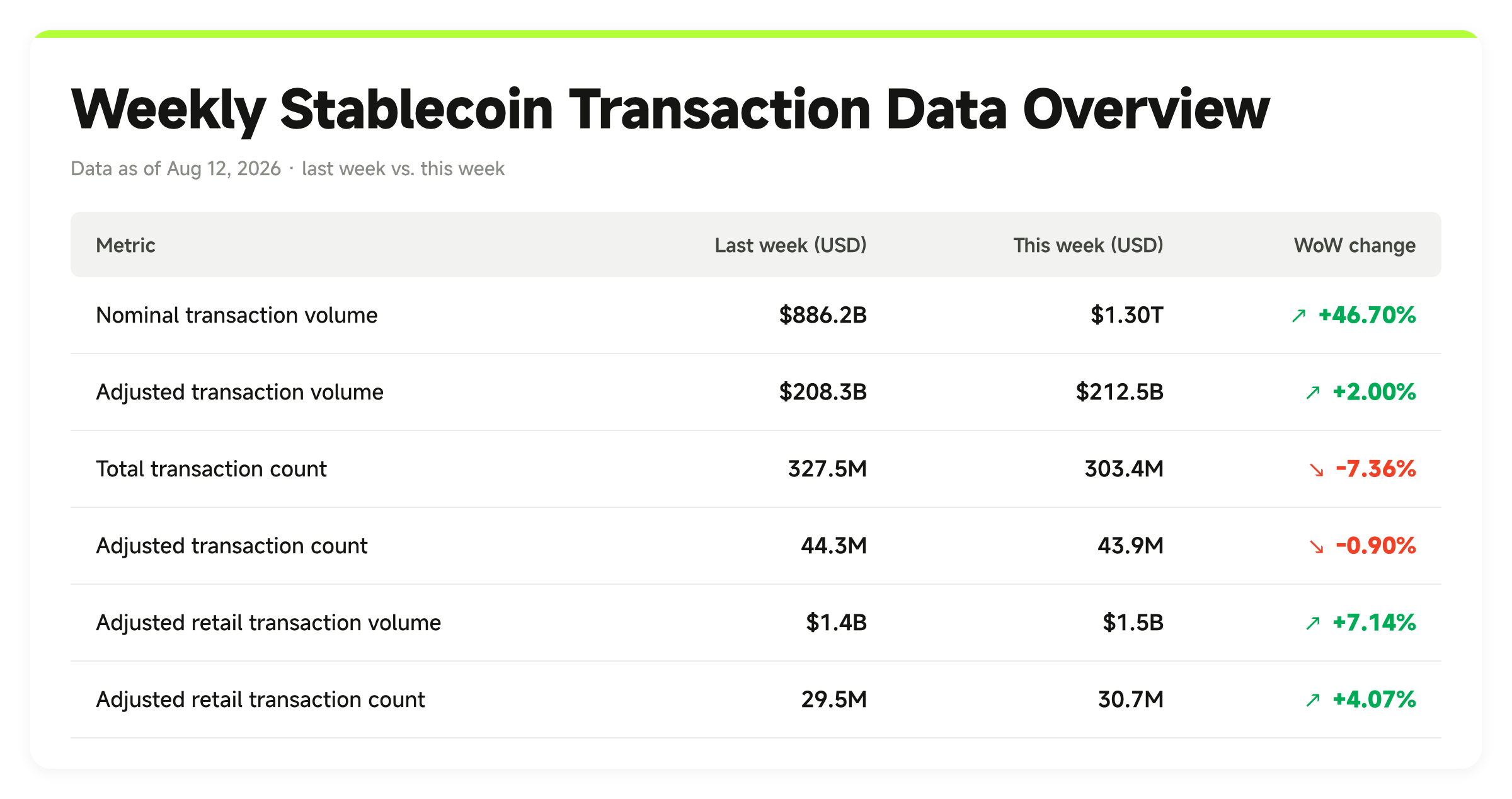
Adjusted Volume at 16.3%: Over the past seven days, nominal transaction volume reached US$1.3 trillion, with adjusted volume at US$212.5 billion (accounting for 16.3% of nominal volume); total transactions were 303.4 million, with adjusted transactions at 43.9 million.
High-Frequency, Small-Ticket Retail Usage: Adjusted retail transaction volume was approximately US$1.5 billion (accounting for 0.7% of total adjusted volume), while transaction count reached 30.7 million (70% of total adjusted transactions).
Stablecoin Transaction Overview
Sharp Divergence Between Nominal and Adjusted Metrics: As of August 12, nominal transaction volume surged by 46.7% week-on-week, whereas adjusted transaction volume rose by a modest 2.0%. Transaction count fell instead of rising, indicating that expansion in nominal activity was driven almost entirely by non-settlement transactions.
Rising Speculative Noise, Plunging Adjusted Share: The adjusted-to-nominal ratio dropped from roughly 23.5% last week to about 16.3% this week, reaching a multi-week low. The influx in nominal transaction volume was predominantly driven by non-settlement activity such as arbitrage, internal fund transfers, and market-maker round-trips, rather than a parallel expansion in adjusted economic transfers.
Structural Analysis: Top-Level Noise Expands, Ground-Level Settlement Warms Up
Rebound Concentrated in Retail: Among the six core metrics this week, the surge in nominal transaction volume was primarily driven by non-settlement activity, while adjusted settlement volume saw only a minor uptick; in contrast, both real retail transaction volume (+7.1%) and real retail transaction count (+4.1%) rebounded against the trend, representing the few positive signals at the real settlement layer. High-frequency, small-ticket on-chain payment activity actually strengthened against the backdrop of overall nominal expansion.
Barbell Structure Persists as Retail Transaction Share Rises: The barbell structure - dominated by small-ticket retail transactions in count and large-value institutional transactions in volume - remained unchanged. Retail-sized transactions accounted for approximately 70% of total adjusted real transaction count, up from roughly 67% last week, while retail-sized volume still represented just 0.7% of total adjusted real volume—retail dominance in transaction count strengthened further, while institutional dominance in volume remained intact.
Divergence Between Nominal and Adjusted Figures Is the Key Signal: Nominal transaction volume climbed to US$1.3 trillion while the adjusted real share dropped to 16.3%, indicating that the uptick in on-chain activity was concentrated in non-settlement activities. Whether this surge translates into genuine demand depends on whether real settlement volume and retail usage hold their upward trajectory.
Sources: Artemis, Visa, OSL Research
Definitions: Adjusted real figures exclude arbitrage, fund transfers, market-maker round-trips, and similar noise. Visa classifies individual transactions below US$250 as retail and those of US$250 or above as non-retail.
II. This Week in Stablecoin Payments and Infrastructure
Court the market, or guard autonomy? The dollar's rivals may be its biggest recruiters.
1. Hong Kong's regulated stablecoin HKDAP begins institutional rollout via Beta Access
On August 12, Anchorpoint Financial, a licensed stablecoin issuer in Hong Kong, announced the official launch of HKDAP (HKD At Par), a Hong Kong dollar-pegged compliant stablecoin, opening the first phase of its institutional rollout to professional investors, including institutions. OSL Group and HashKey Exchange, both licensed under Hong Kong's Virtual Asset Trading Platform (VATP) regime, are the key authorized distributors.
OSL will provide secure, compliant and efficient distribution and liquidity support for HKDAP. Anchorpoint will prioritize use cases including tokenized funds, trade finance and cross-border payments. The two companies are expected to launch several commercial applications during this phase, demonstrating how HKDAP can support real-world activity through more efficient settlement and value transfer.
Anchorpoint is a joint venture co-founded by Standard Chartered, Animoca Brands and HKT, and in April 2026 became one of Hong Kong's first two licensed stablecoin issuers - alongside HSBC. Anchorpoint said it would initially focus on exploring stablecoin applications with tangible benefits to the real economy, including cross-border payments and settlement, and the on-chain distribution of real-world assets (RWA).
2. IMF Warns Promoting Local-Currency Stablecoins Could Boost USD Stablecoin Adoption Instead
On August 7, Dan Katz, the International Monetary Fund's First Deputy Managing Director, warned in a speech at the University of Cape Town that emerging markets promoting local-currency stablecoins may achieve the opposite of their intended effect. Where local-currency and dollar-pegged stablecoins run on the same blockchain infrastructure, Katz said, users can convert freely between them through decentralized exchanges, liquidity pools or peer-to-peer trades — bypassing banks and foreign-exchange controls, and could accelerate adoption of US dollar stablecoins instead.
Katz cited South Africa as an example: the country's institutional rand stablecoin, ZARU, has not yet disclosed transaction volumes since its February launch, while data of South African Reserve Bank shows that dollar-pegged USDT settled roughly 27 billion rand (about US$1.7 billion) on-chain across the country's exchanges in the year to April.
Katz recommended bringing on- and off-ramps - the points at which fiat currency converts into and out of stablecoins, within the scope of regulatory oversight. Data collection should not wait for "perfect regulation." The IMF is working through the G20 Data Gaps Initiative to help improve statistical coverage in the sector.
3. EU Plans MiCAR Revision to Cover Non-EU Stablecoins
On August 7, several European Union diplomats told Euronews that the EU plans to close a gap in its Markets in Crypto-Assets Regulation (MiCAR) governing non-EU stablecoin issuers, and that a revision is now "a foregone conclusion." The new rules are expected to be formally proposed in 2027 and could extend to tokenized deposits, tokenized payment instruments and other new categories. The European Commission has opened a consultation on the revision, with a deadline of September 30.
Under current rules, stablecoins publicly offered or traded in the EU must have an authorized EU issuer - a requirement that has left several non-EU issuers, including USDT, without regulatory recognition and excluded from compliant exchanges. The revision will also address gaps in multi-issuance structures, under which parts of a token's reserves and issuance can sit outside EU regulatory oversight.
One EU diplomat said reopening the revision has become "unavoidable" citing pressure from institutions such as the European Central Bank and mounting competition from the US GENIUS Act. Under MiCAR, the European Commission must submit an implementation report to the European Parliament and Council by June 30, 2027.
4. Germany Weighs Crypto Critic Nagel for ECB Post
On August 6, Bloomberg reported that the German government is discussing whether to back Joachim Nagel, president of the Bundesbank, for the presidency of the European Central Bank, amid market speculation that current President Christine Lagarde could step down before her term ends in 2027.
Nagel has taken a consistently hard line against cryptocurrencies, once comparing bitcoin to a "digital tulip" and saying reserve assets "must be secure, liquid and transparent — and bitcoin is none of those things." He is also one of the most vocal proponents of a digital euro, framing it as a key tool for Europe to counter private stablecoin networks and preserve "strategic autonomy."
Lagarde herself recently rejected calls to promote a euro stablecoin. Should Nagel take over, the ECB's stance toward private stablecoins could harden further.
5. OFAC Sanctions Uncover US$6.3 Billion Iran-Russia Stablecoin Network
On August 7, the US Treasury's Office of Foreign Assets Control (OFAC) sanctioned Shelbit, an unlicensed crypto exchange registered in Dubai, along with its founder, Siavash Kayvanpour, and Aban Tether, an Iran-based exchange (unrelated to stablecoin issuer Tether despite the shared name). The designations allege Shelbit provided settlement services to wallets linked to Iran's Islamic Revolutionary Guard Corps (IRGC), while Aban Tether processed funds for several sanctioned Iranian exchanges.
Blockchain analytics firm TRM Labs traced roughly US$6.3 billion in funds moving through Shelbit-linked wallets between May 2024 and March 2026. About 88% of that total, roughly US$5.56 billion, settled in USDT on the Tron blockchain. The investigation also found about US$318 million connected to A7, a sanctioned Russian cross-border payment network.
Tether can freeze USDT at the issuer level and has done so twice before at the request of US authorities, blocking about US$475 million and US$131 million tied to Iran-linked addresses, respectively - a capability that assets without an issuer, like bitcoin, cannot offer. The sanctions are seen as another example of governments pressuring digital asset issuers to enforce compliance.
This Week in Brief
On August 6, Nigeria's tax authority published detailed rules for taxing digital assets, imposing a 1.5% stamp duty on virtual-asset transactions — including USDT and USDC — and requiring digital-asset service providers to withhold the tax in-kind, in the corresponding token, before crediting users. Digital Assets Coalition, an industry group, said the rule could push trading activity away from compliant platforms.
On August 7, the European Securities and Markets Authority's updated registry showed that Bridge Building, the Luxembourg entity behind Stripe-owned stablecoin infrastructure firm Bridge, had completed registration as the 42nd authorized electronic money token issuer under MiCAR. Luxembourg's financial regulator, the CSSF, had granted Bridge the underlying crypto-asset service provider and electronic money institution licenses on June 29.
On August 7, SBI Digital Practice, a unit of Japan's SBI Group, and South Korea's NodeInfra signed a memorandum of understanding to build the Musubi Project on the Canton Network, aiming to let yen- and won-denominated stablecoins settle atomically without routing through the dollar. Project launch will depend on when South Korea's Digital Asset Basic Act clears the National Assembly.
On August 7, Japan's Financial Services Agency named Toshiaki Adomi as the first head of its newly created Digital Assets and Stablecoins Division, upgraded from the former Digital Assets and Blockchain Innovation Office and placed under a newly established Asset Management and Insurance Supervision Bureau. Adomi does not come from a digital-asset background; he has held roles in bank supervision and policy coordination and most recently served as director-general for postal savings and insurance supervision.
On August 10, CertiK published a report saying Brazilian virtual-asset service providers are undergoing a wave of compliance upgrades ahead of the central bank's October 30 deadline for provider (PSAV) license applications. Since May 29, applications have required an independent assurance report — issued by an audit firm registered with Brazil's securities regulator — attesting to the effectiveness of the applicant's anti-money-laundering and sanctions controls.
On August 12, the Bank of England said it would begin testing stablecoins, settling a single cross-border trade-finance transaction alongside a simulated digital pound, and the retail central bank digital currency (CBDC) continues to research. Polygon Labs, NOBO Finance and business-data and analytics firm Dun & Bradstreet are taking part in this second phase of the Bank's Digital Pound Lab.
On August 12, KakaoPay disclosed in a job posting that it has made won-stablecoin issuance and a global ecosystem build-out a core pillar of its next-generation financial infrastructure strategy, planning to work with major South Korean partners, global companies and overseas payment and remittance networks. The company is hiring a product manager for stablecoin and wallet products and server engineers to build its issuance and circulation systems.
III. Analyst Deep Dive
Tokenized Deposits vs. Stablecoins
Even as the two camps converge, each still guards its own red line. Each side can clearly see which piece of the puzzle the other holds — yet neither is willing to surrender its core commercial moat.
On August 4, Wells Fargo, the fourth-largest bank in the United States, announced plans to roll out tokenized deposit services for corporate and commercial clients in the autumn. Clients will be able to move funds around the clock, execute programmable payments, and settle transactions instantly.
Wells Fargo is not the first major bank to pilot tokenized deposits. The Clearing House (TCH), jointly owned by 21 large commercial banks including JPMorgan, Citi, Bank of America, Wells Fargo and BNY Mellon, is working with its member banks to build a shared, industry-wide tokenized deposit network, expected to go live in the first half of 2027. At the same time, the Regulated Settlement Network (RSN), coordinated by SIFMA and involving several top-tier banks along with observers from the Federal Reserve, has already completed multi-asset shared-ledger testing.
On the other side of the divide, more than 140 institutions — including Visa, Mastercard, Stripe, Coinbase and BlackRock, spanning payments, asset management, Web3 and banking — have formed the Open USD stablecoin coalition. Stripe, for its part, spent$1.1 billion acquiring Bridge, a stablecoin infrastructure platform.
Banks are building their defenses on one side; payments and Web3 firms are massing their formation on the other. This standoff is no longer a contest between individual products — it is a far deeper struggle over the restructuring of financial market microstructure and control over monetary sovereignty.
Endogenous Credit Liabilities vs. External Narrow "Money"
A tokenized deposit remains, at its core, a credit liability of a commercial bank. When a depositor places funds with a bank, the bank records a liability on its books — but in exchange, it gains the power to expand that money through credit creation and channel it back into the real economy. Blockchain gives that traditional liability a higher-frequency, programmable digital ledger and settlement layer. The legal and accounting nature of "commercial bank credit" remains unchanged.
Stablecoins follow an entirely different logic — that of narrow money. A compliant stablecoin is backed by highly liquid reserve assets at close to a 1:1 ratio — typically central bank deposits or short-term government bonds. Those reserves are held in segregation, and the issuer has no right to deploy them directly for lending. This means that as a supply grows, it does not generate the money-multiplier effect found within the banking system. It resembles — though it is not identical to — a form of digital "external narrow money" that sits outside the commercial banking system altogether, rather than a claim on a bank.
A stablecoin transfer on-chain constitutes final settlement in itself, with no need to loop back through a traditional clearing system for confirmation — which is precisely why it can be seamlessly plugged into decentralized protocols, serving as collateral or a liquidity instrument. Tokenized deposits, by contrast, have largely been confined to a single bank's "walled garden"; even as they move toward multi-bank networks, access remains tightly restricted to a closed loop of licensed financial institutions.
So when a corporate treasurer shifts funds out of a commercial bank deposit account and into an on-chain stablecoin, what the bank loses is never just a customer or a sum of money — it loses the credit base that underpins its ability to lend against those funds and drive economic activity. Industry estimates suggest that as high interest rates push corporates to demand ever more efficient use of their cash, several trillion dollars in commercial bank deposits could be at risk of migrating to stablecoins and on-chain assets over the coming years.
Intraday Liquidity and Network Interoperability
It was widely assumed that commercial banks were building tokenized deposits merely to "keep pace" or respond to public pressure. In reality, what is driving TCH and other institutions toward industry-wide coordination is a recalculation, at the level of market microstructure, of intraday liquidity and the opportunity cost of capital.
Against a backdrop of high interest rates, corporate treasury departments now demand capital efficiency measured in hours, even minutes. Traditional wire clearing, constrained by banking hours and batch-processing delays, has long generated significant friction costs from money sitting "in transit." The round-the-clock, programmable experience offered by stablecoins has fundamentally reset what corporate CFOs now consider the baseline for capital turnover efficiency.
A single bank issuing its own tokenized deposit is, in essence, no more than a digital overhaul of an internal ledger — its network effects confined to that bank's own client base. If Company A and Company B bank with different institutions, cross-bank settlement still has to fall back on traditional clearing networks, exposing a structural fault line, not a feature gap.
This is precisely why TCH has brought together 21 major commercial banks to build a shared tokenized deposit network: the banking industry needs an industry-wide, coordinated effort to build a programmable clearing rail that works across banks. Only when tokenized deposits can move freely and settle in real time across different banks' ledgers — while preserving their original status as commercial bank credit — will the banking sector achieve the degree of network interoperability needed to fend off stablecoins eating into its pool of commercial deposits.
Banks Going On-Chain, Stablecoin Payment Giants Going Bank
This race is pushing two camps that once occupied entirely separate territory to accelerate toward each other, giving rise to two parallel trends: the "on-chain migration of banking" and the "bank-ification of stablecoin payment giants."
On the banking side, the move toward Web3 is unfolding along three lines.
First, a shift from "closed internal ledgers" to "shared cross-bank infrastructure" — as seen in the link between JPMorgan's Kinexys and TCH's interbank clearing bridge.
Second, a move from private consortium chains toward public blockchain ecosystems, with some banks already experimenting with issuing programmable deposit tokens for institutional clients directly on public chains, actively tapping into public-chain liquidity pools.
Third, a deeper reworking of use cases, as tokenized deposits are increasingly deployed for cross-border intraday liquidity transfers, programmable intraday repo, and automated conditional custody — substantially reducing counterparty settlement risk between institutions.
On the stablecoin and payments-giant side, the ambition to become bank-like burns just as fiercely. Leading stablecoin issuers such as Circle and Ripple continue to pursue federal trust bank charters, seeking to shed the "crypto-native" label in favor of official regulatory legitimacy. Stripe paid$1.1 billion to acquire Bridge, a stablecoin API platform, while Mastercard and Visa have likewise acquired their way into stablecoin clearing channels — traditional payments giants are positioning stablecoins as the settlement rail underpinning the next generation of global payments.
The most ambitious frontier for stablecoin giants, however, is securing direct access to a master account at the central bank. Should a stablecoin issuer succeed in custodying its reserves directly at the central bank, it would eliminate commercial bank failure risk altogether — effectively becoming a form of privately issued central bank money. That ambition remains some distance from reality.
Institutional Trust and Total Openness
Yet even as both sides converge, the boundaries beneath them remain sharply defined. No matter how far commercial banks push their migration on-chain, they will never abandon the core principle of tightly controlled access, nor will they cede deposit insurance and the central bank's ultimate backstop in pursuit of full permissionlessness. And even once stablecoin firms secure a trust charter or a central bank custody account, their business remains strictly confined to full-reserve custody and payment clearing. It cannot cross into the core commercial bank privilege of taking deposits and extending loans against them.
The irony at the heart of this race is this: the credit and compliance moat that commercial banks have spent centuries building is exactly what stablecoin giants covet most and cannot easily replicate quickly. The openness, seamless programmability and global reach that come naturally to stablecoins are precisely the qualities banks, bound by traditional compliance frameworks, strive to imitate but can never fully attain.
Both sides can see the missing piece the other holds. But under the current constraints of regulation and financial market microstructure, neither is willing to surrender its own moat to obtain it.
Perhaps this suggests that, within today's macro-financial system, "institutional trust" and "total openness" are qualities that cannot yet be seamlessly fused into a single financial medium. This mutual encroachment between commercial banks and Web3 firms looks less like a final battle in which one side will completely absorb the other, and more like two transitional forms — each borrowing from the other, each constrained in its own way — shaped by the real-world contest playing out before the next generation of financial infrastructure is truly built.
As for how the two will ultimately merge, or whether they will give rise to an entirely new financial infrastructure, this decades-long experiment in reconstruction has, perhaps, only just begun.
This content is for general information only and does not constitute investment, legal, tax or other professional advice, or an offer or solicitation; please read the full Disclaimer and Disclosure.
More topics
More topics
Latest
Why India's $620B Bond Pilot Changed Nothing Legal
SEBI and the RBI's Demat 2.0 pilot issues corporate bonds as digital tokens and settles them with the wholesale digital rupee, preserving existing legal terms while digitizing the infrastructure beneath a $620...
Why India's $620B Bond Pilot Changed Nothing Legal
Why S&P Global Leads Kaiko: Not Hype, But 24/7 Market Infrastructure
S&P Global led a $110 million extension of Kaiko's Series B to build data infrastructure for round-the-clock tokenized markets.
Why S&P Global Leads Kaiko: Not Hype, But 24/7 Market Infrastructure
When One Firm Holds 5% of Ethereum: Infrastructure Stress Test
Bitmine's accumulation of more than 5 million staked ETH raises questions about whether custody, audit, and validator infrastructure can support single-asset concentration at public-company scale.
When One Firm Holds 5% of Ethereum: Infrastructure Stress Test
Best Enterprise Stablecoin Payment Providers: A 2026 Evaluation Framework
Compare enterprise stablecoin payment providers by use case, legal entity, workflow, controls, integration, reconciliation, support, and contract terms.
Best Enterprise Stablecoin Payment Providers: A 2026 Evaluation Framework
How to Reconcile a USDGO Payment: An Illustrative Finance-Close Example
See how Finance can trace a USDGO payment from an approved obligation through payment records, recipient confirmation, reconciliation, and accounting close.
How to Reconcile a USDGO Payment: An Illustrative Finance-Close Example
A USDGO Reserve Review in Practice: Findings, Limits and Follow-up Questions
Review what the July 2026 USDGO reserve attestation establishes, what it does not prove, and which issuer, redemption, and liquidity questions remain.
A USDGO Reserve Review in Practice: Findings, Limits and Follow-up Questions
Recommended for you
More topics
More topics
