AVAX Price Outlook 2026–2030–2040: Where Could Avalanche Go Next?

Key Takeaways: AVAX Price Predictions at a Glance
AVAX’s all-time high is shown around $146.22 (Nov 21, 2021) on CoinMarketCap, while TradingView shows an ATH around $147.50 (index/venue differences).
Avalanche describes AVAX as capped supply up to 720M, with emissions and burn dynamics influencing long-run supply path.
Third-party 2030 projections often cluster in a broad band (e.g., CoinCodex ~$16–$45; ChangeHero ~$17–$41), reflecting high uncertainty and different models.
Some long-horizon publications (e.g., Changelly) publish very large 2040 numbers; treat them as speculative scenarios, not targets.
This article summarizes third-party sources and public information—not investment advice.
AVAX All-Time Price Performance
Avalanche (AVAX) has historically tracked broader crypto cycles: sharp rallies during risk-on periods and steep drawdowns in risk-off regimes. For a consistent, publishable chart, use TradingView’s AVAXUSD page (embed or screenshot) as your canonical reference.
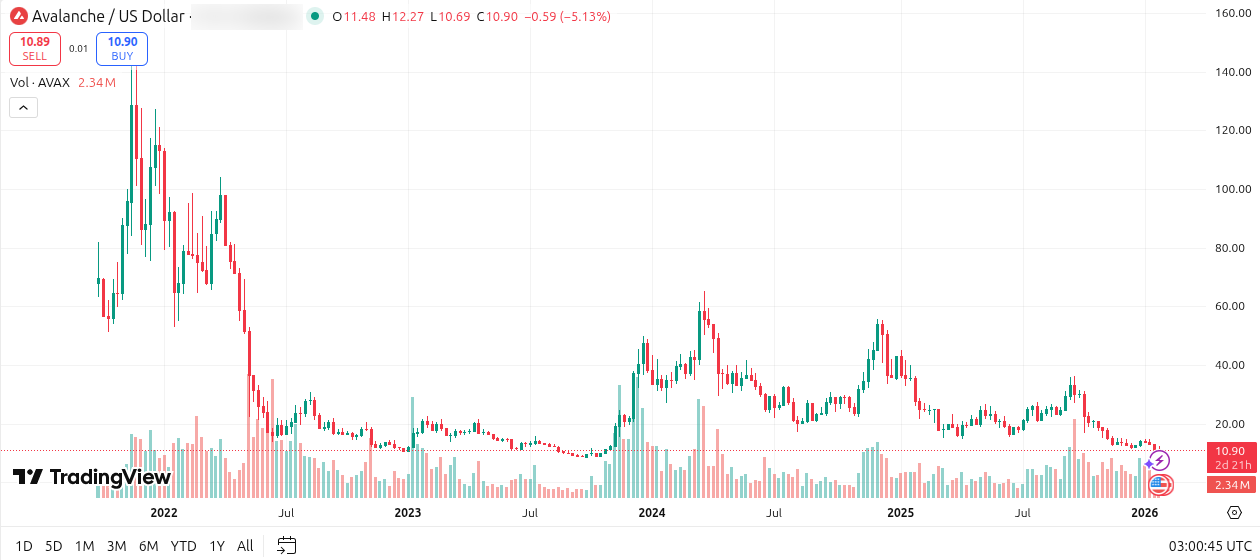
Source: TradingView chart
Scenario Definition + Forecast Summary Table
This avax price prediction 2026–2030–2040 guide compiles third-party forecasts and frames them into bear/base/bull scenarios. These are not OSL targets and should be treated as opinions.
Why forecasts differ (and why that matters)
Most prediction pages rely on one (or a mix) of these approaches:
Quant/technical models: extrapolate historical volatility and trend behavior (can underweight regime shifts).
Narrative outlooks: assume a particular adoption path (tokenization, DeFi growth, subnets, enterprise pilots).
Hybrid summaries: aggregate multiple sources into a “range,” sometimes without consistent methodology.
Forecast summary table (illustrative, third-party)
Year | Source | Low | High | Approach |
|---|---|---|---|---|
2026 | Changelly | ~$12.05 | ~$12.13 | Example monthly window (Jan 2026); short-horizon slice, not a full-year band. |
2030 | CoinCodex | ~$16.42 | ~$44.93 | Model range for 2030 (wide uncertainty). |
2030 | ChangeHero | ~$17.47 | ~$41.45 | Another published 2030 range (method differs). |
2040 | Changelly | (very high) | (very high) | Long-horizon figures published; treat as highly speculative scenario material. |
How to read this table: the practical takeaway is not the “exact number,” but the assumptions each source is making about adoption, liquidity, and market structure.
AVAX Price Outlook for 2026
Because 2026 is closer than 2030/2040, many published forecasts stay tethered to current market structure and recent volatility.
Bear case (range: around current levels, choppy)
A bear scenario assumes liquidity stays selective and altcoins struggle to attract sustained capital. In that environment, AVAX price tends to remain sensitive to macro conditions (rates, risk appetite) and crypto-cycle rotation.
What could align with this scenario
Weak risk appetite for altcoins for extended periods
Lower on-chain demand across DeFi and gaming/NFT sectors
Heightened regulatory uncertainty that reduces retail participation in high-volatility assets
Base case (range: modest recovery if cycle improves)
In a base scenario, AVAX participates in periodic market upswings, but rallies are punctuated by sharp drawdowns. Short-horizon forecast slices (like Changelly’s monthly estimates) can be viewed as “near-term sentiment snapshots,” not definitive year-end calls.
Bull case (range: depends on measurable adoption signals)
A bullish 2026 scenario usually depends on catalysts that show up in real data:
higher sustained activity (transactions/fees),
deeper liquidity across venues,
and credible institutional or enterprise usage that persists beyond pilot headlines.
AVAX Price Outlook for 2030
2030 projections widen because they compound assumptions across multiple market cycles.
Why 2030 forecasts diverge
Two credible sources can still disagree because:
one assumes slow, mean-reverting behavior (conservative quant model),
while another assumes structural adoption improvements (expanding on-chain usage + better market infrastructure).
For example, CoinCodex publishes a 2030 range of roughly $16 to $45, while ChangeHero publishes a similar but not identical band.
Scenario framing for 2030
Bear case ($10s–$20s): AVAX remains relevant but faces intense competition among L1/L2 networks; value capture and liquidity stay constrained.
Base case ($20s–$50s): Avalanche maintains a durable niche, with steady use and recurring cycle participation (consistent with the “mid-range” of several published forecasts).
Bull case ($50+): requires sustained growth in real usage and liquidity, plus favorable market structure (more institutional rails, better custody/trading access, clearer regulation).
AVAX Price Outlook for 2040
2040 estimates are highly speculative—even more so for assets whose future depends on ecosystem competitiveness and evolving regulation.
Some publications (e.g., Changelly) provide long-horizon figures that are far above near-term model outputs. The responsible way to treat these numbers is as scenario illustrations: they imply decades of compounding adoption, sustained relevance, and strong market cycles—assumptions that can’t be validated today.
A more grounded 2040 discussion focuses on “what must be true”:
Avalanche must keep attracting developers and users over many cycles
On-chain demand must translate into durable fee economics
Market access must remain broad enough (regulation, listings, custody standards) to support deep liquidity
AVAX Metrics to Watch Checklist
If you want to track whether Avalanche is trending toward conservative or optimistic scenario bands, focus on measurable signals:
Supply dynamics and tokenomics
AVAX is described as capped supply (up to 720M), with staking emissions and fee burning shaping the long-run path.
Network usage
Transactions, active addresses, and fee metrics (sustained activity matters more than spikes).
Validator and staking health
Staking participation and validator counts as a proxy for network security and economic alignment.
Ecosystem depth
DeFi usage, stablecoin activity, and cross-chain liquidity. (Even without “price targets,” these are the drivers most narratives depend on.)
Institutional/enterprise traction
Separate “pilot announcements” from durable production usage; watch for repeatable integrations and ongoing flows.
From AVAX Insights to Practical Access with OSL
Price scenarios are inherently uncertain, especially when looking toward 2030 and beyond. For many market participants—particularly institutions and professional investors—the more actionable question is how to access digital assets through a secure, transparent, and regulated infrastructure.
OSL is Asia’s leading digital asset trading and infrastructure provider, backed by a global record US$1 billion in insurance coverage. At OSL, professional investors can trade AVAX through institutional-grade market services, hold it in insured custody, and integrate it into broader, rules-based portfolios, all within a strictly compliant framework.
By utilizing a regulated venue, investors can significantly reduce operational risks—such as venue counterparty risk, slippage, and custody mistakes—that often dominate outcomes for volatile assets like AVAX.
OSL offers two distinct pathways to trade AVAX, matching your specific liquidity and settlement requirements:
1. Pro Trade: Institutional Spot Trading (AVAX/USD)
Designed for investors who require precision, deep liquidity, and professional order management via a central limit order book.
Best for: Large-block executions, limit-order strategies, and professional charting.
Settlement: Direct settlement in USD.
Access: Trade AVAX/USD on OSL Pro
2. Flash Trade: Instant, Zero-Fee Connectivity (AVAX/USDT)
A simplified trading service that allows users to convert AVAX with zero trading fees and no slippage.
Best for: Immediate execution at a locked quoted price and simple stablecoin settlement.
Settlement: Instant settlement in USDT.
Access: Convert AVAX/USDT on OSL Flash
FAQs on AVAX Price Predictions
Can AVAX reach $100 dollars?
It can happen in a bullish market-cycle scenario, but it would require a combination of strong risk-on conditions, deep liquidity, and sustained network usage over time. A useful reference point is that AVAX’s historical all-time high is shown around $146.22 (Nov 21, 2021) on CoinMarketCap—so $100 is not unprecedented in “cycle peak” conditions, even though past peaks don’t predict future outcomes.
Is AVAX expected to go up?
There’s no single “expected” path—published forecasts vary because they use different methods. For example, Changelly shows an end-of-year 2026 estimate around $12 while other sources publish different bands. Treat these as opinions/scenarios, not certainty.
Is AVAX a good investment?
We can’t label AVAX (or any token) a “good investment.” What we can do is outline how people typically evaluate it:
Network fundamentals: real usage, fees, and developer adoption
Tokenomics: AVAX is described as capped supply (up to 720M), with emissions and fee burning dynamics influencing the long-run supply path
Risks: high volatility, competition among L1/L2 ecosystems, security incidents, and changing regulation
A “good investment” depends on your risk tolerance, time horizon, and jurisdictional constraints—not just a forecast number.
How much will AVAX be worth in 2030?
Third-party estimates differ widely. One example: CoinCodex currently shows an end-of-year 2030 estimate around $30.66. That’s not a promise, just a published model output you can cite as one reference point.
How much will Avalanche be worth in 2026?
Again, forecasts vary by source and by whether the figure is a monthly window or a year-end estimate:
CoinCodex shows an end-of-year 2026 estimate around $30.47 (model-based).
ChangeHero publishes month-specific 2026 forecasts (e.g., a May 2026 forecast in the mid-$20s and a March 2026 min/max band).
The key is to label each number clearly as EOY vs month window, and as third-party opinion, not an OSL target.
Start your safe cryptocurrency journey now
OSL | Secure Ramps. Trusted Rails !
More topics
More topics
Latest
Why India's $620B Bond Pilot Changed Nothing Legal
SEBI and the RBI's Demat 2.0 pilot issues corporate bonds as digital tokens and settles them with the wholesale digital rupee, preserving existing legal terms while digitizing the infrastructure beneath a $620...
Why India's $620B Bond Pilot Changed Nothing Legal
Why S&P Global Leads Kaiko: Not Hype, But 24/7 Market Infrastructure
S&P Global led a $110 million extension of Kaiko's Series B to build data infrastructure for round-the-clock tokenized markets.
Why S&P Global Leads Kaiko: Not Hype, But 24/7 Market Infrastructure
When One Firm Holds 5% of Ethereum: Infrastructure Stress Test
Bitmine's accumulation of more than 5 million staked ETH raises questions about whether custody, audit, and validator infrastructure can support single-asset concentration at public-company scale.
When One Firm Holds 5% of Ethereum: Infrastructure Stress Test
Best Enterprise Stablecoin Payment Providers: A 2026 Evaluation Framework
Compare enterprise stablecoin payment providers by use case, legal entity, workflow, controls, integration, reconciliation, support, and contract terms.
Best Enterprise Stablecoin Payment Providers: A 2026 Evaluation Framework
How to Reconcile a USDGO Payment: An Illustrative Finance-Close Example
See how Finance can trace a USDGO payment from an approved obligation through payment records, recipient confirmation, reconciliation, and accounting close.
How to Reconcile a USDGO Payment: An Illustrative Finance-Close Example
A USDGO Reserve Review in Practice: Findings, Limits and Follow-up Questions
Review what the July 2026 USDGO reserve attestation establishes, what it does not prove, and which issuer, redemption, and liquidity questions remain.
A USDGO Reserve Review in Practice: Findings, Limits and Follow-up Questions
Recommended for you
More topics
More topics
