PEPE Price Prediction 2026–2030–2040–2060: Pepe’s Outlook

Key Takeaways: PEPE Price Predictions at a Glance
PEPE is fully circulating on many trackers, with a max/total supply around 413.77T shown by CoinMarketCap (supply figures vary slightly by provider formatting).
Third-party forecasts for 2026–2040 vary massively: model-based sites cluster in micro-dollar ranges, while some narrative articles publish much higher long-range numbers.
CoinCodex publishes end-of-year estimates such as ~$0.00001185 (2026), ~$0.00001093 (2030), and ~$0.00003012 (2040) (model output, not certainty).
2060 forecasts are not consistently published by major trackers; where numbers exist, they’re typically extrapolations without robust methodology—so in this article, we treat 2060 as scenario discussion, not numeric targets.
PEPE All-Time Price Performance
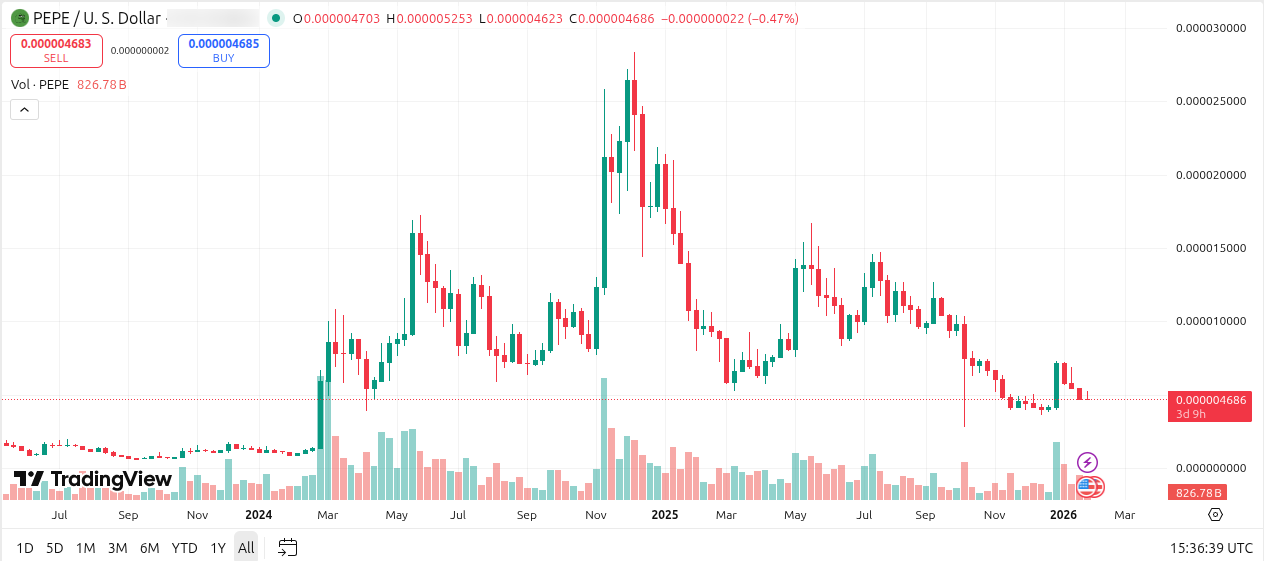
Source: TradingView chart
Scenario Definition + Forecast Summary Table
This PEPE price prediction 2026–2030–2040–2060 summarizes third-party sources and common forecasting styles. These are not OSL targets, and nothing here is investment advice.
Why forecasts differ so much
Most “price prediction” pages fall into three buckets:
Model-based outputs (technical/quant models, historical volatility, cycle assumptions) such as those provided by CoinCodex.
Calculator tools where the reader sets a growth rate, so outputs are not a house view. Example include Kraken
Narrative projections that assume viral adoption, new utility, or sustained meme relevance over many market cycles. Examples of this approach include changelly.com
Forecast summary table
Year | Source | Low | High | Approach |
|---|---|---|---|---|
2026 | CoinCodex | — | ~$0.00001185 (EOY) | End-of-year model estimate |
2026 | Kraken tool | ~$0.0000047 | — | Example output depends on user-entered growth rate |
2026 | Flitpay | ~$0.0000223 | ~$0.0000987 | Narrative band; wide uncertainty |
2030 | CoinCodex | — | ~$0.00001093 (EOY) | End-of-year model estimate |
2040 | CoinCodex | — | ~$0.00003012 (EOY) | End-of-year model estimate |
2040 | Changelly | ~$0.0024859 | ~$0.0030343 | Very bullish long-range numbers (highly speculative) |
Important: When predictions show orders-of-magnitude differences, the best takeaway is not the number—it’s the assumption set behind it, for example market cycles, community relevance, liquidity, regulation, and any credible new utility.
PEPE Price Outlook for 2026
A practical way to treat 2026 is a three-scenario band.
Bear scenario (micro-range stays compressed)
In a risk-off macro environment (tight liquidity, weaker altcoin bid), model outputs often stay in low micro-dollar ranges. CoinCodex’s end-of-year estimate is still in the $0.00001 neighborhood, reflecting a “not crazy, not moon” baseline.
What would align with a bear scenario
Lower meme-coin rotation and fewer “viral catalysts”
Exchange volumes fade and liquidity thins (slippage increases)
Regulatory headlines reduce retail participation in high-volatility tokens (jurisdiction dependent)
Base scenario (range expands modestly during a cycle)
If broader crypto conditions improve and meme coins see periodic flows, PEPE could experience intermittent rallies (with sharp drawdowns). Some narrative sources publish materially higher 2026 bands. Treat these as scenario sketches rather than “expected outcomes.”
Bull scenario (hype cycle + liquidity)
In a strong risk-on environment, meme coins can overshoot. But it’s worth grounding the conversation: even aggressive outcomes are still constrained by market cap math given PEPE’s massive supply. Sources that discuss $1 or even 1 cent typically note how extreme the required market cap would be.
PEPE Price Outlook for 2030
2030 forecasts tend to diverge more than 2026 forecasts because they compound assumptions over multiple cycles.
Why 2030 ranges widen
Model sites may keep PEPE in micro-ranges (CoinCodex’s 2030 EOY is still ~0.00001).
Some publisher summaries and “People Also Ask” style writeups quote far higher numbers from other prediction sites; these often bundle multiple forecast providers and can include extremely optimistic endpoints.
Scenario framing for 2030
Bear case: PEPE survives but remains primarily a speculative meme asset with declining attention; liquidity concentrates elsewhere.
Base case: PEPE remains culturally relevant, continues to be listed/liquid, and benefits from periodic meme rotations each cycle.
Bull case: PEPE becomes one of the “long-lived” meme brands and captures recurring retail attention for years—but still faces the structural constraint that large price moves imply enormous market cap at current supply.
PEPE Price Outlook for 2040
By 2040, any numeric forecast should be treated as highly speculative.
CoinCodex projects an end-of-year 2040 estimate around $0.00003012 (still micro-priced).
Changelly publishes much higher 2040 numbers in the ~$0.0025–$0.0030 region. That is a very different assumption set and should be framed as “high-uncertainty narrative upside,” not a baseline.
How to sanity-check 2040 claims One quick reality check is market cap arithmetic: with supply in the hundreds of trillions, even tiny changes in price imply very large valuations. CoinMarketCap’s supply stats are useful for this kind of grounding.
PEPE Price Outlook for 2060
Why a numeric “2060 prediction” is usually not reliable
Unlike 2026/2030/2040, 2060 is rarely covered by major trackers with transparent, repeatable methodology. Many “prediction tools” are essentially extrapolation engines—meaning the output is more about the chosen growth rate than about PEPE itself.
A responsible way to discuss 2060
For a meme coin, 2060 depends on questions that can’t be answered today:
Cultural longevity: Does PEPE remain a multi-decade internet brand?
Liquidity durability: Does it stay widely listed with meaningful market depth?
Market structure evolution: Do regulations, exchange rules, and custody standards make it easier or harder for retail to access high-volatility tokens in major jurisdictions?
Token supply permanence: Supply caps matter—TradingView and CoinMarketCap both reflect capped supply and full circulation on many feeds, which affects how valuation math is interpreted.
Because these variables are unknowable over 35+ years, we will not publish a numeric 2060 target. It’s cleaner, and more compliant, to treat 2060 as a thought exercise about survivability and market structure, not price.
PEPE Metrics to Watch Checklist
If you want to see whether PEPE is aligning with “survival + recurring cycles” versus “fade-out,” track real-world signals:
1. Liquidity + venue coverage
Depth on major venues, spreads, and consistent volume (especially during drawdowns).
2. Holder distribution and on-chain participation
Holder growth can indicate lasting community presence (though it can also be a lagging indicator).
3. Supply clarity
Confirm max/total supply and whether supply is effectively fully circulating on major trackers.
4. Narrative resilience
Meme coins are narrative-driven; sustained attention often matters more than “roadmaps.” That’s why many analyses focus on social traction, community momentum, and meme-sector rotation.
5. Regulatory developments
Rules affecting exchange access, marketing standards, custody, and risk disclosures can materially shape meme-coin participation in different regions.
From PEPE Insights to Practical Access With OSL
Price predictions are inherently uncertain. For many participants—especially institutions—the more practical question is access and operational safety.
OSL is Asia’s leading digital asset trading and infrastructure provider, backed by up to US$1 billion in insurance coverage. At OSL, users can trade PEPE through institutional-grade market services, hold it in insured custody, and integrate it into broader, rules-based portfolios, subject to applicable regulations.
By utilizing a regulated venue and robust custody standards, OSL helps reduce operational risk—a critical factor for volatile assets like PEPE where slippage, venue risk, and custody mistakes can dominate outcomes.
PEPE is available on OSL through Flash Trade, a simplified trading service that allows users to buy, sell, or convert supported tokens with zero trading fees. All transactions are executed at a quoted price that can be reviewed before confirmation. You can access PEPE trading directly on our PEPE/USDT Flash Trade page.
FAQs on PEPE Price Predictions
Can PEPE reach $1?
Multiple sources highlight the market-cap math problem: with supply in the hundreds of trillions, $1 would imply an enormous market cap—far beyond typical crypto market totals. It’s widely framed as extremely unlikely under normal assumptions.
Can PEPE reach 1 cent?
Some recent writeups call 1 cent in 2026 “highly unlikely,” again due to the scale of the required move relative to supply and market size.
Why do PEPE predictions vary so much?
Because many predictions are either (a) extrapolation tools driven by user inputs, or (b) narrative pieces that assume very different levels of long-term attention and adoption.
What matters most for PEPE over the long run?
For meme coins, the key variables are usually liquidity, exchange access, and cultural relevance, rather than protocol revenue or utility expansion. Community persistence can keep a meme coin in the market conversation across cycles.
Start your safe cryptocurrency journey now
OSL | Secure Ramps. Trusted Rails !
More topics
More topics
Latest
Why India's $620B Bond Pilot Changed Nothing Legal
SEBI and the RBI's Demat 2.0 pilot issues corporate bonds as digital tokens and settles them with the wholesale digital rupee, preserving existing legal terms while digitizing the infrastructure beneath a $620...
Why India's $620B Bond Pilot Changed Nothing Legal
Why S&P Global Leads Kaiko: Not Hype, But 24/7 Market Infrastructure
S&P Global led a $110 million extension of Kaiko's Series B to build data infrastructure for round-the-clock tokenized markets.
Why S&P Global Leads Kaiko: Not Hype, But 24/7 Market Infrastructure
When One Firm Holds 5% of Ethereum: Infrastructure Stress Test
Bitmine's accumulation of more than 5 million staked ETH raises questions about whether custody, audit, and validator infrastructure can support single-asset concentration at public-company scale.
When One Firm Holds 5% of Ethereum: Infrastructure Stress Test
Best Enterprise Stablecoin Payment Providers: A 2026 Evaluation Framework
Compare enterprise stablecoin payment providers by use case, legal entity, workflow, controls, integration, reconciliation, support, and contract terms.
Best Enterprise Stablecoin Payment Providers: A 2026 Evaluation Framework
How to Reconcile a USDGO Payment: An Illustrative Finance-Close Example
See how Finance can trace a USDGO payment from an approved obligation through payment records, recipient confirmation, reconciliation, and accounting close.
How to Reconcile a USDGO Payment: An Illustrative Finance-Close Example
A USDGO Reserve Review in Practice: Findings, Limits and Follow-up Questions
Review what the July 2026 USDGO reserve attestation establishes, what it does not prove, and which issuer, redemption, and liquidity questions remain.
A USDGO Reserve Review in Practice: Findings, Limits and Follow-up Questions
Recommended for you
More topics
More topics
