AAVE Price Outlook 2026-2040: Scenarios, Drivers, and Key Risks

Key Takeaways: AAVE Price Predictions at a Glance
2026 refresh: scenario framework and risk checks
This update reframes the article as scenario analysis rather than a single-point price forecast. Crypto price outlooks can change quickly, so readers should treat the numbers as directional context and verify market data before making decisions.
Scenario | What would need to happen | Key risk |
|---|---|---|
Bull case | Stronger liquidity, positive ecosystem catalysts, and broader risk-on sentiment. | Momentum can reverse quickly if liquidity weakens. |
Base case | Moderate adoption with price mostly driven by market beta and project-specific updates. | Sideways markets can reduce search and trading interest. |
Bear case | Macro weakness, token unlock pressure, regulatory stress, or security concerns. | Downside can be amplified in thin liquidity. |
Related reading: Bitcoin price outlook | Bitcoin as digital gold
Sources to verify during editorial review: CoinMarketCap market data | Official project documentation
FAQ: reading this price outlook
Is this a financial prediction?
No. It is a scenario framework based on public market context. It should not be read as investment advice or a guaranteed target.
What can invalidate the outlook?
Liquidity changes, token unlocks, protocol events, macro shocks, and regulatory developments can all invalidate prior assumptions.
AAVE’s all-time high is shown around $666.86 (May 18, 2021) on CoinMarketCap, while TradingView shows ~$670 for AAVEUSD (index/venue differences can slightly vary).
AAVE’s max supply is capped at 16,000,000, with ~15.32M circulating on major trackers—important for long-term dilution discussions.
Third-party 2026–2040 forecasts vary widely: some quant models project hundreds of dollars by 2030/2040, while some narrative pieces publish very large 2040 figures. Treat these as scenario illustrations, not targets.
Aave’s long-run narrative often depends on DeFi credit demand, Aave v3 risk/capital features (e.g., E-Mode), and stablecoin strategy (GHO)—plus regulatory clarity and market cycles.
This article summarizes third-party opinions and public information. It is not investment advice.
AAVE All-Time Price Performance
Aave (AAVE) has historically moved with broader DeFi and crypto market cycles, experiencing sharp drawdowns and recoveries.
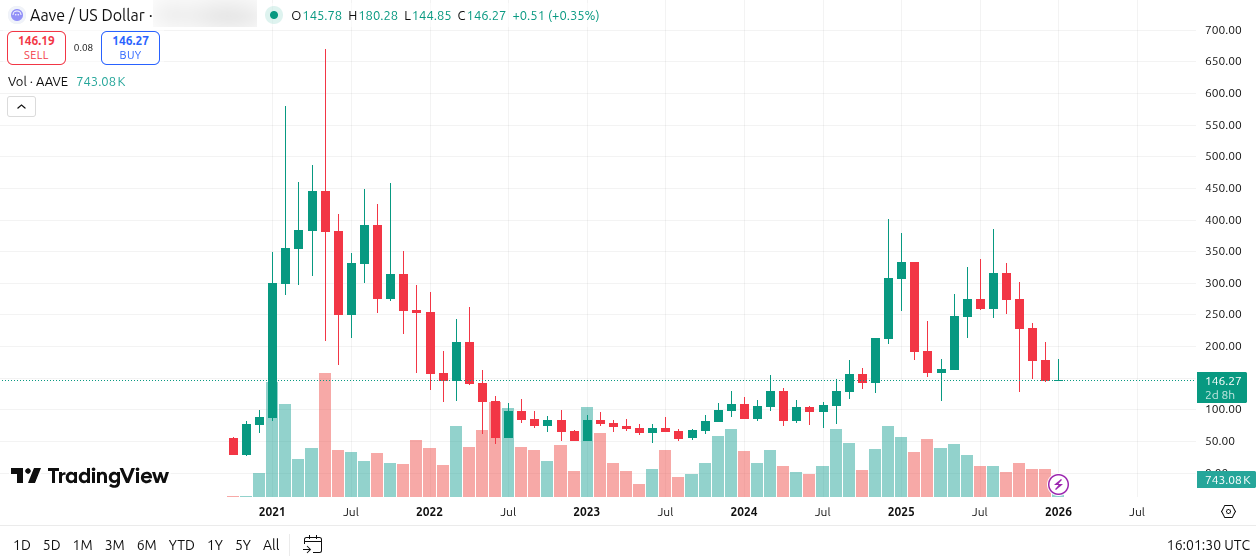
Source: TradingView chart
Scenario Definition + Forecast Summary Table
This AAVE price prediction 2026–2030–2040 guide synthesizes published third-party forecasts. OSL does not set price targets here. Forecasts differ because they use different methodologies:
Quant/technical models extrapolating historical price behavior (volatility, momentum, mean reversion).
Narrative-driven outlooks that assume deep DeFi adoption, institutional usage, or major market structure changes.
Forecast summary table
Year | Source | Low | High | Approach |
|---|---|---|---|---|
2026 | CoinCodex | — | ~$229–$248 (EOY) | Model-based end-of-year estimate range depends on update/version. |
2030 | CoinCodex | — | ~$427–$481 (EOY) | Model-based EOY estimate. |
2040 | CoinCodex | — | ~$572–$695 (EOY) | Model-based EOY estimate. |
2040 | Changelly | ~$29,295 | ~$51,564 | Extremely high long-horizon band; highly speculative. |
2040 | Binance Square (article by Coingabbar Analysis) | ~$3,500 | ~$5,000 | Narrative scenario band tied to DeFi maturation. |
How to read the table: the gap between ~$600 and five-figure predictions signals that long-range numbers are mostly assumption engines. The more useful output is what must be true for each scenario (adoption, revenue/fees, risk controls, and regulation).
AAVE Price Outlook for 2026
A sensible way to frame 2026 is with bear/base/bull bands based on common forecast logic and observable drivers.
Bear case (range: below or around prior-cycle midrange)
This scenario assumes choppy macro conditions, weaker altcoin liquidity, or regulatory headwinds that limit DeFi participation. Under such conditions, price tends to remain sensitive to broader risk appetite and on-chain borrowing demand.
What would align with bear conditions
Lower sustained demand for DeFi borrowing and leverage
Liquidity fragmentation across chains and venues
Unfavorable regulatory signals for retail access or DeFi interfaces in major jurisdictions
Base case (range: recovery with selective DeFi growth)
In a base scenario, Aave continues to operate as a major on-chain money market while gradually expanding product depth and risk tooling. Aave v3’s design includes capital-efficiency mechanisms (like E-Mode) intended to optimize b9orrowing for correlated assets—useful if stablecoin and LST/LRT borrowing strategies remain popular.
Aave’s roadmap and ecosystem features can matter here, but the “base case” is still highly dependent on the overall crypto cycle and DeFi credit appetite.
Bull case (range: strong cycle + strong adoption signals)
Under a favorable cycle, AAVE may benefit if:
DeFi usage grows (more collateral, more borrows, stronger fee generation)
Product expansion translates into durable demand (not just short-term incentives)
Aave’s stablecoin strategy strengthens ecosystem stickiness
Aave documentation notes the launch of GHO in July 2023, which some analysts interpret as a strategic lever for protocol revenue and ecosystem depth (through governance-managed parameters).
AAVE Price Outlook for 2030
2030 forecasts widen because they compound assumptions over multiple market cycles.
Why 2030 predictions diverge
Model-based views (like CoinCodex) publish EOY numbers in the mid-hundreds.
Narrative views assume DeFi becomes a more standard part of global market structure and that Aave captures significant value from on-chain credit; these can push projections much higher or much lower depending on assumptions about competition, regulation, and user behavior.
Scenario framing
Bear case (sub-$200–$300): DeFi grows, but value capture is muted; competition compresses margins; regulation fragments access.
Base case (~$300–$700): consistent growth in DeFi credit with Aave maintaining leadership, robust risk management, and sustained multi-chain liquidity. (CoinCodex-style pathways sit in this zone.)
Bull case (>$700): DeFi is meaningfully integrated into broader finance; Aave becomes a core venue for collateralized lending across chains, with stablecoin strategy and governance delivering strong fundamentals.
AAVE Price Outlook for 2040
2040 is where “prediction” becomes mostly speculative storytelling.
CoinCodex projects ~$572–$695 (EOY 2040) depending on its latest model update.
Changelly publishes very large 2040 ranges (tens of thousands), which should be treated as highly uncertain because small assumption changes over 15 years explode into huge number differences.
Other narrative articles publish multi-thousand ranges tied to “DeFi becomes mainstream,” again reflecting assumption-heavy thinking rather than a falsifiable model.
A more responsible way to interpret 2040 is: What would have to be true for DeFi credit markets to be large, regulated enough to support institutions, and still meaningfully decentralized? That’s a long list of dependencies.
AAVE Metrics to Watch Checklist
If you want to track whether real-world progress is aligning with conservative vs optimistic scenario bands, these are practical indicators:
Supply and distribution stability
AAVE max supply is commonly shown as 16M with most circulating—helpful for dilution expectations.
Aave v3 product adoption
Usage of E-Mode and other v3 risk features can signal whether Aave is winning “capital efficiency” use cases.
GHO traction and governance effectiveness
Aave governance discussions and changelog entries document GHO’s proposal and launch timeline; monitor whether it meaningfully supports protocol economics and user retention.
Safety backstop design
Aave’s help docs describe the legacy Safety Module slashing mechanics and parameters (noting they can be modified by governance). This matters for systemic risk perception.
Regulatory posture and market access
DeFi is increasingly shaped by venue rules, custody standards, and jurisdictional requirements. Adoption scenarios often depend on improved clarity, especially for institutional participation.
English Version
From AAVE Insights to Practical Access With OSL
Price predictions are inherently uncertain. For many participants—especially institutions—the more practical question is access and operational safety.
OSL is Asia’s leading stablecoin and digital‑asset trading and infrastructure provider, backed by up to US$1 billion in insurance coverage. At OSL, users can trade AAVE through institutional-grade market services, hold it in insured custody, and integrate it into broader, rules-based portfolios, subject to applicable regulations.
AAVE is available on OSL through Flash Trade, a simplified trading service that allows users to buy, sell or convert supported tokens with zero trading fees. All transactions are executed at a quoted price that can be reviewed before confirmation. You can access AAVE trading directly on our AAVE/USD Flash Trade page.
Flash Trade is designed to complete transactions in just three steps:
Buy AAVE Select AAVE and pay with USD.
Enter Amount Enter either the USD amount you want to spend or the amount of AAVE you want to buy.
Review and Confirm Review the real-time quote and confirm to complete the transaction instantly.
FAQs on AAVE Price Predictions
What makes AAVE different from many other DeFi tokens?
AAVE is associated with a large on-chain lending protocol with governance mechanics, risk parameterization, and a safety backstop design discussed openly in Aave governance and documentation.
Why do some AAVE 2040 forecasts look unrealistically high?
Long-horizon projections often rely on aggressive compounding adoption assumptions. Over 15 years, tiny differences in assumed growth rates or “market size” expectations can produce orders-of-magnitude differences.
Where can I verify AAVE’s historical ATH?
CoinMarketCap lists an ATH around $666.86 (May 18, 2021), while TradingView’s AAVEUSD references an ATH around $670. Different indices/venues can create small discrepancies.
Does AAVE have a future?
AAVE’s “future” depends less on hype and more on whether Aave remains a widely used DeFi lending venue across market cycles. The strongest scenario-based signals are continued adoption of Aave v3 features (like risk controls and capital efficiency) and whether the ecosystem’s stablecoin strategy (e.g., GHO) adds durable utility. The main risks are regulatory pressure on DeFi access, competition from other money markets, and security/market-structure shocks. This is why long-term outlooks should be framed around usage, risk management, and governance execution, not a single price target.
Can AAVE hit $1000?
It’s possible as a bull scenario because AAVE has a hard-capped max supply (commonly cited at 16M), which means large price moves don’t require infinite dilution assumptions. But whether $1,000 is plausible depends on conditions like: a strong macro + crypto cycle, meaningful expansion of DeFi credit demand, Aave maintaining/expanding market share, and a regulatory environment that doesn’t severely constrain participation. It should be treated as a high-uncertainty, cycle-dependent scenario, not a base expectation or a forecasted “destination.”
Start your safe cryptocurrency journey now
OSL | Secure Ramps. Trusted Rails !
More topics
More topics
Latest
Why India's $620B Bond Pilot Changed Nothing Legal
SEBI and the RBI's Demat 2.0 pilot issues corporate bonds as digital tokens and settles them with the wholesale digital rupee, preserving existing legal terms while digitizing the infrastructure beneath a $620...
Why India's $620B Bond Pilot Changed Nothing Legal
Why S&P Global Leads Kaiko: Not Hype, But 24/7 Market Infrastructure
S&P Global led a $110 million extension of Kaiko's Series B to build data infrastructure for round-the-clock tokenized markets.
Why S&P Global Leads Kaiko: Not Hype, But 24/7 Market Infrastructure
When One Firm Holds 5% of Ethereum: Infrastructure Stress Test
Bitmine's accumulation of more than 5 million staked ETH raises questions about whether custody, audit, and validator infrastructure can support single-asset concentration at public-company scale.
When One Firm Holds 5% of Ethereum: Infrastructure Stress Test
Best Enterprise Stablecoin Payment Providers: A 2026 Evaluation Framework
Compare enterprise stablecoin payment providers by use case, legal entity, workflow, controls, integration, reconciliation, support, and contract terms.
Best Enterprise Stablecoin Payment Providers: A 2026 Evaluation Framework
How to Reconcile a USDGO Payment: An Illustrative Finance-Close Example
See how Finance can trace a USDGO payment from an approved obligation through payment records, recipient confirmation, reconciliation, and accounting close.
How to Reconcile a USDGO Payment: An Illustrative Finance-Close Example
A USDGO Reserve Review in Practice: Findings, Limits and Follow-up Questions
Review what the July 2026 USDGO reserve attestation establishes, what it does not prove, and which issuer, redemption, and liquidity questions remain.
A USDGO Reserve Review in Practice: Findings, Limits and Follow-up Questions
Recommended for you
More topics
More topics
