Cold Storage Explained: Secure Cryptocurrency Storage for Institutions

Cold storage is the practice of keeping cryptocurrency private keys offline, disconnected from the internet. It isolates the sensitive code that controls digital assets, preventing them from being accessed by remote hackers, malware, or other online threats.
As we move into 2026, this model has become the standard for institutions with large holdings or client assets. Not only have regulations tightened in Asia and Europe, but cyber breaches remain in the news, and the amount of digital assets held by corporations continues to increase.
For organisations that handle payments, trading, or settlement between fiat and stablecoins, cold storage is no longer just a technical choice; it forms a core part of responsible risk management. This article will delve into how cold storage works, the tools and methods institutions use, and the rules and steps needed to keep digital assets safe.
What Cold Storage Really Means in Practice
At its core, every cryptocurrency transaction relies on a pair of keys:
A public key (similar to an account number), and
A private key (the cryptographic credential that proves ownership and authorises transactions).
If someone gains access to the private key, they can move the funds. Blockchain transactions are generally irreversible once confirmed.
Hot wallets store the private keys on internet-connected devices to enable rapid access and high transaction frequency. Cold storage solutions move the private key, or the ability to use it, into a state that is not connected to the internet during normal operation. This is often referred to as an air-gapped solution.
This division eliminates several common avenues for remote attacks that exchanges and individuals have experienced in the past. However, it places more emphasis on physical security, operational security, and recovery processes.
Institutions that custody client assets or operate payment and trading infrastructure typically treat cold storage as one layer within a broader security architecture. It is commonly integrated with licensed trading, settlement, and custody frameworks.
How Cold Storage Works Step by Step
The process follows a clear sequence that institutions repeat with strict controls.
First, keys are generated on a dedicated offline machine that has never been connected to the internet. This machine verifies every piece of software before use.
Next, the private key or a share of it is stored on secure media: a purpose-built hardware device, durable metal plates, or, in rarer cases, paper. The device stays in a controlled vault or safe.
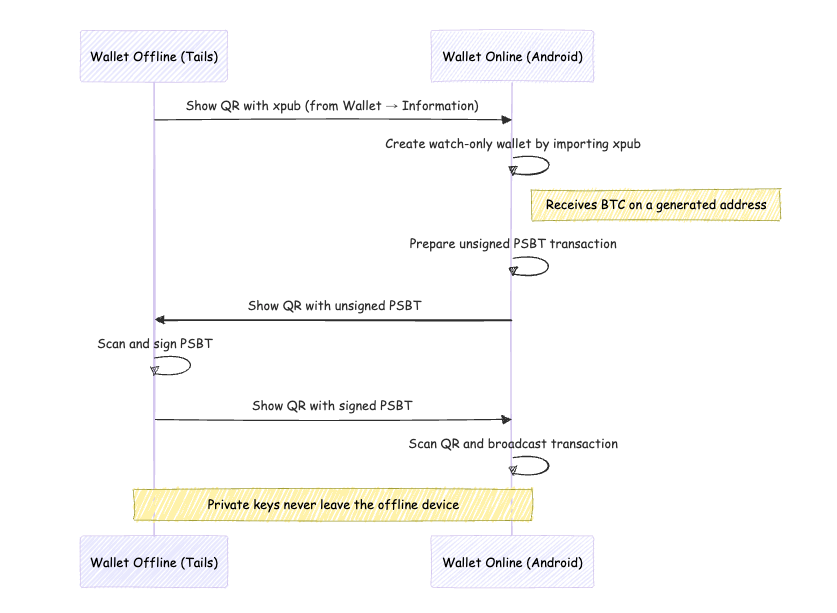
When a transaction is needed, staff create an unsigned transaction on an online system, transfer it to the offline environment via QR code or clean USB (never the same one twice), sign it with the private key, then move the signed transaction back online for broadcasting. The private key itself never leaves the offline zone.
For larger organisations, this signing step often requires multiple people to be present at a process known as a key ceremony, with video recordings, logs, and dual approval.
Common Forms of Cold Storage Used by Institutions
Hardware Wallets
Purpose-built devices that store keys inside secure chips and sign transactions under controlled physical access. Leading models require PINs and passphrases.
Metal Backup Systems
Engraved steel or titanium plates are used for recovery purposes. These are preferred over paper due to their durability against fire and water damage.
Multi-Signature (Multi-Sig)
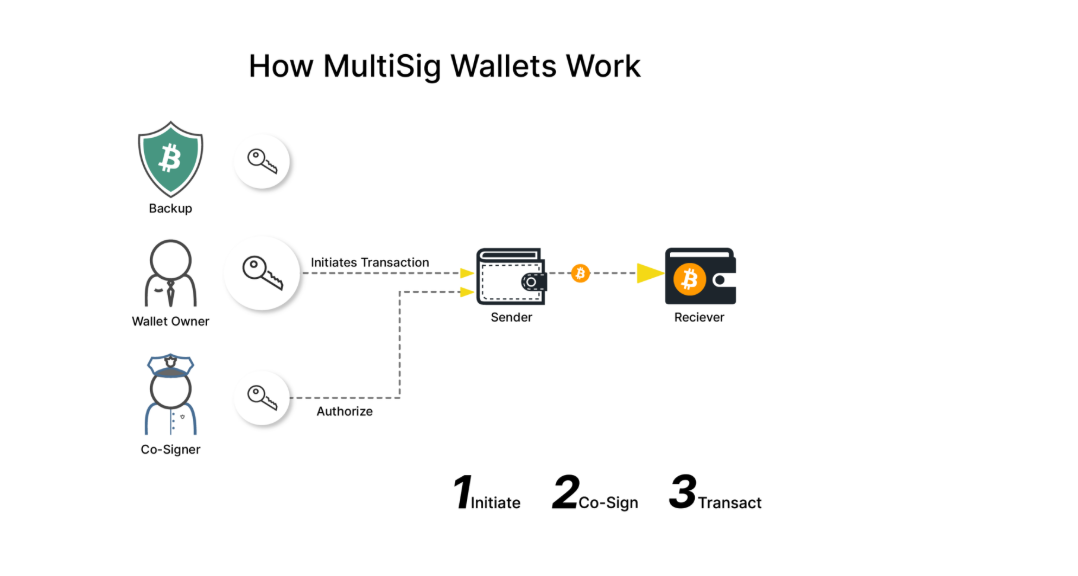
Multi-signature arrangements require multiple independent keys to approve a transaction (e.g., 3-of-5 approval). The approval policy is enforced on-chain, reducing the risk of a single point of failure.
Multi-Party Computation (MPC)
Rather than storing a single complete private key, MPC mathematically splits signing authority among participants. No single device ever holds the full key. Transactions are signed collaboratively without reconstructing them.
Hardware Security Modules (HSMs)
Some custodians deploy offline HSMs for deep cold vaults. These devices meet international tamper-resistance standards and are commonly used in financial infrastructure.
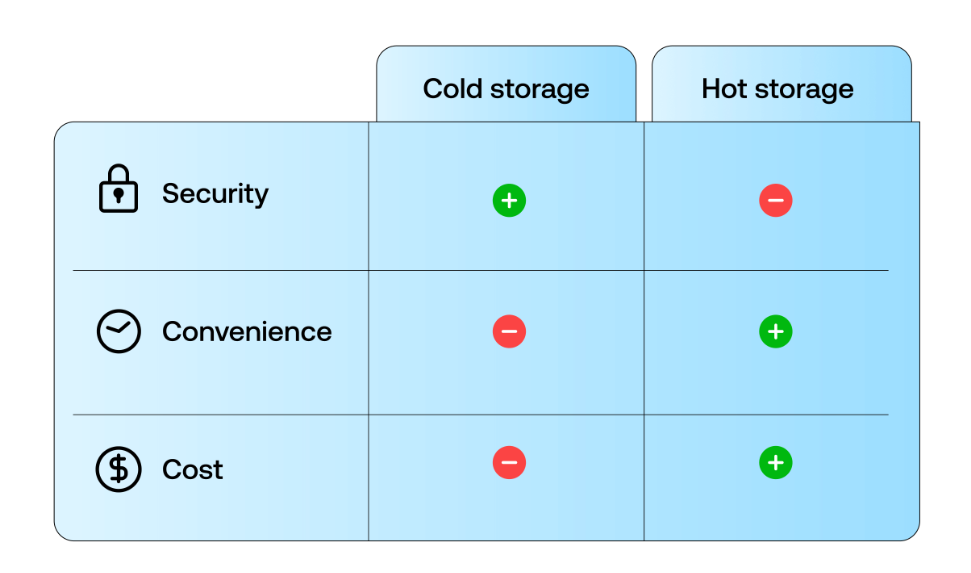
Comparison Table: Hot Storage vs Cold Storage
Aspect | Hot Storage | Cold Storage |
|---|---|---|
Connection | Always online | Offline except during controlled signing |
Convenience | Instant transactions | Requires physical procedures |
Primary Risk Mitigated | Limited protection against remote attacks | Strong protection against remote hacking & malware |
Typical use | Daily operations & liquidity | Long-term reserves and settlement buffers |
Institutional Role | Liquidity management | Core asset protection |
This table highlights why most institutions run both systems side by side: hot wallets for speed, cold storage for safety.
Benefits and Real-World Limitations
The clearest advantage is protection against remote attacks. Private keys never sit on a server or laptop that could be reached from anywhere in the world. Phishing campaigns, ransomware, and clipboard hijackers lose their target.
However, cold storage alone does not eliminate all risk. Physical theft, insider risk, device supply chain contamination, and even human error in handling backups can still pose issues. As a result, institutions use a combination of cold storage and logging, geographic dispersion of backups, and regular recovery drills.
In 2026, regulators increasingly expect proof that these controls actually work. Independent audits and certifications have become routine for any platform handling significant client assets.
Regulatory Context and Compliant Custody in 2026
Regulatory frameworks across Asia and Europe now emphasise licensed custody and segregation of client assets.
In Hong Kong, the Securities and Futures Commission (SFC) has established licensing requirements for digital asset trading platforms and custodians under its virtual asset regime.
The Hong Kong-listed digital asset platform OSL Group (863.HK) was among the early platforms to operate under SFC licensing standards. Such regulated platforms integrate offline key management with broader compliance obligations, including custody segregation, audit requirements, and risk controls.
Insurance coverage levels vary by provider and policy structure, and institutions should verify specific terms directly with the custodian.
Across jurisdictions, qualified custodians assume regulated responsibility for safeguarding client assets, combining technical cold storage with legal and governance protections.
For institutions moving between fiat and stablecoins, this combination of offline security and regulated settlement infrastructure is often preferred over pure self-custody.
Implementing Cold Storage: Practical Considerations
Organisations starting out follow a few consistent steps. They define clear policies for which assets belong in deep cold storage versus warm operational wallets. They test every recovery procedure on fresh hardware before placing real funds. They enforce role separation so no single person can complete a withdrawal alone.
Firmware on hardware devices is checked and re-verified before each use. Backup locations are spread across different jurisdictions to reduce the impact of any local disaster. And every key ceremony is documented with timestamps, participant names, and cryptographic proofs.
These steps may sound detailed, but they become routine once embedded in operational manuals.
The payoff is measurable: significantly lower exposure to the types of incidents that have affected less-prepared platforms. Platforms such as OSL’s institutional custody services and exchange are built around exactly these principles. They allow enterprises to maintain cold storage while still executing regulated trading, stablecoin payments, and settlement without compromising security.
Frequently Asked Questions
How does cold storage work for institutions?
Institutions generate and store private keys on air-gapped systems or hardware devices that never connect to the internet. Transactions are prepared online, transferred offline for signing, then broadcast once signed. Multiple approvals and detailed logging are standard.
Does cold storage make cryptocurrency completely unhackable?
No. It greatly reduces remote online threats, but physical theft, insider risks, or errors during recovery can still occur. Strong processes and governance remain essential alongside the offline layer.
What is the difference between multi-signature and MPC in cold storage?
The multi-signature method stores the approval process on the blockchain itself, which is an on-chain process. MPC divides the key mathematically so that no party has the entire key. These methods eliminate single points of failure. However, the selection depends on the organisation's scale and complexity.
How do qualified custodians differ from self-custody?
Qualified custodians are regulated entities that must meet licensing, segregation, audit, and insurance standards. Self-custody places full responsibility on the organisation itself. Many institutions prefer qualified custody for client assets because it adds external oversight and legal protections.
Is cold storage still relevant for enterprises in 2026?
Yes. With larger asset volumes and stricter regulations, offline key management has become a baseline expectation. The most secure programmes combine cold storage with licensed infrastructure for both protection and efficient operations.
Conclusion
Cold storage provides the strongest practical defence against remote compromise by keeping private keys offline. When paired with multi-signature controls, rigorous procedures, and regulatory licensing, it gives institutions the confidence to operate at scale in digital finance.
The approach is not about eliminating every risk; no system can do that, but about managing them thoughtfully and transparently. In 2026, organisations that treat custody as a professional discipline rather than an afterthought are the ones best positioned for long-term success.
Ready to strengthen your digital asset infrastructure? Explore OSL’s Institutional Solutions, including licensed custody, exchange, and stablecoin payment services designed for enterprises and financial institutions that demand the highest standards of security and compliance.
Start your safe cryptocurrency journey now
OSL | Secure Ramps. Trusted Rails !
More About Topics
More About Topics
Latest
How to Evaluate Tokenised Bonds: Rights, Custody and Settlement Checks
Putting a bond on-chain does not remove credit risk. Use this checklist to review holder rights, legal records, custody, settlement and transfer restrictions.
How to Evaluate Tokenised Bonds: Rights, Custody and Settlement Checks
How to Choose a Bitcoin Platform in Hong Kong: A Practical Checklist
Compare Bitcoin platforms by custody arrangements, total costs, withdrawal rules, account security and support records, not by return forecasts.
How to Choose a Bitcoin Platform in Hong Kong: A Practical Checklist
Five Checks Before Opening a Crypto Account in Hong Kong
Overseas regulatory news does not mean a platform is licensed in Hong Kong. Check the legal entity, official website, service scope, client eligibility and terms before opening an account.
Five Checks Before Opening a Crypto Account in Hong Kong
60-Vote Hurdle for CLARITY Act Exposes Limits of Legislative Hope
The CLARITY Act's September 15 procedural vote exposes why implemented regulatory frameworks may offer institutions more operational certainty than pending U.S. legislation.
60-Vote Hurdle for CLARITY Act Exposes Limits of Legislative Hope
XRP Rebounds 30% Then Slips: DeFi Infrastructure Faces Volatility Exam
XRP Ledger's $1.1 billion stablecoin expansion and new lending protocol foundation face an immediate stress test as XRP price swings 30% monthly.
XRP Rebounds 30% Then Slips: DeFi Infrastructure Faces Volatility Exam
$0.325 SKY Forecast: Valuation Model or Institutional Wish?
Standard Chartered's $0.325 price target on Sky's governance token applies bank-style valuation to on-chain credit infrastructure, but the forecast depends on USDS adoption and borrowing expansion that remains nascent.
$0.325 SKY Forecast: Valuation Model or Institutional Wish?
Recommended For You
More About Topics
More About Topics