How to Solve the "Slippage" and "Friction" Dilemma in Stablecoin Swaps?

In the crypto market, investors often focus on asset price volatility but overlook the hidden costs involved in stablecoin interactions.
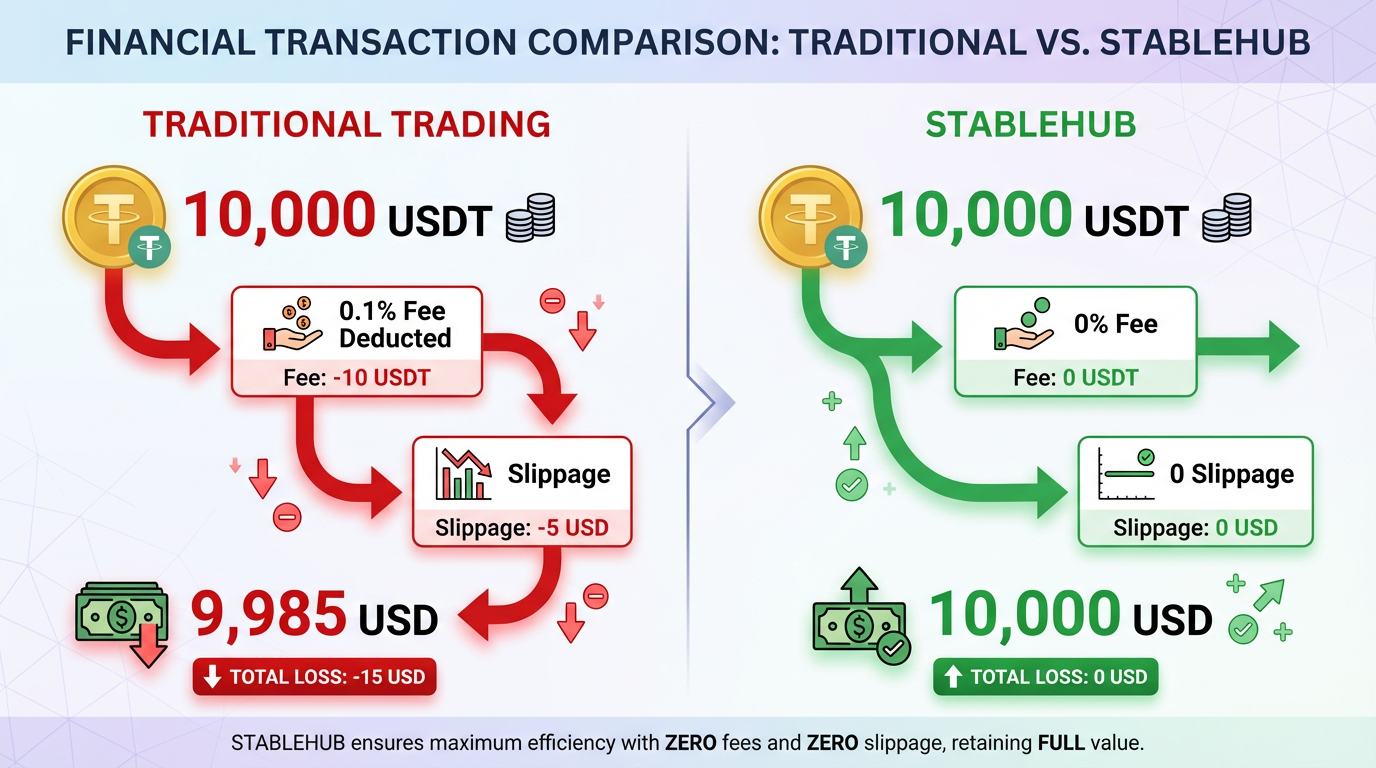
When you need to swap USDT for USDC to participate in on-chain activities, or convert stablecoins back to USD for fiat settlement, the traditional "trading pair" model often erodes your principal. Whether it's the 0.1%-0.2% trading fee or the slippage caused by insufficient depth during large transactions, these frictions represent a significant cost for institutions and individuals who trade frequently or make large payments.
To solve this problem, OSL Group introduces StableHub. This article explains how it resolves the pain points of traditional exchanges and achieves frictionless asset flow.
I. What is OSL StableHub?
OSL StableHub is a one-stop exchange and rewards hub for multiple stablecoins and USD.
Unlike traditional exchanges that treat USDT and USDC as two separate commodities for matching (Order Book), StableHub bridges mainstream USD stablecoins (such as USDT, USDC, RLUSD) with fiat USD by aggregating institutional-grade underlying liquidity.
1. Strict 1:1 Lossless Exchange
Under the StableHub mechanism, within the specified quota range:
Zero Slippage: Regardless of minor market price fluctuations, the system locks in a rigid 1:1 exchange ratio.
Zero Fees: StableHub waives all fees for supported stablecoin pairs, achieving a truly zero-cost seamless switch.
2. Institutional-Grade Liquidity Aggregation
StableHub aggregates institutional-level liquidity, supporting single large transactions worth hundreds of thousands of dollars.
This surpasses the depth of traditional order books, providing users with superior liquidity to meet the large-scale exchange needs of institutions and enterprises.
II. Don't Let Idle Funds Go to Waste: Holding Rewards Carnival
During the launch period, OSL is launching the StableHub Rewards Carnival. [Join Now >]
1. New User Exclusive: 100% APR Experience
If you are a new user holding specified stablecoins on OSL for the first time:
Ultra-High Return: Enjoy up to 100% APR reward quota (valid for 7 days).
Quota & Mechanism: Applies to the first 1,000 U share of your initial holding.
First Come, First Served: The exclusive reward pool totals $100,000. The system ranks users based on the time of their first holding. The earlier you deposit and hold, the greater your chance of locking in high-interest rewards!
2. Shared by All: 18% Excess Rewards
Whether you are a new or existing user, as long as you hold the specified stablecoins for the event, you can enjoy tiered high rewards, making your idle funds grow every second.
Core Holding Tier: The first 30,000 holding share enjoys 18% APR rewards.
Large Holding Tier: The portion exceeding 30,000 still enjoys long-term APR rewards of 3% or more (refer to the event page for details).
Daily Distribution: The 18% reward pool totals $500,000, calculated and distributed daily until the pool is exhausted.
Recommended Reading: Ripple USD (RLUSD) Officially Joins StableHub Rewards Carnival >
(Please refer to the event page for specific details)
III. How to Participate in the Rewards Carnival
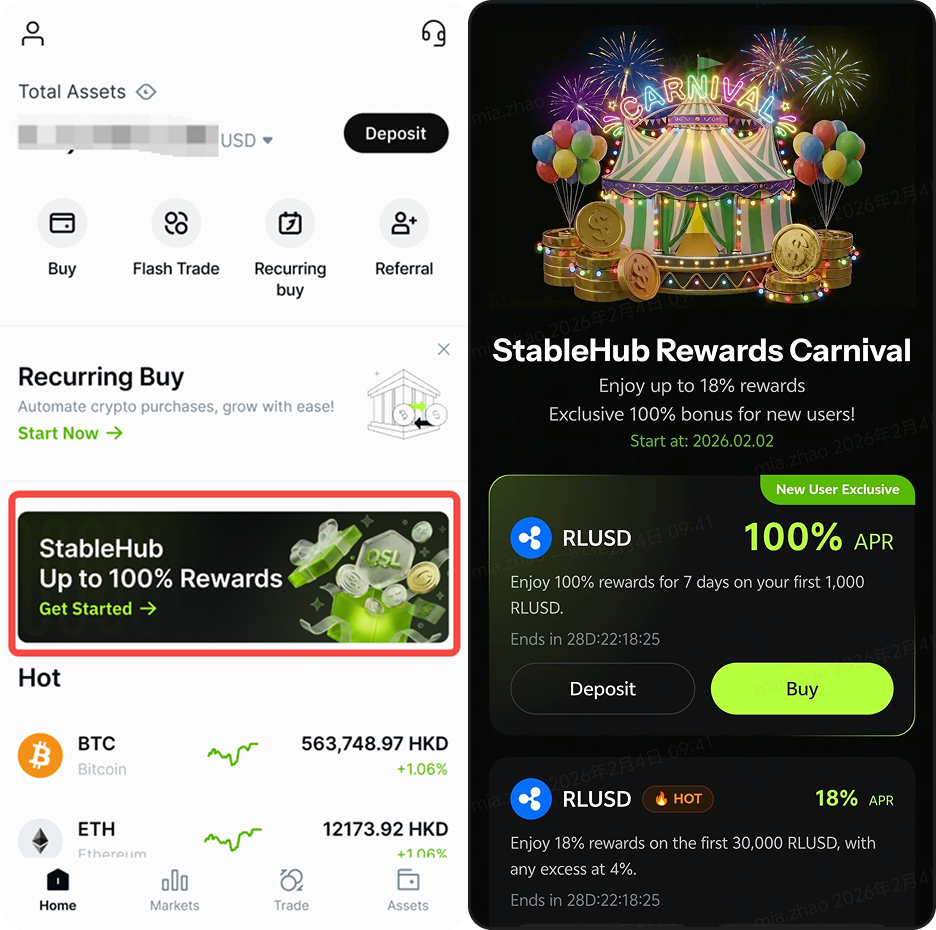
Step 1: Enter the StableHub Rewards Carnival Page
App: Click on the event banner.
Web: Click the "StableHub Rewards Carnival" entry in the official website navigation bar.
Step 2: Deposit or Trade Specified Stablecoins
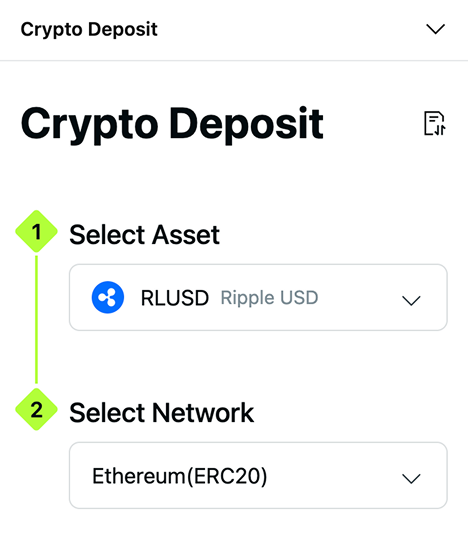
You can directly deposit the specified stablecoins into your OSL account via on-chain transfers or from other exchanges.
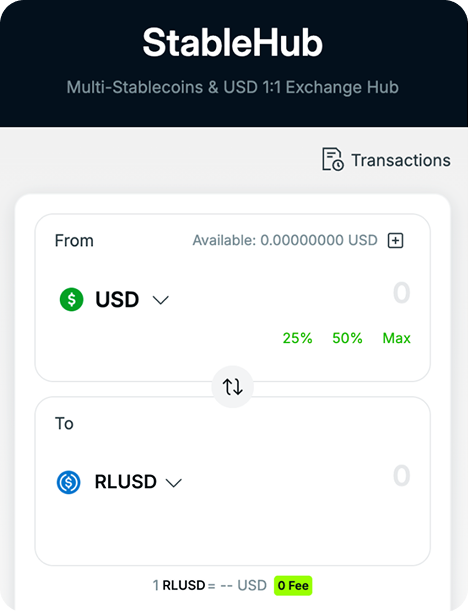
Or deposit USD or USDT via bank transfer, credit card purchase, or Flash Trade, and then convert them 1:1 into the specified stablecoins via StableHub.
Step 3: Hold Stablecoins to Claim Rewards
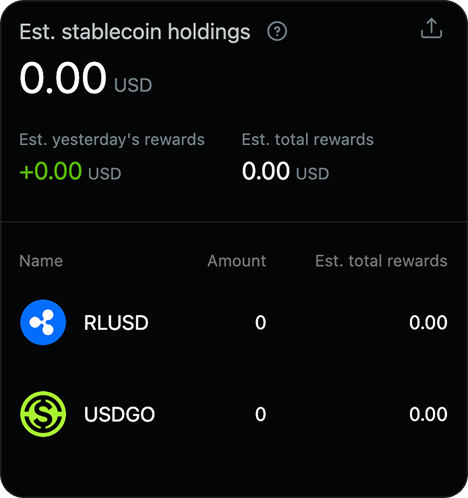
Hold the specified stablecoins in your account. The system takes daily snapshots of holdings and automatically calculates rewards.
IV. Transparent Mechanism: About 1:1 Quotas & Rules
To ensure the long-term health of the ecosystem and prevent abuse, StableHub adopts a fair quota management mechanism.
1. Quotas are not unlimited, but very flexible StableHub's 1:1 exchange has a personal monthly quota and a total platform quota.
Unlimited for some pairs: E.g., USDC/USD currently supports unlimited exchanges.
Pairs like USDT: Have a monthly 1:1 exchange cap (e.g., 20,000 USD per person per month).
2. What if I exceed the quota?
If your order amount exceeds the remaining 1:1 quota for the month, the entire order will be converted to market price:
Your entire order will be executed at the current market price (Flash Trade).
The system will pop up a prompt with the latest market quote. If it does not meet your expectations, you can choose to decline and modify the amount.
3. Quota Reset
Personal and global quotas are automatically reset at 23:59 (UTC+8) on the last day of each calendar month.
Whether you are an individual investor looking to save on fees, or a business owner seeking a compliant channel for large fiat settlements, OSL StableHub is currently the optimal solution in the market balancing "Low Cost" and "High Return".
👉 [Go to StableHub Now and Start Zero-Friction Exchange]
Recommended Reading:
More About Topics
More About Topics



Latest
How to Evaluate Tokenised Bonds: Rights, Custody and Settlement Checks
Putting a bond on-chain does not remove credit risk. Use this checklist to review holder rights, legal records, custody, settlement and transfer restrictions.
How to Evaluate Tokenised Bonds: Rights, Custody and Settlement Checks
How to Choose a Bitcoin Platform in Hong Kong: A Practical Checklist
Compare Bitcoin platforms by custody arrangements, total costs, withdrawal rules, account security and support records, not by return forecasts.
How to Choose a Bitcoin Platform in Hong Kong: A Practical Checklist
Five Checks Before Opening a Crypto Account in Hong Kong
Overseas regulatory news does not mean a platform is licensed in Hong Kong. Check the legal entity, official website, service scope, client eligibility and terms before opening an account.
Five Checks Before Opening a Crypto Account in Hong Kong
60-Vote Hurdle for CLARITY Act Exposes Limits of Legislative Hope
The CLARITY Act's September 15 procedural vote exposes why implemented regulatory frameworks may offer institutions more operational certainty than pending U.S. legislation.
60-Vote Hurdle for CLARITY Act Exposes Limits of Legislative Hope
XRP Rebounds 30% Then Slips: DeFi Infrastructure Faces Volatility Exam
XRP Ledger's $1.1 billion stablecoin expansion and new lending protocol foundation face an immediate stress test as XRP price swings 30% monthly.
XRP Rebounds 30% Then Slips: DeFi Infrastructure Faces Volatility Exam
$0.325 SKY Forecast: Valuation Model or Institutional Wish?
Standard Chartered's $0.325 price target on Sky's governance token applies bank-style valuation to on-chain credit infrastructure, but the forecast depends on USDS adoption and borrowing expansion that remains nascent.
$0.325 SKY Forecast: Valuation Model or Institutional Wish?
Recommended For You
More About Topics
More About Topics