Monad Foundation and High-Performance Blockchain Execution Explained

Monad sits at the crossroads of advanced math ideas and real-world blockchain use. In this article, we break down what monad means in simple terms, how it shapes the design of the Monad blockchain, and the role of the Monad Foundation in guiding the ecosystem. You’ll also learn how the mainnet works, what makes its execution high performance, and how the MON token fits into the network’s economics and public sale.
Understanding the Monad Concept
Definition of Monad
In everyday language, a monad is a structured way to handle a series of steps. Imagine a factory conveyor belt: boxes move past stations where workers add or check items, and the belt keeps everything in order. In computing, a monad works like that belt, carrying data through many steps and enforcing rules so each step runs safely; this idea guides how the Monad blockchain handles many actions without losing control. For absolute simplicity, you can think of a monad as instructions plus a safety rail that keeps every step in line.
Historical Background of Monad
The word monad appears in philosophy and later in advanced mathematics, where it describes a general way to connect processes. Programmers adopted monads to manage tricky tasks, such as dealing with errors or data that arrives later, while still writing clear code.
Importance in Blockchain Technology
Blockchains are shared ledgers that track who owns what over time. Every transaction updates common state, and all nodes must agree on the same order of updates. A monad style of thinking helps designers break those updates into small steps and connect them safely, which is essential when building high throughput networks like Monad. In short, monad keeps complexity manageable.
Monad Foundation and Its Role
Overview of the Monad Foundation
The Monad Foundation is an independent organisation that supports the Monad protocol and ecosystem. It funds core software work, coordinates upgrades, and helps builders launch tools and applications over the long term.
Community Involvement in Monad
The foundation runs programs, grants, and events to attract developers, founders, and educators into the monad ecosystem. Community members can run validators, build wallets or analytics tools, write documentation, and join public discussions about changes.
Objectives of the Monad Foundation
The key goals of the Monad Foundation are to keep the network performant and secure, support decentralisation, and grow a healthy ecosystem. That includes spreading validator nodes across regions, backing open source projects, and managing the MON token treasury in a transparent way. Clear rules about how MON is created, allocated, and used make it easier for regulators and institutions to understand the monad ecosystem.
Monad and Blockchain Technology
How Monad Integrates with Blockchain
Monad is a high performance layer one blockchain that is fully compatible with the Ethereum Virtual Machine. Developers can deploy many existing smart contracts with little or no change, connect popular wallets, and use familiar tools such as Hardhat or Foundry, while the monad design underneath adds parallel execution, an efficient database, and a fast consensus protocol.
Benefits of Using Monad in Blockchain
Because of this design, Monad targets very high throughput, low fees, and near instant finality. That can support use cases like high frequency trading, gaming, or micro payments that struggle on slower chains. For developers, staying within the EVM world lowers learning costs and lets them reuse tested code, while users get an Ethereum style experience with faster confirmation.
Comparison with Other Blockchain Solutions
Compared with Ethereum mainnet, Monad aims to deliver much higher transaction capacity while keeping the same basic programming model. Unlike some newer chains that use their own virtual machines, Monad focuses on strict EVM compatibility. Instead of being a rollup that depends on another chain for security, Monad is a monolithic layer one where execution and consensus live together.
Mainnet and Monad Execution
Introduction to Monad Mainnet
Monad public mainnet launched in November 2025, moving the protocol from test environment to live network with real value at stake. Validators, wallets, bridges, and early decentralised applications came online, and the MON token became transferable.
High-Performance Features of Monad Execution
Monad execution is tuned for speed. The protocol can analyse which transactions do not touch the same state and run them in parallel, like having many conveyor belts working side by side. It also uses an optimised storage engine so that reading and writing blockchain state is fast, even when blocks are large.
Deployment Strategies on Monad Mainnet
For developers, deploying on Monad usually starts with adding Monad endpoints to their toolchain, funding a wallet with MON for gas, and deploying contracts as they would on any EVM chain. Teams porting over from other networks often begin with audited code, then run testing to see how their apps behave under higher throughput.
Token Economics and Sales
Overview of Monad Token
MON is the native token of the Monad network. It is used to pay gas fees, to stake and secure the chain through validators, and may in time be used for protocol governance. At mainnet launch, the initial supply was fixed at 100 billion MON, with portions set aside for public sale, airdrops, ecosystem development, contributors, and investors.
Tokenomics Overview
The token allocation is summarized below.
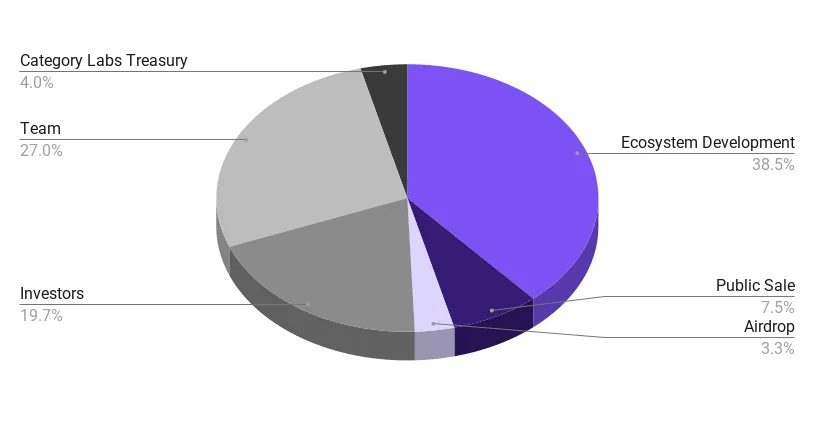
Allocation Group | Status at Public Mainnet | # Tokens | % |
|---|---|---|---|
Ecosystem Development | Unlocked | 38,544,142,854 | 38.5% |
Team | Locked | 26,989,187,887 | 27.0% |
Investors | Locked | 19,683,237,451 | 19.7% |
Public Sale | Unlocked | 7,500,000,000 | 7.5% |
Category Labs Treasury | Locked | 3,952,848,412 | 4.0% |
Airdrop | Unlocked | 3,330,583,396 | 3.3% |
Total Initial Token Supply | 100,000,000,000 | 100.0% |
Token Sale Platforms
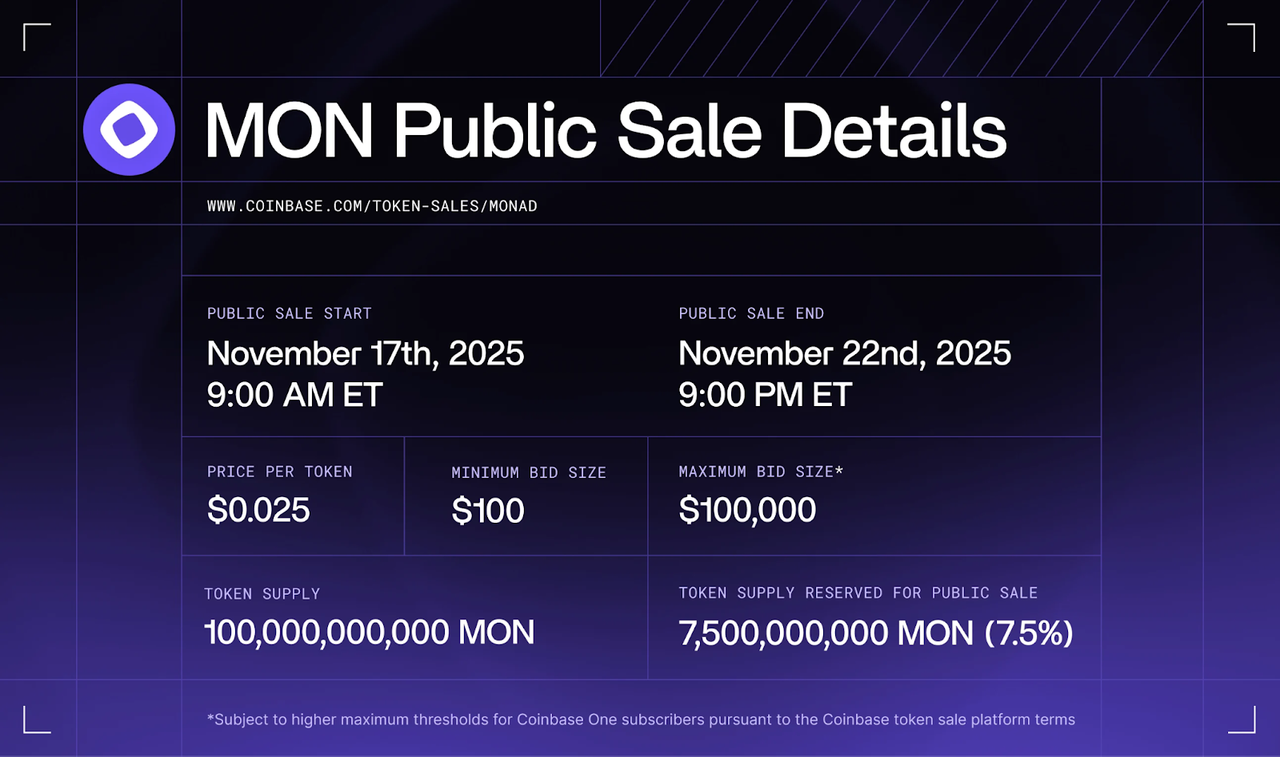
The public sale of MON took place on a new Coinbase token sale platform before mainnet went live. Participants could commit funds in USDC during a set window, and an algorithm allocated up to 7.5 billion MON, or 7.5%cent of the initial supply, at a fixed price.
Public Sale and Onchain Transactions
After the token generation event, MON became usable onchain. Holders can now pay transaction fees, stake with validators where available, and interact with applications that deploy on Monad. Trading, custody, and onchain activity remain subject to local regulation in each market, so institutions combine blockchain analysis, wallet screening, and internal risk controls when they engage with the Monad network or list MON as a supported asset.
Start your safe cryptocurrency journey now
OSL | Secure Ramps. Trusted Rails !
More topics
More topics
Latest
Why India's $620B Bond Pilot Changed Nothing Legal
SEBI and the RBI's Demat 2.0 pilot issues corporate bonds as digital tokens and settles them with the wholesale digital rupee, preserving existing legal terms while digitizing the infrastructure beneath a $620...
Why India's $620B Bond Pilot Changed Nothing Legal
Why S&P Global Leads Kaiko: Not Hype, But 24/7 Market Infrastructure
S&P Global led a $110 million extension of Kaiko's Series B to build data infrastructure for round-the-clock tokenized markets.
Why S&P Global Leads Kaiko: Not Hype, But 24/7 Market Infrastructure
When One Firm Holds 5% of Ethereum: Infrastructure Stress Test
Bitmine's accumulation of more than 5 million staked ETH raises questions about whether custody, audit, and validator infrastructure can support single-asset concentration at public-company scale.
When One Firm Holds 5% of Ethereum: Infrastructure Stress Test
Best Enterprise Stablecoin Payment Providers: A 2026 Evaluation Framework
Compare enterprise stablecoin payment providers by use case, legal entity, workflow, controls, integration, reconciliation, support, and contract terms.
Best Enterprise Stablecoin Payment Providers: A 2026 Evaluation Framework
How to Reconcile a USDGO Payment: An Illustrative Finance-Close Example
See how Finance can trace a USDGO payment from an approved obligation through payment records, recipient confirmation, reconciliation, and accounting close.
How to Reconcile a USDGO Payment: An Illustrative Finance-Close Example
A USDGO Reserve Review in Practice: Findings, Limits and Follow-up Questions
Review what the July 2026 USDGO reserve attestation establishes, what it does not prove, and which issuer, redemption, and liquidity questions remain.
A USDGO Reserve Review in Practice: Findings, Limits and Follow-up Questions
Recommended for you
More topics
More topics
