Why Professional Traders Prefer USDC-Margined Perpetual Futures

Core Summary
In crypto derivatives trading, the margin model dictates both capital efficiency and risk ceilings. OSL Global has officially launched USDC-settled Perpetual Contracts, initially supporting 19 popular assets including XRP, DOGE, and XAUT (Tether Gold).
By utilizing a compliant stablecoin for settlement, traders can effectively eliminate the "double-whammy" risk inherent in coin-margined models, enabling precise strategic positioning with up to 10x leverage.
🔗:Official Launch of OSL Global USDC-Margined Perpetual Futures with Up to 10 × Leverage
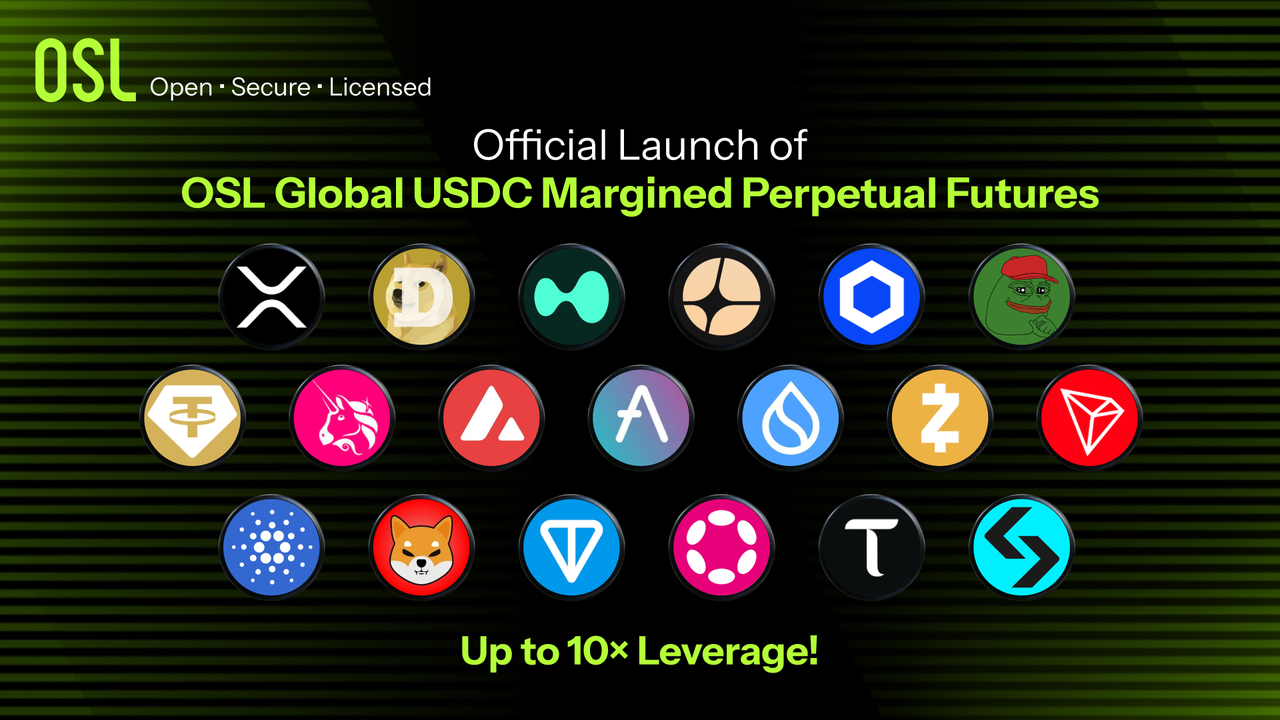
Eliminating "Risk Resonance": The Underlying Advantages of USDC Settlement
Traditional Coin-Margined contracts often trap traders in an invisible financial dilemma during high volatility: when the market drops, not only does the position incur a loss, but the underlying asset held as collateral also depreciates simultaneously. This "risk resonance" rapidly accelerates the likelihood of forced liquidation.
By establishing USDC (a highly transparent, compliant USD stablecoin) as the unified settlement currency, OSL provides a stable fiat-based reference frame:
Linear Return Profile: Whether trading high-volatility Meme coins or mainstream Layer 1 tokens, your PnL and margin requirements are anchored 1:1 to USD value. This eliminates the price volatility of the margin itself, making risk management highly predictable.
Precision in Strategy Execution: Linear return curves make cross-asset hedging, quantitative backtesting, and position management more scientific—providing a robust foundation for institutional-grade capital seeking financial transparency.
The Golden Ratio of Capital Efficiency and Defensive Depth: 10x Leverage
In derivatives trading, the leverage ratio directly impacts an account’s margin for error. OSL Global has capped perpetual contract leverage at 10x, a setting that reflects a balanced approach between investor protection and capital efficiency.
Optimized Capital Expenditure: 10x leverage allows traders to control a position with only 10% margin. This significantly boosts capital turnover while retaining essential risk control capabilities.
Enhanced Safety Buffer: Compared to the razor-thin tolerance of high-leverage platforms (e.g., 50x or 100x), 10x leverage provides a more effective defense against short-term "flash crashes" or irrational market spikes, giving strategies the "breathing room" necessary to reach fruition.
Cross-Asset Hedging: From Crypto-Native to "Digital Gold"
OSL’s unique advantage lies in the strategic depth of its asset list.
Unified Multi-Asset Margin: Users can trade the AI sector (TAO), public chains (SUI/TON), and gold tokens (XAUT) simultaneously using a single USDC account.
Seamless Hedging: There is no need to transfer funds between different sub-accounts. Traders can offset risks between "crypto assets" and "safe-haven assets," greatly improving the execution efficiency of macro-hedging strategies.
OSL Global Perpetual Contracts: Practical Guide
Unified Collateral Configuration: Maintain sufficient USDC in your account to serve as universal margin for all 19 trading pairs.
Leverage Compliance Benefits: During extreme market conditions, OSL’s compliant custody and asset segregation mechanisms ensure high levels of execution certainty and security.
💡 Frequently Asked Questions (FAQ)
Q1: Why are USDC-margined contracts called "Linear Contracts"?
A: Linear contracts mean your PnL calculation is direct and proportional. Since USDC is used as margin, gains and losses are settled directly in USD value. This differs from "Coin-Margined" contracts, where the value of the collateral fluctuates alongside the market, creating complex logic and overlapping risks.
Q2: Can I trade Gold (XAUT) and cryptocurrencies using the same USDC account?
A: Yes. This is a core advantage of OSL’s USDC-margined contracts. You don’t need to move funds between different asset accounts. By using USDC as universal margin, you can hold positions in XRP or PEPE while utilizing XAUT (Gold tokens) for macro risk hedging, simplifying cross-asset management.
Q3: Why is a compliant platform like OSL safer than offshore high-leverage platforms?
A: In extreme market scenarios, offshore platforms often suffer from liquidity droughts or technical "downtime." As a regulated digital asset trading platform, OSL provides segregated asset storage and legally protected custody services. This means your margin is not just a tool for trading, but is also shielded by institutional-grade legal safeguards.
Start your safe cryptocurrency journey now
OSL | Secure Ramps. Trusted Rails !
More topics
More topics


Latest
Why India's $620B Bond Pilot Changed Nothing Legal
SEBI and the RBI's Demat 2.0 pilot issues corporate bonds as digital tokens and settles them with the wholesale digital rupee, preserving existing legal terms while digitizing the infrastructure beneath a $620...
Why India's $620B Bond Pilot Changed Nothing Legal
Why S&P Global Leads Kaiko: Not Hype, But 24/7 Market Infrastructure
S&P Global led a $110 million extension of Kaiko's Series B to build data infrastructure for round-the-clock tokenized markets.
Why S&P Global Leads Kaiko: Not Hype, But 24/7 Market Infrastructure
When One Firm Holds 5% of Ethereum: Infrastructure Stress Test
Bitmine's accumulation of more than 5 million staked ETH raises questions about whether custody, audit, and validator infrastructure can support single-asset concentration at public-company scale.
When One Firm Holds 5% of Ethereum: Infrastructure Stress Test
Best Enterprise Stablecoin Payment Providers: A 2026 Evaluation Framework
Compare enterprise stablecoin payment providers by use case, legal entity, workflow, controls, integration, reconciliation, support, and contract terms.
Best Enterprise Stablecoin Payment Providers: A 2026 Evaluation Framework
How to Reconcile a USDGO Payment: An Illustrative Finance-Close Example
See how Finance can trace a USDGO payment from an approved obligation through payment records, recipient confirmation, reconciliation, and accounting close.
How to Reconcile a USDGO Payment: An Illustrative Finance-Close Example
A USDGO Reserve Review in Practice: Findings, Limits and Follow-up Questions
Review what the July 2026 USDGO reserve attestation establishes, what it does not prove, and which issuer, redemption, and liquidity questions remain.
A USDGO Reserve Review in Practice: Findings, Limits and Follow-up Questions
Recommended for you
More topics
More topics
