TRUMP Coin Price Prediction 2026: Official Trump Meme Token Outlook
Key Takeaways: TRUMP Price Predictions at a Glance
The Official Trump meme token ($TRUMP) launched on January 17, 2025, days before Donald Trump’s inauguration, and runs on Solana.
Key tokenomics widely cited by major trackers: ~1B max supply, with ~200M circulating and the remainder associated with Trump-affiliated entities (release schedules/vesting are a major variable).
The token’s early trading was extremely volatile: TradingView shows a high around $49.26 in January 2025 and a low around $4.57 in October 2025.
For 2026, third-party forecasts are all over the map—from single digits (more conservative) to double digits, and even $50–$160 (highly aggressive, assumption-heavy).
This article is scenario-based and not investment advice. Meme coins can move on sentiment, headlines, liquidity, and token distribution changes.
TRUMP All-Time Price Performance
The goal of looking at past performance is simply to understand volatility and range—not to extrapolate a straight line.
On TradingView’s TRUMPUSD page, $TRUMP’s highest recorded price is shown around $49.26 (January 2025) and its lowest around $4.42 (January 26, 2026).
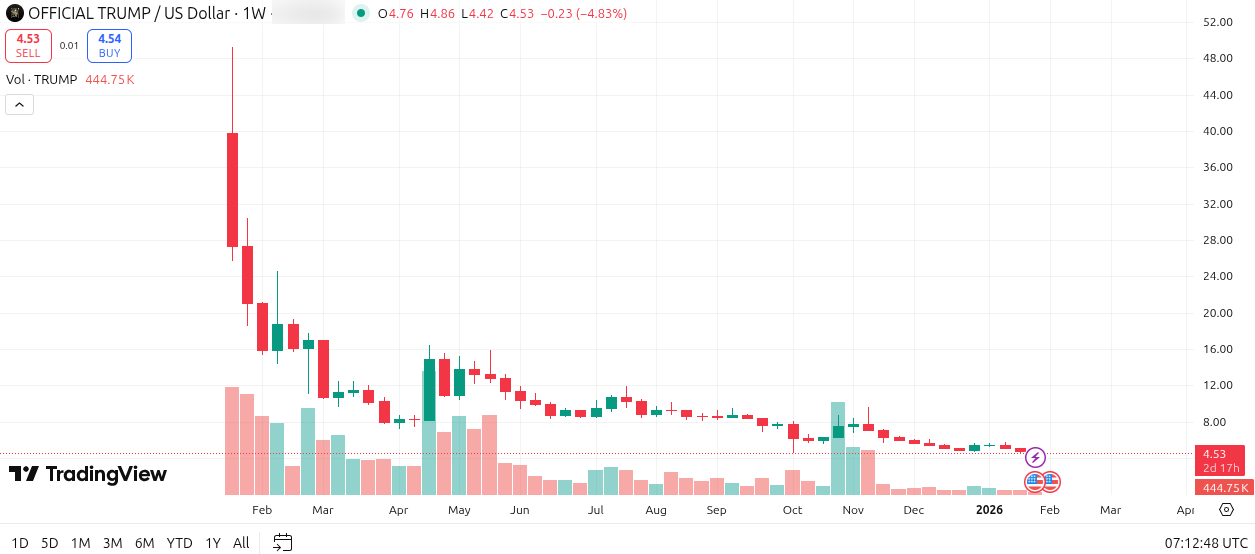
Source: TradingView chart
Why this matters for 2026: after a sharp post-launch spike and a deep drawdown, the token enters 2026 with the market already aware of:
extreme headline sensitivity, and
supply/ownership structure concerns (including unlock expectations).
Scenario Definition + Forecast Summary Table
This trump coin price prediction 2026 uses third-party sources as inputs and frames them into clear scenarios. None of these numbers are OSL targets.
What typically drives meme-token forecasts
Forecast pages usually rely on one or more of the following:
Quant/technical models (trend + volatility), often producing moderate targets.
Assumption engines (fixed growth rates or “market returns” inputs), which can look stable but are sensitive to the chosen parameters.
Narrative projections (political news cycle, culture relevance, “viral” momentum), which can generate very wide ranges.
2026 forecast table
Note: Some sources publish extremely aggressive targets; those should be treated as speculative scenarios, not baseline expectations.
Source | 2026 low | 2026 high | Approach |
|---|---|---|---|
FXOpen (summary of “most projections”) | ~$3 | ~$17 | Describes 2026 forecasts as more conservative; cites dilution + sentiment + political catalysts. |
CoinCodex (EOY model) | — | ~$10.66 (EOY) | Model-based end-of-year estimate (time-stamped). |
StealthEX (cites multiple forecasters) | ~$6.8 | ~$56.2 | Mentions DigitalCoinPrice ($6.8–$8.1), CoinLore ($41.2–$56.2), Telegaon ($12.7–$21.05). |
Flitpay | ~$55 | ~$95 | Very bullish 2026 band; highly assumption-driven. |
“Benzinga” repost via Binance Square | ~$80 | ~$160 | Extremely aggressive; treat as high-uncertainty narrative. |
What the dispersion tells you: the market does not have a consensus model for $TRUMP. That makes 2026 best handled as scenario bands tied to observable drivers: supply distribution, liquidity, and political/news-cycle catalysts.
TRUMP Price Outlook for 2026
The 4 core drivers that can dominate 2026 for $TRUMP
1) Supply trajectory and concentration risk
Major trackers describe a structure where only about 200M tokens circulate initially, with the remainder associated with affiliated entities and planned releases. Even if releases are scheduled “gradually,” the expectation of new supply can impact price behavior through:
liquidity shocks (more tokens available to trade),
sentiment (fear of dilution), and
market maker positioning (if derivatives/liquidity deepen).
A practical way to track this in 2026 is to monitor circulating supply changes and wallet concentration around known large holders. For on-chain tracing context, TRM Labs identifies a Solana address associated with the token’s creation.
2) Narrative intensity (politics + culture) and headline reflexivity
Unlike “utility-first” tokens, meme tokens can move on attention. In $TRUMP’s case, the project’s public discourse has included ethical/conflict-of-interest criticism alongside strong supporter enthusiasm. That means 2026 price action can be influenced by:
high-visibility news events,
social amplification cycles, and
broader “politifi/memecoin” sector rotations.
3) Market structure: liquidity, listings, and derivatives
Even without making any “up” claim, you can see market structure metrics on large data aggregators:
$TRUMP’s volume and market cap change meaningfully with sentiment.
TradingView lists both spot and perpetual markets (depending on venue), which affects volatility and liquidation cascades.
In 2026, liquidity depth (not just headline volume) becomes critical: shallow books can produce large wicks; deep books can dampen them.
4) “Not an investment” disclaimers and regulatory scrutiny risk
Reporting has quoted the project’s website disclaimer that the token is not intended to be an investment opportunity/security and is “not political” / not tied to a campaign or office. Even with disclaimers, politically adjacent tokens can face heightened scrutiny from:
exchanges (listing/labeling decisions),
advertisers/platforms, and
regulators in multiple jurisdictions.
2026 Scenarios in Depth
Below are three scenario bands designed for 2026 specifically. Each scenario is framed around measurable “if/then” conditions rather than hype.
Bear scenario for 2026: $3–$7 range (or lower wicks)
This scenario aligns with the more conservative “cluster” described by FXOpen (many projections between $3 and $17, with averages around $7–$10).
What would likely drive a bear 2026
Supply/dilution overhang becomes the dominant narrative (even if releases are orderly).
Memecoin sector cools and liquidity moves to other narratives. The Financial Times recently described a sharp decline versus early highs as memecoin frenzy faded.)
Regulatory or platform friction reduces access or promotion, lowering “new buyer” inflow.
Derivatives-driven drawdowns: if perps remain active, liquidation cascades can worsen downside moves.
What you’d see in data if this is playing out
Flat or declining spot volumes on major trackers, fading social interest, and/or increasing circulating supply into weak demand.
Base scenario for 2026: $7–$12 range (high volatility inside the band)
This scenario is roughly consistent with:
CoinCodex’s ~$10.66 EOY model output,
and FXOpen’s “average clustering” around $7–$10.
What would likely drive a base 2026
Supply changes are telegraphed and absorbed without panic.
The token stays liquid and widely traded, but without a mega-viral catalyst.
Broader crypto conditions are “okay” (not a blow-off top, not a deep bear).
What you’d see in data
Sideways behavior with spikes: bursts of volume around news events, then mean reversion.
Bull scenario for 2026: $12–$20+ (and why some sources go far higher)
A moderate bull band (low double digits into ~$20) lines up with the upper end of StealthEX’s cited Telegaon range ($12.7–$21.05).
What would likely drive a bull 2026
A strong “politifi” cycle where attention and liquidity flow back to headline meme assets.
Material improvement in market structure such as deeper liquidity, better spreads, and more venues.
A narrative tailwind from 2026 political fundraising and attention cycles. Some reporting discusses crypto money and the 2026 midterms environment broadly.
About the ultra-bull forecasts ($50–$160) Some sources publish extremely aggressive 2026 projections—e.g., $55–$95 (Flitpay) or $80–$160 (Benzinga repost). For those to be plausible, you would generally need multiple compounding conditions:
sustained global attention,
no major access restrictions,
very strong crypto bull market, and
a market cap outcome that the market is willing to support even as supply potentially expands.
Given how uncertain those assumptions are, it’s more responsible to treat those values as highly speculative “tail” scenarios, not central cases.
TRUMP Metrics to Watch in 2026
If you’re writing this for a serious venue, this checklist is more useful than any single number:
Circulating supply trend (monthly): does it stay near 200M, or start rising meaningfully?
Top-holder concentration + major wallet movements (on-chain monitoring): TRM Labs provides context on tracing and has referenced the token’s Solana address.
Spot liquidity depth on major venues (spreads, slippage), not just reported volume.
Derivatives footprint: Perpetuals open interest and liquidation sensitivity, where available).
Policy/headline volatility: whether $TRUMP becomes a recurring focal point in broader crypto-politics discourse (recent news coverage highlights ongoing controversy and attention).
From TRUMP Insights to Practical Access with OSL
Scenario analysis is one thing—execution and safeguards are another.
For market participants who prioritize governance, controls, and compliant infrastructure, OSL positions itself around licensed access and institutional-grade custody. At OSL, users can buy, sell, and convert TRUMP through Flash Trade with zero trading fees. All transactions are executed at a quoted price that can be reviewed before confirmation. You can access TRUMP trading directly on our TRUMP/USD Flash Trade page. Flash Trade is designed to complete transactions in just three steps:
Buy TRUMP
Select TRUMP and pay with USD.
Enter either the USD amount you want to spend or the amount of TRUMP you want to buy.
Review the quote and confirm the trade.
FAQs on TRUMP Coin Price Prediction 2026
What is the official Trump coin 2026?
In 2026, the “official Trump coin” generally refers to OFFICIAL TRUMP ($TRUMP) — the Solana-based meme token whose market trackers list a max supply near 1,000,000,000 and a circulating supply around 199,999,165 (figures update over time). It is importantly referred to as “OFFICIAL TRUMP ($TRUMP)” to avoid confusing it with unrelated tokens that also use “TRUMP” in the name.
What is the future price of Trump coins?
There isn’t one reliable “future price.” Published outlooks for $TRUMP vary widely because meme tokens are driven by sentiment, liquidity, and supply expectations more than fundamentals. For example, CoinCodex’s model shows an end-of-year 2026 estimate around $10.66, while an FXOpen analytical summary notes a wide cluster of third-party 2026 forecasts (roughly $1.77 to $16.59, depending on source).
Is $TRUMP “official,” and what does the project claim?
Public reporting describes it as an “official” meme coin introduced in January 2025, and notes the project’s website disclaimer that it’s not intended to be an investment opportunity/security and not tied to a political campaign or office.
What are the biggest TRUMP risks specific to 2026?
Most 2026 risk discussion concentrates on supply/dilution expectations, sentiment dependence, and headline-driven volatility. One analytical summary explicitly links 2026 outcomes to dilution risk and sentiment/policy catalysts.
Why do some 2026 predictions go as high as $50–$160?
Those high-end forecasts typically assume exceptional meme momentum, strong market cycles, and sustained attention—assumptions that are difficult to validate and may not account for supply and liquidity realities. They’re best treated as “tail scenarios,” not central cases.
Start your safe cryptocurrency journey now
OSL | Secure Ramps. Trusted Rails !
More topics
More topics
Latest
Best Enterprise Stablecoin Payment Providers: A 2026 Evaluation Framework
Compare enterprise stablecoin payment providers by use case, legal entity, workflow, controls, integration, reconciliation, support, and contract terms.
Best Enterprise Stablecoin Payment Providers: A 2026 Evaluation Framework
How to Reconcile a USDGO Payment: An Illustrative Finance-Close Example
See how Finance can trace a USDGO payment from an approved obligation through payment records, recipient confirmation, reconciliation, and accounting close.
How to Reconcile a USDGO Payment: An Illustrative Finance-Close Example
A USDGO Reserve Review in Practice: Findings, Limits and Follow-up Questions
Review what the July 2026 USDGO reserve attestation establishes, what it does not prove, and which issuer, redemption, and liquidity questions remain.
A USDGO Reserve Review in Practice: Findings, Limits and Follow-up Questions
Stablecoin Payment Platform vs Traditional Cross-Border Provider: Evaluating OSL Business Payments
Compare stablecoin platforms and traditional cross-border providers by service scope, recipient responsibility, records, controls, and support.
Stablecoin Payment Platform vs Traditional Cross-Border Provider: Evaluating OSL Business Payments
Recommended for you
More topics
More topics
