ADA Price Predictions 2026, 2030 & 2040: Market Trends and Analysis
Key Takeaways: ADA Price Predictions at a Glance
ADA trades around the mid‑0.30 USD range in early 2026, far below its all‑time high near 3.10 USD from 2021.
Third‑party 2026 forecasts span roughly from 0.37 USD in conservative scenarios to over 3 USD in very bullish setups, highlighting wide uncertainty.
For 2030, external predictions range from sub‑1 USD conservative levels to around 10–12 USD in the most optimistic models, depending on adoption and market cycles.
2040 projections are highly speculative, with some models pointing to mid‑single‑digit prices and others suggesting triple‑digit valuations under aggressive long‑term assumptions.
None of these figures are guarantees; they are opinions from third‑party platforms and should not be treated as financial advice.
ADA All-Time Price Performance
Cardano (ADA) launched in 2017 and traded near its all‑time low around 0.017–0.019 USD in its early years before the broader crypto bull market.
ADA climbed dramatically in 2020–2021, eventually reaching an all‑time high of about 3.09–3.10 USD in early September 2021 as smart contracts went live and market sentiment peaked.
After that peak, ADA declined through the 2022 bear market, ending that year around 0.25 USD and later fluctuating mostly in the 0.25–0.60 USD band through 2023 and 2025.
By January 2026, major exchanges list ADA in roughly the 0.35–0.40 USD range, meaning it trades more than 80% below its all‑time high despite remaining one of the largest smart‑contract platforms by market cap.
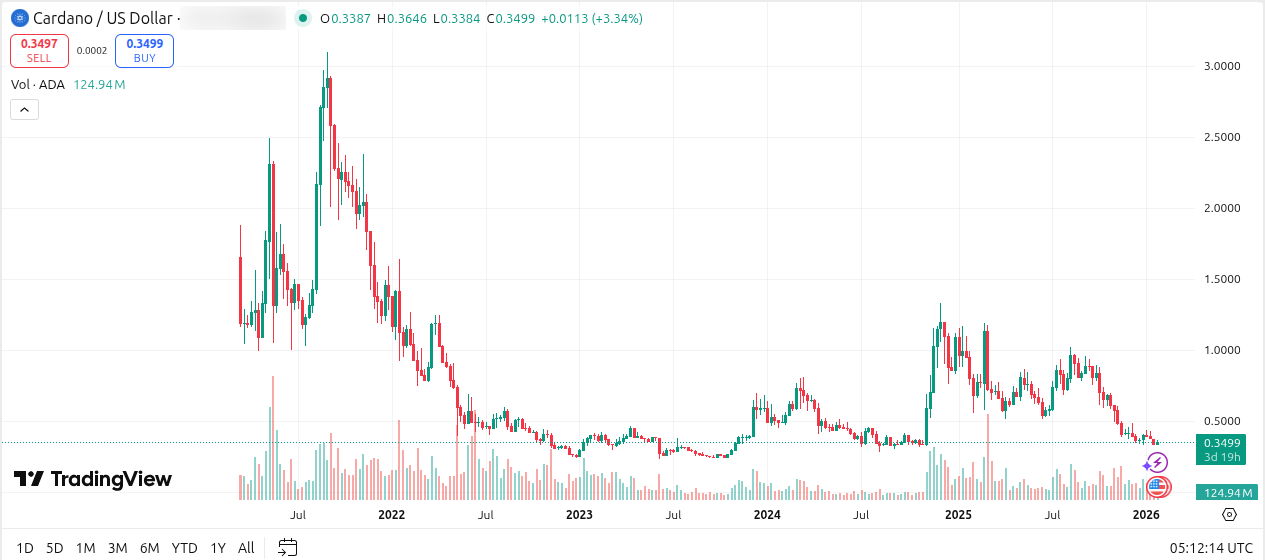
Source: TradingView
Scenario Definition and Forecast Summary Table
This article aggregates ADA forecasts from third‑party platforms; it does not reflect OSL research, internal targets, or guidance on the price of Cardano.
Each forecast typically uses a mix of technical indicators, sentiment assumptions, macro views and, in some cases, simple AI or extrapolation models rather than detailed fundamental valuation of Cardano’s network.
Long‑term prices for 2030 and especially 2040 are extremely uncertain, so the following table should be read as a scenario map, not as a set of actionable targets or promises.
Summary of ADA Price Predictions from Selected Sources
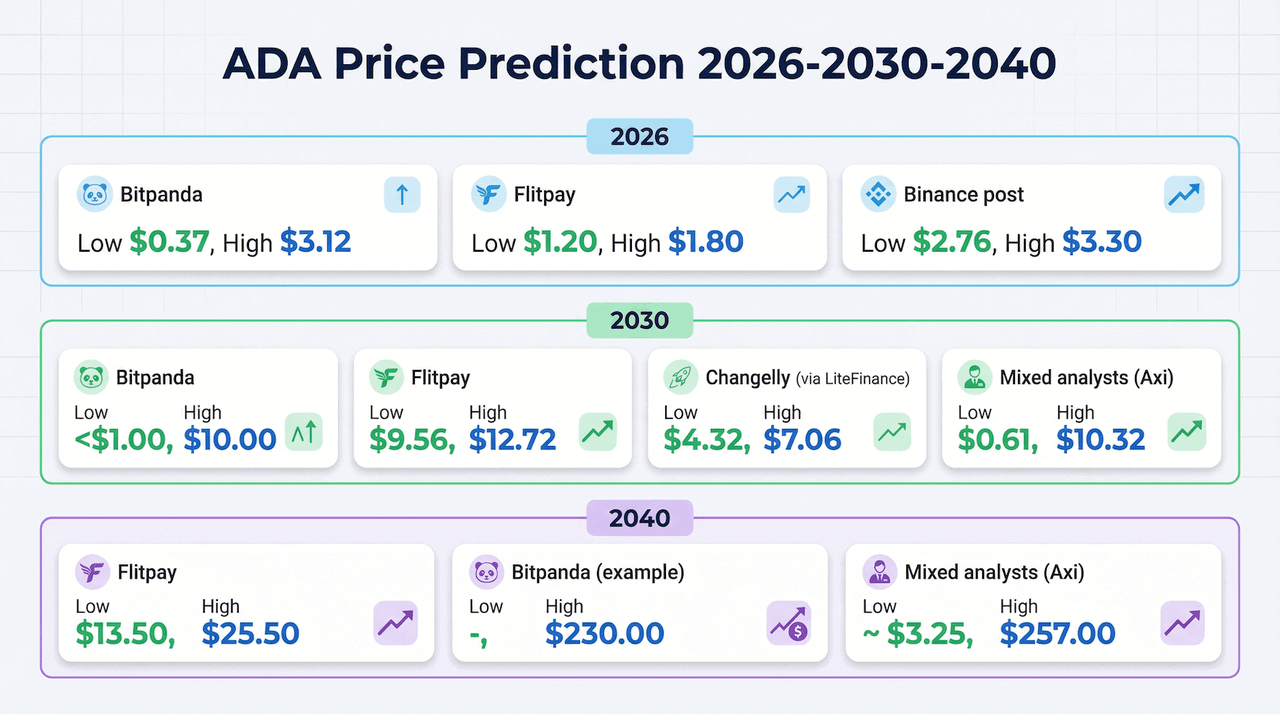
These values are indicative and simplified; each provider may define “low” and “high” differently (minimums, averages, or end‑of‑year points).
ADA Price Outlook for 2026
Across mainstream forecast providers, ADA’s 2026 outlook ranges from modest appreciation to a potential retest of multi‑dollar territory, depending largely on market cycles and Cardano’s on‑chain traction.
Bitpanda’s scenario analysis places 2026 between about 0.37 USD and 3.12 USD, with conservative cases near current levels and bullish cases assuming renewed altcoin momentum.
Flitpay’s projection is more optimistic, suggesting a band of roughly 1.20–1.80 USD for 2026 with a 1.40 USD “average,” implying sustained recovery but not necessarily new all‑time highs for the minimum price of Cardano.
A Binance‑hosted community forecast goes further, suggesting 2.76–3.30 USD with a ~3.03 USD mean, which would bring the price of Cardano closer to its 2021 peak if risk appetite and liquidity improve.
Key assumptions for 2026 include:
Broader crypto market environment (Bitcoin cycle, risk‑on sentiment, interest‑rate conditions).
Delivery of Cardano upgrades and rollups that could improve scalability and developer experience.
Growth (or stagnation) in DeFi, NFTs and real‑world use cases on Cardano relative to competing chains.
If macro conditions remain tight or adoption disappoints, the lower end of these ranges or below is possible; if liquidity and activity surge, upper bands become more plausible for Cardano's price history.
ADA Price Outlook for 2030
Forecast dispersion increases significantly by 2030, reflecting compounding uncertainty over multiple market cycles.
Bitpanda notes that conservative estimates keep ADA below 1 USD in 2030, while optimistic scenarios extend as high as around 10 USD, tied to the platform’s user base and app ecosystem.
Flitpay’s 2030 view is clearly bullish, with a range of about 9.56–12.72 USD and a 10.37 USD “average,” assuming Cardano secures a strong position in DeFi and broader Web3 infrastructure.
LiteFinance cites Changelly’s range of roughly 4.32–7.06 USD for 2030, suggesting steady, but not euphoric, long‑term growth under a constructive market regime.
Axi aggregates multiple analyst sources, with projections spanning around 0.61 USD at the cautious end up to roughly 10.32 USD in the most optimistic forecast, underlining how assumptions about regulation, adoption and competition can radically change outcomes.
Important drivers toward 2030 include the maximum price expectations for ADA coin:
Size of the on‑chain economy (total value locked, active addresses, transaction volumes).
Regulatory clarity around proof‑of‑stake tokens in major markets such as the US, EU and Asia.
Interoperability and real‑world integrations (enterprise, identity, stablecoins, tokenized assets).
None of these 2030 figures should be viewed as targets; they illustrate how different models map scenarios from stagnation to strong multi‑cycle growth.
ADA Price Outlook for 2040
By 2040, most projections are best seen as thought experiments rather than precise forecasts.
Flitpay’s long‑horizon estimate suggests a band of about 13.5–25.5 USD for 2040, with an “average” near 18.9 USD, tied to Cardano’s ability to sustain innovation and respond to regulatory changes.
Bitpanda cites at least one external forecast implying ADA could reach up to around 230 USD by 2040, but explicitly notes this would require exceptional adoption and persistent long‑term strength in the crypto market.
Axi’s survey of other providers shows mid‑single‑digit to low‑double‑digit numbers from some platforms, while one source even suggests a 237–257 USD band, underscoring how speculative these long‑range numbers are.
For such distant horizons, structural themes matter more than any single price point, including the price forecast for Cardano.
The role of public blockchains in global finance and identity infrastructure.
Whether Cardano can maintain technological relevance over multiple innovation cycles.
Long‑term regulatory and macroeconomic landscapes, which are impossible to predict with precision.
Readers should treat 2040 scenarios strictly as illustrations of possible paths rather than as any form of guidance or expectation.
ADA Metrics to Watch Checklist
To judge whether ADA is tracking closer to conservative, base or bullish scenario bands, observers often monitor:
Network usage: Daily active addresses, transaction counts, fees paid, and on‑chain volume related to the Cardano network.
DeFi and liquidity: Total value locked in Cardano DeFi protocols, depth on major DEXs and CEXs, stablecoin activity.
Developer activity: Number of projects building on Cardano, GitHub commits, mainnet upgrades and feature rollouts.
Ecosystem integrations: Listings on major regulated platforms, institutional products, and real‑world partnerships.
Regulatory developments: Clarity around staking, token classifications and reporting requirements in key jurisdictions.
Market structure: Spot and derivatives liquidity, open interest, volatility regimes and correlation with broader crypto indices.
Tracking these variables over time can help contextualize how realistic any given forecast band might be relative to actual network performance and the price movement of Cardano.
FAQs on ADA Price Predictions for 2026, 2030 and 2040
Q1. What factors will influence ADA’s price between 2026 and 2040?
Several variables could shape ADA’s long‑term price path, including overall crypto‑market cycles, macroeconomic conditions, and Bitcoin’s halving‑driven liquidity waves that often spill into major altcoins. Technological progress on Cardano (such as Hydra scaling, governance upgrades, and real‑world applications) and regulatory clarity in major regions like the EU, US, and Asia will also be important for the future price of ADA.
Q2. Can Cardano (ADA) reach a new all‑time high by 2030?
Some third‑party forecasts suggest ADA could revisit or exceed its previous all‑time high if adoption, DeFi TVL, and institutional interest grow steadily across the decade. However, other models remain more conservative and keep 2030 targets below past peaks, highlighting uncertainty around competition, regulation, and the average price of ADA. These projections are opinions only and should not be treated as financial advice.
Q3. How reliable are ADA price predictions for 2026, 2030, and 2040?
Most long‑term ADA forecasts rely on historical data, mathematical models, or AI‑driven curves, all of which are sensitive to assumptions about growth, volatility, and regulation. Even reputable analyses emphasize that predictions for 2030 and especially 2040 become increasingly speculative, with wide ranges between conservative and optimistic scenarios. None of these models can guarantee future performance, so they should be viewed as illustrative scenarios rather than precise targets.
Q4. Is ADA a suitable asset for long‑term holding?
Analyst commentary on Cardano highlights both potential strengths (energy‑efficient proof‑of‑stake, active development roadmap, and focus on governance and real‑world use cases) and risks (strong competition from other smart‑contract platforms, regulatory shifts, and market volatility). Whether ADA fits a long‑term strategy depends on each user’s objectives, risk tolerance, and time horizon; any decision regarding a Cardano price prediction should be made independently and not on the basis of forecasts alone.
Q5. Could ADA really trade above $100 or even near $200 by 2040?
A few aggressive AI‑style or long‑horizon models project ADA reaching ranges in the high double‑digits or even around $200–$250 by 2040, but these scenarios assume very strong adoption, favorable regulation, and major expansion of the entire digital‑asset market. Other sources keep 2040 expectations in the single‑ or low‑double‑digit‑dollar range, underscoring that such distant projections are highly uncertain and should not be interpreted as investment guidance.
Start your safe cryptocurrency journey now
OSL | Secure Ramps. Trusted Rails !
More topics
More topics
Latest
Why India's $620B Bond Pilot Changed Nothing Legal
SEBI and the RBI's Demat 2.0 pilot issues corporate bonds as digital tokens and settles them with the wholesale digital rupee, preserving existing legal terms while digitizing the infrastructure beneath a $620...
Why India's $620B Bond Pilot Changed Nothing Legal
Why S&P Global Leads Kaiko: Not Hype, But 24/7 Market Infrastructure
S&P Global led a $110 million extension of Kaiko's Series B to build data infrastructure for round-the-clock tokenized markets.
Why S&P Global Leads Kaiko: Not Hype, But 24/7 Market Infrastructure
When One Firm Holds 5% of Ethereum: Infrastructure Stress Test
Bitmine's accumulation of more than 5 million staked ETH raises questions about whether custody, audit, and validator infrastructure can support single-asset concentration at public-company scale.
When One Firm Holds 5% of Ethereum: Infrastructure Stress Test
Best Enterprise Stablecoin Payment Providers: A 2026 Evaluation Framework
Compare enterprise stablecoin payment providers by use case, legal entity, workflow, controls, integration, reconciliation, support, and contract terms.
Best Enterprise Stablecoin Payment Providers: A 2026 Evaluation Framework
How to Reconcile a USDGO Payment: An Illustrative Finance-Close Example
See how Finance can trace a USDGO payment from an approved obligation through payment records, recipient confirmation, reconciliation, and accounting close.
How to Reconcile a USDGO Payment: An Illustrative Finance-Close Example
A USDGO Reserve Review in Practice: Findings, Limits and Follow-up Questions
Review what the July 2026 USDGO reserve attestation establishes, what it does not prove, and which issuer, redemption, and liquidity questions remain.
A USDGO Reserve Review in Practice: Findings, Limits and Follow-up Questions
Recommended for you
More topics
More topics
