OSL Global : One-click to Buy Crypto with Card

On the OSL platform, users can securely and compliantly purchase cryptocurrencies (such as BTC, ETH, etc.) directly using a Visa or Mastercard credit card.
The credit card crypto purchase feature offers three major advantages: instant settlement, a low barrier to entry, and the elimination of wait times associated with bank wire transfers. It is particularly ideal for investors looking to capitalize on sudden market movements and quickly build their positions.
Global Reach: Pay with your local currency from a selection of over 100+ fiat options.
Flexible Payment: We support Visa and Mastercard (Credit or Debit cards), as well as Apple Pay and Google Pay.
Zero Friction: No tedious forms to fill out; your account is automatically created upon your first order.
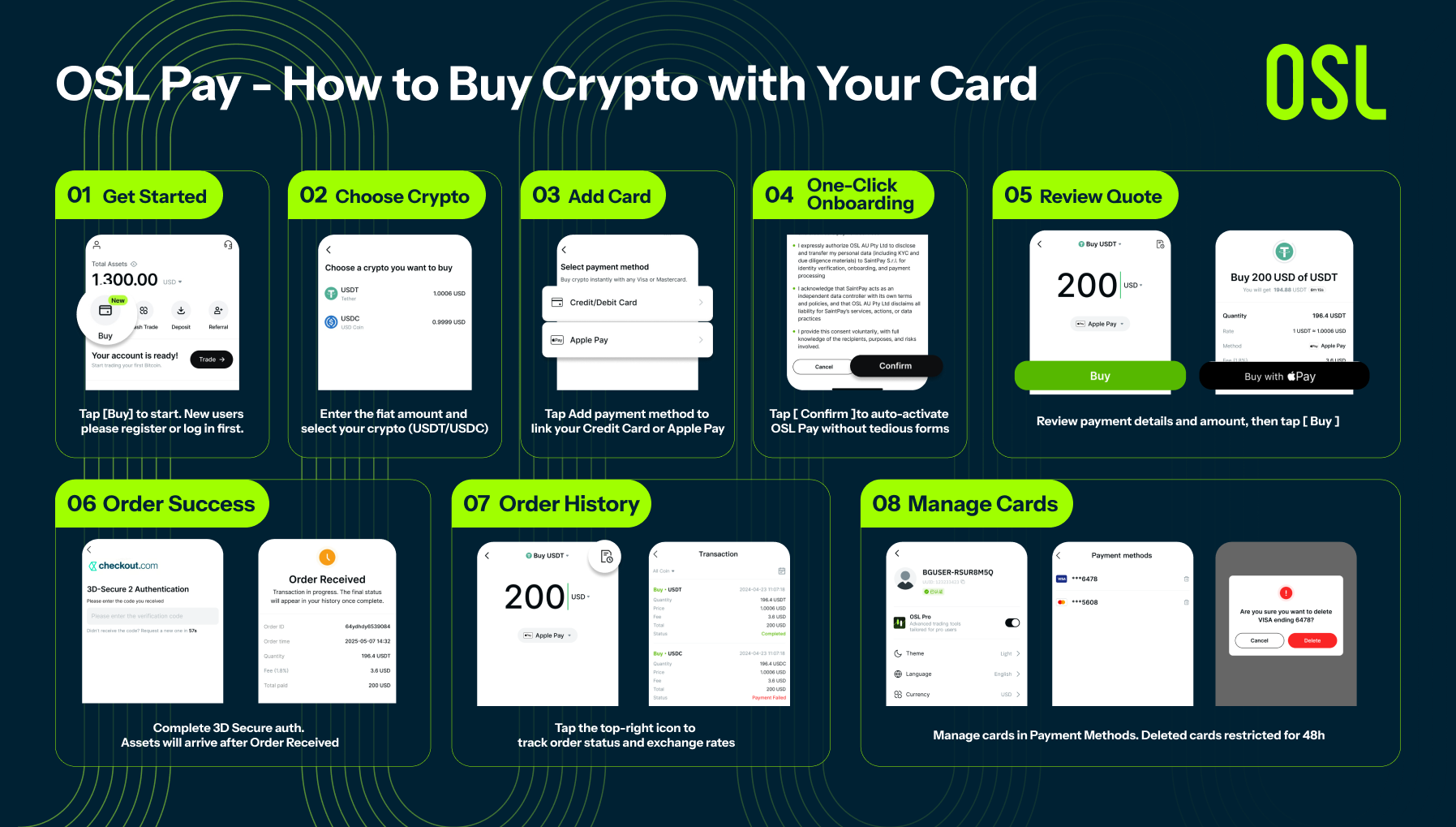
01 | Quick Access
Open the OSL App Home Page and click the [Buy] button to start. Users must be logged in to proceed.
02 | Select Currency & Amount
Enter the amount of fiat currency you wish to pay. With support for 100+ fiat currencies, you can pay in your preferred local currency. Then, select the crypto you want to buy (USDT or USDC).
03 | Choose Payment Method
For first-time use, select your payment method. You can link a Credit/Debit Card (Visa/Mastercard) or choose the faster Apple Pay or Google Pay options.
04 | Automatic Account Creation
Click [Confirm] on the authorization page. The system will automatically apply for an OSL Pay account for you—no need to fill out complex forms, enabling a true "one-click" experience.
05 | Confirm Quote
Review the transparent order preview, including the fiat amount, payment method, and estimated crypto to be received. The final amount received will match the displayed quote with no hidden fees. Click [Buy] to confirm.
06 | Security & Completion
Complete the 3D Secure verification (service provided by Checkout). When the screen shows Order Received, your order is successful and assets will be credited shortly.
07 | View History
Tap the icon in the top right corner of the Buy page to view order status and exchange rate details at any time.
08 | Manage Cards
Manage your linked cards in Payment Methods. Please note: once a card is deleted, it cannot be re-added for 48 hours. Proceed with caution.
(Note: This feature is currently supported only on OSL Global and is not available on OSL HK.)
More topics
More topics


Latest
Why India's $620B Bond Pilot Changed Nothing Legal
SEBI and the RBI's Demat 2.0 pilot issues corporate bonds as digital tokens and settles them with the wholesale digital rupee, preserving existing legal terms while digitizing the infrastructure beneath a $620...
Why India's $620B Bond Pilot Changed Nothing Legal
Why S&P Global Leads Kaiko: Not Hype, But 24/7 Market Infrastructure
S&P Global led a $110 million extension of Kaiko's Series B to build data infrastructure for round-the-clock tokenized markets.
Why S&P Global Leads Kaiko: Not Hype, But 24/7 Market Infrastructure
When One Firm Holds 5% of Ethereum: Infrastructure Stress Test
Bitmine's accumulation of more than 5 million staked ETH raises questions about whether custody, audit, and validator infrastructure can support single-asset concentration at public-company scale.
When One Firm Holds 5% of Ethereum: Infrastructure Stress Test
Best Enterprise Stablecoin Payment Providers: A 2026 Evaluation Framework
Compare enterprise stablecoin payment providers by use case, legal entity, workflow, controls, integration, reconciliation, support, and contract terms.
Best Enterprise Stablecoin Payment Providers: A 2026 Evaluation Framework
How to Reconcile a USDGO Payment: An Illustrative Finance-Close Example
See how Finance can trace a USDGO payment from an approved obligation through payment records, recipient confirmation, reconciliation, and accounting close.
How to Reconcile a USDGO Payment: An Illustrative Finance-Close Example
A USDGO Reserve Review in Practice: Findings, Limits and Follow-up Questions
Review what the July 2026 USDGO reserve attestation establishes, what it does not prove, and which issuer, redemption, and liquidity questions remain.
A USDGO Reserve Review in Practice: Findings, Limits and Follow-up Questions
Recommended for you
More topics
More topics
