The $2,400 Gravity Trap: Is Ethereum Losing Its "Value Moat"?
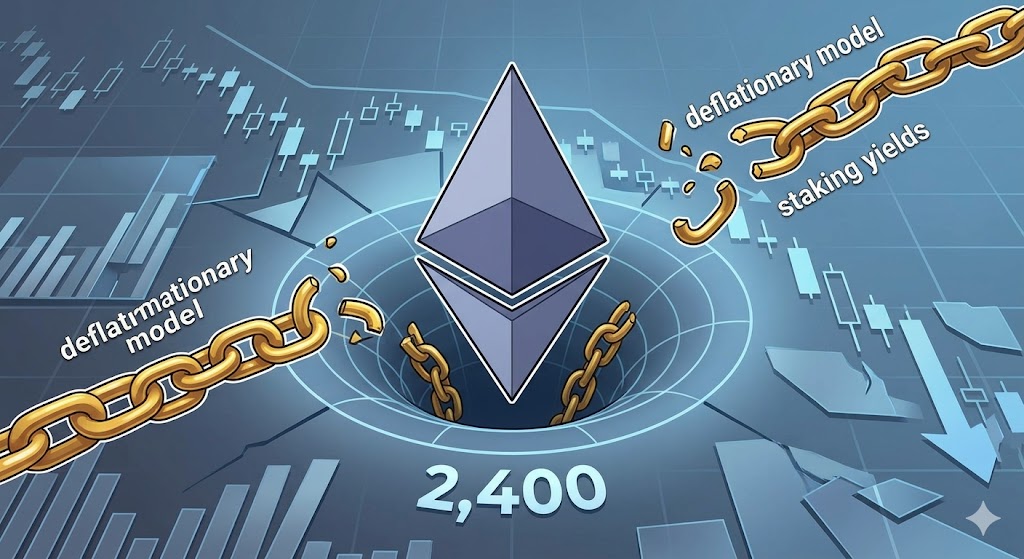
In the grand narrative of the cryptocurrency market, Ethereum (ETH) was once hailed as the eternal "World Computer." Its deflationary model and staking yields were once considered the gold standard for institutional entry. However, reality is turning cold—ETH's momentum has come to a screeching halt near the $2,400 mark. This is not merely a technical correction, but a collective re-evaluation of liquidity, productivity, and institutional trust.
Since the start of 2026, ETH has plummeted by 21%. Its growth has not only lagged behind the broader market but appears particularly sluggish against the backdrop of a mere 11% contraction in total crypto market capitalization. This divergence signals a dangerous trend: Ethereum is undergoing a crisis of "hollowing out."
Vanishing Productivity: DApp Revenue and Activity Halved
Data is the most authentic quantitative indicator of market sentiment. Over the past six months, trading volume on Decentralized Exchanges (DEXs) within the Ethereum ecosystem has shrunk by 53%, leading directly to a 49% plunge in related DApp revenue. The logical chain here is clear and brutal: the receding Memecoin craze and the decreasing frequency of token issuances have drained the on-chain activity that was once Ethereum's pride.
A deeper concern lies in the collapse of the "security premium." In April alone, the industry suffered $630 million in losses due to hacks, with KelpDAO and Drift Protocol accounting for over 80% of that figure. When the myth of invincibility is shattered, the migration of users toward safety becomes inevitable. In contrast, Solana and Hyperliquid, leveraging extremely low transaction friction, have already seized 42% of the market share in DApp revenue.
OSL Insight: This "outflow of activity" reflects the market's increasing pickiness regarding native on-chain environments. The OSL senior analysis team notes that retail investors currently prefer low-friction public chains, while institutions exhibit high sensitivity to security risks. In this fragmentation, pure on-chain native interaction struggles to support ETH's high valuation; the market desperately needs an exit that bridges "on-chain efficiency" with "compliant security."
The Scaling Paradox: Can Glamsterdam Save the Day?
The market holds high expectations for Ethereum's upcoming Glamsterdam hard fork, which is expected to triple base-layer capacity and enable parallel execution. However, this introduces a profound logical contradiction: if Layer-1 scaling reaches a certain threshold, what remains of the niche for high-cost Layer-2 Rollups?
A more practical issue is that the efficiency gains from network upgrades often translate to a reduction in total network fees in the short term. With staking yields lacking a catalyst, investors find it difficult to identify a financial driver to push the ETH price back toward $2,800.
Institutional Dilemma: The $1.4 Billion Floating Loss Shadow
Confidence among institutional investors is currently in a "deep freeze." The situation of Bitmine (BMNR US), the public company with the largest Ethereum holdings, is most representative. Under the aggressive strategy of Chairman Tom Lee, the company’s ETH reserves—built at a cost of $12.2 billion—have now shrunk to $10.8 billion.
While this $1.4 billion floating loss has not yet triggered forced liquidations, it hangs like a Sword of Damocles over the heads of all spectating institutional investors.
When an asset consistently underperforms the overall crypto market, Traditional Finance (TradFi) naturally shifts its allocation preference toward Bitcoin or more explosive tokens.
Conclusion: Seeking "Certainty" at the Cycle Bottom
Ethereum is enduring the most difficult transition pains in its history. The drain of on-chain activity and the waning of institutional interest have collectively constructed a formidable ceiling at $2,400. From another perspective, however, this is exactly the moment for the market to "separate the wheat from the chaff."
In this complex macro environment, "streaking" blindly in the decentralized world or seeking volatility on platforms lacking regulatory safeguards carries risks that far outweigh the rewards. As a global leader in compliant digital asset trading, OSL consistently emphasizes capturing the "compliance premium" amidst an uncertain market.
Chief Analyst's Suggestion: The current slump in ETH is not an end, but a restructuring of the holder base. For investors wishing to seize the lead in the next recovery, choosing the compliant custody and professional trading services provided by OSL is not just about avoiding security black holes like KelpDAO—it is about securing the purest and safest positions when institutions re-enter the fray.
Market reversals often occur at the moments of deepest frustration. Now is the time to arrange your compliant crypto asset allocation through OSL, locking out risk and keeping opportunity in hand.
立即展開安全的加密貨幣之旅
OSL | 出入金從未如此安心!
更多主題
更多主題
最新發佈
Why India's $620B Bond Pilot Changed Nothing Legal
SEBI and the RBI's Demat 2.0 pilot issues corporate bonds as digital tokens and settles them with the wholesale digital rupee, preserving existing legal terms while digitizing the infrastructure beneath a $620...
Why India's $620B Bond Pilot Changed Nothing Legal
Why S&P Global Leads Kaiko: Not Hype, But 24/7 Market Infrastructure
S&P Global led a $110 million extension of Kaiko's Series B to build data infrastructure for round-the-clock tokenized markets.
Why S&P Global Leads Kaiko: Not Hype, But 24/7 Market Infrastructure
When One Firm Holds 5% of Ethereum: Infrastructure Stress Test
Bitmine's accumulation of more than 5 million staked ETH raises questions about whether custody, audit, and validator infrastructure can support single-asset concentration at public-company scale.
When One Firm Holds 5% of Ethereum: Infrastructure Stress Test
Best Enterprise Stablecoin Payment Providers: A 2026 Evaluation Framework
Compare enterprise stablecoin payment providers by use case, legal entity, workflow, controls, integration, reconciliation, support, and contract terms.
Best Enterprise Stablecoin Payment Providers: A 2026 Evaluation Framework
How to Reconcile a USDGO Payment: An Illustrative Finance-Close Example
See how Finance can trace a USDGO payment from an approved obligation through payment records, recipient confirmation, reconciliation, and accounting close.
How to Reconcile a USDGO Payment: An Illustrative Finance-Close Example
A USDGO Reserve Review in Practice: Findings, Limits and Follow-up Questions
Review what the July 2026 USDGO reserve attestation establishes, what it does not prove, and which issuer, redemption, and liquidity questions remain.
A USDGO Reserve Review in Practice: Findings, Limits and Follow-up Questions
為你精選
更多主題
更多主題
