Stablecoin Payments vs Traditional Banking Rails: A Practical Comparison for Enterprises

“Stablecoin payments vs traditional banking rails” is no longer a theoretical debate. For many finance teams, it has become a practical question about settlement speed, cost predictability, visibility, and controllability, especially for cross-border payments and multi-entity treasury operations. Traditional rails (correspondent banking, wires, and clearing systems) remain foundational, but they also reflect constraints such as cut-off times, operating hours, reconciliation complexity, and layered intermediary fees. Meanwhile, stablecoin-based settlement introduces a different operating model, often nearer to T+0 value transfer, but requires mature governance around custody, compliance, and operational controls.
In this article, we provide a neutral, enterprise-focused comparison to help CFOs, treasury teams, and compliance leaders decide where stablecoin settlement can complement banking rails, and where banking rails still dominate.
Traditional Banking Payment Rails
Traditional banking rails include domestic high-value systems (e.g., RTGS), cross-border correspondent banking (often via SWIFT messaging), and specialized clearing networks. They are proven, regulated, and deeply integrated into enterprise finance. However, they can introduce friction that becomes more visible at global scale.
Settlement Cycles and Delays
T+1/T+2 timelines
In capital markets, “T+1/T+2” refers to securities settlement cycles (trade date plus one or two business days). While this is not the same as payment settlement, it illustrates how system design, risk controls, and operational windows can shape when funds are truly final. The U.S. moved most securities transactions to T+1 on May 28, 2024, explicitly to reduce risk and improve market efficiency.
In payments, settlement timing depends on the rail:
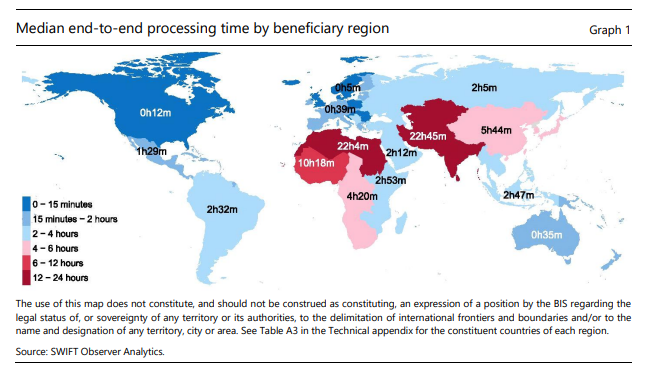
Fedwire Funds Service is a real-time gross settlement system, but it operates on business days with defined hours (not 24/7). The US Federal Reserve notes the business day runs from 9:00 p.m. ET to 7:00 p.m. ET, Monday–Friday, excluding holidays, with a customer transfer deadline near the end of day.For cross-border correspondent flows, the speed depends on intermediary banks, time zones, compliance checks, and local banking hours, even when messaging is modernized. The FSB’s G20 cross-border KPI reporting shows performance is improving but still uneven, and targets remain challenging to hit.
Impact on working capital
When settlement is constrained by cut-off times, business-day calendars, and intermediary routing, finance teams may face:
higher buffer balances to avoid payment failures,
timing mismatches between receivables and payables, and
less flexible liquidity management across entities and time zones.
Even modest delays can compound at scale, especially for high-frequency supplier payments, marketplace payouts, or multi-currency treasury rebalancing.
Costs and Fees
Wire fees
Bank wires can be reliable, but the total cost is rarely just the stated wire fee. Enterprises often encounter:
intermediary bank fees (including lifting fees),
repair fees for payment exceptions,
recall/trace charges, and
operational overhead for investigations and reconciliations.
Because pricing is corridor, bank, and relationship-dependent, “one number” is hard to state credibly without a specific bank schedule. The more important enterprise reality is cost variability, fees may be predictable domestically but less transparent cross-border.
FX conversion costs
For cross-border flows, FX spreads and execution timing can be meaningful, especially when settlement windows are tight. For example, tightening settlement cycles in one market can force accelerated FX conversion and increase operational pressure on global managers, highlighting how payment timing constraints ripple into treasury and funding decisions.
Transparency Limitations
Reconciliation challenges
Traditional rails often distribute the “truth” of a payment across multiple systems:
bank statements (end-of-day or intraday),
SWIFT messages,
intermediary confirmations,
ERP/TMS records,
and counterparty acknowledgements.
That fragmentation can slow exception handling, especially when a payment is delayed or requires a trace.
Limited real-time visibility
Visibility has improved. For example, SWIFT GPI is designed to provide end-to-end traceability via a tracker, improving status transparency across the chain. But transparency is not the same as real-time settlement. Many cross-border payments still depend on banking hours, compliance holds, and local clearing availability.
Advantages of Stablecoin Payments
Stablecoin settlement changes the operating model: value can move on-chain with near-real-time finality depending on network and implementation, potentially reducing dependence on multi-bank corridors and time-zone alignment. That said, stablecoin rails must be wrapped in enterprise controls to be usable by CFOs and compliance teams. The Bank for International Settlements (BIS) notes stablecoins can support better payments in some contexts but also introduce risks that require robust regulatory and supervisory frameworks.
Faster Settlements
Real-time or same-day liquidity
One of the clearest differences in “stablecoin payments vs traditional banking rails” is the potential for T+0 or near-instant settlement, which can reduce reliance on cut-offs and weekends for certain flows.
For enterprises, faster settlement can translate into:
lower prefunding needs across regions,
improved supplier experience (fewer “where is my payment?” escalations),
reduced payment failure rates due to timing windows, and
tighter cash forecasting and liquidity management.
Cost Efficiency
Reduced transaction and capital costs
Stablecoin-based settlement can reduce some categories of overhead, for example, intermediary routing fees, repeated traces, and certain operational expenses.
One of the primary concerns for CFOs is often capital efficiency: if settlement is quicker and more predictable, working capital buffers can potentially be optimized, subject to risk appetite and control maturity.
Importantly, “cost efficiency” should be assessed in total cost of ownership:
custody and controls,
compliance operations,
treasury integration work,
reporting and assurance,
and vendor SLAs.
Operational Transparency
Real-time tracking and reporting
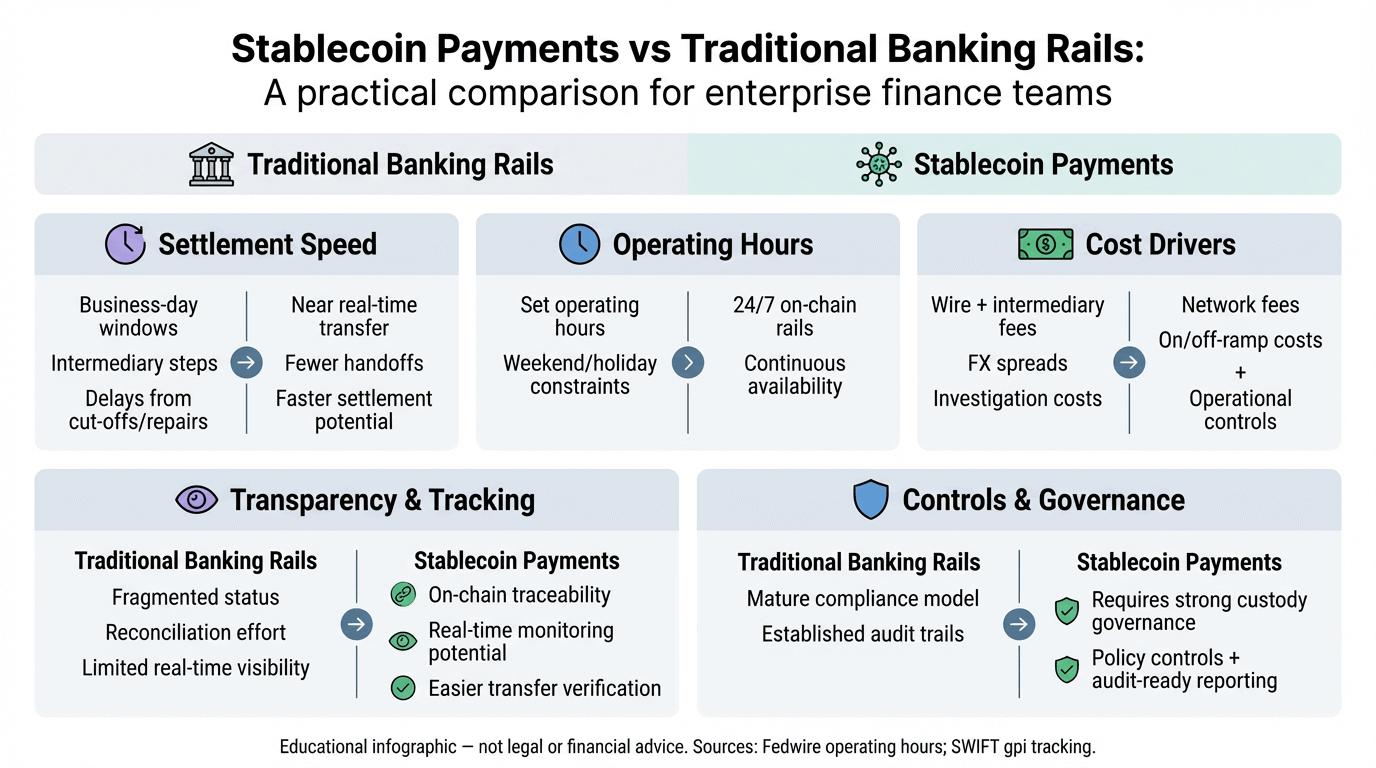
On-chain settlement can support more direct tracking of transfers and statuses than traditional fragmented messaging. However, enterprises still need “reporting that accountants can use”, audit trails, reconciliation formats, and ERP-ready outputs.
A practical standard for enterprise adoption is: real-time visibility + auditable reporting + controllable permissions, not just a blockchain explorer link.
Considerations for Enterprise Adoption
Stablecoin payments are not “plug and play” for most enterprises. Adoption typically succeeds when the operating model is treated as a regulated payments program, not an experiment.
Compliance and Risk Management
Regulatory adherence
Enterprises must align with applicable regimes across jurisdictions such as AML/CFT, sanctions, reporting, and licensing requirements for intermediaries. FATF standards for virtual assets and VASPs reinforce the direction of travel: risk-based supervision and controls should be comparable to traditional finance expectations.
Custody and safeguard standards
Custody architecture and safeguarding standards determine whether stablecoin settlement is acceptable for corporate funds. A finance team should be able to answer:
Where is value held before and after settlement?
Are assets segregated?
What are the failure and recovery procedures?
What assurance (attestations/audits) supports the model?
The BIS and other public-sector bodies repeatedly emphasize that stablecoin benefits depend on integrity, oversight, and robust safeguards.
Technology Integration
Compatibility with treasury systems
Stablecoin settlement must connect to:
treasury management systems (TMS),
ERP accounting workflows,
payment approval hierarchies,
reconciliation and audit processes.
The risk is not that the rail “doesn’t work,” but that it creates a parallel finance stack that breaks governance. Successful implementations treat integration as a core workstream—not an afterthought.
Cross-Border Potential
Global scalability
Cross-border payments are a major policy focus precisely because improvements have been modest and uneven across corridors. The BIS and FSB continue to track this space through the G20 Roadmap, including speed, cost, transparency, and access targets. Stablecoin settlement can be attractive where enterprises need:
24/7 operations across time zones,
rapid global payouts,
multi-entity liquidity movement,
predictable settlement for trade flows.
But scalability requires multi-jurisdiction compliance and strong counterparties—especially when stablecoin settlement touches fiat banking endpoints.
Making Informed Decisions
Stablecoin payments vs traditional banking rails
In practice, many enterprises do not choose one rail exclusively. Instead, they build a policy-driven approach:
Use traditional rails where they are efficient, compliant, and operationally integrated.
Use stablecoin settlement where it improves speed, predictability, and transparency—without weakening controls.
Factors to Evaluate Payment Providers
When selecting a stablecoin payments partner, enterprise teams should evaluate the same categories they apply to banks and PSPs—plus digital asset-specific safeguards.
Security and compliance
Licensing and regulatory perimeter in relevant jurisdictions
AML/CFT controls and sanctions screening integration
Segregation, custody design, and operational safeguards
SLA and reliability
Availability, incident response, and business continuity
Cut-off dependencies (fiat on/off ramps still have banking-hour constraints)
Operational escalation processes for exceptions
Audit and reporting capabilities
Audit-ready transaction records and reconciliation outputs
Reporting that supports accounting close
Evidence pack availability for internal/external auditors
Where USDGO fits in an enterprise evaluation
In enterprise evaluations, it is important to distinguish between stablecoin issuance and the infrastructure that governs how value is moved, reconciled, and controlled.
USDGO operates as a regulated liquidity and settlement layer designed to support enterprise use of USD-denominated stablecoins and fiat in cross-border payments and treasury operations. Rather than functioning as a standalone crypto workflow, it connects banking rails, custody arrangements, and on-chain settlement within a structured operational framework.
For enterprises assessing stablecoin payment providers, infrastructure of this kind is evaluated not only on settlement speed, but on licensing alignment, custody architecture, auditability, and integration with existing treasury controls. The objective is to embed stablecoin settlement within institutional governance standards, rather than operate it as an isolated digital asset process.
FAQ
What are the main advantages of stablecoin payments?
Advantages are faster settlement, potential cost predictability (fewer intermediary layers), and improved operational transparency—especially for cross-border flows. The realized benefit depends on custody, compliance and quality.
Which enterprises are best suited?
Stablecoin settlement is often best suited to enterprises with:
meaningful cross-border payables/receivables,
multi-region treasury operations,
high-frequency payouts (e.g., multiple supplier ecosystems that value fast settlement and transparency.
Fit should be assessed through a risk framework, not just a cost comparison.
How do they integrate with treasury systems?
Integration typically involves:
payment initiation and approvals (role-based controls),
wallet/custody governance,
reconciliation into ERP/TMS (bank + on-chain records),
reporting for audit and compliance,
operational monitoring and exception handling.
The target state is a single controlled treasury workflow, not an “extra” payment system outside governance.
Start your safe cryptocurrency journey now
OSL | Secure Ramps. Trusted Rails !
More About Topics
More About Topics
Latest
60-Vote Hurdle for CLARITY Act Exposes Limits of Legislative Hope
The CLARITY Act's September 15 procedural vote exposes why implemented regulatory frameworks may offer institutions more operational certainty than pending U.S. legislation.
60-Vote Hurdle for CLARITY Act Exposes Limits of Legislative Hope
XRP Rebounds 30% Then Slips: DeFi Infrastructure Faces Volatility Exam
XRP Ledger's $1.1 billion stablecoin expansion and new lending protocol foundation face an immediate stress test as XRP price swings 30% monthly.
XRP Rebounds 30% Then Slips: DeFi Infrastructure Faces Volatility Exam
$0.325 SKY Forecast: Valuation Model or Institutional Wish?
Standard Chartered's $0.325 price target on Sky's governance token applies bank-style valuation to on-chain credit infrastructure, but the forecast depends on USDS adoption and borrowing expansion that remains nascent.
$0.325 SKY Forecast: Valuation Model or Institutional Wish?
SEC Custody Rewrite Hits White House, Jurisdictional Gap Widens
The SEC's proposed crypto custody rewrite entered White House review on August 25, 2026, leaving U.S. institutional frameworks unresolved while banks and custodians position services under divergent national rule stacks.
SEC Custody Rewrite Hits White House, Jurisdictional Gap Widens
India's $100M Bond Tokenization: A Rights Structure Stress Test
SEBI's Demat 2.0 pilot issued over $100 million in tokenized bonds using digital rupee settlement, but its phased rollout from institutional pilots to secondary trading and retail access tests whether off-chain...
India's $100M Bond Tokenization: A Rights Structure Stress Test
Recommended For You
More About Topics
More About Topics