Meta Stablecoin Payments 2026: What WhatsApp and Instagram Could Change
According to sources, Meta has issued a Request for Proposal (RFP) to third-party companies to assist in managing stablecoin-based payments.
Stripe, which acquired the stablecoin company Bridge last year, was mentioned by sources as a potential candidate for Meta's stablecoin pilot.
Meta previously attempted to launch the Libra stablecoin in 2019, which was later rebranded as Diem; however, it was ultimately forced to shut down operations due to regulatory scrutiny.
According to recent reports, tech giant Meta plans to re-enter the stablecoin market in the second half of 2026, integrating third-party stablecoin payments across WhatsApp, Instagram, and Facebook. After the setbacks of the Libra and Diem projects, how will Meta overcome regulatory hurdles this time?
2026 update: what readers should check first
This refresh turns the article into a practical stablecoin decision guide. Readers should verify reserve quality, redemption access, jurisdiction, liquidity, fees, and compliance fit before choosing a token, exchange, or payment route.
Question | What to check | Why it matters |
|---|---|---|
Reserve and issuer | Issuer disclosures, reserve composition, attestations, and redemption terms. | Weak transparency can raise depeg or liquidity risk. |
Liquidity and network | Supported chains, spreads, withdrawal costs, and settlement time. | A stablecoin is only useful if it can move and redeem efficiently. |
Compliance fit | Jurisdiction, KYC, account records, and counterparty requirements. | Business payments and fiat exits depend on auditability. |
User action | Use regulated platforms, keep transaction records, and test small transfers first. | Operational mistakes are often more costly than headline fees. |
Related reading: USDT and USDC comparison | Stablecoin payments vs banking rails | Fiat-to-crypto on-ramp guide.
FAQ: stablecoin safety and use cases
Is the stablecoin fully backed, and where can users verify the reserve information?
Which network should users choose for lower fees and fewer operational mistakes?
Can the stablecoin be redeemed or converted to fiat through a regulated route?
What records should businesses keep for compliance and reconciliation?
On February 24, CoinDesk reported, citing people familiar with the matter, that Mark Zuckerberg's tech conglomerate Meta plans to re-enter the stablecoin space in the second half of this year. Departing from its previous aggressive strategy of "issuing its own token," Meta is now opting to integrate third-party providers to support the stablecoin payment needs of its vast social empire.
Meta spokesperson Andy Stone subsequently responded on social media: "Business as usual. There is still no Meta stablecoin. The focus of the plan... is to allow individuals and businesses to make payments on Meta's platforms using their preferred payment methods." This "cautious strategic shift" marks a major milestone in the mainstream adoption of Web3 payments.
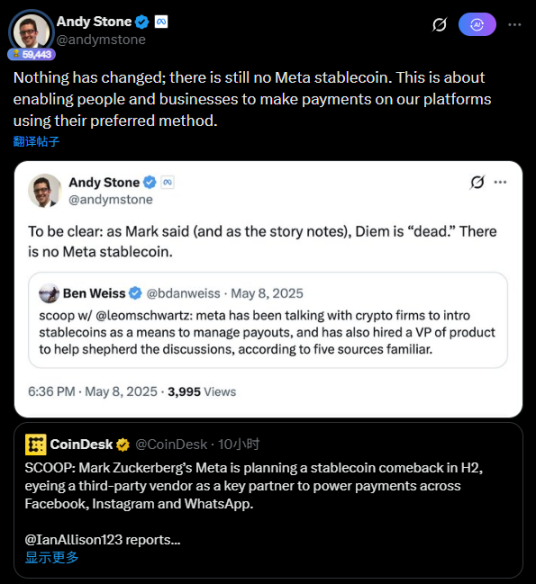
Abandoning "Token Issuance" for "Integration"
Compared to the grand vision of creating a global digital currency during the Libra era in 2019, the Meta of 2026 appears much more pragmatic and steady.
According to leaked Request for Proposals (RFPs), Meta is no longer seeking to build its own cryptocurrency network. Instead, it relies on mature, third-party stablecoin operators to embed digital dollar payments. This decision significantly reduces the compliance burden and potential operational risks.
Partnerships: It is reported that Meta's long-term partner, Stripe, is the leading candidate for this pilot. Stripe CEO Patrick Collison not only holds a seat on Meta's board of directors, but his company also acquired the stablecoin platform Bridge in October 2024 and the crypto wallet Privy in June 2025, completing its comprehensive stablecoin payment infrastructure.
Comprehensive Integration: This new payment wallet is expected to be rolled out to all Facebook, Instagram, and WhatsApp users, offering dollar-pegged token payment capabilities. This means that Meta's over 3 billion monthly active users will soon be able to enjoy low-cost, instant cross-border settlement services.
The Social Payment War and AI Strategy
In terms of market competition, Web3 social payment has become a highly contested battleground. Elon Musk's social platform, X, is continuously advancing the built-in payment plans for its "everything app," while Telegram has already seized the initiative in the crypto payment space through its TON ecosystem.
For Meta, returning to the stablecoin market is not merely about reducing traditional bank transaction fees or vying for leadership in social e-commerce; it is also about paving the way for its AI strategy. Given Meta's aggressive investment in its Llama series of large models, seamless and instant stablecoin payments will serve as an indispensable financial foundation for its AI Agent ecosystem.
If this initiative succeeds, stablecoins will evolve beyond being mere crypto tools—they will become essential social media infrastructure.
OSL Analyst Insights: The global stablecoin market has currently entered a mature stage of development. As of February 2026, the total market capitalization of global stablecoins has surpassed the $3 trillion mark. US dollar-pegged stablecoins (primarily USDT and USDC) account for over 99% of the market share, establishing absolute dominance. Furthermore, stablecoin payments have been successfully implemented across various sectors, including:
Cross-border payments: Improving efficiency and reducing costs
Overseas remittances: Shortening transaction delivery times
E-commerce payments
Supply chain settlements
Payment supplementation: Serving financially underserved/underbanked regions
Meta's strategic pivot sends a clear market signal: stablecoins are set to become a vital supplementary layer within the global payment system, poised to play an increasingly significant role, particularly in cross-border transactions and the broader digital economy.
📌 Further Reading:
👉Stablecoin Payment: The Future of Payments?
👉OSL StableHub Grand Launch: Multi-Stablecoin and USD Seamless 1:1 Exchange & Rewards Hub
👉What Is a Compliant Crypto Exchange?
Start your safe cryptocurrency journey now
OSL | Secure Ramps. Trusted Rails !
More About Topics
More About Topics
Latest
60-Vote Hurdle for CLARITY Act Exposes Limits of Legislative Hope
The CLARITY Act's September 15 procedural vote exposes why implemented regulatory frameworks may offer institutions more operational certainty than pending U.S. legislation.
60-Vote Hurdle for CLARITY Act Exposes Limits of Legislative Hope
XRP Rebounds 30% Then Slips: DeFi Infrastructure Faces Volatility Exam
XRP Ledger's $1.1 billion stablecoin expansion and new lending protocol foundation face an immediate stress test as XRP price swings 30% monthly.
XRP Rebounds 30% Then Slips: DeFi Infrastructure Faces Volatility Exam
$0.325 SKY Forecast: Valuation Model or Institutional Wish?
Standard Chartered's $0.325 price target on Sky's governance token applies bank-style valuation to on-chain credit infrastructure, but the forecast depends on USDS adoption and borrowing expansion that remains nascent.
$0.325 SKY Forecast: Valuation Model or Institutional Wish?
SEC Custody Rewrite Hits White House, Jurisdictional Gap Widens
The SEC's proposed crypto custody rewrite entered White House review on August 25, 2026, leaving U.S. institutional frameworks unresolved while banks and custodians position services under divergent national rule stacks.
SEC Custody Rewrite Hits White House, Jurisdictional Gap Widens
India's $100M Bond Tokenization: A Rights Structure Stress Test
SEBI's Demat 2.0 pilot issued over $100 million in tokenized bonds using digital rupee settlement, but its phased rollout from institutional pilots to secondary trading and retail access tests whether off-chain...
India's $100M Bond Tokenization: A Rights Structure Stress Test
Recommended For You
More About Topics
More About Topics