USD1 Stablecoin Explained: How It Works, Key Risks, and Use Cases
USD1 is a USD‑denominated stablecoin intended to maintain a 1:1 peg with the US dollar, functioning as a digital representation of cash that can move natively on-chain. It targets users who want to access crypto markets, DeFi, and cross‑border payments without being fully exposed to the volatility of assets like BTC or ETH.
2026 update: what readers should check first
This refresh turns the article into a practical stablecoin decision guide. Readers should verify reserve quality, redemption access, jurisdiction, liquidity, fees, and compliance fit before choosing a token, exchange, or payment route.
Question | What to check | Why it matters |
|---|---|---|
Reserve and issuer | Issuer disclosures, reserve composition, attestations, and redemption terms. | Weak transparency can raise depeg or liquidity risk. |
Liquidity and network | Supported chains, spreads, withdrawal costs, and settlement time. | A stablecoin is only useful if it can move and redeem efficiently. |
Compliance fit | Jurisdiction, KYC, account records, and counterparty requirements. | Business payments and fiat exits depend on auditability. |
User action | Use regulated platforms, keep transaction records, and test small transfers first. | Operational mistakes are often more costly than headline fees. |
Related reading: USDT and USDC comparison | Stablecoin payments vs banking rails | Fiat-to-crypto on-ramp guide.
FAQ: stablecoin safety and use cases
Is the stablecoin fully backed, and where can users verify the reserve information?
Which network should users choose for lower fees and fewer operational mistakes?
Can the stablecoin be redeemed or converted to fiat through a regulated route?
What records should businesses keep for compliance and reconciliation?
USD1 is issued by World Liberty Financial, a project associated in public discourse with members of the Trump family, which has amplified attention around the token’s launch, adoption, and governance. Since launch, USD1 has expanded across multiple networks and trading venues, becoming part of a broader conversation about politically linked stablecoins and their role in digital finance.
An official reference point for the token is WLFI’s own USD1 page, which provides a public description of the stablecoin’s purpose and positioning. External data aggregators such as CoinGecko and CoinMarketCap additionally track circulating supply, contract addresses, and market activity for USD1.
What Is USD1?
USD1 is a fiat-backed stablecoin designed to maintain price stability by pegging its value to the US dollar. Each token is intended to be backed by a corresponding value of USD-denominated reserves, allowing users to treat USD1 as a programmable digital dollar within the crypto ecosystem.
Like other major stablecoins, USD1 serves as:
A settlement asset for trading
A store of value during market volatility
A bridge between fiat currencies and blockchain-based applications
Its core value proposition lies in combining price stability with blockchain-native speed, transparency, and global accessibility.
How USD1 Works Under the Hood
Peg Mechanism and Reserves
USD1 is designed as a fiat‑backed stablecoin: in principle, every token in circulation should correspond to an equivalent unit of USD or high‑quality, liquid assets such as short‑duration US Treasuries held in reserve. Users or institutional partners can mint USD1 by depositing dollars (or accepted equivalents) with WLFI or its banking and custody partners, and can redeem by reversing the process.
This reserve‑backing model is meant to support price stability around 1 USD per token, with arbitrageurs incentivised to buy below par and redeem at par—or mint at par and sell above—whenever the market price deviates. Public communications around USD1 emphasise transparency and risk controls, with references to custodial arrangements and on‑chain monitoring tools similar to proof‑of‑reserves frameworks used across the stablecoin sector.
Minting, Redemption, and Flow of Funds
In a typical flow, a KYC’d user or institution wires USD (or uses a supported rail) to WLFI or an authorised partner and receives freshly minted USD1 on a supported chain. Conversely, they can send USD1 back to the issuer for redemption, at which point the tokens are burned and fiat is returned, subject to fees, cut‑off times, and minimum sizes.
These primary market operations interact with secondary‑market trading on exchanges and DeFi pools, where most users actually acquire USD1. When redemptions remain open and functioning, arbitrage between primary and secondary markets is a key stabilising force for the peg, particularly during stress episodes.
Networks and Smart Contract Design
USD1 has been deployed on multiple smart‑contract networks, including leading general‑purpose chains where most stablecoin liquidity sits. This multi‑chain strategy enables integration with a range of DeFi protocols, centralised exchanges, and payment applications that use USD1 as a base asset or settlement currency.
Smart contracts governing USD1 typically include upgradeable components and admin controls (for example, pausing transfers or freezing addresses) to support compliance and incident response. From an institutional perspective, these controls can be a double‑edged sword: they provide risk‑management hooks, but also consolidate power in the issuer’s hands, making governance and safeguards around key management central considerations.
USD1 Tokenomics and Ecosystem Incentives
Supply Structure and Allocation
USD1 sits within the broader World Liberty Financial ecosystem, where value capture and governance are anchored in the WLFI token. WLFI launched with a fixed initial supply of 100,000,000,000 (100 billion) tokens, with the current total supply slightly lower at around 99.95 billion WLFI due to burns or adjustments.
The initial 100 billion WLFI were allocated across four main buckets: 33.893% (33.893 billion) to Token Sale participants, 32.6% (32.6 billion) to Community Growth & Incentives, 30% (30 billion) to Co‑Founders, and 3.507% (3.507 billion) to Team and Advisors. This structure is designed to balance fundraising, long‑term ecosystem growth, and alignment of core contributors and strategic stakeholders.
Token Sale, Community Growth, and Governance
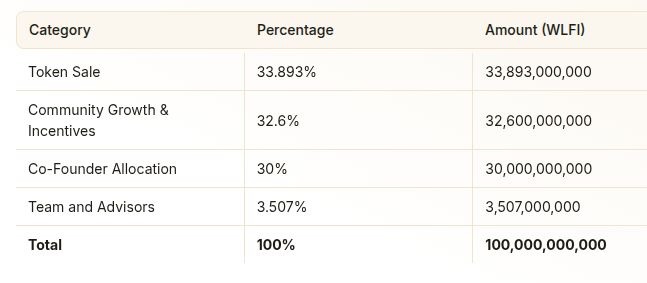
Source: worldlibertyfinancial.com
Within the 33.893% Token Sale allocation, 25 billion WLFI were sold in a public sale between October 14, 2024 and March 14, 2025 at prices of 0.015 and 0.05 USD per token, raising approximately 550 million USD. The remaining ~8.893 billion tokens were placed with strategic and institutional participants, reflecting an intent to bring in long‑term aligned capital alongside the broader community.
The 32.6% Community Growth & Incentives allocation finances ecosystem development, liquidity provision, partnerships, marketing, and treasury reserves for future protocol initiatives. As WLFI underpins governance of the WLF Protocol, this pool is central to expanding participation, sustaining USD1’s integrations, and funding the ongoing build‑out of the product suite.
Alignment of Founders, Team, and Risk Disclosure
Thirty percent of supply (30 billion WLFI) is reserved for co‑founders DT Marks, AMG, and WC Digital Fi, LLC, with tokens locked at launch and subject to an unlock schedule to be determined. A further 3.507% (3.507 billion WLFI) is allocated to team members, advisors, and service providers, also locked at launch and unlocking over time.
Lock‑ups for founders and contributors are intended to align incentives with the long‑term success of the WLF Protocol and, by extension, the health and adoption of USD1 as its flagship stablecoin. World Liberty Financial emphasises transparency around these figures, providing detailed supply, allocation, and risk‑disclosure documentation so that community members, exchanges, and institutional partners can independently assess WLFI and the ecosystem that supports USD1.
Key Use Cases and Features of USD1
Trading and Hedging
For active traders, USD1 functions as a base pair and settlement asset, allowing rapid movement between volatile tokens and a dollar‑linked instrument without leaving the crypto ecosystem. Because it is designed to maintain a stable price, USD1 can also be used as a short‑term hedge during risk‑off periods or ahead of major events, while keeping capital on‑chain.
On derivatives venues, USD1 may be accepted as margin or collateral, which can improve capital efficiency relative to posting volatile assets. That said, risk frameworks often apply haircuts or additional checks to newer or politically sensitive stablecoins, reflecting lessons from past depegs and liquidity shocks.
DeFi and Yield Generation
USD1 can be supplied to lending markets, used in automated market‑maker (AMM) pools, or deposited into structured yield products, generating returns that come from a mix of lending spreads, protocol incentives, and any yield on underlying reserves. These strategies layer smart‑contract, liquidity, and counterparty risk on top of issuer risk, which makes diversification and due diligence essential.
Payments, Remittances, and Commerce
USD1’s on‑chain nature allows near‑instant settlement of cross‑border transfers, potentially at lower cost than traditional correspondent‑bank networks. Businesses can use USD1 for B2B payments, supplier settlements, or payroll to contractors who prefer to receive a dollar‑linked asset rather than local currency.
Risk Profile: Lessons from the 2026 USD1 Depeg Incident
What Happened in February 2026?
In February 2026, USD1 briefly depegged from its 1 USD target following a period of intense scrutiny over an alleged “attack” and subsequent public communications from figures associated with WLFI. News coverage described an initial price drop, rapid social‑media speculation, and a partial recovery as team members and allied voices offered explanations and reassurances.
The episode highlighted how sensitive stablecoins can be to information shocks, especially when narratives involve hacks, governance disputes, or politically exposed persons. Even when the market price returns to par, such incidents can leave a lasting mark on institutional risk assessments and counterparties’ trust.
Technical, Governance, and Liquidity Risks
Analysts have debated the relative weight of potential technical issues, key‑management practices, and governance decisions in the USD1 incident. Regardless of the ultimate cause, it underscored that stablecoin risk is multi‑dimensional: smart‑contract vulnerabilities, operational lapses, and communication missteps can all manifest as peg pressure.
Liquidity structure also matters: when a large share of trading is concentrated on a small number of venues or pools, order‑book imbalances can accelerate price moves during stress. For institutions, these factors reinforce the need for position limits, collateral haircuts, and contingency plans specific to each stablecoin, including USD1.
Regulatory and Reputational Considerations
The political associations of USD1 have drawn additional regulatory and media attention, which can influence how supervisors and policymakers view the token. Discussions about stablecoin legislation, reserve standards, and systemic risk increasingly reference such high‑profile projects when considering new rules.
Reputation is another key dimension: even if a depeg is short‑lived, questions about governance, disclosure, or crisis handling can affect banking partners, institutional clients, and integration decisions. Many professional users therefore evaluate USD1 in the context of a broader stablecoin and payments strategy, rather than as a standalone bet.
From Single Tokens to Stablecoin Networks: Introducing OSL Global Stablehub
As stablecoin usage has grown, many institutions have shifted from relying on a single issuer to using infrastructure that supports multiple USD‑denominated stablecoins and fiat. This approach allows them to diversify issuer risk, optimise liquidity, and maintain access to settlement even if one stablecoin experiences disruption.
OSL Global Stablehub is part of OSL Group’s regulated digital asset infrastructure, providing an execution and settlement layer for USD‑linked stablecoins and fiat within the firm’s licensed environment. It is designed to aggregate liquidity across supported stablecoins and facilitate conversions with transparent pricing, while integrating with OSL’s exchange and custody services.
For professional users considering USD1 alongside other stablecoins, a hub model enables them to manage exposures, rebalance between assets, and standardise operational processes such as treasury, payments, and trading workflows. In this framework, USD1 becomes one component of a broader, infrastructure‑driven stablecoin strategy rather than a standalone solution.
How Institutions Can Approach USD1 Exposure
Due Diligence Checklist
When assessing USD1 or any other stablecoin, institutions typically evaluate at least three dimensions: issuer and governance, reserves and transparency, and technical/operational risk. For USD1, that includes understanding WLFI’s legal structure, banking and custody partners, disclosure practices, and decision‑making processes.
Reserve documentation, audit or attestation reports, and any real‑time proof‑of‑reserves implementation are central to judging the robustness of the peg. On the technical side, audit reports on smart contracts, key‑management policies, and incident‑response playbooks help quantify operational risk.
Stablecoin Hubs and Diversification
Instead of concentrating on a single stablecoin, institutions can allocate across a basket of fiat‑backed tokens and manage flows through platforms such as OSL Global Stablehub. This allows treasury teams to rebalance between assets as liquidity, regulation, or risk profiles evolve, while keeping settlement and reporting processes centralised.
In practice, that might mean holding operational balances in several compliant stablecoins, using OSL’s exchange for execution, and relying on OSL’s custody service for secure storage and governance controls. OSL’s guide to regulated digital‑asset custody details how these safeguards can be implemented at an institutional scale.
Integrating USD1 in Treasury, Payments, and Trading
Where USD1 offers specific liquidity or access benefits—for example, in certain markets or DeFi protocols—institutions can ring‑fence that usage within defined limits. Stablecoin hubs like OSL’s can then serve as neutral infrastructure to move between USD1 and other assets as conditions change.
This approach supports a more resilient operating model: USD1 can be used tactically where it is most efficient, while core treasury functions remain diversified and anchored in regulated infrastructure. Policy frameworks around exposure limits, approved venues, and monitoring of peg health and liquidity complete the picture.
FAQs About the USD1 Stablecoin
What is the USD1 stablecoin?
USD1 is a fiat‑backed, US dollar‑pegged stablecoin issued by World Liberty Financial, designed to provide a programmable digital representation of USD for trading, DeFi, and payments.
How does USD1 maintain its 1:1 peg?
USD1’s peg is supported by reserves of cash and short‑term liquid assets, combined with issuance and redemption mechanisms that allow arbitrage when the market price deviates from 1 USD.
What happened during the February 2026 depeg?
In February 2026, USD1 briefly traded below its peg amid reports of an “attack” and conflicting public communications, before recovering following clarification and market stabilisation efforts.
Is USD1 suitable for institutional use?
Suitability depends on each institution’s risk framework, but key factors include WLFI’s governance, reserve transparency, regulatory posture, and how USD1 fits into a diversified stablecoin strategy.
Start your safe cryptocurrency journey now
OSL | Secure Ramps. Trusted Rails !
More topics
More topics
Latest
Why India's $620B Bond Pilot Changed Nothing Legal
SEBI and the RBI's Demat 2.0 pilot issues corporate bonds as digital tokens and settles them with the wholesale digital rupee, preserving existing legal terms while digitizing the infrastructure beneath a $620...
Why India's $620B Bond Pilot Changed Nothing Legal
Why S&P Global Leads Kaiko: Not Hype, But 24/7 Market Infrastructure
S&P Global led a $110 million extension of Kaiko's Series B to build data infrastructure for round-the-clock tokenized markets.
Why S&P Global Leads Kaiko: Not Hype, But 24/7 Market Infrastructure
When One Firm Holds 5% of Ethereum: Infrastructure Stress Test
Bitmine's accumulation of more than 5 million staked ETH raises questions about whether custody, audit, and validator infrastructure can support single-asset concentration at public-company scale.
When One Firm Holds 5% of Ethereum: Infrastructure Stress Test
Best Enterprise Stablecoin Payment Providers: A 2026 Evaluation Framework
Compare enterprise stablecoin payment providers by use case, legal entity, workflow, controls, integration, reconciliation, support, and contract terms.
Best Enterprise Stablecoin Payment Providers: A 2026 Evaluation Framework
How to Reconcile a USDGO Payment: An Illustrative Finance-Close Example
See how Finance can trace a USDGO payment from an approved obligation through payment records, recipient confirmation, reconciliation, and accounting close.
How to Reconcile a USDGO Payment: An Illustrative Finance-Close Example
A USDGO Reserve Review in Practice: Findings, Limits and Follow-up Questions
Review what the July 2026 USDGO reserve attestation establishes, what it does not prove, and which issuer, redemption, and liquidity questions remain.
A USDGO Reserve Review in Practice: Findings, Limits and Follow-up Questions
Recommended for you
More topics
More topics
