How to Securely Store Cryptocurrency: The Ultimate Security Guide for Beginners

Welcome to the world of crypto! The feeling of owning Bitcoin or Ethereum for the first time is undoubtedly novel and exciting. But soon, a more important question will pop into your mind: How do I securely store these digital assets? Understanding how to securely store cryptocurrency: best security practices is not just the first lesson for beginners, but a crucial factor that will determine the success of your future journey.
Imagine you're not just buying a string of code, but collecting a rare treasure. How would you protect it? Would you leave it casually on the living room coffee table, or lock it in a professional safe? This article will provide you with a clear and easy-to-understand action guide to help you guard your digital assets as you would a precious treasure.
Private Keys: The Only Key to Your Crypto Assets
Before diving into the crypto world, let's first understand the most important concept: the 'private key'.
Simply put, a private key is a long, extremely complex password that serves as the sole credential for transferring or using your crypto assets. You can think of your 'public key' (generated from the private key) as your bank account number, which you can safely share with others to receive funds. However, the 'private key' is like the PIN and ultimate authorization for that bank account. Whoever holds it truly owns all the assets in the account.
Remember the first rule of crypto: 'Not your keys, not your coins.' This means if you store your assets in a place where you don't have direct control over the private keys, you only have the right to use them, not absolute ownership. Therefore, learning to manage your private keys is the first step toward achieving asset sovereignty.
Hot vs. Cold Wallets Explained: Choosing the Right Safe for Your Assets
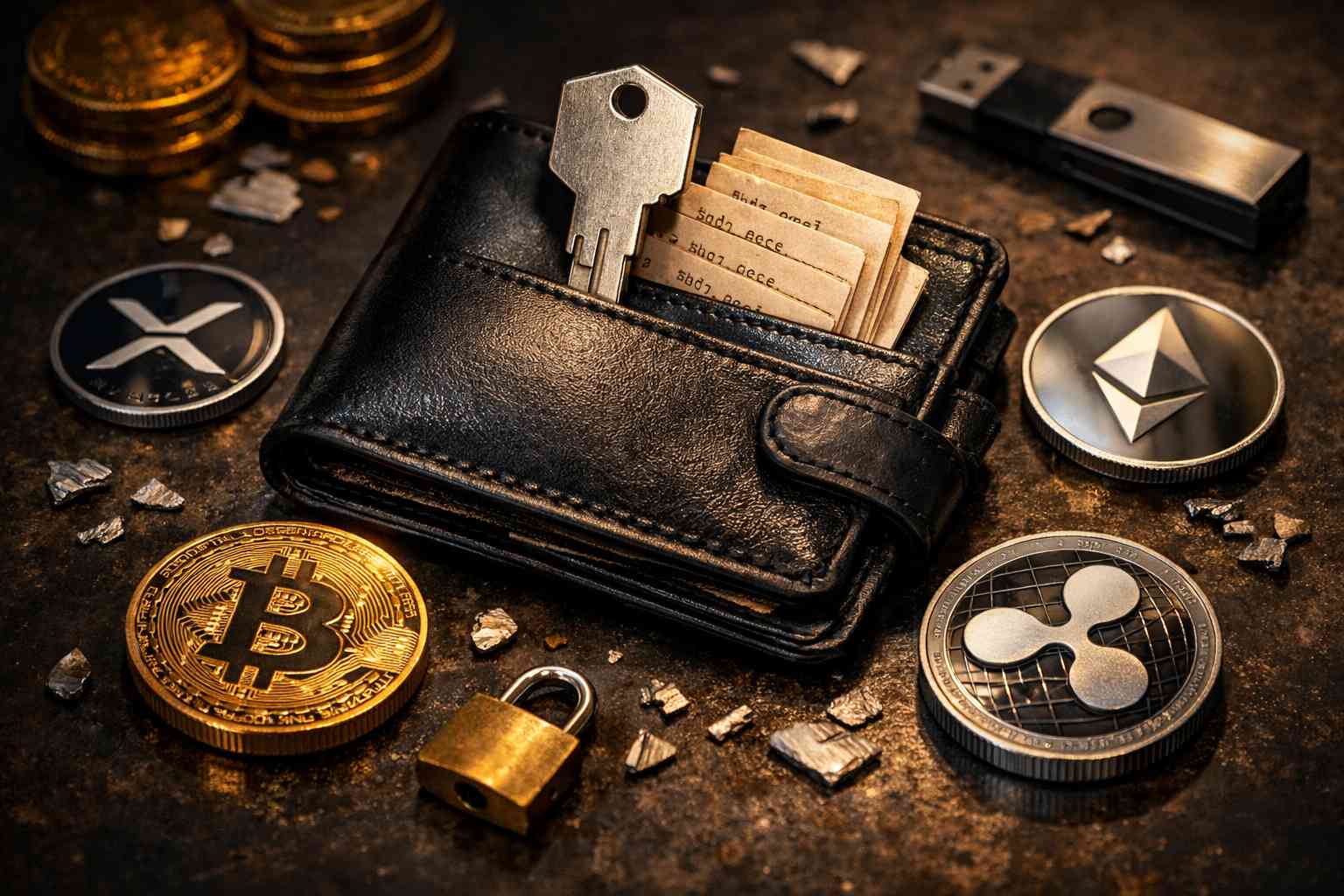
Since private keys are so important, what should we use to store them? The answer is a 'crypto wallet.' A wallet doesn't actually 'hold' coins; it's a tool for 'holding' private keys. They are mainly divided into two categories: hot wallets and cold wallets.
Hot Wallet:
Analogy: Like your everyday physical wallet. You keep some cash and credit cards in it for convenient, frequent spending.
Definition: A hot wallet is a wallet connected to the internet, typically in the form of a mobile app, desktop software, or browser extension.
Characteristics: Its advantage is convenience and speed, making it suitable for small, frequent transactions. However, because it's always online, it's more vulnerable to hacking attempts and has relatively lower security.
Cold Wallet:
Analogy: Like a safe in your home or a safe deposit box at a bank. You store large amounts of cash, gold bars, and important documents in it.
Definition: A cold wallet is a completely offline wallet. The most common forms are hardware wallets (a device similar to a USB drive) or paper wallets.
Characteristics: Because it's not connected to the internet, a cold wallet can fundamentally isolate assets from online attacks, making it one of the most secure storage methods available. It is better suited for long-term storage of large amounts of assets. According to reports from blockchain analysis firms, thefts resulting from private key compromises account for a very high percentage of all attack types, highlighting the importance of offline storage.
For beginners, a wise strategy is to use a combination: keep a small amount of assets for daily transactions in a hot wallet, and store the majority of your long-term holdings in a cold wallet. This is one of the core ideas behind how to securely store cryptocurrency: best security practices.
Seed Phrases and Physical Backups: The Core Guide to Preventing Loss and Theft
When you create a new wallet, you will typically be given a 'seed phrase' (or recovery phrase) consisting of 12 or 24 English words.
Imagine the seed phrase as the 'master blueprint' for your entire vault. Even if you lose the key to the safe (your private key), you can recreate an identical key to open the vault as long as you have this blueprint. Therefore, the seed phrase is another representation of your private keys, and its importance cannot be overstated.
How do you securely store your seed phrase? Please strictly adhere to the following points:
Physical Backup, Stay Offline: You must write it down with a pen and paper (or on a more durable material like a metal plate). Absolutely, under no circumstances, should you take a screenshot, photo, copy-paste, or store it on any internet-connected device (like a computer, phone, cloud drive, or email).
Store in Multiple Locations to Reduce Risk: Don't put all your eggs in one basket. You can store the written-down seed phrase in two or more physically secure locations that you trust, such as a home safe and a bank's safe deposit box.
Never Share It, Stay Vigilant: Anyone or any platform asking for your seed phrase for any reason is a scam. Also, do not read your seed phrase aloud in any environment where you might be recorded or monitored.
Beware of Ubiquitous Traps: Security Red Lines for Daily Transactions and Storage
Once you've mastered the storage tools, you also need to increase your vigilance in daily operations. Industry security reports show that phishing attacks and scams targeting individual users are rampant and cause enormous losses. These traps often exploit human carelessness.
Common scams you might encounter include:
Phishing Attacks: You might receive emails or direct messages disguised as official projects, leading you to click on links and enter your private key or seed phrase. An increasingly common scam is 'address poisoning': a scammer creates a 'vanity address' with starting and ending characters that are very similar to an address you frequently transact with. They then send a tiny transaction to your wallet. This transaction appears in your history, and the next time you try to copy the address from your history, you might accidentally copy the poisoned one, leading to a loss of funds.
Fake Airdrops: You might suddenly find some unknown tokens or NFTs in your wallet. Interacting with these unsolicited assets (such as approving, selling, or clicking on embedded links) can trigger a malicious contract, which could drain all the assets from your wallet. Simply put, the best strategy for 'freebies' that fall from the sky is to not touch, not look, and not engage.
Public Network Risks: Try to avoid performing any crypto wallet-related operations on public Wi-Fi networks, such as those in cafes or airports, as these networks are more susceptible to eavesdropping or hijacking.
Conclusion: Cultivating a Long-Term Wallet Security Mindset
How to securely store cryptocurrency: best security practices is not a one-time setup, but rather a security habit and mindset that requires long-term commitment.
Let's review the key points: maintain absolute control over your assets with your private keys, balance convenience and security using a 'hot/cold wallet' strategy, protect your seed phrase with meticulous physical backups, and remain highly vigilant against traps like phishing attacks in your daily operations.
Security is the cornerstone of your exploration in the crypto world. We encourage you to continuously learn and stay updated on the latest security knowledge to protect your digital assets.
Start your safe cryptocurrency journey now
OSL | Secure Ramps. Trusted Rails !
More topics
More topics



Latest
Why India's $620B Bond Pilot Changed Nothing Legal
SEBI and the RBI's Demat 2.0 pilot issues corporate bonds as digital tokens and settles them with the wholesale digital rupee, preserving existing legal terms while digitizing the infrastructure beneath a $620...
Why India's $620B Bond Pilot Changed Nothing Legal
Why S&P Global Leads Kaiko: Not Hype, But 24/7 Market Infrastructure
S&P Global led a $110 million extension of Kaiko's Series B to build data infrastructure for round-the-clock tokenized markets.
Why S&P Global Leads Kaiko: Not Hype, But 24/7 Market Infrastructure
When One Firm Holds 5% of Ethereum: Infrastructure Stress Test
Bitmine's accumulation of more than 5 million staked ETH raises questions about whether custody, audit, and validator infrastructure can support single-asset concentration at public-company scale.
When One Firm Holds 5% of Ethereum: Infrastructure Stress Test
Best Enterprise Stablecoin Payment Providers: A 2026 Evaluation Framework
Compare enterprise stablecoin payment providers by use case, legal entity, workflow, controls, integration, reconciliation, support, and contract terms.
Best Enterprise Stablecoin Payment Providers: A 2026 Evaluation Framework
How to Reconcile a USDGO Payment: An Illustrative Finance-Close Example
See how Finance can trace a USDGO payment from an approved obligation through payment records, recipient confirmation, reconciliation, and accounting close.
How to Reconcile a USDGO Payment: An Illustrative Finance-Close Example
A USDGO Reserve Review in Practice: Findings, Limits and Follow-up Questions
Review what the July 2026 USDGO reserve attestation establishes, what it does not prove, and which issuer, redemption, and liquidity questions remain.
A USDGO Reserve Review in Practice: Findings, Limits and Follow-up Questions
Recommended for you
More topics
More topics
