First Lesson for Web3 Beginners: A Complete Guide to Private Keys, Seed Phrases, and Wallet Permissions

Welcome to the world of Web3. If we compare it to a digital forest full of treasures, your crypto wallet is the sole credential for your survival. Many newcomers pay a hefty price when they first enter this domain because they fail to distinguish between several core concepts.
To ensure you don't get lost while exploring, we first need to establish a solid concept: Build Your Own Digital Vault: Distinguish Between Private Keys and Seed Phrases, and Protect Your Lifeline. This is not just security advice; it's the bottom line for survival in the decentralized world.
Deconstructing Core Concepts: The Real Relationship Between Wallet Addresses, Private Keys, and Seed Phrases
When you first encounter a crypto wallet, you might be dizzied by a jumble of random characters. Let's use a common real-life analogy—a 'bank account'—to help you instantly clarify their relationship.
Wallet Address (Hash of the Public Key): Imagine your bank account number or email address. It's public. You can send it to anyone to receive transfers or messages. On the blockchain, this is your identifier. It doesn't matter who knows it; they can even view the asset movements of this address on a blockchain explorer.
Private Key: This is a combination of your bank card PIN and personal seal. It's a long string of seemingly random characters (usually a 64-character hexadecimal string). Possessing the private key means you have absolute control over the assets at the corresponding address. Whoever gets this 'key' can immediately transfer all your funds.
Seed Phrase (Mnemonic Phrase): This is the 'stand-in' for the private key. Because private keys are too long and difficult to remember, developers created mnemonic standards (like BIP-39) to convert complex private keys into 12 to 24 simple English words.In simple terms, the seed phrase is the 'Master Key' to your vault. With this set of words, you can restore your wallet and all its assets on any new device.
Avoiding Confusion: The Difference and Conversion Logic Between Private Keys and Seed Phrases
You might ask: 'Since both private keys and seed phrases can control assets, what's the fundamental difference?'
It's like the relationship between a 'barcode' and a 'product name'. The private key is for machines to read (the barcode), while the seed phrase is for humans to read (the product name).
Technically, they have a hierarchical relationship:
Seed Phrase Generates Private Keys: One seed phrase (the master key) can sequentially generate countless private keys (sub-keys). This is why, within a single wallet software, you can use one set of seed phrases to create multiple different addresses like 'Account 1', 'Account 2', etc.
Irreversibility: You can usually recover private keys from a seed phrase, but it's extremely difficult to reverse the process and derive the original seed phrase from a specific private key.
The key takeaway is: The seed phrase is at the highest level. If a private key is the key to your front door, the seed phrase is the 'mold' used to cast that key. If the mold is lost, anyone can make infinite copies of the key.
The Invisible Killer: A Deep Dive into Wallet Approvals and Smart Contract Interactions
According to 2025 data from industry security firms, over 78% of user asset losses are not due to direct private key theft but from 'reckless approvals'. This is a fatal blind spot that many tutorials overlook.
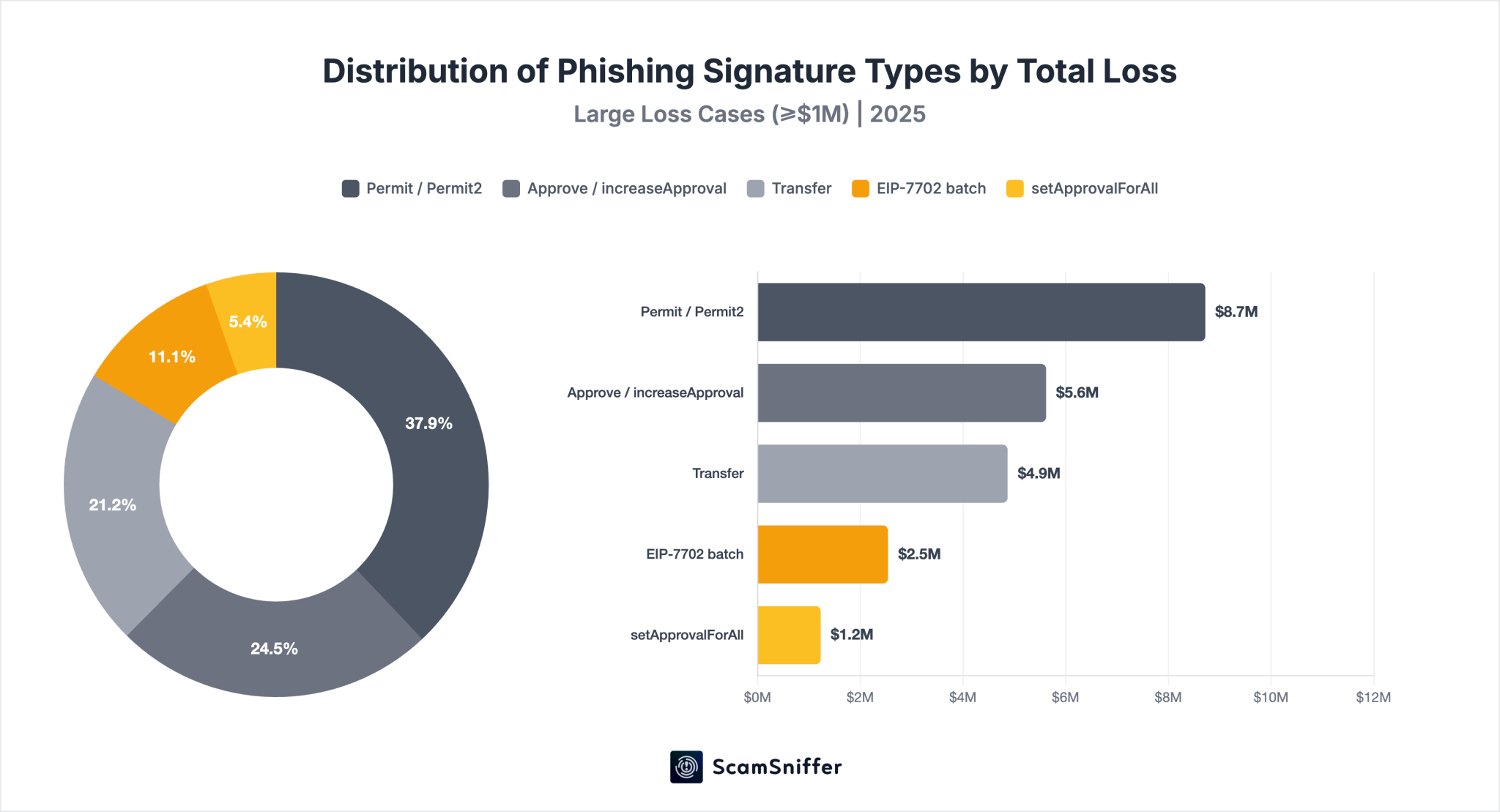
Distribution of Crypto Phishing Losses in 2025. Data indicates that over 78% of losses stem from signature authorization traps such as Permit and Approve, rather than private key leaks.
What is an Approval? When you want to make a transaction in a decentralized application (DApp), such as swapping tokens, you must first click an 'Approve' button.
Imagine this: You're staying in a grand hotel. If you hand your room key directly to a staff member, that's a 'transfer'. But if you sign an agreement allowing the staff to enter your room to clean at any time for the next year, that's an 'approval'.
If you accidentally grant 'unlimited approval' to a malicious website, it's like allowing them to 'empty everything from your room at any time' without needing your confirmation again. Many hackers exploit this 'invisible' contract permission to transfer assets without you ever noticing.
Survival Tip: Regularly check your wallet's approval list and revoke permissions for contracts you no longer use or don't recognize.
Digital Vault Construction Guide: How to Back Up Confidential Information Scientifically and Securely
Now we return to the most critical topic—how to build your Digital Vault: Distinguish Between Private Keys and Seed Phrases, and Protect Your Lifeline. This isn't just a slogan; it's a strict operational procedure.
The vast majority of asset losses occur because backup methods are too 'modern'. Remember: If it's connected to the internet, it's at risk.
Here are expert-level backup recommendations:
Physical Backup is King: Find a high-quality piece of paper and write down your seed phrase by hand. Check it three times to ensure there are no spelling errors. Then, store this paper in a fireproof and waterproof safe place (like a safe deposit box or between the pages of a book). More tech-savvy users engrave their seed phrase on a steel plate to protect it from fire.
Strictly Prohibit Screenshots and Cloud Storage:Absolutely do not take a screenshot of your seed phrase, nor should you save it in WeChat Favorites, notes apps, cloud drives, or email it to yourself. Phone photo albums and cloud data are the easiest targets for hackers. If your phone gets infected with a trojan, the screenshot of your seed phrase in your album becomes the hacker's prize.
Split Storage Method: If you are extremely security-conscious, you can split the 12 words into two groups (e.g., 6 words on each piece of paper) and store them in two different physical locations. This way, even if a thief steals one half, they won't be able to crack your wallet.
Survival Rules: Avoiding Common Web3 Security Traps and Misconceptions
Finally, to survive longer in this forest, you need to avoid a few common traps:
'Helpful' Customer Support: On social media, anyone who proactively sends you a private message claiming to be 'official customer support' and asking to help you solve a problem is 100% a scammer. Official support will never ask for your seed phrase in a private message.
Clipboard Hijacking: There's a type of virus that can lurk on your computer. When you copy a wallet address to make a transfer, it automatically replaces the address in your clipboard with the hacker's address. Countermeasure: Before clicking 'Send', always double-check the first 4 and last 4 characters of the address.
Fake Wallet Apps: Don't randomly download wallet apps from search engines. Many of the top-ranking ads are fake phishing websites. Always go to the official website through official Twitter accounts or other authoritative channels to download.
Understanding these concepts is your first and most important step into Web3. Technology itself is neutral. Only when you have fully mastered the core logic of Build Your Own Digital Vault: Distinguish Between Private Keys and Seed Phrases, and Protect Your Lifeline can you truly enjoy the freedom and convenience that technology brings.
It is recommended that beginners choose well-known, compliant, and regulated platforms or tools for small-scale learning and experimentation before attempting any operations, gradually building up their security defenses through practice.
Start your safe cryptocurrency journey now
OSL | Secure Ramps. Trusted Rails !
More topics
More topics


Latest
Why India's $620B Bond Pilot Changed Nothing Legal
SEBI and the RBI's Demat 2.0 pilot issues corporate bonds as digital tokens and settles them with the wholesale digital rupee, preserving existing legal terms while digitizing the infrastructure beneath a $620...
Why India's $620B Bond Pilot Changed Nothing Legal
Why S&P Global Leads Kaiko: Not Hype, But 24/7 Market Infrastructure
S&P Global led a $110 million extension of Kaiko's Series B to build data infrastructure for round-the-clock tokenized markets.
Why S&P Global Leads Kaiko: Not Hype, But 24/7 Market Infrastructure
When One Firm Holds 5% of Ethereum: Infrastructure Stress Test
Bitmine's accumulation of more than 5 million staked ETH raises questions about whether custody, audit, and validator infrastructure can support single-asset concentration at public-company scale.
When One Firm Holds 5% of Ethereum: Infrastructure Stress Test
Best Enterprise Stablecoin Payment Providers: A 2026 Evaluation Framework
Compare enterprise stablecoin payment providers by use case, legal entity, workflow, controls, integration, reconciliation, support, and contract terms.
Best Enterprise Stablecoin Payment Providers: A 2026 Evaluation Framework
How to Reconcile a USDGO Payment: An Illustrative Finance-Close Example
See how Finance can trace a USDGO payment from an approved obligation through payment records, recipient confirmation, reconciliation, and accounting close.
How to Reconcile a USDGO Payment: An Illustrative Finance-Close Example
A USDGO Reserve Review in Practice: Findings, Limits and Follow-up Questions
Review what the July 2026 USDGO reserve attestation establishes, what it does not prove, and which issuer, redemption, and liquidity questions remain.
A USDGO Reserve Review in Practice: Findings, Limits and Follow-up Questions
Recommended for you
More topics
More topics
