What are Real-World Assets (RWA)? 2025 Year-End Review & Institutional Guide
Feb 4, 2025

What is RWA? Real-World Assets (RWA) refer to the process of converting tangible assets—such as real estate, commodities, and bonds—into digital tokens on a blockchain. As of late 2025, RWA has evolved from a technical experiment into a mainstream pillar of global finance. This article explores the core concepts and tokenisation processes of RWA, incorporating the latest 2025 regulatory shifts and market data. Discover how this financial revolution is reshaping asset management, liquidity, and transparency, and redefining ownership within the decentralised ecosystem.
What is the RWA Sector?
In the 2025 Web3 landscape, the "RWA Sector" represents the ultimate bridge between Traditional Finance (TradFi) and Decentralised Finance (DeFi). It goes beyond simple digitisation; it is a liquidity revolution. By transforming trillions of dollars in tangible assets—such as U.S. Treasuries, real estate, and private credit—into on-chain tokens, the RWA sector addresses long-standing issues of market fragmentation and high intermediary costs. This year, RWA has transitioned from a conceptual narrative to a massive institutional reality.
What are Real World Assets (RWA)?
Real-World Assets (RWA) refer to physical or tangible assets that exist in the non-digital world, such as real estate, commodities, fine art, and intellectual property. These assets can now be represented on blockchain networks using tokenisation, where ownership is encoded as digital tokens. The ability to tokenise RWAs has enabled the transformation of traditionally illiquid or hard-to-access assets into more accessible, fractionalised, and tradeable forms. This innovation bridges the gap between traditional finance and decentralised finance (DeFi), opening new doors for investors and asset owners alike. In this section, we’ll explore the foundational elements of RWAs and their integration into blockchain technology.
Types of Real World Assets
Real-World Assets span a broad spectrum of categories, each with unique characteristics and tokenisation possibilities:
Real estate: Residential and commercial properties tokenised for fractional ownership.
Commodities: Physical goods like gold, oil, and agricultural products represented on blockchain.
Intellectual property: Patents, copyrights, and trademarks converted into digital tokens.
Luxury goods: Rare collectibles, art, jewellery, and vintage items available in digital form.
Financial instruments: Bonds, invoices, and other contractual agreements tokenised for broader access.
Tokenisation of Real World Assets
Tokenisation is the process of converting the ownership or value of a real-world asset into a digital token on a blockchain. This token represents a fractional share or full ownership of the underlying asset, depending on the structure. Through smart contracts, tokenisation ensures that transactions and asset ownership are transparent, secure, and traceable. The process begins with asset validation, ensuring its legitimacy and value, followed by the creation of digital tokens linked to the asset. These tokens can then be traded on decentralised marketplaces, increasing liquidity and accessibility for investors globally.
Benefits of Real World Assets in Blockchain
Integrating Real World Assets into blockchain ecosystems brings several advantages to investors, asset managers, and markets. By leveraging the decentralised nature of blockchain, RWA tokenisation enhances accessibility to assets that were traditionally limited to specific geographic or financial demographics. The transparency offered by blockchain also ensures that transactions are verifiable and immutable, reducing fraud and enhancing trust in asset ownership.
The increased liquidity is another significant advantage of RWAs, as tokenisation enables assets like real estate and commodities to be traded in smaller, more flexible units. This liquidity benefits both asset owners looking to unlock value and investors seeking diverse opportunities. Additionally, the global reach of blockchain eliminates geographical barriers, creating a truly borderless marketplace for RWAs.
Enhanced accessibility for smaller investors and global participants.
Improved transparency through blockchain’s immutable ledger.
Increased liquidity by enabling fractional ownership and secondary market trading.
Reduction in administrative costs and inefficiencies through automation.
Creation of borderless markets for previously localised or exclusive assets.
Challenges Facing Real World Assets Tokenisation
Despite the promising potential of RWAs, there are challenges to their widespread adoption and tokenisation. Regulatory uncertainty remains one of the biggest hurdles, as governments and financial institutions grapple with how to classify and oversee tokenised assets. The legal frameworks governing asset ownership, transfer, and taxation vary widely across jurisdictions, creating barriers to standardisation.
Another challenge is ensuring the accurate valuation and auditing of physical assets, as discrepancies could undermine trust in the system. The reliance on intermediaries for asset verification and custodianship adds another layer of complexity. Additionally, technological risks, such as vulnerabilities in smart contracts or blockchain platforms, pose potential threats to security. Addressing these challenges will be critical to scaling the adoption of RWAs.
Regulatory uncertainty and lack of global standardisation.
Challenges in accurate valuation and auditing of assets.
Dependence on intermediaries for verification and custodianship.
Technological risks, including smart contract vulnerabilities.
Resistance from traditional financial institutions and asset owners.
2025 RWA Sector Review: Institutional Adoption & Regulatory Milestones
Reflecting on the end of 2025, the RWA sector has undergone a monumental transformation over the past year. According to the latest data from RWA.xyz, the total market value of on-chain RWAs (excluding stablecoins) surpassed $18.6 billion this December, more than doubling since last year.
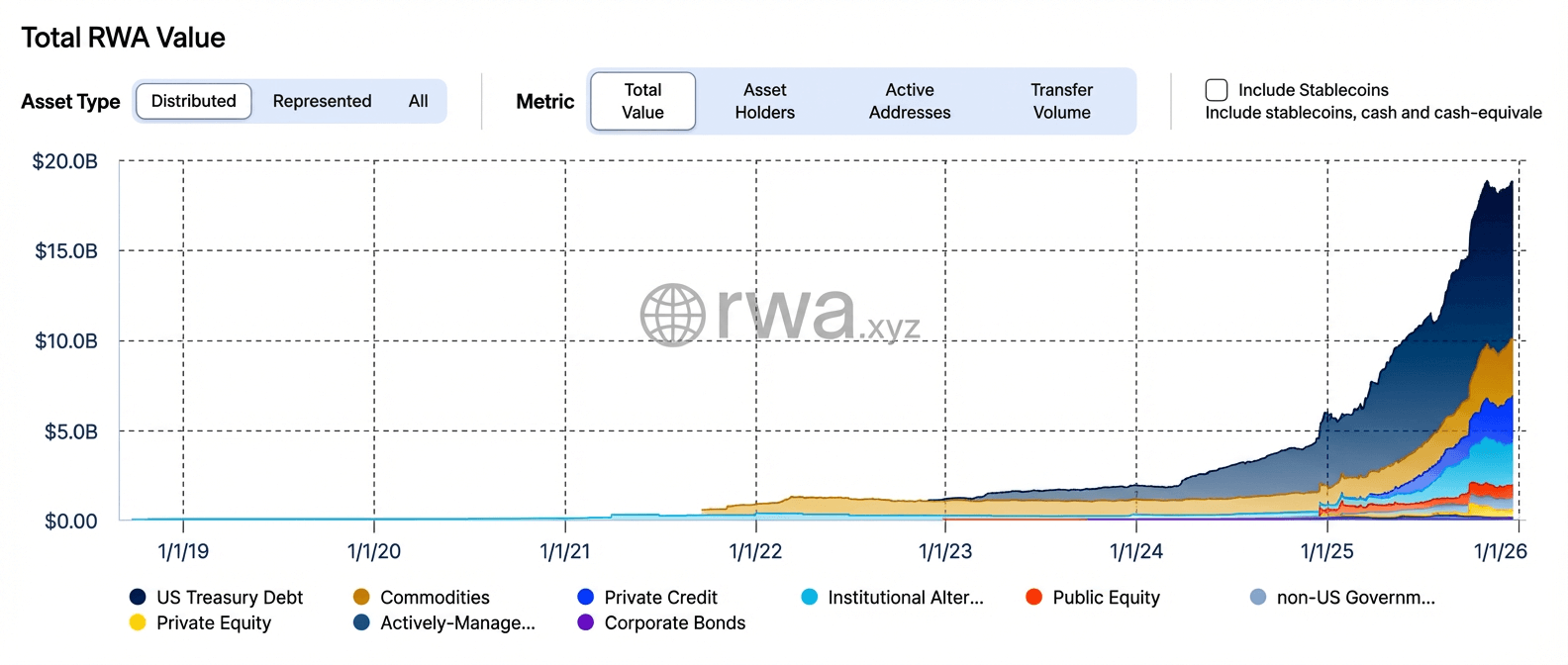
Chart: Global On-chain RWA Total Market Value Growth Trend (2019-2025). As of Dec 22, 2025, the market value has exceeded $18.6 billion. Source: RWA.xyz
The chart clearly illustrates a vertical ascent in the RWA sector during 2025, transitioning from "Proof of Concept" to "Scalable Growth," primarily driven by three key factors:
Absolute Dominance of U.S. Treasuries: Tokenized U.S. Treasury debt remains the sector's bedrock. BlackRock’s BUIDL fund and Franklin Templeton’s BENJI continue to attract massive capital, serving as the preferred choice for institutions seeking low-risk benchmark yields.
Catalysis from Hong Kong’s Regulatory Dividends: On November 3, 2025, the Hong Kong SFC issued landmark circulars easing distribution restrictions for licensed platforms (VATPs) and allowing for global liquidity sharing. This has directly stimulated explosive demand for compliant tokenized assets in Asia.
From Experimentation to Implementation: Practical applications by HSBC and the HKMA in tokenized deposits and green bonds have demonstrated RWA's tangible value in enhancing settlement efficiency and reducing operational costs.
The Future of Real World Assets
With the landmark SFC circulars issued in November 2025 and the global on-chain RWA market value surpassing $18.6 billion, the integration of physical assets and blockchain has reached an irreversible turning point. Moving forward, RWA will be more than just digitization; it will be the ultimate solution for global financial liquidity. As a pioneer in licensed exchange services, OSL continues to lead the compliant tokenization wave, helping institutional and sophisticated investors unlock trillions in potential within a regulated and transparent ecosystem.
Start your safe cryptocurrency journey now
OSL | Secure Ramps. Trusted Rails !