Must-Read Before Participating in Pi Network: A Guide to Potential Risks and Personal Information Security

You might have seen promotions on your social media feeds: no expensive mining rigs, no massive electricity consumption, just a simple tap on your phone screen each day to 'mine for free' and acquire future digital assets. This low-barrier entry has allowed Pi Network to rapidly accumulate a massive user base worldwide.
But before you press that lightning button, do you truly understand the mechanism behind it? Can you really mine on a phone? A deep dive into the logic and risks of Pi Network is not just a technical question, but a game of cognition, privacy, and time cost. This article will cut through the fog of 'free' to help you see the essence of this phenomenon from an objective and rational perspective.
What Exactly is Pi Network: Deconstructing the Logic of Mobile Mining
First, we need to clarify a misconception: what you do on Pi Network is fundamentally different from the traditional 'mining' associated with Bitcoin.
Imagine Bitcoin mining as a team of geological surveyors operating heavy machinery (high-powered professional miners), consuming vast amounts of diesel (electricity) to solve complex mathematical puzzles in a race for gold. This is a 'Proof of Work' (PoW) process that genuinely requires significant physical costs.
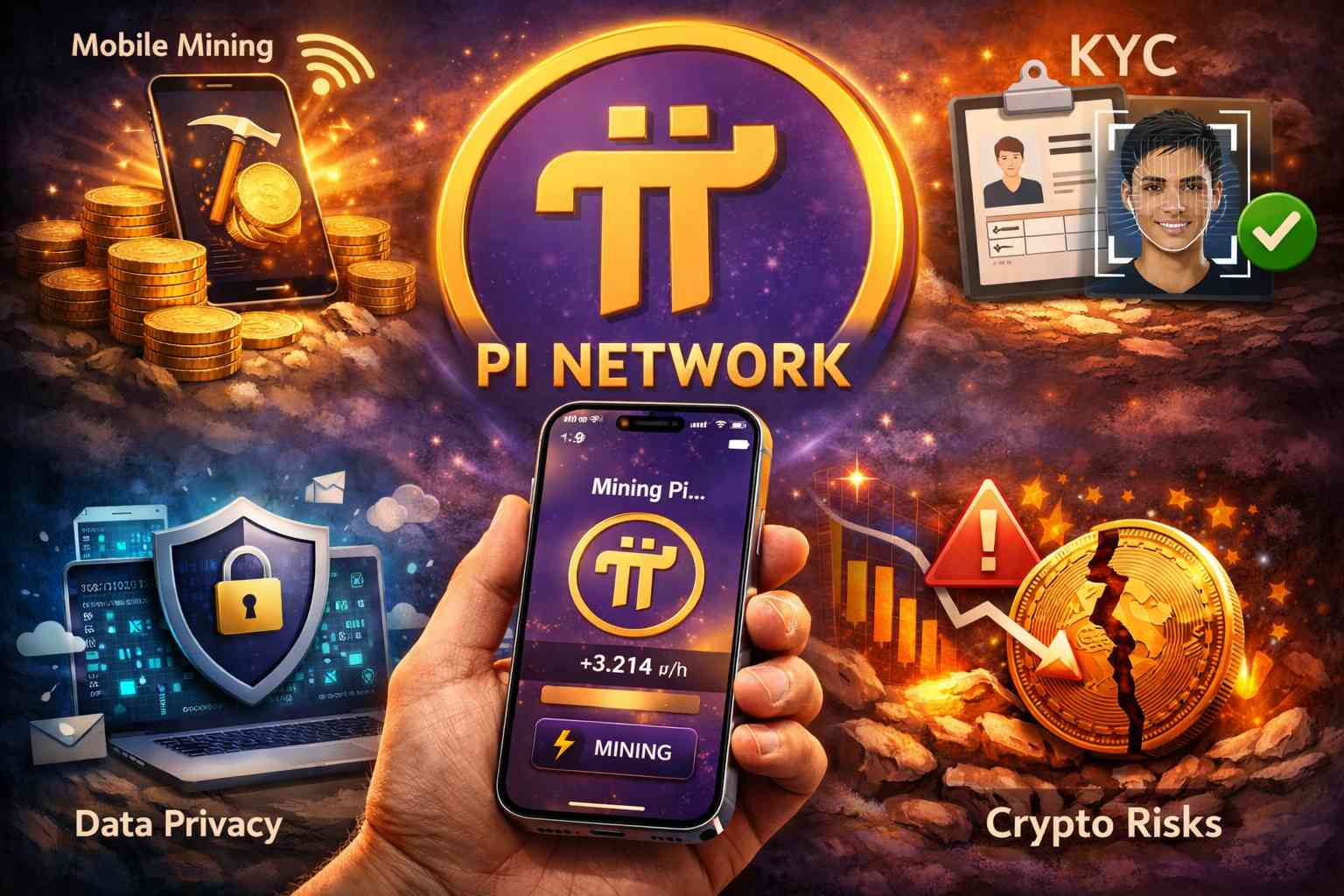
In contrast, Pi Network's proclaimed 'mobile mining' is more like a 'digital check-in system.' When you tap the lightning icon daily, your phone isn't performing complex hash calculations, and your battery doesn't heat up. The system is actually just recording your activity. Pi uses a variation of the 'Stellar Consensus Protocol' (SCP). Simply put, it relies on 'security circles' (a trust graph) established among users to reach consensus, rather than brute-force computation.
So, strictly speaking, the numbers increasing in your phone are currently more like 'points' issued by the project team—a reward for your attention and social connections, not a crypto asset produced through computation in the traditional sense.
Why is it Free? Unveiling the Traffic Business Behind the Zero-Cost Model
There's no such thing as a free lunch, but in the internet era, there are indeed 'free' products—on the condition that you are the product.
You might wonder, if the project team isn't charging money, how do they sustain their operations? The answer often lies in the vast amount of traffic data. According to industry observations, an app with tens of millions of daily active users is itself a massive advertising platform.
When you open the app to 'mine,' you'll often see ads pop up (though you can choose to close them, they are enabled by default). This constitutes a classic internet traffic business model:
User Acquisition: Attract users to download and open the app daily by offering 'potentially valuable future tokens' as an incentive.
Traffic Monetization: The large active user base attracts advertisers, and the project team earns cash flow by displaying ads.
Network Value: The larger the user base, the more compelling the project's story is in the capital market.
This model is very common in the Web2 space, like apps that reward you with coins for reading news or红包 (red envelopes) for walking. The difference is that Pi Network packages this incentive mechanism with the Web3 concept of 'mining.' This doesn't necessarily mean it's a scam, but it explains why you can participate at 'zero cost'—because your attention itself is the resource they are monetizing.
In-Depth Analysis of Potential Risks: The Monetization Dilemma and Indefinite Time Investment
For most participants, the biggest expectation is when their Pi coins can be converted into real money. This is where the core risk lies: the uncertainty of monetization and the cost of time.
Since 2019, Pi Network has gone through a long development cycle. Although the official team claims to be advancing through various stages of the 'Mainnet,' for the average user, the tokens they hold are mostly in an 'Enclosed Network' phase, meaning they cannot be freely traded on public secondary markets.
This leads to two levels of problems:
Psychological Sunk Cost: You might feel that spending a few seconds a day is nothing, but the cumulative investment over years can create a compulsion to 'see it through to the end.' This mindset can draw users deeper into the ecosystem, causing them to overlook other, more valuable learning opportunities.
Liquidity Risk: Until a truly decentralized mainnet is fully open, the value of these digital points depends entirely on the project team's ability to deliver and market consensus. If the mainnet is indefinitely postponed, or if supply far exceeds demand upon launch, the value of these points could be much lower than expected.
It's like receiving a check that promises future goods, but the redemption date is 'to be determined,' and what you can ultimately exchange it for is also uncertain.
The Personal Information Security Red Line: Privacy Leak Risks from KYC Verification
This is the 'red line' that requires the most caution during participation. To prevent fake accounts and bots, Pi Network requires users to undergo KYC (Know Your Customer) verification.
KYC verification typically requires you to upload extremely sensitive personal documents like your ID card, passport, or driver's license, and may even include facial recognition data. You need to ask yourself: Is it worth handing over such core identity information to an app that currently lacks clear regulatory backing and has a relatively opaque operating entity?
In the realm of cybersecurity, data breaches are a huge risk. Once a database containing ID numbers, photos, and real names is hacked or sold internally by malicious actors, the consequences go beyond receiving spam calls. You could face identity theft or even have your identity used for money laundering in telecommunication scams.
In reality, legitimate and compliant platforms adhere to extremely high data encryption standards and legal constraints when handling KYC data. For projects operating in a gray area, users must think twice before submitting their information: Are you willing to expose your core privacy for an uncertain chance to get rich?
A Guide to Avoiding Pitfalls Before Participating: How to Identify Scams and Protect Your Device
If you still decide to participate, or are already participating, be sure to take the following measures to protect yourself and avoid being exploited:
Guard Your Wallet Passphrase: Never, under any circumstances, share your passphrase with anyone, and do not enter it into unofficial web links. It is the sole proof of control over your assets.
Refuse Any Financial Investment: Pi's current official logic is free participation. If someone in a social group claims to offer 'private sales' or 'pre-sales' of Pi coins, or asks you to transfer fiat currency to buy 'hash power,' it is 100% a scam.
Check App Permissions: In your phone's settings, review what permissions the app has been granted. A simple check-in app should not need access to your contacts, text messages, or call logs. If you find overreaching permissions, disable them immediately.
Be Wary of 'Over-the-Counter (OTC)' Trading: Since free trading on the mainnet is not yet open, many private 'barters' or 'sales' not only lack protection but are also highly susceptible to scammers, leading to the loss of both your coins and money.
Conclusion: Making Rational Decisions Amidst FOMO
Can you really mine on a phone? A deep dive into the logic and risks of Pi Network, at its core, is a matter of managing expectations.
Pi Network's success lies in its ability to significantly lower the barrier for ordinary people to engage with crypto concepts, introducing millions to wallets, private keys, and consensus mechanisms. From an educational perspective, it has its positive side. However, blind FOMO (Fear Of Missing Out) often causes people to overlook the potential costs.
A rational approach to participation should be:
Maintain a Zero-Cost Mindset: Treat it as a social experiment or a game, and do not invest any money.
Protect Your Privacy: Be extremely cautious when it comes to submitting personal identity information.
Invest in Knowledge, Not Luck: True wealth comes from understanding the underlying technology.
Rather than pinning your hopes on clicking a button, it might be a better path to the future to use that time to systematically learn the fundamentals of blockchain and explore the Web3 world through transparent, time-tested, and regulated channels.
Start your safe cryptocurrency journey now
OSL | Secure Ramps. Trusted Rails !
More topics
More topics


Latest
Why India's $620B Bond Pilot Changed Nothing Legal
SEBI and the RBI's Demat 2.0 pilot issues corporate bonds as digital tokens and settles them with the wholesale digital rupee, preserving existing legal terms while digitizing the infrastructure beneath a $620...
Why India's $620B Bond Pilot Changed Nothing Legal
Why S&P Global Leads Kaiko: Not Hype, But 24/7 Market Infrastructure
S&P Global led a $110 million extension of Kaiko's Series B to build data infrastructure for round-the-clock tokenized markets.
Why S&P Global Leads Kaiko: Not Hype, But 24/7 Market Infrastructure
When One Firm Holds 5% of Ethereum: Infrastructure Stress Test
Bitmine's accumulation of more than 5 million staked ETH raises questions about whether custody, audit, and validator infrastructure can support single-asset concentration at public-company scale.
When One Firm Holds 5% of Ethereum: Infrastructure Stress Test
Best Enterprise Stablecoin Payment Providers: A 2026 Evaluation Framework
Compare enterprise stablecoin payment providers by use case, legal entity, workflow, controls, integration, reconciliation, support, and contract terms.
Best Enterprise Stablecoin Payment Providers: A 2026 Evaluation Framework
How to Reconcile a USDGO Payment: An Illustrative Finance-Close Example
See how Finance can trace a USDGO payment from an approved obligation through payment records, recipient confirmation, reconciliation, and accounting close.
How to Reconcile a USDGO Payment: An Illustrative Finance-Close Example
A USDGO Reserve Review in Practice: Findings, Limits and Follow-up Questions
Review what the July 2026 USDGO reserve attestation establishes, what it does not prove, and which issuer, redemption, and liquidity questions remain.
A USDGO Reserve Review in Practice: Findings, Limits and Follow-up Questions
Recommended for you
More topics
More topics
