Everyday Wealth: How Real Assets Enter Your Digital Life
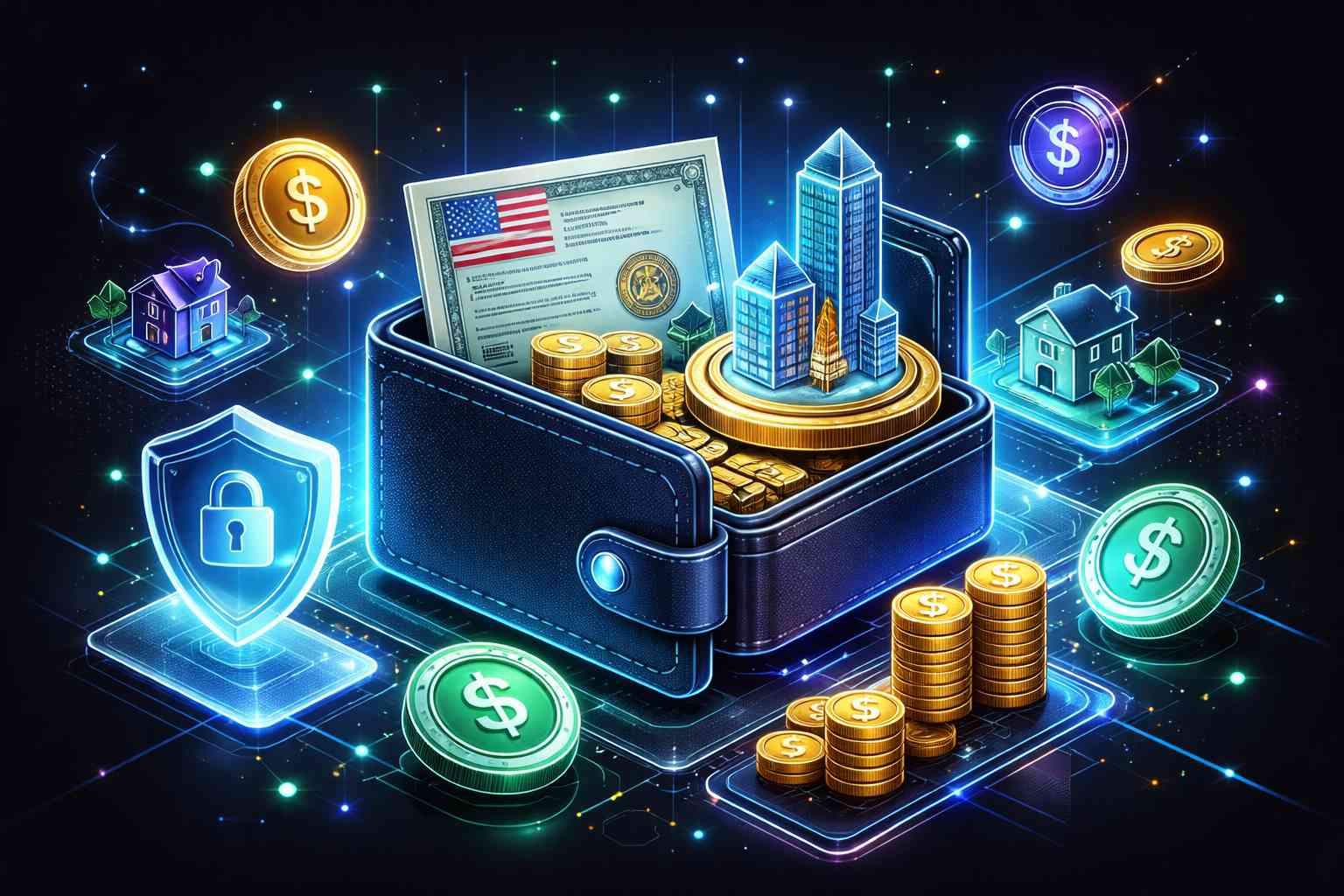
Imagine owning a fraction of a prime office building in Manhattan—without millions of dollars.
Or imagine that the stablecoins sitting idle in your digital wallet are automatically generating yield from U.S. Treasury bonds.
What once sounded like science fiction has become reality.
By 2025, these ideas were no longer experimental concepts, but tangible applications gaining real traction across the Web3 ecosystem.
And as we stand at the threshold of 2026, it is becoming increasingly clear that 2025 was not the peak of the RWA narrative—it was the inflection point, marking the transition from proof of concept to scalable adoption.
At the center of this transformation is one core idea:
Putting real-world assets into digital wallets — an introduction to RWA (Real-World Assets).
What Are Real-World Assets (RWAs)?
Simply put, RWAs (Real World Assets) involve mapping valuable assets from the real world—such as real estate, gold, bonds, or even a famous painting—onto a digital network through a process called 'tokenization' using blockchain technology.
If you think of the blockchain as a universal 'super ledger,' then RWAs are the process of turning offline physical assets into 'digital certificates' that can be traded on this ledger.
For example, when you go to an amusement park, you have to exchange cash for game tokens. In this analogy, cash is the real-world asset, and the game tokens are the on-chain RWA tokens. The key difference is that RWA tokens are backed by strict legal frameworks and asset collateral, with their value directly tied to real-world items. This not only breaks down the barriers of traditional finance but also makes asset mobility as simple as sending an email.
Why Have RWAs Become the Core Narrative of the Crypto Market in 2025?
You might ask, why now? Looking back at the past few years, the crypto market has often been as volatile as a rollercoaster. By 2025, market participants have begun seeking more stable and logical growth drivers to counter this uncertainty.
Here's a key statistic to note: according to a forecast report by the Boston Consulting Group (BCG) and other institutions, the market size for the tokenization of illiquid assets is expected to reach $16 trillion by 2030. In 2025, we are on the cusp of this multi-trillion dollar sector's explosion.
Both institutional investors and retail users are beginning to realize that speculating on purely virtual assets isn't 'solid' enough. We need an asset class that not only leverages the efficiency and transparency of the blockchain but also generates returns from real-world economic activities (Real Yield). RWAs perfectly fill this gap, bringing the stability of traditional finance into the Web3 world.
A Look at Core Sectors: Real-World Cases from Treasury Yields to Real Estate Tokenization
Within the broad landscape of RWAs, the most mature and widely adopted areas are currently the following two:
1. U.S. Treasuries and Fixed-Income Products
This is currently the 'crown jewel' of the RWA space. In simple terms, it involves the tokenization of low-risk assets like U.S. Treasury bonds.
Pain Point Solved: Previously, your idle funds (stablecoins) on-chain typically earned no interest. Now, through compliant RWA protocols, your funds can indirectly hold U.S. Treasuries and enjoy traditionally low-risk yields from the traditional financial world.
Practical Significance: This provides a 'safe haven' for capital in the crypto world, eliminating the need to seek returns through high-risk lending protocols.
2. Real Estate Tokenization
This is perhaps the most intuitive application.
Fractional Ownership: Suppose a luxury property is worth $10 million, making it difficult for the average person to invest. Through RWAs, this property can be divided into 10 million tokens, each worth $1. You could buy just 100 of them.
Revenue Model: By holding these tokens, you can not only potentially benefit from property appreciation but also receive a proportional share of rental income. It's like everyone chipping in to buy a large cake, and each person gets their own sweet slice.
Deconstructing the Mechanism: How to Securely Put Real Assets into a Digital Wallet
The key to putting real assets in your wallet and understanding RWAs lies in the underlying mechanism. It's not a simple 'copy-paste' process but a rigorous legal and technical procedure. We can break it down into three steps:
Off-Chain Asset Verification and Custody: First, a professional third-party institution must purchase and custody the asset in the real world (e.g., buying Treasury bonds or property), ensuring the asset's physical existence and clear ownership.
Legal Structuring (The Bridge): Legal frameworks, such as Special Purpose Vehicles (SPVs), are established to ensure that token holders have a legal claim on the underlying asset. This acts as the 'legal glue' connecting the digital and real worlds.
Token Issuance (On-Chain): Oracles transmit off-chain asset data (like price and audit reports) to the blockchain. A smart contract then mints a corresponding number of tokens based on this data and sends them to investors' wallets.
Imagine it as issuing a 'smart check,' where the amount and payment conditions are written in immutable code, and the back of the check is endorsed by real-world law.
Challenges Behind the Boom: The Compliance and Liquidity Hurdles for RWAs
Although the prospects are vast, we must remain clear-headed. The development of RWAs is not without its obstacles.
Regulatory Complexity: Laws regarding asset securitization vary greatly from country to country. An RWA product that is compliant in the U.S. might cross red lines in some parts of Asia. This is why most high-quality RWA projects currently have strict KYC (Know Your Customer) requirements.
Fragmented Liquidity: Although tokenization aims to increase liquidity, in the early stages, selling your 'real estate tokens' might not be as quick as selling Bitcoin because the pool of buyers is not yet large enough.
The Cost of Trust: Ultimately, RWAs still require trust in off-chain custodians not to mismanage or misappropriate the underlying assets. This conflicts with the 'trustless' (Don't trust, verify) ethos promoted by Bitcoin and is a key challenge the industry is working to solve.
Looking Ahead to 2026: The Next Phase of RWA Evolution
If 2025 was the year RWA gained legitimacy, 2026 is likely to be the year it integrates deeper into financial infrastructure.
Three trends stand out:
From single assets to standardized products
Modular, composable RWA instruments will increasingly integrate with DeFi protocols.
Compliance as a competitive advantage
Strong legal frameworks will evolve from barriers into long-term moats.
Deeper convergence of TradFi and DeFi
RWA will become a foundational layer connecting institutional finance and Web3-native applications.
Conclusion: Beyond 2025, Toward a Tokenized Financial Future
By the end of 2025, RWA had proven its viability. Looking toward 2026 and beyond, it represents a structural transformation rather than a short-term trend.
In the future, not only bonds and real estate, but also carbon credits, intellectual property, and long-term income streams may become tokenized.
Understanding RWA is not about chasing the next narrative—it is about understanding how value may flow in the next generation of global finance.
Start your safe cryptocurrency journey now
OSL | Secure Ramps. Trusted Rails !
More topics
More topics


Latest
Why India's $620B Bond Pilot Changed Nothing Legal
SEBI and the RBI's Demat 2.0 pilot issues corporate bonds as digital tokens and settles them with the wholesale digital rupee, preserving existing legal terms while digitizing the infrastructure beneath a $620...
Why India's $620B Bond Pilot Changed Nothing Legal
Why S&P Global Leads Kaiko: Not Hype, But 24/7 Market Infrastructure
S&P Global led a $110 million extension of Kaiko's Series B to build data infrastructure for round-the-clock tokenized markets.
Why S&P Global Leads Kaiko: Not Hype, But 24/7 Market Infrastructure
When One Firm Holds 5% of Ethereum: Infrastructure Stress Test
Bitmine's accumulation of more than 5 million staked ETH raises questions about whether custody, audit, and validator infrastructure can support single-asset concentration at public-company scale.
When One Firm Holds 5% of Ethereum: Infrastructure Stress Test
Recommended for you
More topics
More topics
