Nasdaq Unveils Equity Tokenization Design: Underlying Logic and Compliance Evolution

Author: Eddie Xin, Chief Analyst, OSL Research Institute
Core Highlights: What exact product is Nasdaq planning to launch? How is it established from a compliance perspective? What stage has the current market infrastructure evolution reached?
I. Conclusion Summary: Not "Coin Issuance," but On-Chain Securities Infrastructure
Nasdaq's current initiative is not about issuing a conventional "stock token." Instead, it aims to reconstruct equity securities—which are regulated by existing U.S. securities laws and carry the same rights and obligations as original stocks—into a compliant format capable of on-chain registration, trading, and settlement.
The U.S. Securities and Exchange Commission (SEC) explicitly stated in its January statement: A tokenized security remains a security. The alteration of its technological format does not change its core security attributes.
Analyzing public rules and regulatory stances, Nasdaq's objective is to enable securities to operate in parallel within the exchange system in either a "Traditional form" or a "Tokenized form," rather than bypassing current securities laws to build a separate framework. Its implementation path is highly transparent:
Regulatory and Clearing Framework: SEC securities law framework + Nasdaq rule amendments + Depository Trust Company (DTC) clearing system + On-chain records and wallet control.
Short-Term Implementation Format: The underlying assets are most likely to be initially launched as regulated tokenized securities or tokenized security entitlements, rather than open "public-chain native U.S. stock tokens" circulating freely worldwide.
Infrastructure Partnerships: According to a Reuters report on March 9, Nasdaq has partnered with Payward, the parent company of Kraken, to jointly develop tokenization infrastructure. The business core focuses on corporate actions, proxy voting, and shareholder engagement.
II. Core Judgment: What is the Underlying Financial Product?
Core Viewpoint: The underlying asset is essentially a compliant tokenized form of the stock itself, not an independent new crypto asset.
This can be analyzed through two critical dimensions:
1. Legal Dimension: It remains an equity security
The SEC has clarified that once a security is formatted as a crypto asset, it remains strictly subject to federal securities laws. If a tokenized security possesses substantially the same rights and characteristics as a traditional stock, it is legally classified as the same type of security.
2. Technological and Clearing Dimension
At this stage, the most feasible implementation path is not to directly "issue fiat stocks natively onto a public chain." A more pragmatic strategy is to first
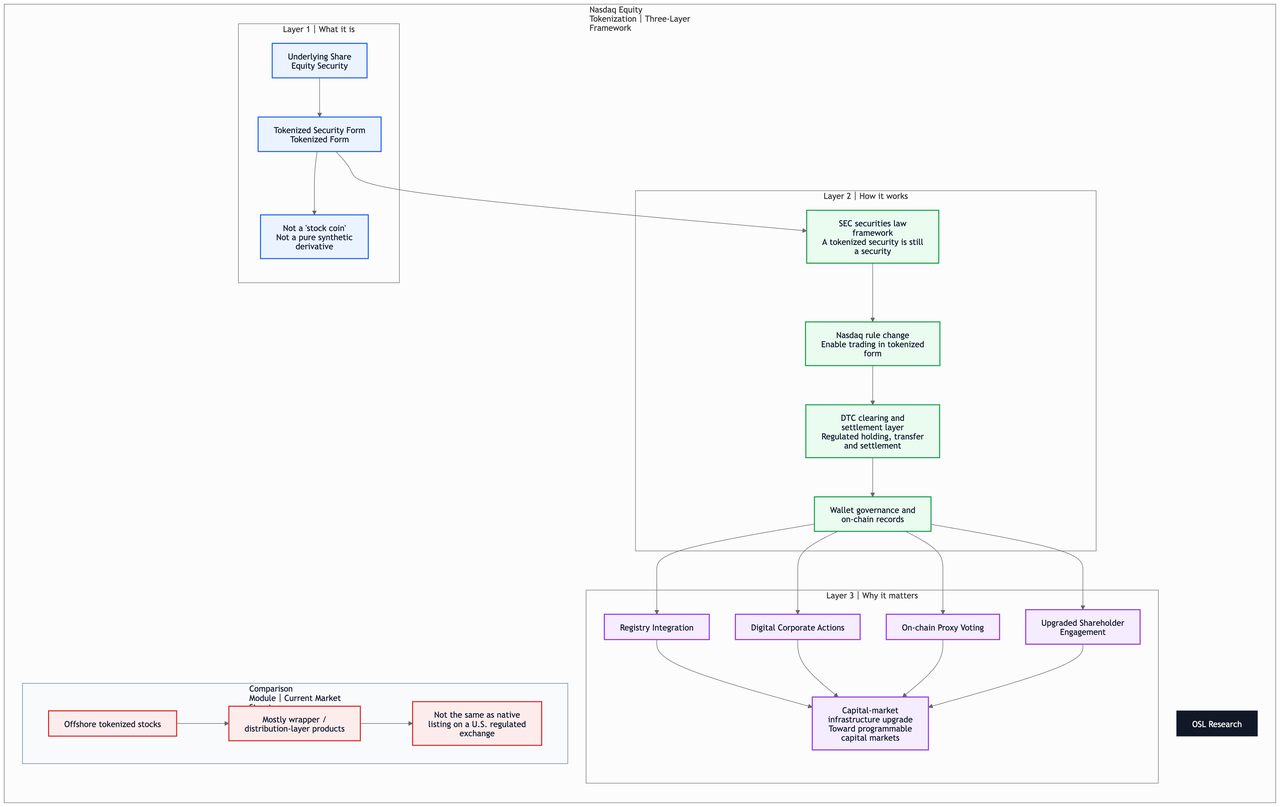
(Nasdaq Equity Tokenization Three-Layer Framework)
III. How Does Nasdaq Achieve Breakthroughs in Compliance?
1. Strict Adherence to Existing Regulatory Frameworks
In its January statement, the SEC categorized tokenized securities into two types:
Issuer-sponsored: The issuer itself or its authorized agent tokenizes the security.
Third-party-sponsored: A third-party institution tokenizes securities issued by another entity.
The SEC reiterated that regardless of the model adopted, the on-chain format absolutely does not alter its fundamental attribute of being subject to U.S. securities laws.
2. Trading Mechanisms Must Embed into Existing Sovereign Exchange Rules
According to official SEC disclosures, the formal rule filing submitted by Nasdaq is titled
3. Core Objective: Reconstructing Shareholder Rights and Registration Systems
Reuters reported that Nasdaq's current proposal focuses on corporate actions, proxy voting, and shareholder interactions. This demonstrates that traditional mainstream exchanges are
IV. Market Status: Are There Mature and Successful Precedents?
Conclusion: "Similar products" exist in the market, but a truly mature "native listing version on a mainstream U.S. exchange" has yet to emerge.
Currently, tokenized stocks launched by platforms like Robinhood, Gemini, and Kraken have appeared in the European market. However, Reuters emphasized that Nasdaq is currently advancing a higher-specification upgrade of regulated market infrastructure, rather than simply replicating the mapping models of offshore markets. This means that while offshore markets have tested related products, implementing rules and infrastructure at the level of a mainstream U.S. domestic exchange is an industry first.
V. Macro Judgment: Why is This Step Crucial?
This development signifies that the core agenda of mainstream U.S. financial markets has substantially transitioned from merely discussing "whether stocks can go on-chain" to the practical stage of "what structure stocks should adopt when going on-chain."
What truly holds epoch-making significance is no longer a single Token itself, but the comprehensive reconstruction of the following core market infrastructures:
Upgrading securities registration mechanisms
Reshaping clearing and settlement models
Transitioning shareholder voting and corporate action processing mechanisms on-chain
Breaking through trading hours: Evolving from restricted traditional trading hours to a more continuous market structure
Establishing a compliance connection layer: Building standardized compliance channels between securities businesses and blockchain networks
VI. Business Guidance
Platform/Type | Directional Judgment | Why (Reasoning) | Signal |
|---|---|---|---|
Pure Order-Matching Crypto-Native Exchanges (Binance, OKX, Bybit, KuCoin, MEXC, Gate, Bitget) | Mildly Bearish | If mainstream exchanges turn tokenized securities into regulated standard products, the traffic and narrative premium these platforms previously acquired through "offshore mapped stocks" and "on-chain US stock concepts" will be compressed. The SEC has also clarified that many third-party tokenized stocks are merely entitlements, linked securities, or security-based swaps, and do not equate to real shareholder rights. (US SEC) | Regulatory arbitrage space shrinks, product differentiation decreases. (US SEC) |
Platforms with Distribution Capabilities like Kraken | Neutral-to-Bullish | Kraken's parent company Payward has partnered with Nasdaq to develop tokenization infrastructure, indicating that crypto-native platforms are not necessarily excluded, but may instead enter the compliant distribution and access layer. (Reuters) | Role shifts from "spontaneous product provider" to "compliant distribution/infrastructure partner." (Reuters) |
Platforms with Stronger Compliance Capabilities like Coinbase | Bullish Mid-to-Long Term | Coinbase sought SEC approval for tokenized equities as early as 2025 and subsequently publicly stated its intention to launch round-the-clock tokenized stocks. As the regulatory path becomes clearer, such platforms have a better chance of undertaking capabilities such as brokerage, custody, wallet, and clearing interfaces. (Reuters) | Licenses, custody, compliance, and wallet integration will become more important than mere trading volume. (Reuters) |
Retail Distribution Platforms like Robinhood | Short-Term Beneficiary, Long-Term Divergence | Robinhood has launched over 200 US stock and ETF stock tokens in the EU, but this path has also raised regulatory concerns that "investors might mistakenly believe they are genuine shareholders." If the mainstream US market introduces more standardized solutions in the future, Robinhood will either benefit from broader market education or face pressure for product upgrades. (Reuters) | Strong distribution, but the legal attributes of the products must be clearer. (Reuters) |
Nasdaq / Traditional Exchange Systems | Clear Beneficiary | Nasdaq has partnered with Payward with the goal of incorporating tokenized stocks into mainstream market infrastructure and promoting rules for securities to be traded in tokenized form. What it takes away is not simply "trading volume," but rather pulling registration, corporate actions, voting, and clearing back into the traditional market system. (Reuters) | Exchanges upgrade from trading venues to the institutional entry points for tokenized securities. (Reuters) |
This also fully explains why Nasdaq chose to partner with Payward/Kraken to build underlying infrastructure instead of directly launching a retail-facing trading product.
This developmental trend is not simply bearish for crypto-native exchanges; rather, it directly squeezes "regulatory arbitrage-style stock token businesses" and serves as a long-term bullish signal for licensed platforms "capable of undertaking compliant tokenized securities infrastructure."
Start your safe cryptocurrency journey now
OSL | Secure Ramps. Trusted Rails !
More About Topics
More About Topics


Latest
How to Evaluate Tokenised Bonds: Rights, Custody and Settlement Checks
Putting a bond on-chain does not remove credit risk. Use this checklist to review holder rights, legal records, custody, settlement and transfer restrictions.
How to Evaluate Tokenised Bonds: Rights, Custody and Settlement Checks
How to Choose a Bitcoin Platform in Hong Kong: A Practical Checklist
Compare Bitcoin platforms by custody arrangements, total costs, withdrawal rules, account security and support records, not by return forecasts.
How to Choose a Bitcoin Platform in Hong Kong: A Practical Checklist
Five Checks Before Opening a Crypto Account in Hong Kong
Overseas regulatory news does not mean a platform is licensed in Hong Kong. Check the legal entity, official website, service scope, client eligibility and terms before opening an account.
Five Checks Before Opening a Crypto Account in Hong Kong
60-Vote Hurdle for CLARITY Act Exposes Limits of Legislative Hope
The CLARITY Act's September 15 procedural vote exposes why implemented regulatory frameworks may offer institutions more operational certainty than pending U.S. legislation.
60-Vote Hurdle for CLARITY Act Exposes Limits of Legislative Hope
XRP Rebounds 30% Then Slips: DeFi Infrastructure Faces Volatility Exam
XRP Ledger's $1.1 billion stablecoin expansion and new lending protocol foundation face an immediate stress test as XRP price swings 30% monthly.
XRP Rebounds 30% Then Slips: DeFi Infrastructure Faces Volatility Exam
$0.325 SKY Forecast: Valuation Model or Institutional Wish?
Standard Chartered's $0.325 price target on Sky's governance token applies bank-style valuation to on-chain credit infrastructure, but the forecast depends on USDS adoption and borrowing expansion that remains nascent.
$0.325 SKY Forecast: Valuation Model or Institutional Wish?
Recommended For You
More About Topics
More About Topics