Jane Street's 10 AM: Are Wall Street Giants Suppressing Bitcoin Prices via ETFs?
Introduction
10 AM—a time slot that has served as a benchmark for the Asian crypto trading market over the past few months—has once again ignited market discourse, pulling it from the liquidity freeze of a bear market back to a boiling point, following the disclosure of a U.S. lawsuit.
It all started with Jane Street Capital, a top-tier Wall Street market maker founded in 2000. The market accused the firm of utilizing the spot ETF Creation & Redemption mechanism to execute a months-long "sleight of hand," deploying directional ETF arbitrage tactics between the spot and derivatives order books.
This covert game, dubbed the "10 AM Manipulation," turned inherently neutral liquidity into a breeding ground for risk-free arbitrage by top-tier institutions. It wasn't until the lawsuit struck like a thunderbolt, forcing the market maker's suppression algorithms to shut down, that the crypto market finally woke up from this artificially manufactured bear market illusion. What followed was a suppressed, epic, and cascading Short Squeeze—within a mere 24 hours, over $240 billion in market capitalization was violently generated, wiping out short sellers across the network.
Market behavior shifted dramatically post-lawsuit, completely revealing the underlying hand of this liquidity war.
Jane street on the different street
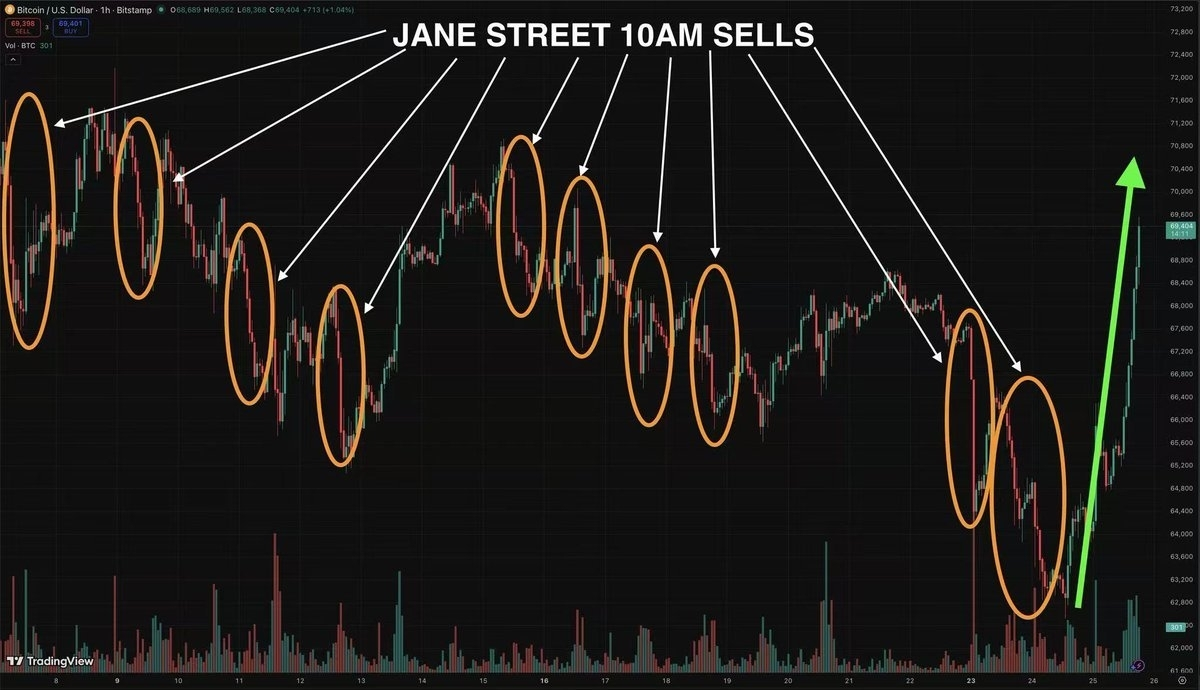
Market behavior shifted dramatically following the lawsuit, completely exposing the underlying cards of this liquidity war.
Today, the billion-dollar question everyone in the market is asking is: Did Jane Street suppress the price of Bitcoin?
This question deserves a precise answer—but the most important thing to understand first is that this is not actually a question about Jane Street.
It is a question about the structural characteristics of the Bitcoin ETF architecture, and it applies equally to every Authorized Participant (AP) in the ecosystem.
For BlackRock's IBIT alone, this roster includes Jane Street, JPMorgan, Macquarie, Virtu Americas, Goldman Sachs, Citadel Securities, Citigroup, UBS, and ABN AMRO. The roles of these institutions are deeply misunderstood by the public, and even among seasoned industry veterans. Before drawing any conclusions, this misunderstanding deserves to be corrected.
Regarding APs, the first thing to understand is that they occupy a fringe exception within the regulatory framework of Reg SHO (the SEC's rules regulating naked short selling). Reg SHO requires short sellers to locate and borrow shares before shorting, but APs are granted an exemption by virtue of their contractual right to participate in creations and redemptions.
While this sounds procedural, its practical consequences are massive: Any AP can create shares at will—with no borrowing costs, no capital lock-up traditionally tied to shorting, and no hard deadline to close the position outside of reasonable commercial terms.
This is the gray area: a regulatory exemption designed for orderly ETF market making that, structurally speaking, is indistinguishable from regulatory arbitrage with an unparalleled duration. This exemption is not unique to any single firm. It is a prerequisite for membership in the AP club.
The second point to understand is the capability this exemption grants in terms of portfolio construction
Normally, if IBIT is trading below its Net Asset Value (NAV), you would expect arbitrage buyers to step in, redeem the shares for Bitcoin, and close the spread. But any AP is that arbitrage buyer themselves. They control the plumbing, which means their incentive to close this spread is entirely different from a third-party trading desk without creation/redemption rights.
It sounds complex, so let me use a simple analogy:
Layer 1: What is normal "spread closing"?
Imagine a blind box on the market (this is the IBIT ETF). Everyone knows the box contains a real Bitcoin voucher worth $100 (this is the NAV). However, due to market panic today, the price tag of this blind box drops to $95. The logic of a normal person is: a smart merchant (arbitrage buyer) will aggressively buy the blind box for $95, go to the official issuer to open it, exchange it for the $100 Bitcoin, and sell it, earning a risk-free $5 spread. Because everyone rushes to buy the blind box for arbitrage, the buying pressure quickly pushes the price back to $100. This is called "closing the spread."
Layer 2: The AP with a "Monopoly Channel"
But in the real world of Bitcoin ETFs, ordinary trading firms and retail investors are not qualified to go to the official issuer to "open the blind box" (i.e., they have no creation/redemption rights). Only a few privileged major Wall Street investment banks (APs) in the entire market can do this. In other words, APs monopolize the only channel to convert ETFs into actual Bitcoin (they control the plumbing).
Layer 3: Why don't APs play by the book? (Different Incentives)
If it were an ordinary third-party merchant, seeing this risk-free $5 spread, they would act immediately. But APs are different. An AP will make a much shrewder calculation: "Since only I can open the blind box, what's the rush? If I deliberately avoid pulling the price back to $100, and instead use the illusion of the current $95 low price to go long or short in another casino (like the Bitcoin futures market), I might be able to make $20!"
To summarize: The market originally had an automatic correction mechanism (if it falls too much, arbitrageurs buy to drive the price up). However, because the "only switch" to execute this correction mechanism is in the hands of the APs, and the APs realize that "not correcting and maintaining the spread" allows them to make more money elsewhere, they have absolutely no incentive to pull the price back to a normal level.
Retail investors are waiting bitterly for an army of arbitrageurs to save the price, not knowing that the only arbitrage army (the APs) is standing by, using this spread to extract profits from other markets.
IBIT's short exposure can, in principle, be hedged by going long on spot Bitcoin—but this is not mandatory, as long as the chosen instrument maintains a tight correlation. The obvious alternative is BTC futures, particularly given their capital efficiency.
The key implication here is: if the hedging instrument is futures rather than spot, then the spot is never actually bought. Because the natural arbitrage buyers choose not to buy spot, this spread cannot be closed through natural arbitrage mechanisms.
It is worth noting that the spot/futures basis itself is the core focus of the entire basis trader community, who strive to keep this relationship tight. However, every separation between the hedging instrument and the underlying asset introduces dirty basis risk, which continuously compounds throughout the structure—and under stressed conditions, basis risk is exactly where market dislocations occur.
The final piece of the puzzle involves the SEC's recently approved in-kind creation and redemption. Under the previous cash-only regime, APs were required to deliver cash to the fund, which the custodian then used to purchase spot Bitcoin. This purchasing action was a structural regulator—it forced the buying of spot as a mechanical consequence of creation.
In-kind redemptions completely eliminate this. Now, any AP can directly deliver Bitcoin, and the timing and counterparties for its sourcing are entirely at their discretion: OTC desks, negotiated pricing, minimizing market impact. The broadest interpretation of this flexibility is that APs can maintain derivative positions aimed at capturing funding rates or volatility profits during the time window between establishing the short and completing physical delivery—all while ensuring that each individual step still fits the definition of legitimate AP activity.
And this is precisely the crux of the problem. The beginning looks like normal market-making behavior. The end looks like normal market-making behavior.
It is the intermediate process that is difficult to clearly categorize.
This is not an indictment of any single firm. Every AP on the IBIT roster—and by extension, every AP for every Bitcoin ETF—operates within the same structural framework, enjoys the same exemptions, and therefore possesses the same theoretical capabilities.
Whether any of them exercised this capability in a manner hovering on the edge of coordinated activity is a question that falls squarely within the purview of the "surveillance-sharing agreements" the SEC required when approving the ETFs. Whether these agreements are sufficient to capture behaviors spanning across spot, futures, and ETF markets simultaneously (even including offshore trading venues) remains a genuinely open question.
The short answer is that no AP is explicitly suppressing the price of Bitcoin. What the AP structure can suppress is the integrity of the price discovery mechanism itself. These are not the same thing—but arguably, the latter has far more profound implications than the former. The real question worth asking is not whether a specific firm is the villain. Rather, it is: Does a regulatory framework built for traditional ETFs suit an asset whose entire value proposition lies in not being controlled by these very institutions?
Disclaimer and Disclosure
1. Nature of Document
This document ("the Document") has been prepared by OSL internal personnel for informational purposes only and does not constitute investment, legal, tax, or other professional advice, nor should it be relied upon as such. No part of this Document may be reproduced, distributed, or transmitted to any third party in any form without OSL's prior written permission. This Document does not constitute an offer, solicitation, marketing material, product disclosure statement, or legal document, nor does it form the basis of any binding contract or commitment. It is intended solely to present OSL's observations and strategic insights into the industry and does not represent OSL's official position, strategy, or decisions. The authors are not independent research analysts, and this Document does not constitute "investment research" as defined by applicable laws or regulations. Consequently, it has not been prepared in accordance with legal requirements designed to ensure the independence of investment research and is not subject to any prohibition on dealing ahead of the dissemination of investment research.
2. No Reliance
The information, opinions, and analysis contained in this Document are based on public information and OSL's internal judgment, without regard to the individual objectives, financial situation, or needs of any recipient. This Document does not constitute a personal recommendation or an invitation or solicitation to buy, sell, or engage in any financial instrument, product, or service. Recipients should consult their own independent advisors regarding their specific circumstances, objectives, experience, and financial resources before making any investment or other decision. All investments involve risk; values may fluctuate, and investors may recover less than the original investment amount. Past performance is not indicative of future results.
3. Accuracy, Completeness, and Limitations
This Document is compiled based on information OSL believes to be reliable, but OSL has not independently verified its accuracy, completeness, or fairness. While reasonable care has been taken to ensure the content is not false or misleading, OSL makes no express or implied warranty regarding the accuracy, completeness, fairness, or reasonableness of the content. OSL assumes no liability for any errors, omissions, or consequences of reliance on third-party information cited in the Document. The performance of any instrument, entity, or strategy mentioned may be significantly affected by market, regulatory, technical, or other factors.
4. Forward-Looking Statements
This Document may contain forward-looking statements involving known and unknown risks, uncertainties, and other factors. Actual results, performance, or achievements may differ materially from those expressed or implied. OSL is under no obligation to update, modify, or withdraw any forward-looking statements.
5. Conflict of Interest Disclosure
OSL, its affiliates, and employees may hold positions in or participate in transactions involving the assets or entities mentioned in this Document. The authors or related personnel may receive compensation related to OSL's business performance. OSL has implemented policies and procedures to identify and manage potential conflicts of interest.
6. Intellectual Property and Usage Restrictions
This Document is protected by copyright and is intended solely for internal use by the designated recipient. Recipients may store, display, analyze, modify, reformat, and print this Document for internal use, but without OSL's prior written consent, may not:
Resell, redistribute, or commercially use this Document;
Reverse engineer, extract, or create derivative works, including for training or application in machine learning/AI systems;
Publish or transmit this Document to third parties.
7. Limitation of Liability
To the maximum extent permitted by applicable law, OSL and its affiliates, officers, employees, and agents shall not be liable for any direct, indirect, incidental, consequential, or special damages arising out of or in connection with the use, reliance, or interpretation of this Document, including but not limited to:
Loss of profits;
Business interruption;
Data corruption or loss;
Reputational damage.
8. Global Distribution
Recipients are responsible for ensuring compliance with applicable local laws. The distribution of this Document may be restricted in certain jurisdictions. Recipients must ensure this Document is not distributed to any person or entity prohibited by law from receiving it.
Start your safe cryptocurrency journey now
OSL | Secure Ramps. Trusted Rails !
More About Topics
More About Topics
Latest
60-Vote Hurdle for CLARITY Act Exposes Limits of Legislative Hope
The CLARITY Act's September 15 procedural vote exposes why implemented regulatory frameworks may offer institutions more operational certainty than pending U.S. legislation.
60-Vote Hurdle for CLARITY Act Exposes Limits of Legislative Hope
XRP Rebounds 30% Then Slips: DeFi Infrastructure Faces Volatility Exam
XRP Ledger's $1.1 billion stablecoin expansion and new lending protocol foundation face an immediate stress test as XRP price swings 30% monthly.
XRP Rebounds 30% Then Slips: DeFi Infrastructure Faces Volatility Exam
$0.325 SKY Forecast: Valuation Model or Institutional Wish?
Standard Chartered's $0.325 price target on Sky's governance token applies bank-style valuation to on-chain credit infrastructure, but the forecast depends on USDS adoption and borrowing expansion that remains nascent.
$0.325 SKY Forecast: Valuation Model or Institutional Wish?
SEC Custody Rewrite Hits White House, Jurisdictional Gap Widens
The SEC's proposed crypto custody rewrite entered White House review on August 25, 2026, leaving U.S. institutional frameworks unresolved while banks and custodians position services under divergent national rule stacks.
SEC Custody Rewrite Hits White House, Jurisdictional Gap Widens
India's $100M Bond Tokenization: A Rights Structure Stress Test
SEBI's Demat 2.0 pilot issued over $100 million in tokenized bonds using digital rupee settlement, but its phased rollout from institutional pilots to secondary trading and retail access tests whether off-chain...
India's $100M Bond Tokenization: A Rights Structure Stress Test
Recommended For You
More About Topics
More About Topics