Block's 50% AI Layoff: The Capital Logic Explained
Just a few days ago (February 22), the financial world was sent shivering by a viral article from macro research firm Citrini Research titled The 2028 Global Intelligence Crisis. Written in the format of a "memo from the future," the piece mapped out a systemic economic collapse triggered by AI.
It stated: "In early 2026, the first wave of layoffs caused by human intelligence displacement began. Margins expanded, earnings beat expectations, and stock prices hit record highs."
Everyone thought it was just an extreme thought experiment. That is, until four days later, on February 26, when Block (formerly Square) founder Jack Dorsey personally pressed the confirmation button in the real world.
He calmly announced on X: "We're making @blocks smaller today."
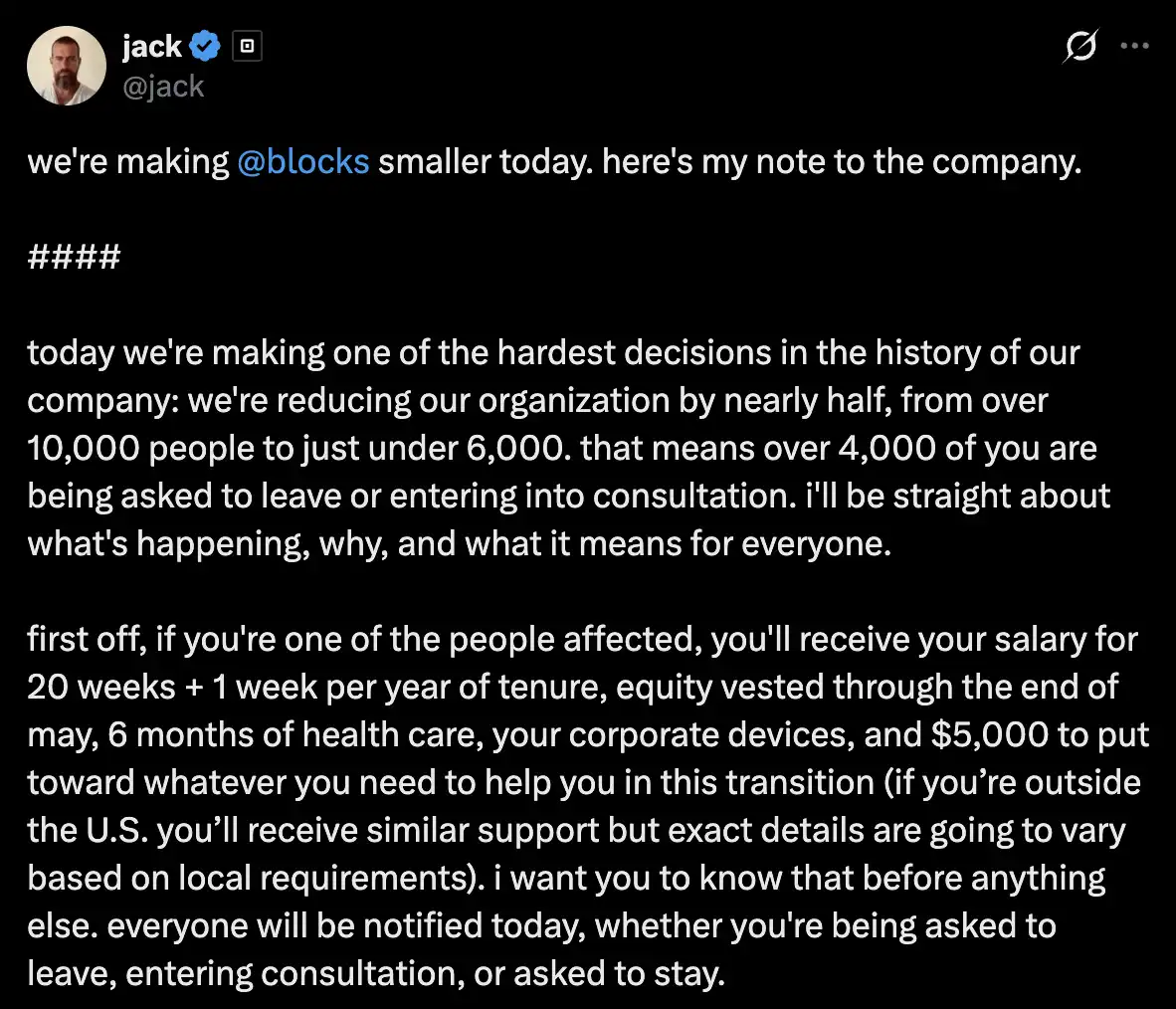
Accompanying this tweet was Block's stellar Q4 earnings report, showing a 24% year-over-year increase in gross profit, a euphoric 24% after-hours surge in its stock price, and—termination notices sent to over 4,000 employees (nearly 50% of the entire company).
Citrini's "2028 Nightmare" premiered its first act ahead of schedule on this Thursday in 2026.
The Executioner "Goose": A Dimensional Strike on Big Tech's Architecture
Unlike past layoff narratives of "cutting off an arm to survive a harsh market winter," Dorsey's all-hands letter was disturbingly candid: "We aren’t doing this because we are in trouble. Our business is strong... But something has changed. We are already seeing internally that, combined with the intelligent tools we are building and using, smaller teams can do more and do it better."
That "intelligent tool" replacing 4,000 people is an internal AI system at Block codenamed Goose. It proved that AI is no longer merely a supportive tool helping "one person do the work of two," but a terminator directly shattering the livelihoods of engineers and project managers.
According to leaked technical details, Goose executed a three-dimensional strike on the traditional organizational structure of tech companies:
Bypassing the "code tailors" to directly take over the bottom layer: Traditional AI assistants can only write code snippets, but Goose possesses global read/write access to Block's massive legacy codebase. In the past, modifying a cross-border payment interface required 5 to 8 engineers across three departments spending two weeks to align. Now, by simply inputting natural language, Goose automatically scans microservices, identifies conflicts, and directly generates a Pull Request. Mid-level engineers responsible for interface integration instantly lost their value.
Extreme "unattended" operations: The payment business requires 24/7 uninterrupted operation, which previously relied on huge teams working in shifts. Today, Goose analyzes logs 10 times faster than humans and can autonomously execute rollbacks or scale-ups.
Eliminating the "middlemen": Project managers who act as "translators" between client needs and development tasks had their communication functions ruthlessly wiped out by the system.
A deeply ironic metaphor: To promote an "AI-first" culture, Dorsey once required all employees to send him a weekly email reporting five work accomplishments. His method for processing these thousands of emails? Using AI to generate summaries for him to read. He was using AI to evaluate who would be replaced by AI.
The Perfect "Fig Leaf": Wall Street's Favorite Sexy Model
However, the reason this AI butcher knife was swung with such resolve lies in an even more hidden layer of business logic.
Dialing the clock back to the zero-interest-rate frenzy between 2020 and 2022, Silicon Valley fell into an irrational "talent-hoarding race." Block's headcount skyrocketed from under 4,000 to over 12,000, and Dorsey even spent nearly $300 million to acquire the streaming platform Tidal, which had absolutely nothing to do with their core business.
When the tide went out, the bloated physique became a heavy shackle for tech giants. How could they shed this historical baggage without exposing their strategic failures to the capital markets? The answer: Use AI to tell a story of cost reduction and efficiency gains.
Packaging brutal layoffs as an "AI-embracing organizational restructuring" not only covered up management's past oversight of blind expansion but also transformed the company into a pioneer of a new era. Wall Street doesn't care what mistakes you made in the past; they only see this: the departure of 4,000 people means an immediate savings of nearly $1 billion in annual operating expenses; the remaining 6,000 employees will support a massive revenue of over $22 billion, with the annual revenue generated per employee soaring directly to over $3.5 million.
Because of this, when Dorsey offered extremely generous severance packages (20 weeks of base pay, six months of health insurance, a $5,000 transition bonus, and even keeping Slack access open for a dignified farewell), the capital markets did not hesitate to vote "yes" with a 24% surge in stock price.
As Cobo founder Discus Fish put it: "What AI is truly changing isn't the enhancement of human skills, but the transformation of corporate organizational structures."
The Death Spiral: A Disaster With No Villains
Block is by no means an isolated case. This is a trajectory that has been running for two years with a dizzying acceleration:
2024: Klarna replaced 700 customer service agents with AI.
2025: IBM replaced 8,000 HR roles with AI; Salesforce laid off 4,000 customer support staff.
Early 2026: Amazon cut 30,000 jobs; even the historically impenetrable law firm Baker McKenzie laid off nearly a thousand support staff.
Returning to Citrini’s predictive article, its most despairing core lies in the "Intelligence Displacement Spiral": AI expands margins - rightarrow funds are reinvested into stronger AI - rightarrow more jobs are replaced - rightarrow unemployment leads to shrinking consumption - rightarrow companies are forced to use AI to compress costs even further.
In this spiral, you can't find a single villain.
Dorsey isn't wrong; he made a highly rational cost-cutting decision. Wall Street isn't wrong; they are rewarding an efficient business model.
The laid-off employees certainly aren't wrong; they simply happened to be sitting on a ship undergoing a structural refit. Just as Citrini stated, incumbents aren't the victims defeated by AI; they are the most aggressive adopters of AI. The ones being defeated are their own employees.
In every past technological revolution, humanity found new places for itself (carriage drivers became car drivers). But this time, the rule has failed. Because those "jobs of the future"—AI trainers, prompt engineers—AI is learning to do them itself.
A Harvard study coldly pointed out: tech companies are, on average, hiring 5 fewer entry-level employees per quarter, and hiring for junior roles has dropped by over 50%. Those positions weren't relocated; they simply are no longer being created.
An entire generation was trained to enter an industry, only to have that industry quietly decide, right as they were about to step in, that it no longer needed entry-level humans.
Block's earnings night was like the canary in the coal mine letting out its highest-decibel cry. But the question was never whether the canary died; it's whether we have an exit when the entire mine starts to shake.
Start your safe cryptocurrency journey now
OSL | Secure Ramps. Trusted Rails !
More About Topics
More About Topics
Latest
60-Vote Hurdle for CLARITY Act Exposes Limits of Legislative Hope
The CLARITY Act's September 15 procedural vote exposes why implemented regulatory frameworks may offer institutions more operational certainty than pending U.S. legislation.
60-Vote Hurdle for CLARITY Act Exposes Limits of Legislative Hope
XRP Rebounds 30% Then Slips: DeFi Infrastructure Faces Volatility Exam
XRP Ledger's $1.1 billion stablecoin expansion and new lending protocol foundation face an immediate stress test as XRP price swings 30% monthly.
XRP Rebounds 30% Then Slips: DeFi Infrastructure Faces Volatility Exam
$0.325 SKY Forecast: Valuation Model or Institutional Wish?
Standard Chartered's $0.325 price target on Sky's governance token applies bank-style valuation to on-chain credit infrastructure, but the forecast depends on USDS adoption and borrowing expansion that remains nascent.
$0.325 SKY Forecast: Valuation Model or Institutional Wish?
SEC Custody Rewrite Hits White House, Jurisdictional Gap Widens
The SEC's proposed crypto custody rewrite entered White House review on August 25, 2026, leaving U.S. institutional frameworks unresolved while banks and custodians position services under divergent national rule stacks.
SEC Custody Rewrite Hits White House, Jurisdictional Gap Widens
India's $100M Bond Tokenization: A Rights Structure Stress Test
SEBI's Demat 2.0 pilot issued over $100 million in tokenized bonds using digital rupee settlement, but its phased rollout from institutional pilots to secondary trading and retail access tests whether off-chain...
India's $100M Bond Tokenization: A Rights Structure Stress Test
Recommended For You
More About Topics
More About Topics