A Practical Guide to P2E Blockchain Gaming: How to Start Earning While You Play

Have you ever thought that gaming could be more than just a 'paid pastime' and become a way to 'accumulate assets'? With the popularization of Web3 technology, a new model known as P2E (Play-to-Earn) is reshaping the gaming industry. For many newcomers, this sounds both enticing and full of unknowns.
This guide will break down the Play-to-Earn: A Guide to Making Money and Cashing Out in P2E Blockchain Games, taking you from the underlying logic to practical steps to understand the mechanics of this emerging field.
What are P2E Blockchain Games? A Deep Dive into the Underlying Logic of Play-to-Earn
Before diving into the operations, let's use an analogy. Traditional online games are like 'renting a house': the equipment and skins you buy in the game essentially only grant you 'usage rights'. Once the server shuts down or your account is banned, all the time and money you've invested vanish.
P2E blockchain games, on the other hand, are more like 'buying a house'. Leveraging blockchain technology, in-game items, characters, and coins are confirmed as NFTs (Non-Fungible Tokens) or crypto tokens. This means these assets truly belong to you, can be taken out of the game, and traded freely on the open market.
Simply put, the core logic of P2E is the 'return of asset ownership'. According to industry observation reports from 2024, user demand for digital asset ownership is growing exponentially, which is the fundamental reason why the P2E model has attracted millions of players. In this ecosystem, players are no longer just consumers but participants and builders of the game's economy.
Starting from Scratch: Essential Tools and Account Setup for Entering P2E Blockchain Gaming
To embark on this journey, you need to prepare a set of 'digital adventure gear'. No complex programming knowledge is required; you just need to handle the following two basic steps:
First, you need a crypto wallet. Imagine this as your 'all-purpose backpack' and 'bank account' in the Web3 world. It's used not only to store your game account (proof of identity) but also to hold the coins and equipment you earn in the game. There are many browser extension wallets on the market with very user-friendly interfaces. You just need to remember your 'seed phrase' (equivalent to a bank card PIN, which you must never share with anyone) to easily create one.
Second, you need to prepare a small amount of base tokens for 'gas fees'. Any operation on the blockchain, such as claiming equipment or trading items, consumes a tiny amount of network resources. This is like paying a toll on a highway. You can obtain these base tokens through compliant channels and transfer them to your wallet for use.
A Guide to Choosing Games and Avoiding Pitfalls: How to Screen for High-Potential, Quality Blockchain Game Projects
There are thousands of blockchain games on the market. How do you avoid the 'minefields' of low-quality projects? Screening for quality projects is surprisingly similar to evaluating a restaurant in real life.
You can consider the following three dimensions:
Team Background and Transparency: Just like checking who the chef is at a restaurant, look into whether the development team is public and if they have a history of successful game development. Teams that are serious about their project usually disclose detailed member information on their official website.
Community Activity and Authenticity: Join the project's official community and observe. Are people discussing gameplay and strategies, or is everyone just spamming 'when will the price go up'? The former usually indicates a more vibrant project, while the latter might just be short-term hype.
Sustainability of the Economic Model: A good P2E game must have a sustainable economic system. If the game promises ridiculously high returns and relies solely on new players to pay out old players' earnings, it's often an unsustainable signal. Quality games design various 'sink scenarios', such as equipment repair and character upgrades, to ensure the economy circulates healthily within the ecosystem.
The Full Process of Cashing Out Earnings: Core Profit Models and Practical Operations of P2E Blockchain Games
Now that you understand the tools and screening criteria, you might ask: how does the Play-to-Earn: A Guide to Making Money and Cashing Out in P2E Blockchain Games manifest in practice? Generally, earnings come from two main sources.
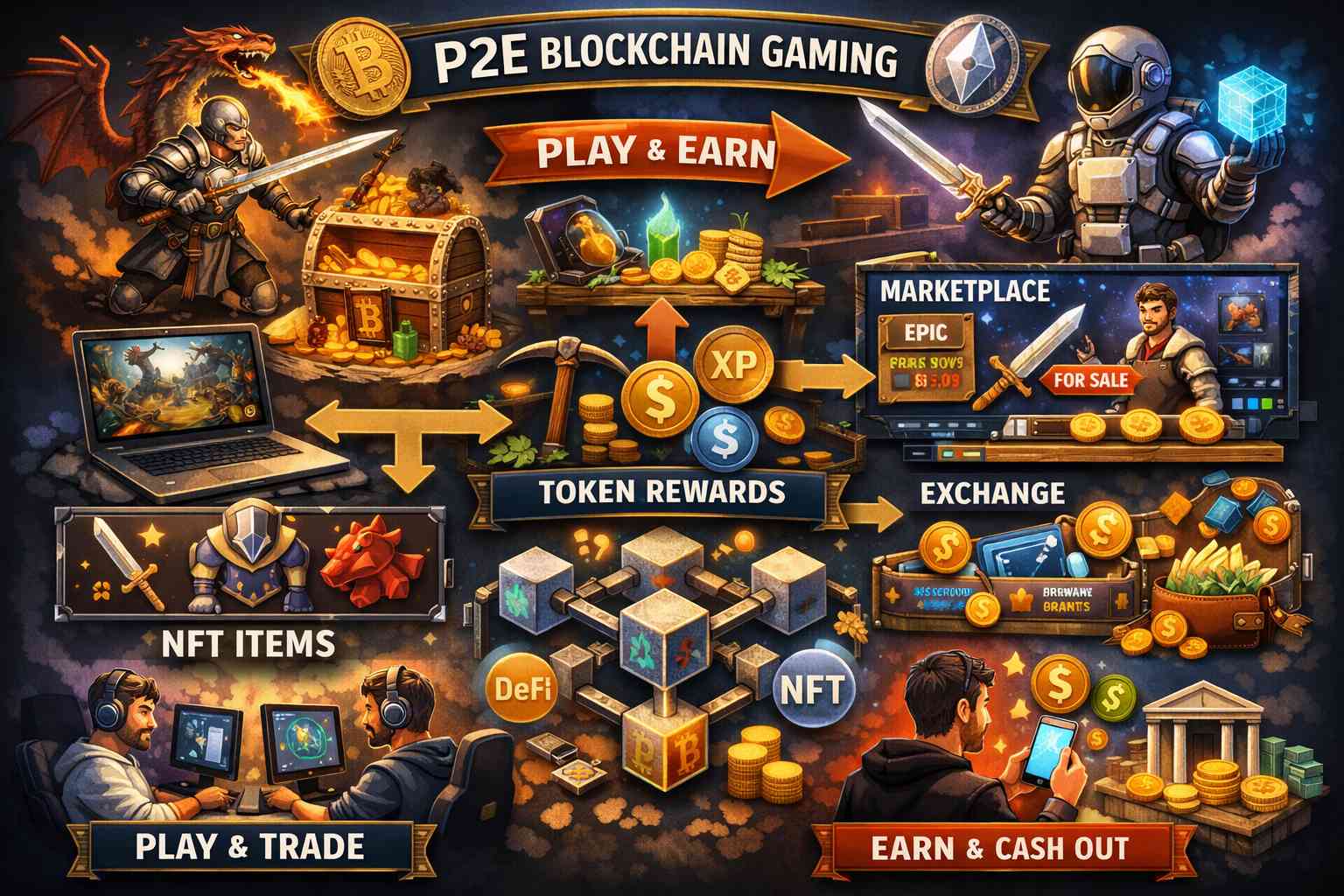
The first is daily earnings. This is similar to traditional 'gold farming'. When you complete daily tasks, pass levels, or win battles in the game, the system rewards you with in-game utility tokens. Once you accumulate a certain amount, you can withdraw these tokens to your wallet and then exchange them for other assets on compliant platforms.
The second is asset appreciation. For example, you might get lucky and find a rare piece of equipment as an NFT, or you might spend time developing a character with top-tier attributes. These NFTs are inherently scarce, and you can sell them to other players who need them on the in-game marketplace or external NFT trading platforms.
This is like playing collectible card games in real life. Not only can you win prize money (token earnings) by participating in tournaments, but if you decide to stop playing, you can also sell your rare, out-of-print cards for a good price (NFT earnings).
Risks and Challenges: Common Traps Newcomers Must Watch Out for in P2E Blockchain Gaming
Although the P2E model sounds wonderful, as an emerging field, it is also full of challenges. To protect yourself, you must always stay vigilant.
First is the market volatility risk. The prices of in-game tokens are not static; they fluctuate dramatically with market supply and demand. An item that is valuable today might depreciate next month due to a game update or a loss of players.
Second is the security risk. There are numerous phishing websites online that masquerade as official game pages to trick you into connecting your wallet and granting permissions. You must develop the habit of 'double-checking official URLs', avoid clicking on unfamiliar links, and never rashly authorize unknown smart contracts.
Finally, avoid a 'get-rich-quick' mentality. Many newcomers, eager to recoup their investment, spend more than they can afford on expensive entry NFTs, only to find themselves in a difficult position due to market changes. Always remember: only invest funds that you can afford to lose without affecting your daily life.
Conclusion: How to Achieve Long-Term, Stable Earnings in the P2E Gaming Market
P2E blockchain games have opened a door for us to the world of Web3, making our gaming time more valuable. By mastering this Play-to-Earn: A Guide to Making Money and Cashing Out in P2E Blockchain Games, you now understand the mechanics of this field better than most.
To achieve long-term, stable earnings, the key lies in 'mindset' and 'learning'. Don't be swayed by short-term price fluctuations. Focus on enjoying the game itself, delve into its mechanics, and seek out projects that are genuinely fun to play and have a strong community consensus.
Finally, in this rapidly evolving field, security is always paramount. It is recommended to always choose well-known, compliant, and regulated platforms for learning, asset management, and gaming experiences. This is the best way to ensure the safety of your digital assets.
Start your safe cryptocurrency journey now
OSL | Secure Ramps. Trusted Rails !
More topics
More topics


Latest
Why India's $620B Bond Pilot Changed Nothing Legal
SEBI and the RBI's Demat 2.0 pilot issues corporate bonds as digital tokens and settles them with the wholesale digital rupee, preserving existing legal terms while digitizing the infrastructure beneath a $620...
Why India's $620B Bond Pilot Changed Nothing Legal
Why S&P Global Leads Kaiko: Not Hype, But 24/7 Market Infrastructure
S&P Global led a $110 million extension of Kaiko's Series B to build data infrastructure for round-the-clock tokenized markets.
Why S&P Global Leads Kaiko: Not Hype, But 24/7 Market Infrastructure
When One Firm Holds 5% of Ethereum: Infrastructure Stress Test
Bitmine's accumulation of more than 5 million staked ETH raises questions about whether custody, audit, and validator infrastructure can support single-asset concentration at public-company scale.
When One Firm Holds 5% of Ethereum: Infrastructure Stress Test
Best Enterprise Stablecoin Payment Providers: A 2026 Evaluation Framework
Compare enterprise stablecoin payment providers by use case, legal entity, workflow, controls, integration, reconciliation, support, and contract terms.
Best Enterprise Stablecoin Payment Providers: A 2026 Evaluation Framework
How to Reconcile a USDGO Payment: An Illustrative Finance-Close Example
See how Finance can trace a USDGO payment from an approved obligation through payment records, recipient confirmation, reconciliation, and accounting close.
How to Reconcile a USDGO Payment: An Illustrative Finance-Close Example
A USDGO Reserve Review in Practice: Findings, Limits and Follow-up Questions
Review what the July 2026 USDGO reserve attestation establishes, what it does not prove, and which issuer, redemption, and liquidity questions remain.
A USDGO Reserve Review in Practice: Findings, Limits and Follow-up Questions
Recommended for you
More topics
More topics
