Who Keeps the Ledger Without a Bank? A Guide to Understanding Bitcoin's Trust Mechanism

Imagine you want to send money to a relative in another country. What's your first instinct? Go to a bank. We've long been accustomed to relying on 'intermediaries' like banks, Alipay, or PayPal to handle our funds. We trust these institutions to accurately debit our accounts and credit the corresponding amount to the recipient's account.
But what if these intermediaries didn't exist, or their systems failed? Could we still transfer money securely? It sounds not only incredible but also somewhat dangerous. Yet, this is precisely the reason Bitcoin was created—to establish an electronic cash system that operates without any centralized authority.
For many beginners, the most confusing question is: Unveiling the Ledger: How Does Bitcoin Operate Without a Bank? Without an authoritative figure like a bank, who ensures no one cheats? Who prevents someone from spending the same money twice? Today, we'll strip away the complex jargon and walk you through the logic of this ingenious system in the simplest terms.
Traditional Bookkeeping vs. The Decentralized Ledger: How Bitcoin Disrupts the Banking Model
In the traditional financial world, trust is based on 'authority.' A bank is like an accountant holding the one and only 'private ledger.' When Alice sends Bob $100, only the bank has the authority to modify the numbers in its ledger. We must unconditionally trust that the bank won't make a mistake or secretly alter the data. This model is efficient but carries the risk of a single point of failure—if the bank's database is hacked or an insider acts maliciously, users' assets are at risk.
Bitcoin completely subverts this logic. It employs a 'decentralized' method of bookkeeping.
Imagine trying to keep accounts in a village. Instead of a single village chief (the bank) managing the books, every villager is given an identical ledger. When Alice wants to transfer money to Bob, she doesn't whisper it to the chief; she shouts from the village square: 'I'm sending Bob $100!'
Upon hearing this, every villager records the transaction in their own ledger. In this system, no single authority has the final say. Instead, consensus is reached because 'everyone's ledger is the same.' This is the most basic explanation of Bitcoin's 'decentralization': trust is distributed from a single institution to every participant in the network.
A Ledger in Every Hand: The Core Logic of Distributed Ledger Technology
This 'everyone keeps a ledger' model is technically known as 'Distributed Ledger Technology' (DLT). Every computer running the Bitcoin software (a node) is like one of those villagers with a ledger.
You might ask, 'What if someone doesn't hear the announcement? Or what if someone intentionally records it incorrectly?'
This is where the power of a distributed system shines. According to 2025 network monitoring data, there are tens of thousands of active Bitcoin full nodes syncing data in real-time. Even if a node goes offline, when it reconnects, it automatically requests the latest ledger pages from its peers to catch up on any missed records.
If one node (let's call him Malicious Mallory) tries to change 'send $100 to Bob' to 'send $100 to Mallory' in his own ledger, the network will discover that his record doesn't match the vast majority when he compares it with others. The system automatically determines that the version 'agreed upon by the majority' is the true one, and Mallory's fraudulent ledger is mercilessly rejected. This 'majority rules' synchronization mechanism ensures the consistency and security of the ledger across the entire network.
Who Gets to Record the Transaction? Miner Competition and the Proof-of-Work Mechanism
Since everyone is keeping the books together, who has the right to write and stamp the next page of transactions (known as a 'block') and distribute it to everyone else? If everyone tried to write at once, it would be chaos.
To solve this, Bitcoin designed a clever competition called 'Proof-of-Work' (PoW). You can think of it as a network-wide math competition. Approximately every 10 minutes, the system issues an extremely difficult mathematical problem.
The 'miners' in the network are the participants dedicated to solving this problem. Whoever finds the solution first wins the 'right to record' that page of transactions.
The Solving Process: This requires an immense amount of electricity and computing power, representing a real-world cost.
The Winner's Reward: In return, the system rewards the winner with a certain amount of new Bitcoin (what's commonly known as the block reward).
This mechanism isn't just for issuing new coins; more importantly, it's for selecting honest record-keepers. Because the cost of solving the problem is so high, if you finally find the answer but try to record a fraudulent transaction, that page will be rejected by the entire network, and the huge amount of money you spent on electricity will be wasted.
How Are Forgeries Prevented? The Game Theory of Hash Algorithms and the Longest Chain Rule
In this public ledger, how can we ensure that historical records are not tampered with? This brings us to a core technology: the 'hash algorithm.'
You can think of a hash value as a 'digital fingerprint' for each block. This fingerprint is generated based on all the transaction data within the block. Even if you secretly change a single punctuation mark, the resulting fingerprint will change dramatically.
What's more ingenious is that Bitcoin's blockchain is like an interlocking chain. The fingerprint of the 100th page contains information from the 99th page. If you wanted to alter a transaction on the 50th page, you would have to recalculate all the fingerprints from the 50th page to the most recent one.
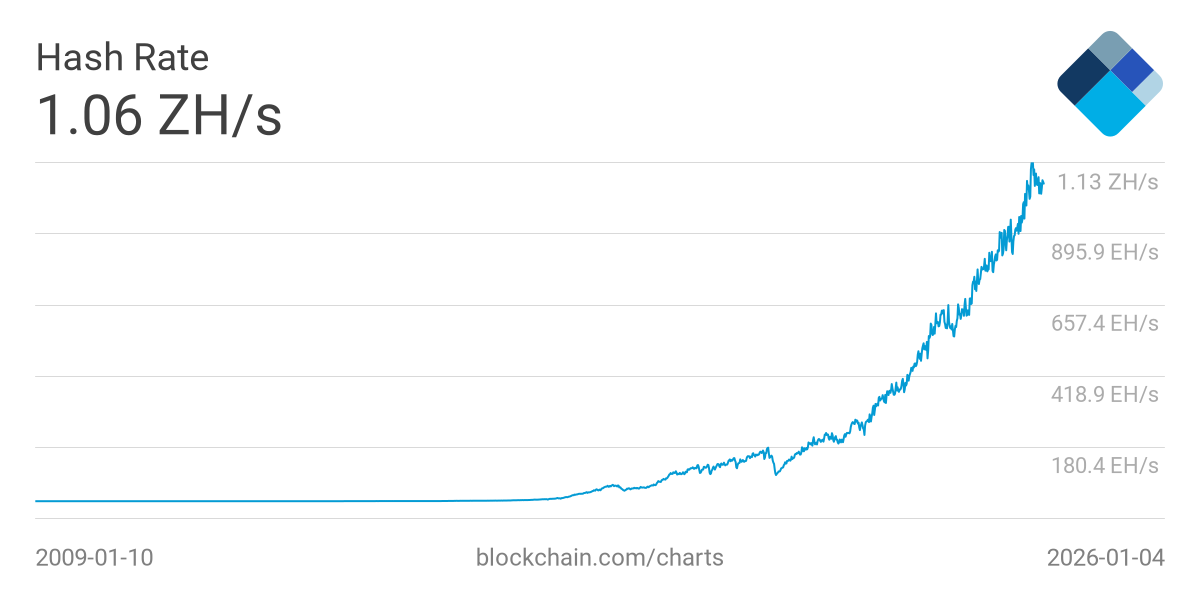
As of 2026, the total computing power of the Bitcoin network has reached astronomical levels. To alter history, you would need to control more than 51% of the entire network's computing power. From both a physical and economic standpoint, the cost of attacking the network far exceeds any potential illicit gains. This is the famous 'longest chain rule': the chain that contains the most work is considered the truth, and any shorter chains attempting to fork or create fraudulent records are abandoned by the network.
Trust Through Incentives: Bitcoin's Unique Economic Model
The reason Bitcoin has run stably for over a decade lies not just in its code, but in its profound insight into 'human nature.' It has constructed a sophisticated system of economic game theory.
In this system, being a 'good actor' is the most profitable choice.
As a Miner: You invest in hardware and electricity to secure the ledger, and in return, you earn valuable Bitcoin rewards and transaction fees.
As an Attacker: If you wanted to destroy the system, you would need to invest billions of dollars in equipment and electricity. If the attack were successful, people would immediately lose faith in the system, the price of Bitcoin could drop to zero, and your ill-gotten gains would become worthless.
This mechanism perfectly aligns individual self-interest with network security. You don't need to trust the miners' character; you only need to trust that they all want to make money. It is this purely profit-driven incentive that forms the unshakable foundation of Bitcoin's trust.
From 'Trusting People' to 'Trusting Code': The Profound Implications of Bitcoin's Trust Mechanism
Looking back at how Bitcoin operates, we see that it has accomplished a significant shift in trust in human history: a migration from 'trusting people' (bankers, auditors) to 'trusting code' (mathematics, cryptography).
A bank might fail due to mismanagement, and an auditor might commit fraud for personal gain, but mathematical formulas do not lie. Bitcoin demonstrates a new possibility—that we can, through sophisticated protocol design, enable a group of strangers who don't know or even trust each other to reach consensus and exchange value without a third-party arbiter.
The implications of this 'decentralized trust' extend far beyond currency itself. Today, similar logic is being explored for applications in supply chain tracking, copyright protection, and even electronic voting.
For the average user, understanding this mechanism isn't about becoming a technical expert. It's about seeing the underlying logic of the digital economy. The next time you use or learn about related technologies, you can be confident that behind the screen isn't a single 'village chief' calling the shots, but a fair, transparent, and automated system of rules governed by code.
Readers exploring this field are advised to choose well-known, compliant, and regulated platforms for learning and experience, to remain rational, and to focus on the value of the technology itself.
Start your safe cryptocurrency journey now
OSL | Secure Ramps. Trusted Rails !
More topics
More topics



Latest
Why India's $620B Bond Pilot Changed Nothing Legal
SEBI and the RBI's Demat 2.0 pilot issues corporate bonds as digital tokens and settles them with the wholesale digital rupee, preserving existing legal terms while digitizing the infrastructure beneath a $620...
Why India's $620B Bond Pilot Changed Nothing Legal
Why S&P Global Leads Kaiko: Not Hype, But 24/7 Market Infrastructure
S&P Global led a $110 million extension of Kaiko's Series B to build data infrastructure for round-the-clock tokenized markets.
Why S&P Global Leads Kaiko: Not Hype, But 24/7 Market Infrastructure
When One Firm Holds 5% of Ethereum: Infrastructure Stress Test
Bitmine's accumulation of more than 5 million staked ETH raises questions about whether custody, audit, and validator infrastructure can support single-asset concentration at public-company scale.
When One Firm Holds 5% of Ethereum: Infrastructure Stress Test
Best Enterprise Stablecoin Payment Providers: A 2026 Evaluation Framework
Compare enterprise stablecoin payment providers by use case, legal entity, workflow, controls, integration, reconciliation, support, and contract terms.
Best Enterprise Stablecoin Payment Providers: A 2026 Evaluation Framework
How to Reconcile a USDGO Payment: An Illustrative Finance-Close Example
See how Finance can trace a USDGO payment from an approved obligation through payment records, recipient confirmation, reconciliation, and accounting close.
How to Reconcile a USDGO Payment: An Illustrative Finance-Close Example
A USDGO Reserve Review in Practice: Findings, Limits and Follow-up Questions
Review what the July 2026 USDGO reserve attestation establishes, what it does not prove, and which issuer, redemption, and liquidity questions remain.
A USDGO Reserve Review in Practice: Findings, Limits and Follow-up Questions
Recommended for you
More topics
More topics
