Goodbye Traditional Banks? A Guide to How DeFi Works in the Web3 Era

Imagine a bank with no physical branches, no 9-to-5 business hours, and not a single employee. Yet, it can process thousands of transfers, loans, and trades every second, with every transaction publicly visible to all. Sounds like science fiction? This is the reality unfolding in the world of Web3.
For users accustomed to traditional finance apps, 'Mobile Banking' in Web3: How Beginners Can Navigate Their First DeFi Application is often the first lesson in this new world. Today, we'll peel back the complex jargon and show you how this system, known as DeFi (Decentralized Finance), actually works.
What is DeFi: A Comprehensive Overview of the Decentralized Finance System in Web3
Simply put, DeFi (Decentralized Finance) is a set of financial tools built on the blockchain, like Lego bricks. In the traditional world, financial services are provided by centralized institutions like banks and stock exchanges. In the world of DeFi, these services are executed automatically by code.
According to 2025 industry data, despite ongoing market volatility, the number of daily active unique addresses on-chain has steadily surpassed the ten-million mark. This indicates that this permissionless form of financial interaction is accelerating in global adoption. You can think of DeFi as a "self-driving global bank": it has no president, no credit managers, only a set of rigorous mathematical rules running 24/7. Anyone with a smartphone and an internet connection can access this system and enjoy the same financial service privileges as Wall Street elites.
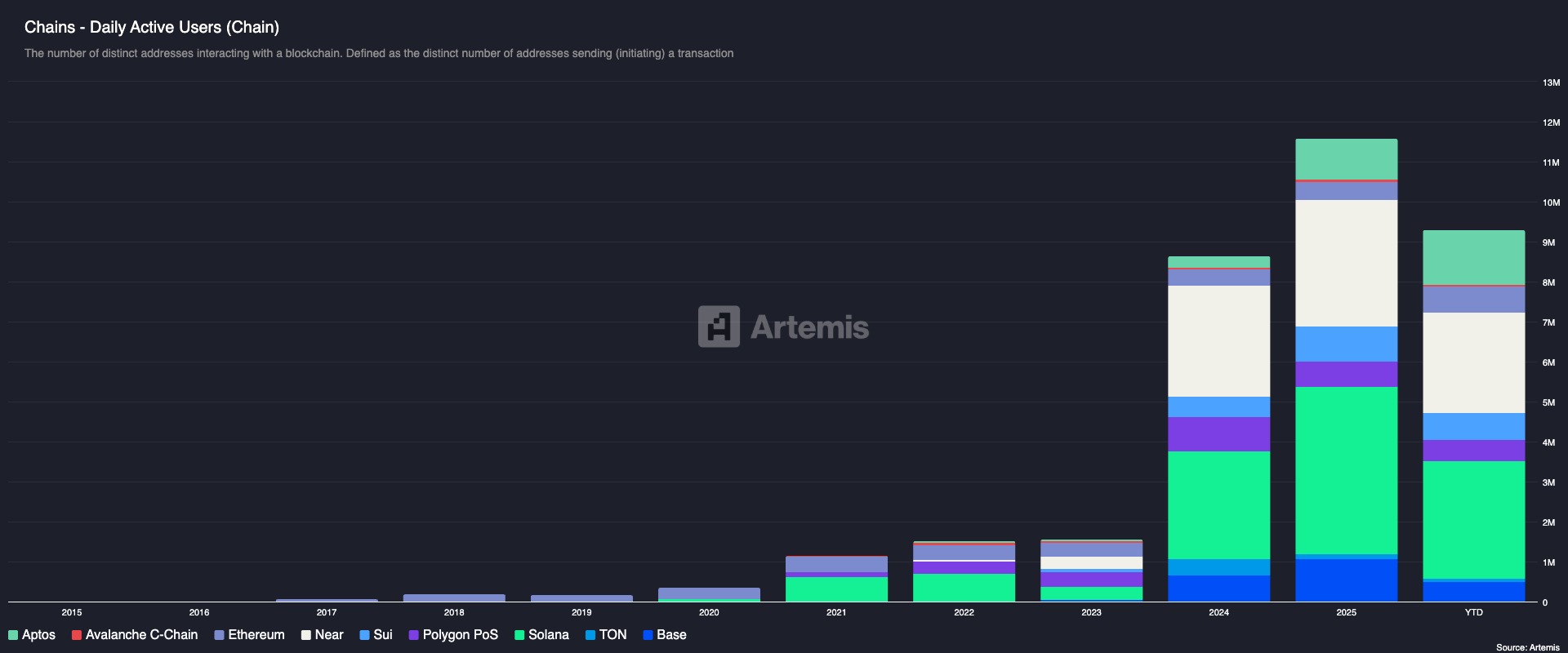
As illustrated in the chart, the full-scale surge of high-performance public chains such as Solana and Near, combined with the explosion of Layer 2 ecosystems, has collectively propelled total network daily active addresses (DAA) into the ten-million era. Source: Artemis (ArtemisAnalytics)
Goodbye Counters and Intermediaries: How Smart Contracts are Reshaping Financial Transaction Logic
You might wonder, how can transactions be secure without bank tellers to verify identities and stamp documents? This brings us to the core of DeFi—'smart contracts'.
To use a simple analogy: a smart contract is like a 'vending machine'.
Traditional Transaction: You give money to a shopkeeper, and they give you the goods. If the shopkeeper is in a bad mood or the shop is closed, the transaction fails.
Smart Contract Transaction: You insert money into the vending machine (the code). As long as the amount is correct, the machine automatically dispenses the product. This process requires no salesperson, and you don't need to trust the machine (because its workings are transparent). You only need to trust that the rule 'insert coin = dispense product' will be executed.
In DeFi, whether it's lending or trading, everything is done through this kind of 'if...then...' automated code. Once the conditions are met (e.g., you deposit sufficient collateral), the contract immediately executes the action (e.g., releases the loan to you), and no one can intervene, stop, or alter it.
The Core Difference Between DeFi and Traditional Banks: A Shift from Asset Custody to Code Trust
When you deposit money into a traditional banking app, you are essentially 'lending' your money to the bank. The bank uses your money for investments and records a number in your account ledger. If the bank goes bankrupt (though rare), your money could be at risk.
In the world of DeFi, the logic is completely different:
Control Over Assets: Your assets are always in your digital wallet, and only you control the private key. No one can move your assets unless you explicitly authorize a smart contract to do so.
Trust Mechanism: Traditional banks rely on 'brand reputation' for trust; DeFi relies on 'open-source code'. All transaction rules are written on the blockchain, and anyone can inspect the code for vulnerabilities. This level of transparency is unparalleled in traditional finance.
It's like choosing between locking your gold bars in a bank's vault (where the bank manager holds the key) or in a transparent but indestructible glass safe at home (where only you have the key).
More Than Just Deposits and Withdrawals: A Look at Mainstream Applications and Use Cases in the DeFi Ecosystem
Once you learn to use a crypto wallet and access these 'mobile banks' of Web3, you'll find that the functionalities go far beyond simple deposits and withdrawals. The current mainstream use cases include:
Decentralized Exchanges (DEXs): Imagine a currency exchange without intermediaries. You can directly swap assets with a smart contract's 'liquidity pool,' for example, exchanging Asset A for Asset B. The entire process usually takes just a few seconds, and the exchange rate is automatically adjusted by an algorithm based on supply and demand.
Over-collateralized Lending: This is somewhat like an online 'pawn shop.' You don't need to submit a credit report or proof of income. You simply need to deposit digital assets worth, say, $150, to instantly borrow other assets worth $100. This model significantly enhances capital liquidity.
Liquidity Providing: You can deposit your idle assets into a public liquidity pool to facilitate trades for others. In return, the smart contract automatically distributes a portion of the trading fees to you. It's like becoming a 'shareholder' of the bank and directly sharing in its business revenue.
The Hidden Pitfalls Behind High Yields: DeFi Security Risks Newcomers Must Watch Out For
While DeFi paints a wonderful picture of financial democratization, for newcomers, it is also a deep sea full of hidden reefs. You must stay vigilant when you see high-yield figures.
Smart Contract Vulnerabilities: Code doesn't lie, but the programmers who write it can make mistakes. If a smart contract has a logical flaw, hackers can 'legally' drain the funds from the pool.
Phishing and Malicious Approvals: This is the most common trap for beginners. Many fake websites look identical to the real ones, tricking you into clicking an 'approve' button. Once you sign a malicious approval, it's like handing the key to your safe to a thief—your assets could be gone in an instant.
Irreversible Transactions: If you make a wrong transfer at a bank, you can contact customer service to try and recover it. On the blockchain, if you accidentally enter the wrong address or use the wrong network, the funds are usually lost forever.
The Future of Financial Democratization: How Far Are We from Completely Replacing Traditional Banks?
The emergence of DeFi has demonstrated a new level of efficiency in capital flow. By using code, it eliminates costly intermediary fees, making financial services as simple and global as sending an email.
However, this doesn't mean traditional banks will disappear tomorrow. Current DeFi still has a long way to go in terms of user experience barriers, regulatory adaptability, and stability under extreme market conditions. A more likely future scenario is a fusion—traditional institutions will start using DeFi's underlying technology to improve efficiency, while DeFi applications will continue to evolve to become more user-friendly and compliant.
For the average user, learning about Web3 is not about speculation, but about understanding the direction of future trends as the digital wave sweeps in. If you decide to take the first step, be sure to choose learning platforms that are time-tested, open-source, and widely recognized. Protect your 'private key' at all costs, and then you can begin to experience the charm of this financial revolution.
Start your safe cryptocurrency journey now
OSL | Secure Ramps. Trusted Rails !
More topics
More topics




Latest
Why India's $620B Bond Pilot Changed Nothing Legal
SEBI and the RBI's Demat 2.0 pilot issues corporate bonds as digital tokens and settles them with the wholesale digital rupee, preserving existing legal terms while digitizing the infrastructure beneath a $620...
Why India's $620B Bond Pilot Changed Nothing Legal
Why S&P Global Leads Kaiko: Not Hype, But 24/7 Market Infrastructure
S&P Global led a $110 million extension of Kaiko's Series B to build data infrastructure for round-the-clock tokenized markets.
Why S&P Global Leads Kaiko: Not Hype, But 24/7 Market Infrastructure
When One Firm Holds 5% of Ethereum: Infrastructure Stress Test
Bitmine's accumulation of more than 5 million staked ETH raises questions about whether custody, audit, and validator infrastructure can support single-asset concentration at public-company scale.
When One Firm Holds 5% of Ethereum: Infrastructure Stress Test
Best Enterprise Stablecoin Payment Providers: A 2026 Evaluation Framework
Compare enterprise stablecoin payment providers by use case, legal entity, workflow, controls, integration, reconciliation, support, and contract terms.
Best Enterprise Stablecoin Payment Providers: A 2026 Evaluation Framework
How to Reconcile a USDGO Payment: An Illustrative Finance-Close Example
See how Finance can trace a USDGO payment from an approved obligation through payment records, recipient confirmation, reconciliation, and accounting close.
How to Reconcile a USDGO Payment: An Illustrative Finance-Close Example
A USDGO Reserve Review in Practice: Findings, Limits and Follow-up Questions
Review what the July 2026 USDGO reserve attestation establishes, what it does not prove, and which issuer, redemption, and liquidity questions remain.
A USDGO Reserve Review in Practice: Findings, Limits and Follow-up Questions
Recommended for you
More topics
More topics
