Cross-border Payment: Visualizing why global payments are broken and how to fix them
We broke down the four engines of cross-border finance—from slow "relay race" of SWIFT to the "atomic settlement" of blockchain—to show exactly where your margins are disappearing.
In the domestic economy, moving money is seamless. You tap a card or send a localized bank transfer, and it feels instant.
But the moment money crosses a border, it enters a time machine. It travels back to an infrastructure built in the 1970s, characterized by multi-day delays, opaque fees, and a frustrating lack of visibility.
For modern businesses operating globally, this isn't just an annoyance; it's an operational drag on working capital.
To fix this, we have to look under the hood. We need to visualize the infrastructure of the global financial system to understand why it leaks value.
Based on the infographic above, here is a breakdown of the four primary ways money moves around the world today, and why a shift in architecture is inevitable.
The old world: sequential processing
The first three models in our diagram—Wire Transfers, Credit Cards, and EFTs—share a common flaw: they rely on sequential processing. Information moves first, and money moves later, often hopping through multiple hands.
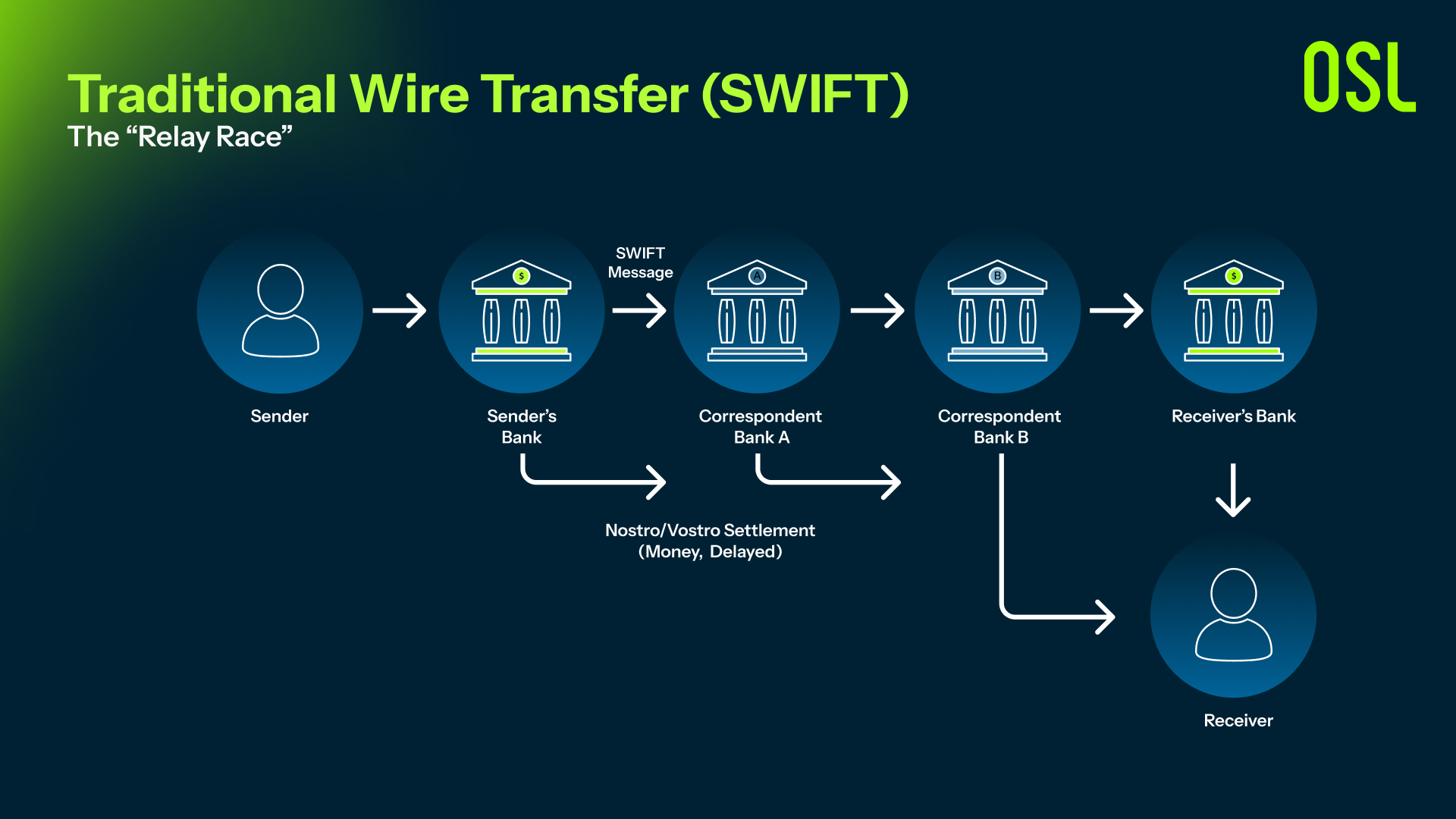
The "Relay Race" (Traditional Wire / SWIFT)
When you send a wire, your bank doesn't usually have a direct relationship with the receiver's bank in another country.
They have to pass your money along a chain of "Correspondent Banks." It’s a relay race. Every time the baton is passed, the relay stops to check compliance and takes a fee.
The Result: It takes 2–5 days because if one bank in the chain is closed for a holiday or weekend, the race stops. If one bank thinks there's a problem with your credentials or KYCs, the process returns back to square one. The fees stack up unpredictably at every hop.
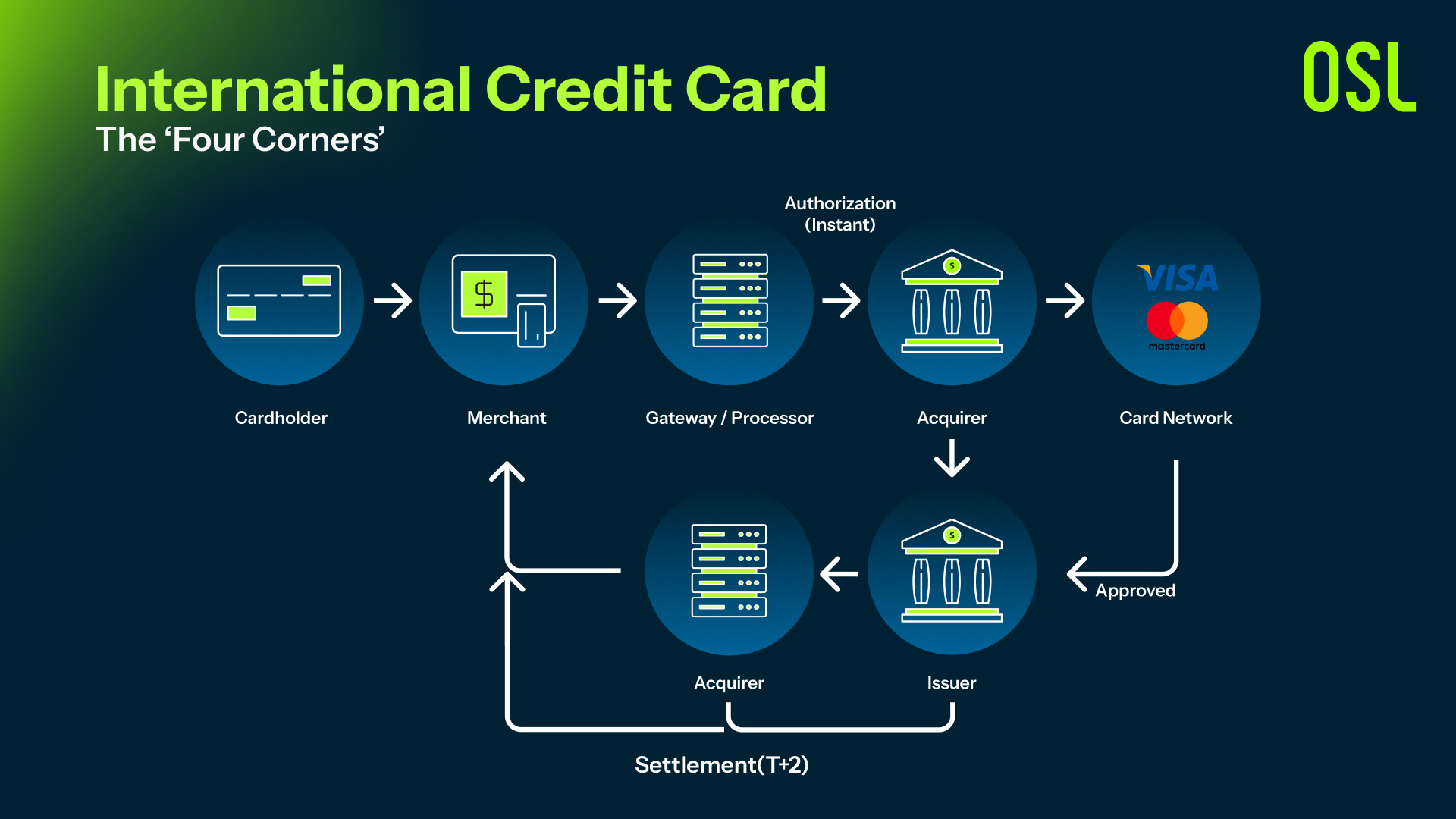
The "Four Corners" (International Credit Cards)
The diagram shows the most convenient, but most expensive, method. It involves four main parties: the Merchant, the Acquirer, the Card Network (Visa/MasterCard), and the Issuer.
The Result: While authorization is instant, the merchant pays a heavy toll—often 3% to 5% on international transactions—to fund the Issuer's risk and the Cardholder's rewards program. It is unsustainable for large B2B invoices.
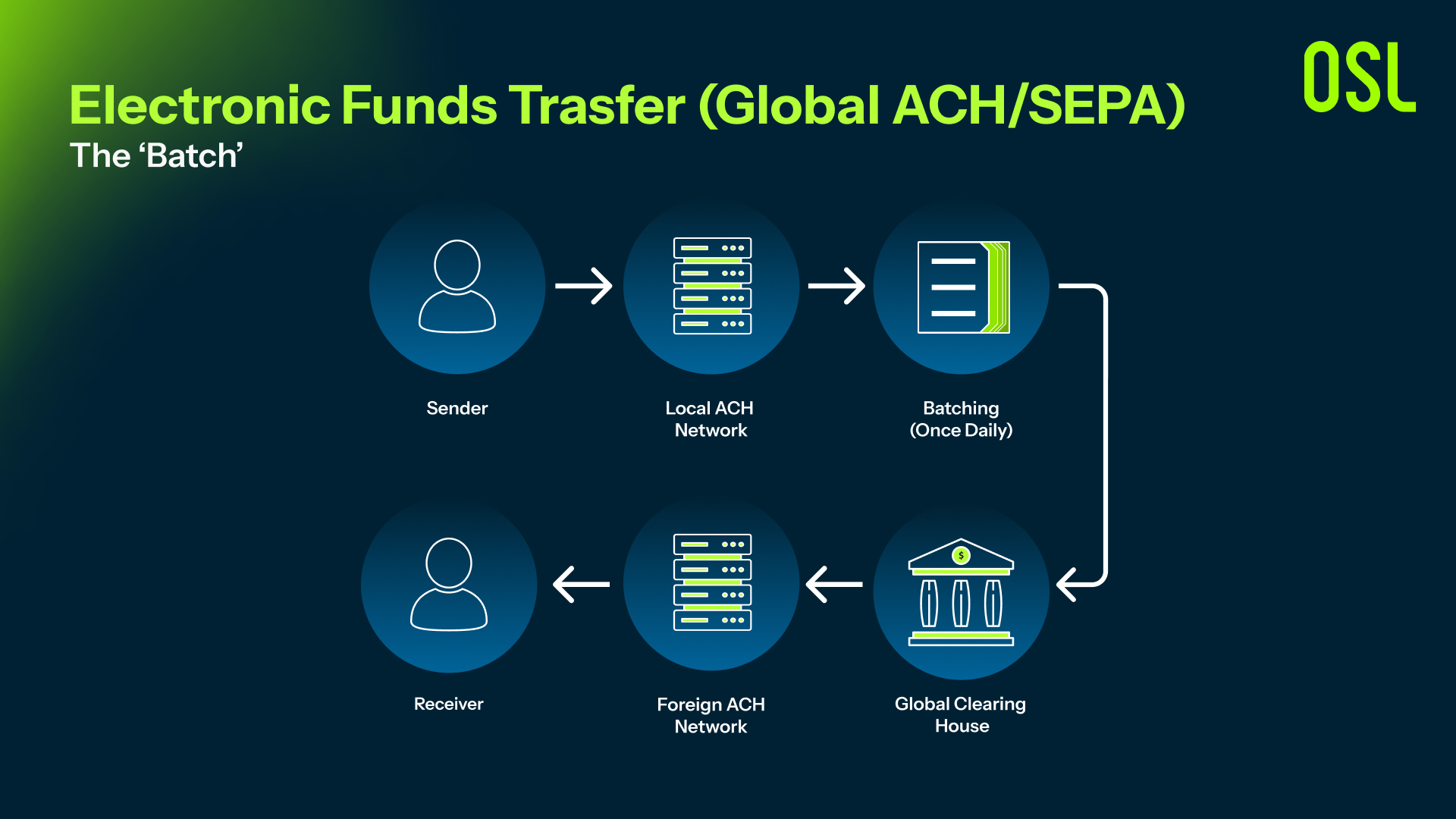
The "Batch" (Global ACH / SEPA)
The diagram is the low-cost, low-speed option. Banks wait to collect thousands of payments and send them through a clearing house in a single "batch" once a day.
The Result: Your money gets stuck in a funnel. It’s cheap, but it's the slowest method (3–7 days) and offers almost zero tracking visibility.
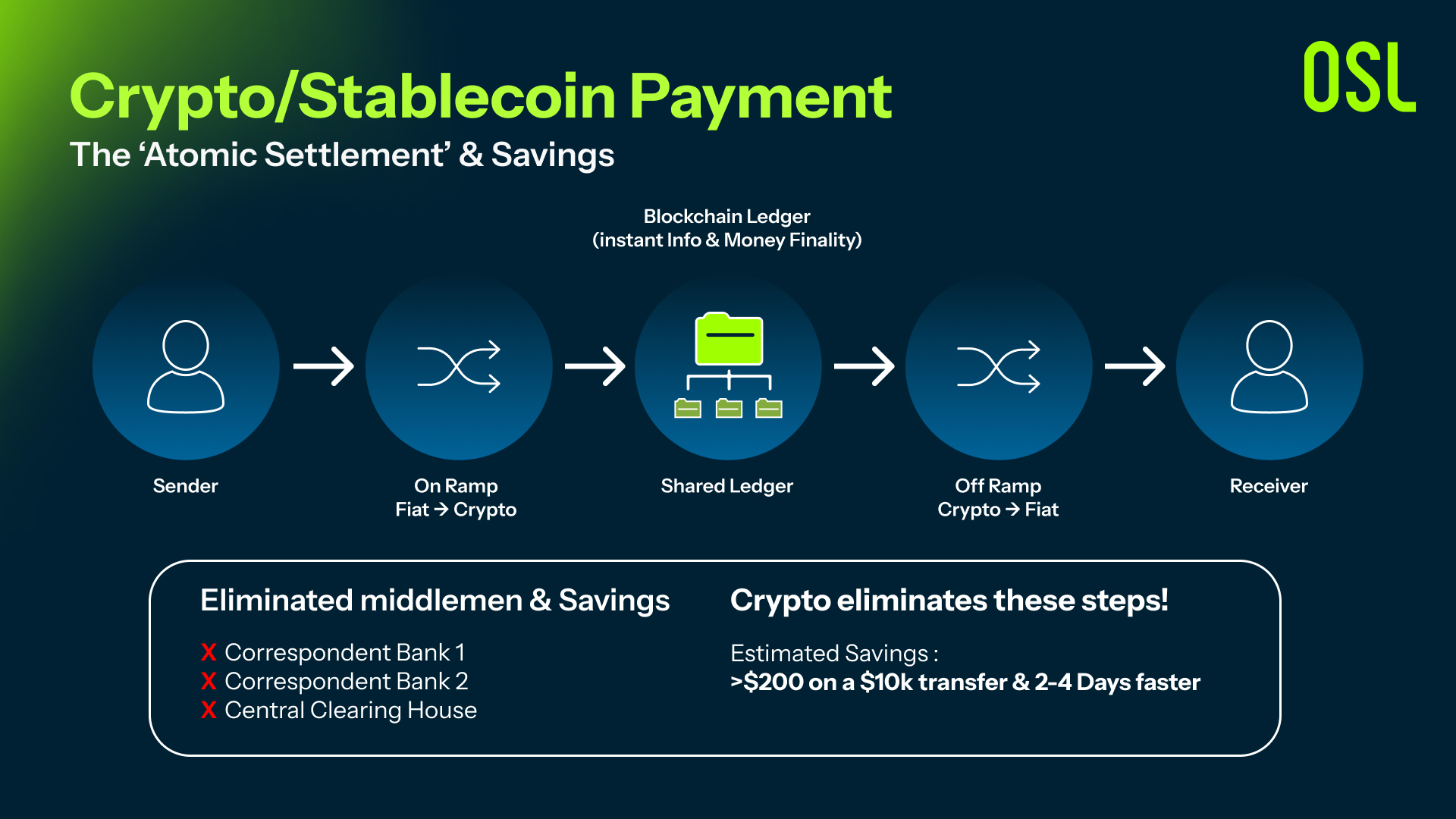
The New World: Atomic Settlement
The diagram illustrates the structural shift that stablecoins and blockchain bring to B2B payments.
The "Shared Ledger" (Crypto / Stablecoin)
In the old world, every bank keeps its own private ledger, and they spend days reconciling them with each other.
In the new world, everyone looks at one Shared Ledger (the Blockchain).
When you send a stablecoin payment, you aren't sending a message asking a series of banks to update their books. You are pushing value directly to the recipient. Information and money move simultaneously.
We call this Atomic Settlement. It’s instant finality.
Middlemen Eliminated
The most critical part of this visualization is the "Eliminated middlemen & savings" box. By moving from a sequential chain to a shared ledger, we don't just speed things up; we remove entire layers of friction.
Who gets eliminated:
❌ Correspondent banks: No more relay race runners taking a $20 fee at every stop.
❌ Central clearing houses: no more waiting for the daily batch cycle.
The dollar value of elimination: We audited a typical $10,000 invoice payment from the US to an emerging market.
Traditional wire cost: Between sender fees, unpredictable intermediary deductions, and high bank FX spreads, the total cost often nears $375 (3.75%).
Stablecoin cost: Between on-ramp / off-ramp fees and tighter market FX spreads, the total cost is closer to $150 (1.5%).
The net result: A savings of over $200 per transaction, delivered 4 days faster.
The future of B2B payments isn't about finding a slightly cheaper wire provider. It's about changing the architecture entirely. It is about choosing between a five-stop relay race and a direct digital teleport.